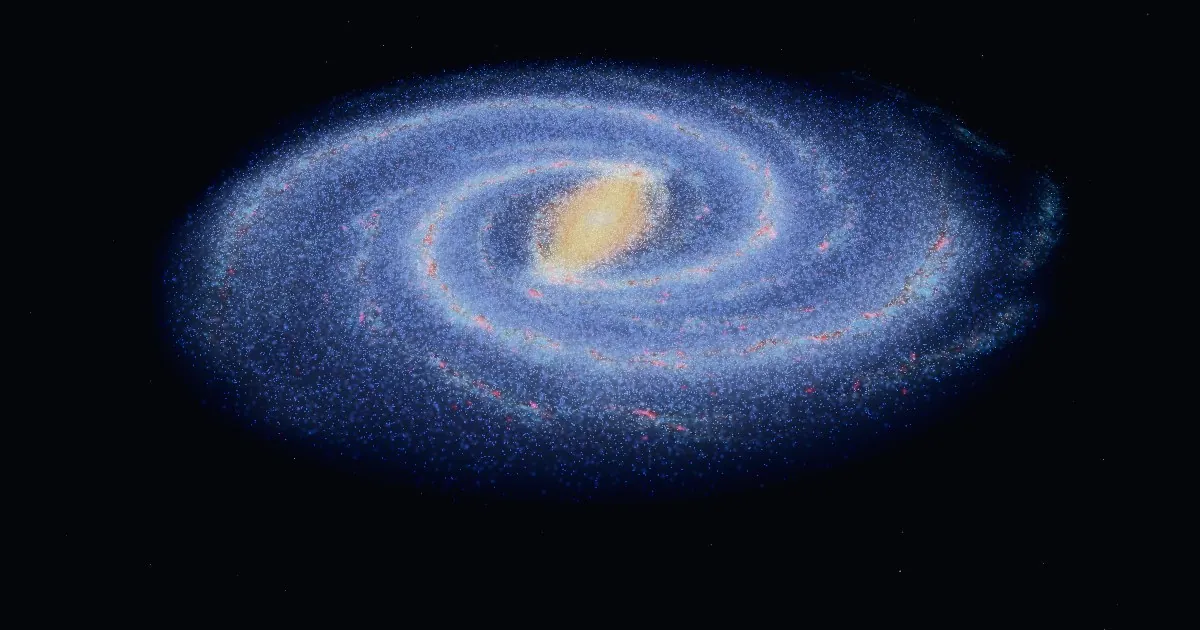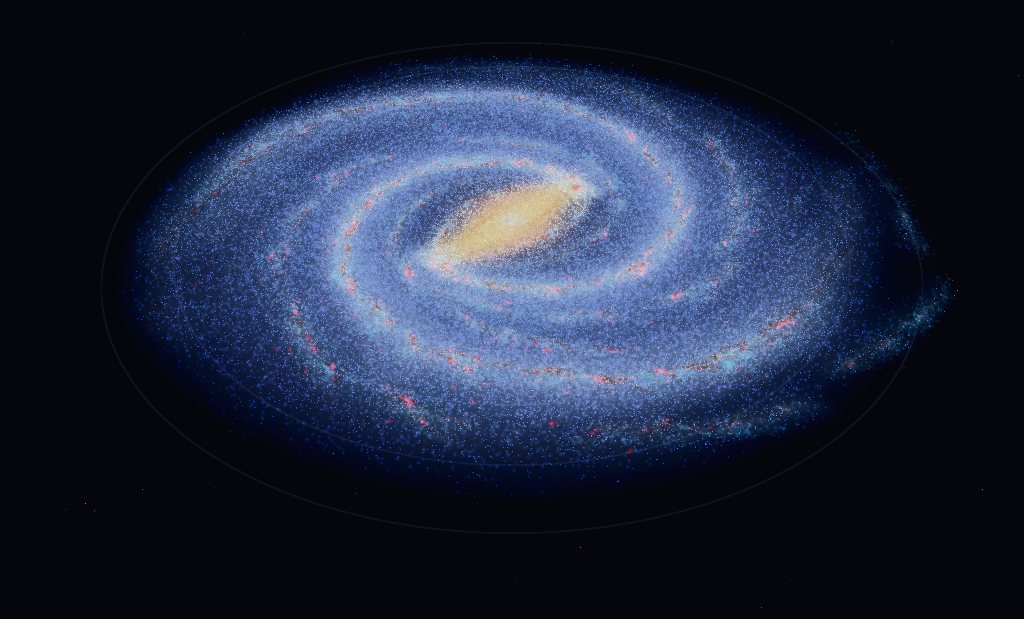
Short answer: The Milky Way is a barred spiral galaxy: a flat disc about 100,000 light-years across with a bar of old stars through the middle, spiral arms winding out from it and a black hole, Sagittarius A*, at the center. The Sun sits about 26,700 light-years out, on a short arm called the Orion Spur. Nobody can photograph the Milky Way from outside, so the model above is an artist’s concept that NASA built from Spitzer Space Telescope data.
The farthest spacecraft, Voyager 1, reached one light-day from Earth on 18 November 2026. The disc is roughly 36 million light-days across.
This article contains Amazon affiliate links. Littleastronomy earns a commission on qualifying purchases. See our affiliate disclosure.
Features on the Milky Way 3D model
“Show on the model” flies the camera to each feature.
Where is Earth in the Milky Way?
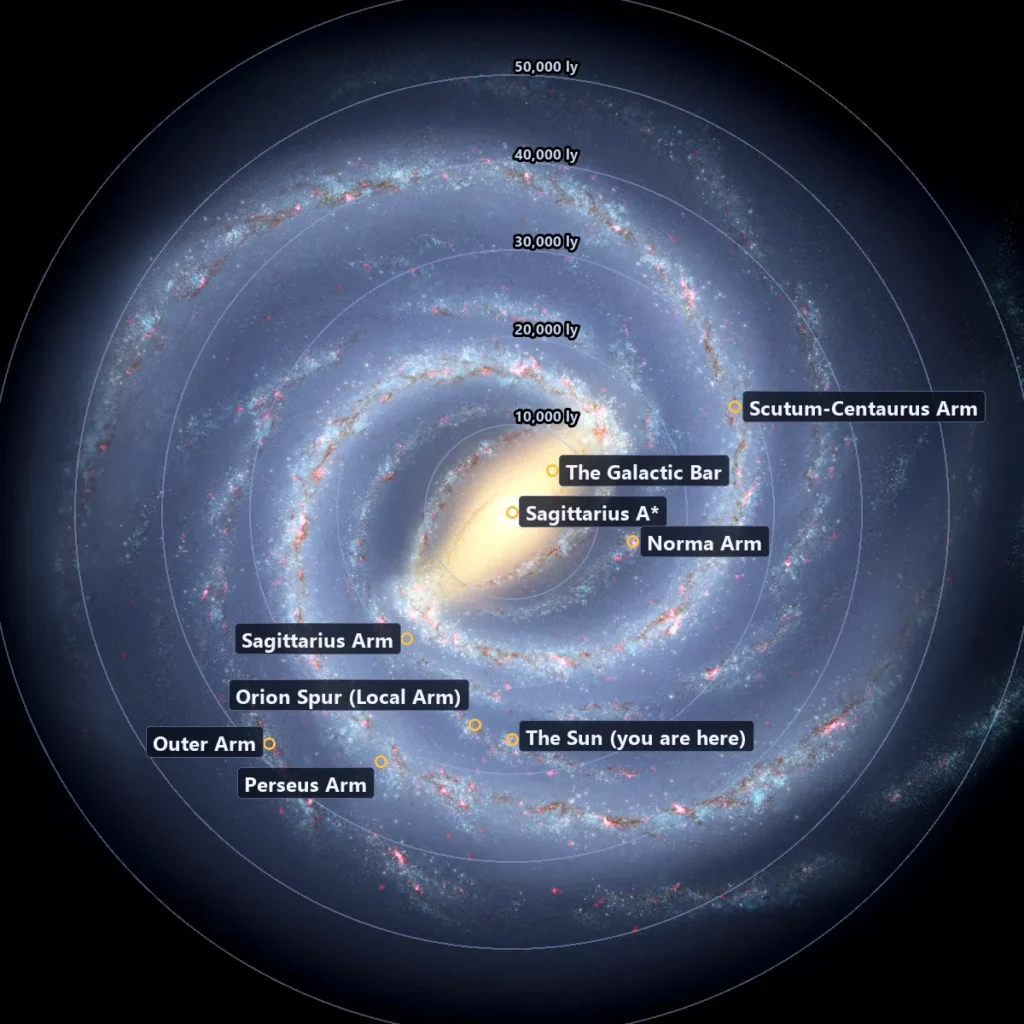
Earth is about 26,700 light-years from the galactic center, in the disc, on the Orion Spur between the Perseus and Sagittarius arms. That figure comes from GRAVITY measurements of stars orbiting the central black hole. Other studies give 26,580 to 26,990.
Fly to the Sun marker to see the neighborhood. One lap around the center takes about 230 million years (NASA; estimates run from 210 to 250 million). More in one galactic year lasts about 230 million years.
Sagittarius A*: the black hole at the center
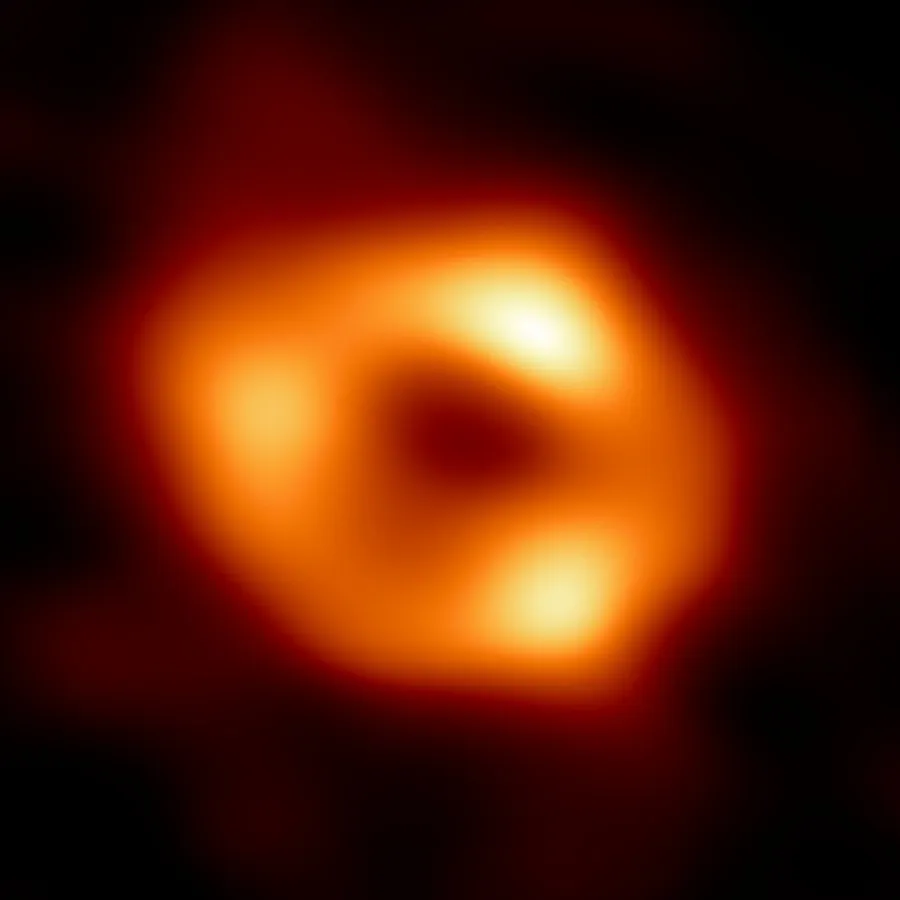
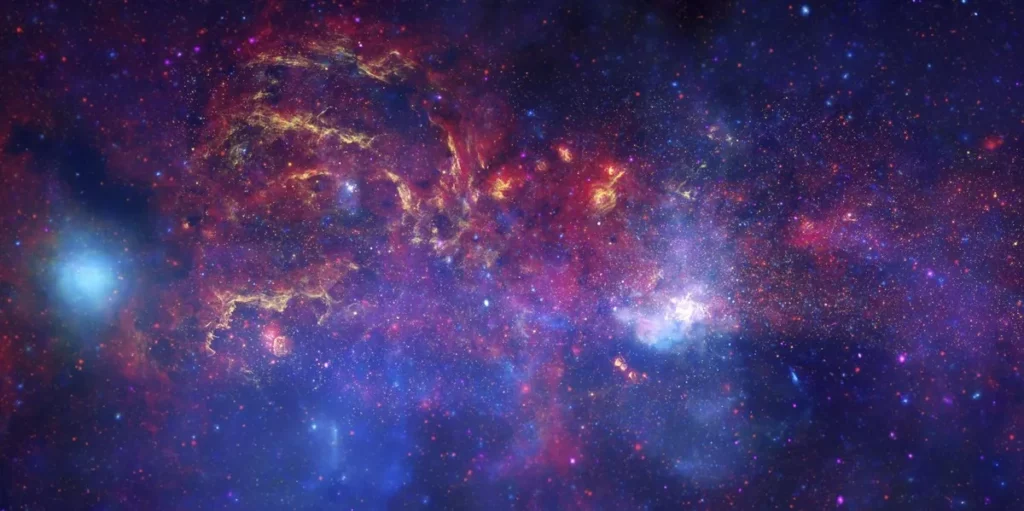
Sagittarius A* (say “A-star”) weighs about 4.3 million Suns, measured to a quarter of a percent from the orbits of nearby stars. The Event Horizon Telescope released its first image on 12 May 2022 and a polarized-light image in March 2024 (ESO). Fly to it on the model.
The black hole sits in the most crowded part of the galaxy, packed with stars, gas and dust:
What type of galaxy is the Milky Way?
A barred spiral. Disc, bulge and arms make it a spiral, and the bar makes it barred. Studies put the bar at about 28,000 to 33,000 light-years long, at 27 to 44 degrees to the line from the Sun to the center. More on the classes in types of galaxies.
| Arm on the model | NASA’s 2008 map | Name in recent papers |
|---|---|---|
| Perseus Arm | Major arm | Perseus |
| Scutum-Centaurus Arm | Major arm | Scutum-Centaurus-OSC |
| Sagittarius Arm | Minor arm | Sagittarius-Carina |
| Norma Arm | Minor arm | Norma-Outer (also 4-kpc arm) |
| Outer Arm | Outermost arm | Far end of the Norma arm |
| Orion Spur | Small partial arm | Local arm, an isolated segment |
Paper names follow Reid et al. (2019). For why the arms lie in one plane, see why galaxies are flat.
Milky Way galaxy map: the top-down view
The Map button turns the tilted disc into a flat top-down map with distance rings every 10,000 light-years. The Sun sits below the center, the bar crosses the middle and the arms curl out around it. Switch to the map view and tap any label.
How big, how old and how many stars
| Question | Answer | Caveat |
|---|---|---|
| How big? | About 100,000 light-years across | A convention. Disc stars reach out to 170,000 to 200,000 light-years across. |
| How thick? | About 1,000 light-years | Scale height of the thin disc (Bland-Hawthorn and Gerhard 2016). |
| How many stars? | 100 to 400 billion | Gaia has measured almost 2 billion, about 1% (ESA). |
| How old? | Oldest part began about 13 billion years ago | The thick disc, less than a billion years after the Big Bang (Xiang and Rix 2022). |
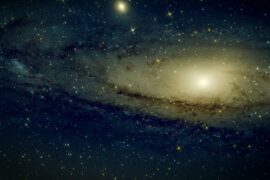
The Milky Way, Andromeda and Triangulum are the big three of the Local Group.
Zoom in toward the Sun: famous objects nearby
Labels sit at each object’s measured direction and distance from the Sun. More nebulae are in the list of nebulae in the Milky Way.
Why we cannot see the Milky Way’s shape from Earth
We are inside the disc. The pale band across a dark sky is the disc seen edge-on from within, brightest toward the center in Sagittarius. The International Space Station is inside it too.
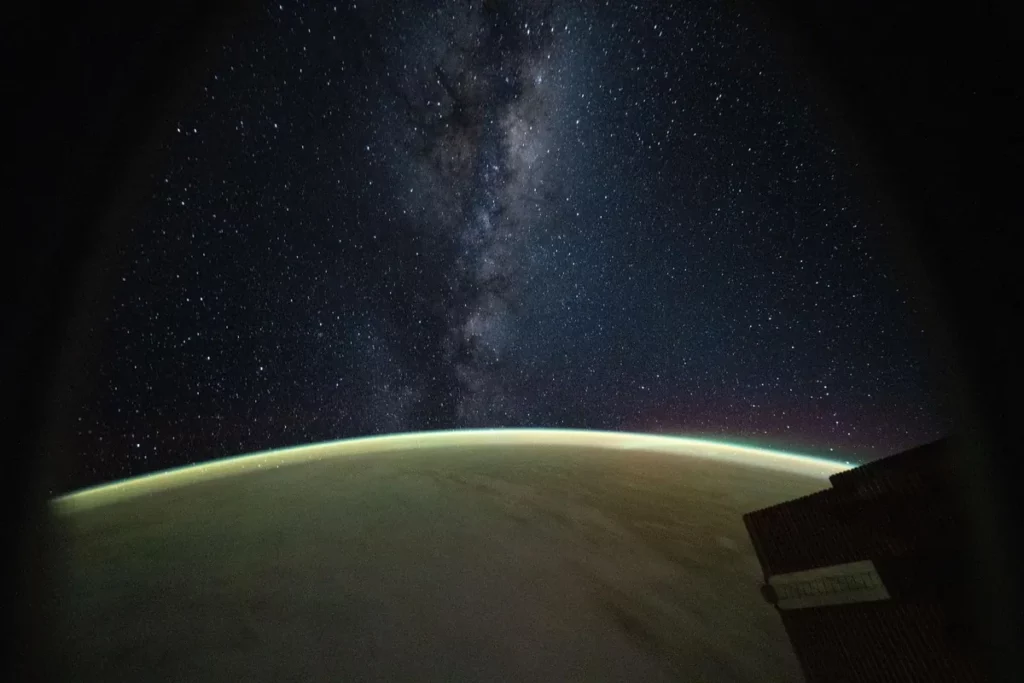
You can see the band without a telescope from a dark site on a Moonless night. NightWatch by Terence Dickinson is a beginner guide to the sky, and astronomy without a telescope lists what else is visible by eye. Other galaxies are harder: see can we see other galaxies with our eyes.
How this Milky Way 3D model was made
For the galaxy’s story told in its own voice, The Milky Way: An Autobiography of Our Galaxy by astrophysicist Moiya McTier is a good read.
There are 3D models of the Moon, Mercury, Venus, Earth, Mars, Jupiter, Saturn, Uranus, Neptune, Pluto, the Sun, an asteroid, a comet and a meteorite, all on the 3D space models hub.
Frequently asked questions
It is a barred spiral: a bright central bulge and bar with spiral arms winding around a flat disc. Nobody has photographed it from outside, so every image is an artist’s concept built from survey data.
Earth is about 26,700 light-years from the galactic center, on the Orion Spur, a short arm between the Perseus and Sagittarius arms. That is a little over halfway out to the edge of the disc.
About 100,000 light-years across, though disc stars reach out to 170,000 to 200,000. The thin disc is about 1,000 light-years thick.
Estimates run from about 100 to 400 billion. ESA’s Gaia has measured almost 2 billion of them, about 1% of the total.
A supermassive black hole called Sagittarius A*, with a mass of about 4.3 million Suns. The Event Horizon Telescope imaged it in 2022.
A barred spiral. Its exact Hubble class depends on the classifier, so astronomers usually just say barred spiral.
Its oldest part, the thick disc, started forming about 13 billion years ago, less than a billion years after the Big Bang.
About 230 million years, according to NASA. Estimates range from 210 to 250 million years.
Sources
- NASA Photojournal. Our Milky Way Gets a Makeover (Artist Concept), PIA10748
- NASA Science. Sun Facts
- NASA Science. Voyager 1: What Is a Light-Day?
- Reid et al. 2019, ApJ 885, 131. Our View of the Milky Way
- GRAVITY Collaboration 2019. Geometric distance to the Galactic Center black hole
- Bland-Hawthorn and Gerhard 2016, ARA&A. The Galaxy in Context
- Xiang and Rix 2022, Nature. The Milky Way’s early formation history
- ESA Gaia. The Milky Way
- ESO. First image of the black hole at the heart of our galaxy
- NASA Image and Video Library. PIA12348
- NASA Image and Video Library. iss074e0521637