
Updated November 2026 by Elena Stone
A telescope’s true field of view is the eyepiece’s apparent field divided by the magnification. A 25 mm eyepiece with a 52° apparent field in a 650 mm telescope magnifies 26× and shows 52 / 26 = 2.0° of sky, about four Moon widths. The exact method divides the eyepiece’s field stop by the telescope’s focal length and multiplies by 57.3.
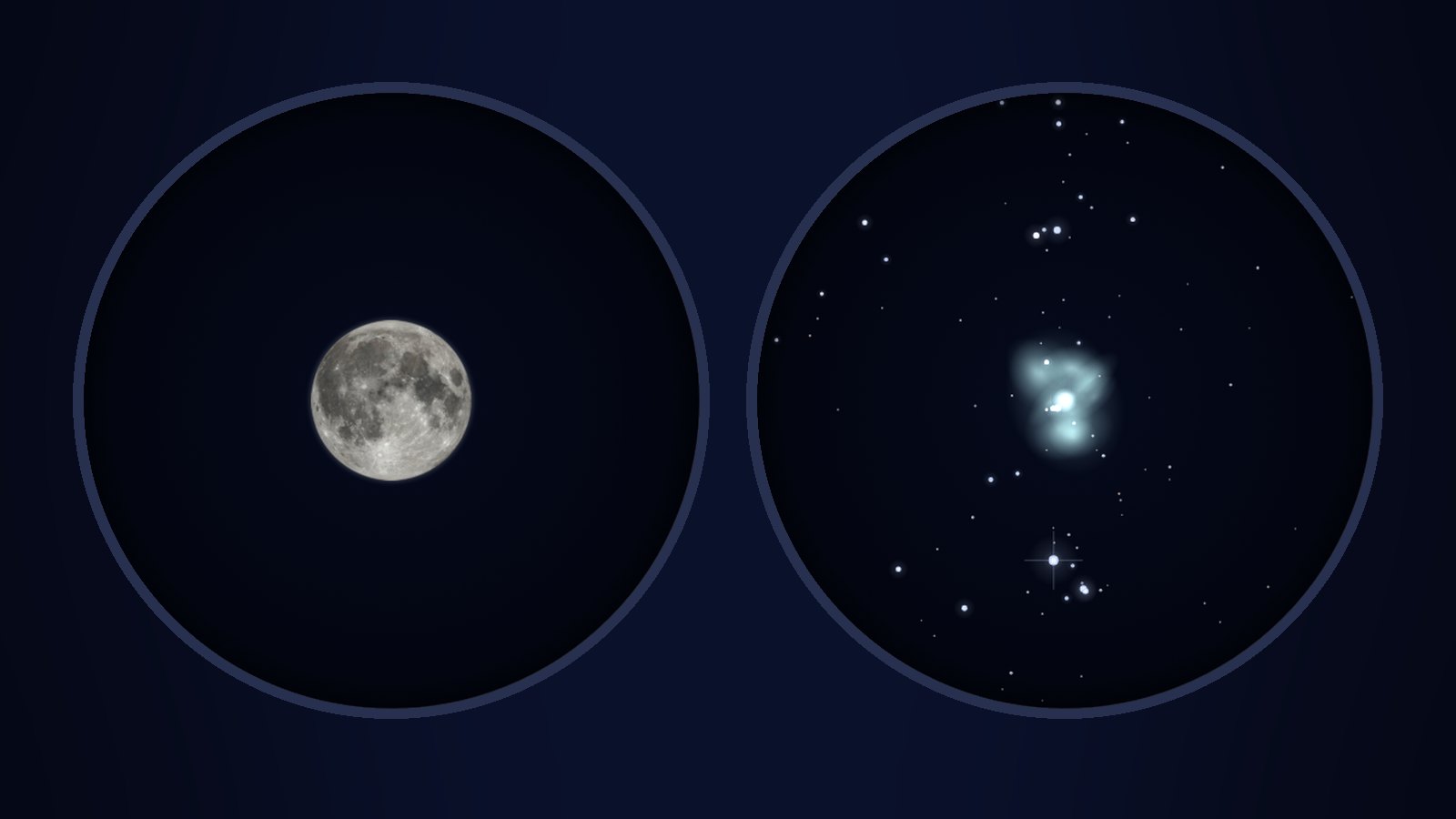
Pick your telescope and eyepiece below. The calculator gives the true field in degrees and arcminutes and draws it to scale on real star fields: the Moon, Jupiter, Saturn, the Pleiades, the Orion Nebula, the Andromeda Galaxy and six more targets. Switch to Camera to frame a target with a DSLR, an astronomy camera or a smart telescope such as the Seestar S50.
Loading eyepieces…
Your eye, the air and the focuser
25 mm eyepiece, 52°
120′ · 3.9 Moon diameters
A 25 mm, 52° eyepiece in a 650 mm telescope shows 2.0° of sky, about 3.9 Moon diameters.
The Pleiades fills the field, edge to edge
No field stop entered: the field is estimated from the apparent field of view, which runs a few percent high for wide eyepieces.
Too big for most telescopes. Brilliant blue-white stars on black; the nebulosity round Merope needs a dark sky and a big scope.
Stars to magnitude 10.5 (Tycho-2). Deep-sky objects are drawn at their visual size, which is smaller than a long-exposure photograph shows.
Camera frame
Pick a sensor to see the frame size and image scale.
Your eyepieces
| Eyepiece | True field | Moons | Power | Exit pupil |
|---|---|---|---|---|
| 25 mm52° apparent field | 2.0° | 3.9 | 26× | 5.0 mm |
| Richest field: large nebulae, star fields, big clusters | ||||
| 10 mm52° apparent field | 0.8° | 1.5 | 65× | 2.0 mm |
| Deep sky: galaxies, clusters, the whole Moon | ||||
The widest field this telescope can show through a 1.25-inch focuser is 2.38° (27 mm field stop).
How to use the field of view calculator
- Choose your telescope from the list, or pick Custom and enter its focal length and aperture in millimeters or inches.
- Choose your eyepiece. The list includes generic Plössls and wide-angles plus named lines with published field stops (Tele Vue, Explore Scientific, Baader, Celestron and SVBONY). For any other eyepiece, enter its focal length and apparent field. The apparent field is printed in the specifications, usually 40° to 52° for a Plössl, 60° to 70° for a wide-angle and 82° to 110° for an ultra-wide.
- Add the field stop if you know it. The calculator then shows the exact true field next to the estimate.
- Pick a target to see how it fits. The verdict says whether it fits with room to spare, fills the field or overflows it.
- Set the orientation to match your telescope, so the preview shows the view the way it appears in your eyepiece.
Compare all my eyepieces draws the field of every eyepiece you added as a ring on the same patch of sky. The link icon copies a URL that reopens the calculator with your setup, and the magnification calculator opens with the same telescope and eyepieces.
Telescope field of view formula
There are two ways to calculate the true field of view. The first needs the eyepiece’s apparent field. The second needs its field stop, the metal ring inside the barrel that forms the sharp edge of the view.
| Method | Formula | Accuracy |
|---|---|---|
| Apparent field | True field = apparent field / magnification | Good for Plössls and other eyepieces under 60°. Overstates wide-angle eyepieces by up to about 10%. |
| Field stop | True field (°) = field stop (mm) / telescope focal length (mm) × 57.3 | Exact for any eyepiece |
Magnification is the telescope’s focal length divided by the eyepiece’s focal length, so the first formula can also be written as apparent field × eyepiece focal length / telescope focal length. With a Barlow lens or a focal reducer, multiply the telescope’s focal length by its factor in both formulas. The 57.3 converts radians to degrees.
Worked example, apparent field method: a 130 mm f/5 reflector has a focal length of 650 mm. A 25 mm Plössl with a 52° apparent field gives 650 / 25 = 26×, and 52 / 26 = 2.0°. Multiply by 60 for arcminutes: 120′. The Moon is about 31′ across, so the field holds about 3.9 Moons side by side.
Worked example, field stop method: a 13 mm Tele Vue Nagler has an 82° apparent field and a 17.6 mm field stop. In a 1000 mm telescope it magnifies 77×. The apparent field method gives 82 / 77 = 1.07°. The field stop method gives 17.6 / 1000 × 57.3 = 1.01°. The second figure is the true one. The difference comes from distortion that wide-angle eyepieces carry at the edge of the field, which makes their apparent field look larger than the geometry implies.
Apparent field of view vs true field of view
The apparent field is how wide the circle of light looks to your eye when you look into the eyepiece, measured in degrees. It belongs to the eyepiece alone. A 52° eyepiece looks like a porthole. An 82° eyepiece looks like a window that fills your vision.
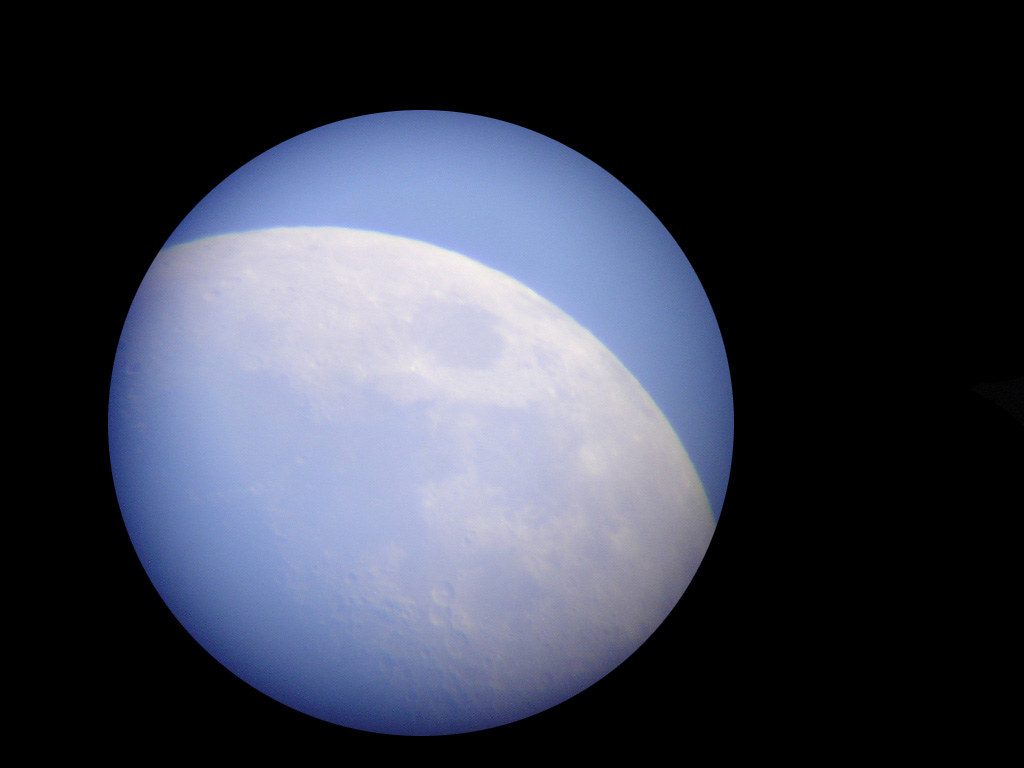
The true field is how much of the sky fits inside that circle. It depends on the eyepiece and the telescope together. The same 25 mm Plössl shows 2.0° of sky in a 650 mm telescope and 0.64° in a 2032 mm Schmidt-Cassegrain. Two eyepieces with the same focal length give the same magnification in a given telescope, but the one with the wider apparent field shows more sky at that magnification.
Field of view chart for popular telescopes
The chart gives the true field of five common eyepieces in ten popular telescopes, and the widest field a 1.25-inch eyepiece can show in each. The Moon column converts the widest field into Moon diameters.
| Telescope | 32 mm52° | 25 mm52° | 20 mm68° | 10 mm52° | 6 mm82° | 1.25″ maximum27 mm stop |
|---|---|---|---|---|---|---|
| Celestron Travel Scope 7070 mm f/5.7, 400 mm | 4.16°8.0 Moons | 3.25°6.3 Moons | 3.4°6.6 Moons | 1.3°2.5 Moons | 1.23°2.4 Moons | 3.87°7.5 Moons |
| Celestron Travel Scope 8080 mm f/5, 400 mm | 4.16°8.0 Moons | 3.25°6.3 Moons | 3.4°6.6 Moons | 1.3°2.5 Moons | 1.23°2.4 Moons | 3.87°7.5 Moons |
| Celestron Inspire 100AZ100 mm f/6.6, 660 mm | 2.52°4.9 Moons | 1.97°3.8 Moons | 2.06°4.0 Moons | 0.79°1.5 Moons | 0.75°1.4 Moons | 2.34°4.5 Moons |
| Celestron StarSense Explorer 114 Tabletop114 mm f/3.9, 450 mm | 3.7°7.1 Moons | 2.89°5.6 Moons | 3.02°5.8 Moons | 1.16°2.2 Moons | 1.09°2.1 Moons | 3.44°6.6 Moons |
| Celestron StarSense Explorer 130 Tabletop130 mm f/5, 650 mm | 2.56°4.9 Moons | 2.0°3.9 Moons | 2.09°4.0 Moons | 0.8°1.5 Moons | 0.76°1.5 Moons | 2.38°4.6 Moons |
| Celestron StarSense Explorer 150 Tabletop150 mm f/5, 750 mm | 2.22°4.3 Moons | 1.73°3.3 Moons | 1.81°3.5 Moons | 0.69°1.3 Moons | 0.66°1.3 Moons | 2.06°4.0 Moons |
| Celestron StarSense Explorer 8" Dobsonian203 mm f/5.9, 1200 mm | 1.39°2.7 Moons | 1.08°2.1 Moons | 1.13°2.2 Moons | 0.43°0.8 Moons | 0.41°0.8 Moons | 1.29°2.5 Moons |
| Sky-Watcher Classic 200P Dobsonian203 mm f/5.9, 1200 mm | 1.39°2.7 Moons | 1.08°2.1 Moons | 1.13°2.2 Moons | 0.43°0.8 Moons | 0.41°0.8 Moons | 1.29°2.5 Moons |
| Sky-Watcher Classic 250P Dobsonian254 mm f/4.7, 1200 mm | 1.39°2.7 Moons | 1.08°2.1 Moons | 1.13°2.2 Moons | 0.43°0.8 Moons | 0.41°0.8 Moons | 1.29°2.5 Moons |
| Sky-Watcher Flextube 300P Dobsonian305 mm f/4.9, 1500 mm | 1.11°2.1 Moons | 0.87°1.7 Moons | 0.91°1.7 Moons | 0.35°0.7 Moons | 0.33°0.6 Moons | 1.03°2.0 Moons |
True field = apparent field / magnification. The Moon is 0.52 degrees across (31.1 arcminutes). The last column is the widest field a 1.25-inch focuser can pass.
How big are the targets?
An object looks best when it fills about a third to two thirds of the field. The table lists the size of common targets as they appear to the eye at the telescope, which is smaller than their size in long-exposure photographs, and the true field that frames each one well.
| Object | Visual size | Field that frames it |
|---|---|---|
| MoonMoon | 31′ | 0.74°–1.73° |
| JupiterPlanet | 44″ | any field: use 150–250× |
| SaturnPlanet | 40″ | any field: use 150–250× |
| AlbireoDouble star | 0.6′ | 0.2°–0.3° (small: raise the power) |
| Mizar and AlcorDouble star | 12′ | 0.28°–0.66° |
| PleiadesOpen cluster | 1.8° | 2.62°–6.11° |
| Beehive ClusterOpen cluster | 1.6° | 2.26°–5.28° |
| Double ClusterOpen clusters | 1° | 1.43°–3.33° |
| Orion NebulaNebula | 30′ | 0.71°–1.67° |
| Andromeda GalaxyGalaxy | 1° | 1.43°–3.33° |
| Hercules ClusterGlobular cluster | 20′ | 0.48°–1.11° |
| Ring NebulaPlanetary nebula | 1.4′ | 0.2°–0.3° (small: raise the power) |
| Lagoon Nebula (M8)Emission nebula | 1° | 1.43°–3.33° |
| Dumbbell Nebula (M27)Planetary nebula | 8′ | 0.2°–0.44° (small: raise the power) |
| Triangulum Galaxy (M33)Galaxy | 1° | 1.43°–3.33° |
| Bode and Cigar pair (M81, M82)Galaxy pair | 45′ | 1.07°–2.5° |
| Veil Nebula (Cygnus Loop)Supernova remnant | 3° | 4.29°–10.0° |
| North America NebulaEmission nebula | 2° | 2.86°–6.67° |
| Whirlpool Galaxy (M51)Galaxy | 11′ | 0.26°–0.61° |
| Pinwheel Galaxy (M101)Galaxy | 20′ | 0.48°–1.11° |
Visual size is what the eye sees at the eyepiece, smaller than a photograph. The framing field makes the object fill 30 to 70 percent of the view.
The Andromeda Galaxy shows the gap between visual and photographic size most clearly. Photographs record it over 3°, six Moon widths. At the eyepiece most observers see the bright core and inner disk, about 1° long. A field of 1.5° to 2° frames that well. The Pleiades and the Beehive Cluster are the opposite case: they are bright enough to see in full, and they overflow most fields above 40×.
The widest field your telescope can show
The focuser sets a hard limit on the true field. A 1.25-inch eyepiece barrel cannot hold a field stop wider than about 27 mm, and a 2-inch barrel about 46 mm. Divide that by the focal length and multiply by 57.3:
- 650 mm reflector with a 1.25-inch focuser: 27 / 650 × 57.3 = 2.4°
- 1200 mm Dobsonian with a 2-inch focuser: 46 / 1200 × 57.3 = 2.2°. With a 1.25-inch eyepiece it drops to 1.3°.
- 2032 mm Schmidt-Cassegrain with a 1.25-inch diagonal: 27 / 2032 × 57.3 = 0.76°. With a 0.63× reducer it grows to 1.2°.

No eyepiece can beat these numbers. A 32 mm Plössl and a 24 mm 68° wide-angle both reach the 1.25-inch limit. The 24 mm gives more magnification at the same field, which darkens the sky background and makes faint objects easier to see.
How a Barlow lens or focal reducer changes the field of view
A 2× Barlow lens doubles the effective focal length, so it doubles the magnification and halves the true field. A 25 mm eyepiece that shows 2.0° in a 650 mm telescope shows 1.0° with a 2× Barlow. A 0.63× focal reducer shrinks the focal length and widens the field by 59%. The calculator applies the factor to both methods.
Camera field of view for astrophotography
A camera has no apparent field. Its field depends on the size of the sensor and the focal length of the telescope:
Camera field (°) = sensor width (mm) / focal length (mm) × 57.3, and the same for the height
An APS-C sensor (23.5 × 15.6 mm) on a 650 mm telescope covers 2.1° × 1.4°. The Seestar S50 has a 250 mm focal length and a Sony IMX462 sensor (5.6 × 3.1 mm), which gives a frame of about 1.3° × 0.7°. That fits the bright heart of the Orion Nebula and the core of the Andromeda Galaxy but crops the Pleiades. The calculator’s Camera mode draws the frame on the target and lets you rotate it.
Camera mode also gives the image scale, the patch of sky each pixel covers:
Image scale (arcseconds per pixel) = 206.3 × pixel size (µm) / focal length (mm)
For deep-sky imaging the scale should be a third to half of your seeing. With seeing of 2.5 arcseconds, aim for 0.8 to 1.3 arcseconds per pixel. A coarser scale makes stars look square (undersampled). A finer one spreads the light over more pixels than the air allows detail for (oversampled), which costs signal. The resolution calculator covers the planetary case, where the rules are different.
Why the view in the eyepiece is upside down or mirrored
Every telescope flips the image. A Newtonian reflector or a Dobsonian rotates it 180°, so north is down and east is right. A refractor, a Schmidt-Cassegrain or a Maksutov used with a star diagonal shows the image the right way up but mirror-reversed left to right. Star charts print north up and east left. The orientation buttons above the preview rotate or mirror the drawing to match your telescope, so the field in the calculator matches the field in your eyepiece.
Frequently asked questions
How do you calculate a telescope's field of view?
Divide the eyepiece's apparent field by the magnification. A 52° eyepiece at 26× shows 52 / 26 = 2.0° of sky. For an exact figure, divide the eyepiece's field stop by the telescope's focal length and multiply by 57.3: a 27 mm field stop in a 650 mm telescope gives 2.38°.
What is the difference between apparent and true field of view?
The apparent field is how wide the eyepiece view looks to your eye, in degrees, and belongs to the eyepiece alone. The true field is how much sky fits in that view, and depends on the eyepiece and the telescope together. True field equals apparent field divided by magnification.
What eyepiece shows the whole Moon?
The Moon is about 0.5° (31 arcminutes) across. To see all of it with a margin you need a true field of 0.7° or more. With a 52° Plössl that means a magnification of about 75× or less. In a 1200 mm telescope a 17 mm or longer Plössl does it, and in a 650 mm telescope the stock 10 mm eyepiece does.
What is a good field of view for a telescope?
For finding objects and viewing large clusters and nebulae, 1.5° to 2.5°. Galaxies and most clusters look best in 0.7° to 1.5°. The planets and double stars need high power, so their fields are 0.2° to 0.4°. A good eyepiece kit covers all three.
Does a Barlow lens reduce the field of view?
Yes. A 2× Barlow halves the true field of every eyepiece, because it doubles the magnification. A 0.63× focal reducer does the opposite and widens the field by about 59%.
What is an eyepiece field stop?
The field stop is the ring inside the eyepiece barrel that forms the sharp edge of the view. Its diameter in millimeters, divided by the telescope's focal length and multiplied by 57.3, gives the exact true field. Tele Vue and some other makers publish it. A 1.25-inch eyepiece cannot have a field stop wider than about 27 mm, and a 2-inch eyepiece about 46 mm.
How do I calculate a camera's field of view through a telescope?
Divide the sensor width in millimeters by the telescope's focal length and multiply by 57.3, then do the same for the height. An APS-C sensor (23.5 × 15.6 mm) on a 650 mm telescope covers 2.1° × 1.4°. The Seestar S50 covers about 1.3° × 0.7°.
Why is the image in my telescope upside down?
A telescope's objective lens or mirror forms an inverted image, and astronomical telescopes do not add the extra glass needed to turn it back because it would cost light. Newtonians and Dobsonians show the sky rotated 180°. Refractors and Schmidt-Cassegrains with a star diagonal show it upright but mirror-reversed.
How much sky is one degree?
One degree is about two full Moon widths, or the width of your little finger held at arm's length. The Pleiades span about 2°, the Andromeda Galaxy's visible core about 1° and Jupiter about 45 arcseconds, under one eightieth of a degree.
More telescope calculators
- Telescope magnification calculator: magnification, exit pupil and useful power range for every eyepiece you own, with a gap finder for your kit.
- Telescope resolution calculator: the finest detail your aperture can show.
- Telescope view simulator: what the Moon, planets and deep-sky objects look like through a given telescope and eyepiece.
- Telescope finder: get a telescope matched to what you want to see.