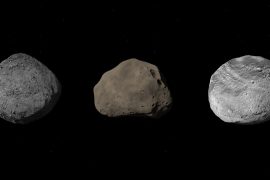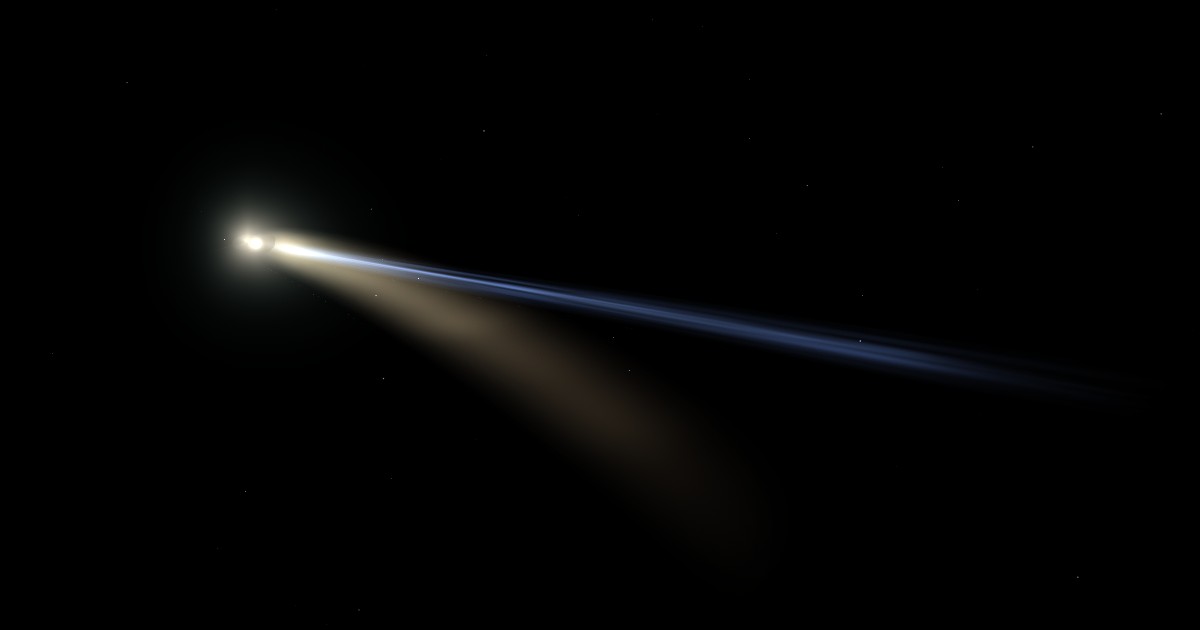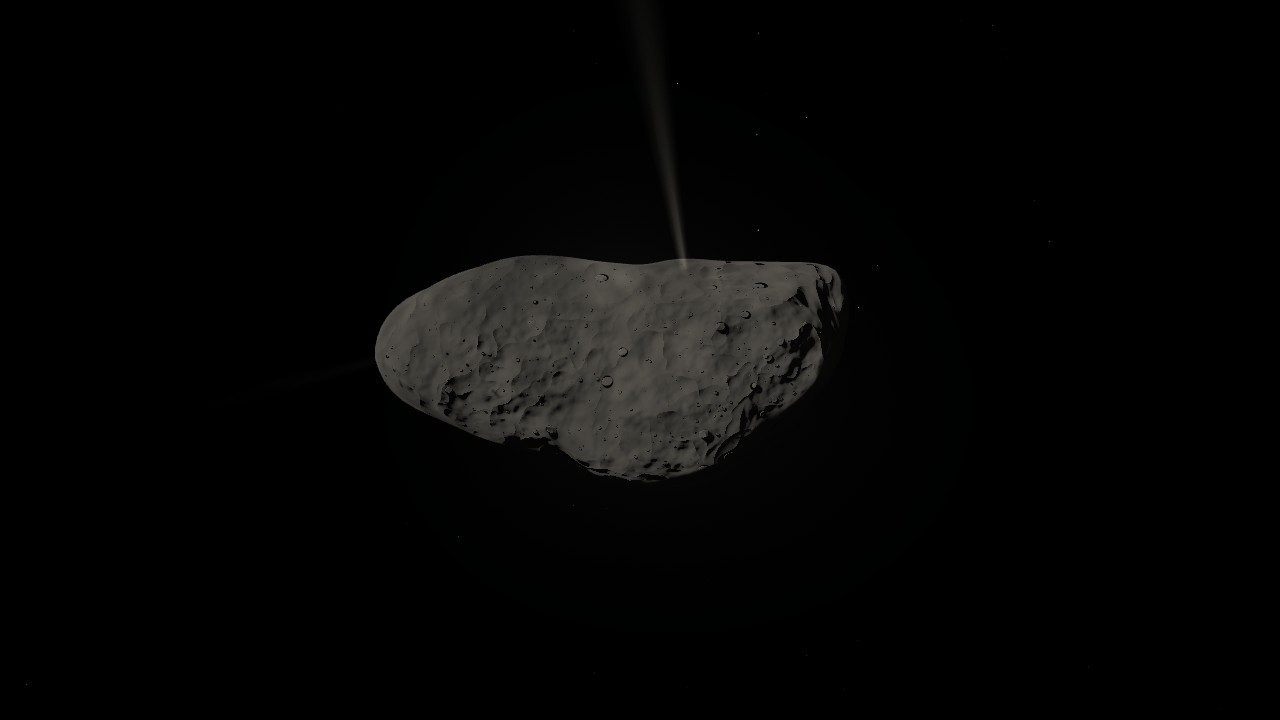
A comet is a mountain-sized ball of ice, dust and rock that grows a glowing head and tails when it nears the Sun. The model above shows the nucleus of three real ones, the solid core at the center of it all: 1P/Halley, the most famous comet in history; 67P/Churyumov-Gerasimenko, the comet the Rosetta spacecraft orbited for two years; and 9P/Tempel 1, the comet NASA hit with a probe in 2005. Switch between them, then turn on Full comet to see the coma and the two tails that point away from the Sun.
Each comet has its own section below. For more of them, see famous comets, and for the basics, comets explained. The other models on this site, including the asteroid 3D model, are on the 3D space models page.
How do I use the comet 3D model?
- Pick a comet: the Halley, 67P and Tempel 1 buttons at the top left switch the model. The strip along the bottom shows the nucleus size, day length, orbit period and when the comet is next closest to the Sun.
- Move: drag to rotate and scroll or pinch to zoom. On a phone, tap Explore first. Until you do, swiping scrolls the page.
- Full comet: zooms out to show the coma, the ion tail and the dust tail, each labeled. The tails point away from the Sun and stay fixed in space as you rotate the view. This view is not to scale: a real tail is millions of kilometers long, far longer than the screen could show.
- Mission sites: marks the places spacecraft touched or studied. Tap a marker for its date and a short description. 67P has three and Tempel 1 has two. Halley has none because no spacecraft has landed on it or hit it.
- Size compare: sets a true-scale Empire State Building (443 m, 1,454 ft) or a city outline next to the nucleus.
- Spin: real time, fast or paused. Real time shows how slowly some nuclei turn. 67P rotates once in about 12.4 hours and Halley in about 2.2 days.
- Share: each comet has its own link, so you can send someone straight to Halley or 67P.
What are the parts of a comet?
A comet has five parts you can name: the nucleus, the coma, the jets, the ion tail and the dust tail. Turn on Full comet to see them together.
- Nucleus: the solid core. It is ice, frozen gases and dust, usually a few kilometers across, coated with dark organic material. Everything else on this list comes from it. The nucleus is the part shown close up in the model.
- Coma: a cloud of gas and dust around the nucleus. It forms when sunlight warms the surface and the ice turns to gas. NASA says the coma may extend hundreds of thousands of kilometers, many times the width of the nucleus inside it.
- Jets: streams of gas and dust that erupt from the nucleus where the ice is near the surface. Because the nucleus spins, jets sweep around like a lawn sprinkler. The Giotto spacecraft saw bright streams of gas and dust leaving Halley in 1986.
- Ion tail: a thin, straight, blue tail of electrically charged gas. The solar wind, a stream of particles from the Sun, sweeps it directly away from the Sun. It is blue because the gas glows.
- Dust tail: a broader, curved, whitish-yellow tail. Sunlight pushes the dust away from the Sun, but the dust keeps some of the comet’s motion, so the tail bends back along the orbit. It shines by reflecting sunlight.
Both tails point away from the Sun, not behind the comet. When a comet is leaving the Sun, the tails go ahead of it. See the characteristics of a comet for how each part changes along the orbit.
Halley’s Comet: when does it come back?
Halley’s Comet returns to the inner Solar System on July 28, 2061. It last passed the Sun on February 9, 1986, and it takes about 76 years to circle it once, so the next pass comes 75 years and a few months after the last. The model above shows the nucleus as it looks on that orbit: about 15 x 8 km (9.3 x 5 mi), elongated and so dark that it reflects only about 4 percent of the light that hits it.
Records of Halley’s appearances go back more than 2,000 years. Edmond Halley worked out in 1705 that the comets seen in 1531, 1607 and 1682 were one object and predicted its return. It reappeared in 1758, after his death. The German amateur astronomer Johann Palitzsch spotted it first, on Christmas Day, and the comet was named for Halley. The period is not exactly 76 years: planets tug on the comet, and past orbits have ranged from 74.4 to 79.3 years. A child who saw it in 1986 will be in their seventies in 2061.
How big is Halley’s Comet?
The nucleus of Halley’s Comet is about 15 km long and 8 km wide. That is roughly two-thirds of the length of Manhattan, which is about 21.6 km (13.4 mi) from tip to tip. Turn on Size compare to set it beside a city outline. Its day is about 2.2 Earth days long, and its path is a stretched oval: 0.59 AU from the Sun at its closest (inside the orbit of Venus) and about 35 AU at its farthest, beyond Neptune. It reached that far point in December 2023, so it is now on its way back. It also circles the Sun backward, against the direction the planets orbit.
What did Giotto see?
In March 1986 the European Space Agency’s Giotto spacecraft flew through the head of Halley’s Comet. It passed within 596 km (370 mi) of the nucleus on March 14, 1986, and returned the first close pictures of a comet’s core. They showed a very dark surface with bright jets of gas and dust bursting from the sunny side. Two Soviet probes, Vega 1 and Vega 2, flew by days earlier. Halley’s shape in the model is built from these 1986 images, which covered only part of the nucleus, so it is the least certain of the three shapes. The credit line in the band says how the surface was made.
Halley leaves dust along its orbit, and Earth passes through it twice a year: the Eta Aquarid meteor shower in May and the Orionids in October. You can watch pieces of this comet burn up overhead without waiting until 2061.
What does comet 67P look like, and what is Rosetta?
Comet 67P looks like a rubber duck: two lobes joined by a narrow neck. The whole nucleus is 4.34 x 2.60 x 2.12 km (2.7 x 1.6 x 1.3 mi), with a larger lobe about 4.1 km long and a smaller one about 2.5 km long. It was discovered in 1969 by Soviet astronomers Klim Churyumov and Svetlana Gerasimenko. It orbits the Sun about every 6.4 years, which makes it a Jupiter-family comet (see short-period comets explained), and it passed closest to the Sun, at 1.24 AU, in August 2015. Its next close pass is on April 9, 2028.
The European Space Agency’s Rosetta spacecraft launched on March 2, 2004, reached 67P on August 6, 2014 and operated at the comet for 786 days, through its closest approach to the Sun. The nucleus has a mass of about 10 trillion tonnes and a density of 0.53 g/cm3, about half that of water, so it is mostly empty space. It spins once every 12.4 hours.
Where did Philae land?
Philae, the lander Rosetta carried, first touched 67P at Agilkia on November 12, 2014, after a seven-hour descent. The harpoons that were supposed to anchor it did not fire and the ice screws could not hold it, so Philae bounced. It hopped across the small lobe for about two hours and came to rest at Abydos, wedged in a dark crack that hid it for almost two years. Philae worked for about three days, until its battery ran out. Rosetta’s camera found it on September 2, 2016 from 2.7 km away. The model marks both sites under Mission sites.
How did the Rosetta mission end?
Rosetta ended by landing on the comet. On September 30, 2016, after a descent from an altitude of about 19 km, the spacecraft touched down at around 10:39 UTC near active pits in the Ma’at region on the small lobe and switched off. Mission managers named the spot Sais, after the Egyptian town where the Rosetta Stone once stood. Abydos is also the name of an Egyptian town, and the names of many features on 67P come from ancient Egypt. Tap Sais in the model to see it.
What happened to comet Tempel 1?
NASA’s Deep Impact spacecraft hit comet Tempel 1 on July 4, 2005. The 372 kg (820 lb) impactor struck at about 37,000 km/h (23,000 mph) to see what lay under the surface. The impact threw out a cloud of dust that hid the crater from the flyby camera. The results showed that the comet’s surface layer is very porous and that Tempel 1 is about 75 percent empty space.
Tempel 1 is a Jupiter-family comet, discovered on April 3, 1867 by William Tempel in Marseille, France. The nucleus is about 5.7 km (3.5 mi) across on average and 7.6 x 4.9 km at its longest. It now circles the Sun about every 6 years (it was 5.5 years at the time of Deep Impact, because Jupiter’s pull keeps changing its orbit) and rotates in about 41 hours. The model uses a shape built from images taken by two spacecraft.
Did anyone see the Deep Impact crater?
Yes, almost six years later. NASA’s Stardust-NExT flew past Tempel 1 at a distance of 178 km (111 mi) on the evening of February 14, 2011 in California, which is February 15 in UTC. It found the crater Deep Impact had made, about 150 m (500 ft) wide. It also found that erosion had worn the surface down by 20 to 30 m (65 to 100 ft) in the years between the visits. The model marks the impact site and the Stardust-NExT observation.
How do Halley, 67P and Tempel 1 compare?
| Halley | 67P | Tempel 1 | |
|---|---|---|---|
| Size | 15 x 8 km | 4.34 x 2.60 x 2.12 km | 7.6 x 4.9 km |
| Orbit period | about 76 years | 6.4 years | about 6 years |
| Closest to the Sun | 0.59 AU | 1.2 AU | 1.8 AU |
| Family | Halley-type | Jupiter-family | Jupiter-family |
| Day length | about 2.2 days | 12.4 hours | about 41 hours |
| Known since | More than 2,000 years | Discovered 1969 | Discovered 1867 |
| Mission | Giotto, 1986 | Rosetta, 2004 to 2016 | Deep Impact, 2005 |
| Mission sites in the model | None | Agilkia, Abydos, Sais | Impact site, Stardust-NExT view |
Halley’s orbit is long enough that it spends most of its life beyond Neptune, while the other two stay between the Sun and Jupiter and return every few years. That is why comets like 67P and Tempel 1 are visited again and again, and why Halley gets one visit a lifetime.
What is the difference between a comet and an asteroid?
A comet is mostly ice and dust that releases gas near the Sun; an asteroid is mostly rock or metal and stays a bare surface. Both are leftovers from the formation of the Solar System. A comet grows a coma and tails, while an asteroid does not. Comets are also lighter: 67P has a density of 0.53 g/cm3, and Bennu, a loose pile of rubble in our asteroid 3D model, has 1.19 g/cm3. Most asteroids stay in the belt between Mars and Jupiter, and most comets come from the cold outer Solar System.
The line is not sharp. In 2019 Bennu was seen throwing off pebbles like a weak comet. Read the differences between comets and asteroids for more cases, then open both models and compare.
How big are these comets next to a building?
The Empire State Building, at 443 m, is about one-tenth the length of 67P’s 4.34 km nucleus and about one-seventeenth the length of Tempel 1’s 7.6 km. Halley, at 15 km, is too long for a building to be a useful measure, so a city outline works better. Switch on Size compare and each nucleus appears at true scale. A nucleus is small next to its own coma, which is why a comet looks so much bigger in the night sky than the rock at its center.
How are comet 3D models made?
Comet shape models come from spacecraft images. For 67P, Rosetta’s OSIRIS cameras imaged the nucleus from orbit and mission scientists rebuilt its shape from the pictures. For Tempel 1, a shape model by Thomas and colleagues (2013) combines Deep Impact’s pictures from 2005 with Stardust-NExT’s from 2011. For Halley, only the 1986 flybys saw the nucleus up close, so its model is the least precise. Each shape was reduced to a mesh light enough to load on a phone.
The surfaces differ from the shapes. Where a global photo map of a nucleus exists, the model wraps it around the shape. Where it does not, the surface is artistic: dark noise in the right color on the right shape, and the credit line in the band says so. The coma, jets and tails are always artistic, because they change constantly and no spacecraft has imaged a whole tail up close.
Questions people ask
Is there a 3D model of a comet?
Yes. This page has an interactive 3D model of three real comets: Halley, 67P/Churyumov-Gerasimenko and Tempel 1. Drag to rotate and zoom, switch between comets, turn on Full comet to see the coma and the ion and dust tails, mark the places where spacecraft landed or struck, and set each nucleus beside the Empire State Building or a city outline at true scale. The nucleus shapes come from spacecraft images. The tails are labeled as not to scale.
When will Halley's Comet return?
Halley's Comet reaches its closest point to the Sun on July 28, 2061. Its last pass was on February 9, 1986. The orbit takes about 76 years, but planetary gravity changes it, and past orbits have ranged from 74.4 to 79.3 years. The comet reached its farthest point, about 35 AU from the Sun, in December 2023.
How big is Halley's Comet?
The nucleus of Halley's Comet is about 15 km (9.3 mi) long and 8 km (5 mi) wide, roughly two-thirds the length of Manhattan. It is one of the darkest objects in the Solar System, reflecting about 3 percent of the sunlight that hits it. The coma around it can be hundreds of thousands of kilometers across.
What are the parts of a comet?
A comet has a nucleus, a coma, jets, an ion tail and a dust tail. The nucleus is the solid core of ice, gas and dust, usually a few kilometers across. The coma is the cloud of gas and dust around it. Jets are streams of gas and dust that erupt from the nucleus. The ion tail is a thin, straight, blue tail of charged gas, and the dust tail is a broader, curved, yellowish tail. Both tails point away from the Sun.
Which way does a comet's tail point?
A comet's tails always point away from the Sun, whichever way the comet is moving. The solar wind pushes the ion tail straight away from the Sun. Sunlight pushes the dust tail away too, but the dust keeps some of the comet's motion, so that tail curves back along the orbit. When a comet is heading away from the Sun, its tails lead the way.
What is the difference between a comet and an asteroid?
A comet is mostly ice and dust and releases gas as it nears the Sun, forming a coma and tails. An asteroid is mostly rock or metal and stays a bare surface. Comets are usually lighter: comet 67P has a density of 0.53 g/cm3, while the asteroid Bennu has 1.19 g/cm3. The line is not sharp, since some asteroids have been seen shedding material like weak comets.
What did the Rosetta mission do at comet 67P?
ESA's Rosetta reached comet 67P/Churyumov-Gerasimenko on August 6, 2014 and operated at the comet for 786 days. Its lander Philae first touched down at Agilkia on November 12, 2014, bounced, and came to rest at Abydos. Rosetta ended its mission on September 30, 2016 by landing on the comet at a site named Sais.
Is the surface of the comet in the model real?
Partly. The shape of each nucleus comes from spacecraft images: Halley from the 1986 Giotto and Vega flybys, 67P from Rosetta and Tempel 1 from Deep Impact and Stardust-NExT. Where no global photo map of a nucleus exists, the surface is artistic, and the credit line in the model says so. The coma, jets and tails are always artistic and not to scale.
Where the data comes from
- Halley: NASA Halley facts, the JPL Small-Body Database and ESA’s Giotto overview. Shape from the Giotto and Vega images of 1986.
- 67P: shape from the ESA Rosetta OSIRIS archive. Facts from ESA’s comet 67P page and the Rosetta end-of-mission report.
- Tempel 1: the Thomas et al. 2013 shape model from the NASA Planetary Data System, and NASA’s Deep Impact and Stardust-NExT pages.
- Orbits and sizes: JPL Small-Body Database. Tail and coma facts: NASA comet facts.
Data verified October 2026. To see how a different small world compares, open the asteroid 3D model.