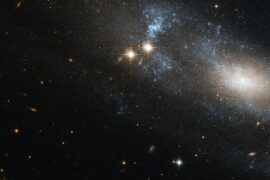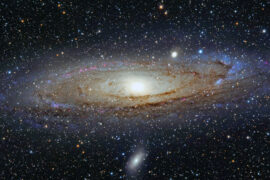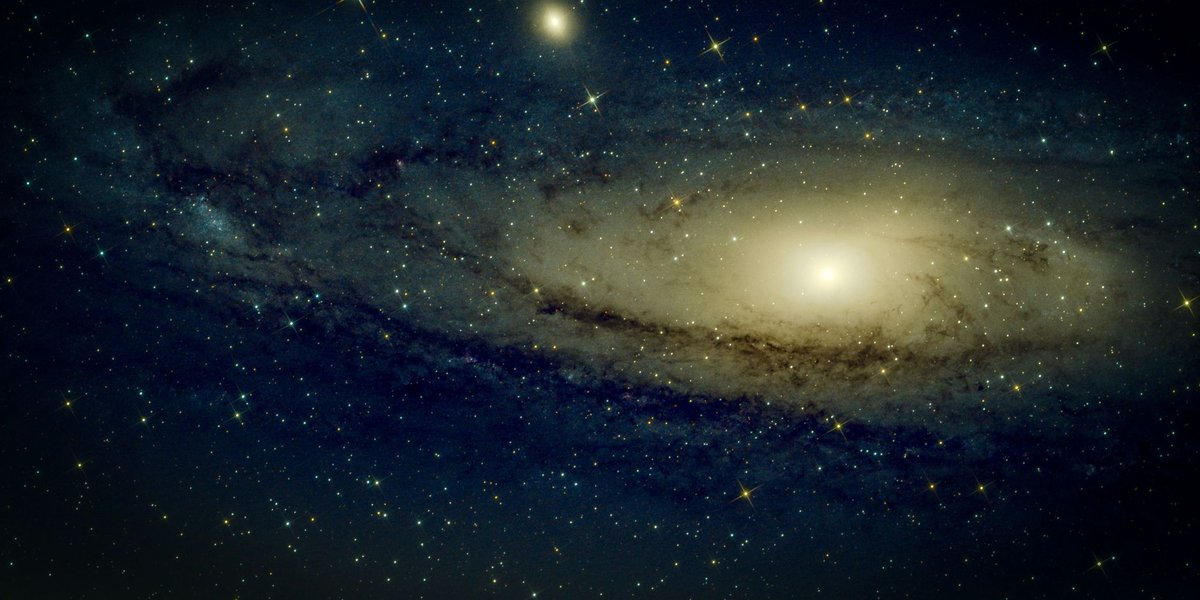
A galaxy is a gravitationally bound system of stars, gas, dust and dark matter, ranging from a few thousand stars to well over a trillion. In 1926 Edwin Hubble sorted the galaxies he could photograph by shape, and astronomers still use that scheme, expanded but never replaced.
The types of galaxies come down to a short list: spiral, barred spiral, elliptical, lenticular and irregular, plus a few oddballs that don’t fit anywhere. What separates them is less about looks than about history. Gas supply, star formation and past collisions decide which shape a galaxy ends up with.
Contents
- The types of galaxies at a glance
- How Hubble sorted galaxies
- Spiral and barred spiral galaxies
- Elliptical galaxies
- Lenticular galaxies
- Irregular galaxies
- Peculiar and interacting galaxies
- Dwarf, ring and ultra-diffuse galaxies
- Active galaxies: Seyferts, quasars and blazars
- Why galaxies look different: mergers and gas
- How to see galaxy types yourself
- FAQ
- Types of galaxies: the short version
The types of galaxies at a glance
Use this table as a cheat sheet, then read the sections below for the reasoning behind each row.
| Type | Shape | Star age | Gas and dust | Star formation | Share of galaxies | Famous example |
|---|---|---|---|---|---|---|
| Spiral | Flat disk, central bulge, winding arms | Mixed: young blue arms, old yellow bulge | Plenty | Ongoing, concentrated in the arms | About 60% of bright nearby galaxies | Andromeda (M31) |
| Barred spiral | Spiral with a straight bar of stars through the core | Mixed | Plenty, funneled along the bar | Ongoing, often boosted near the center | About two-thirds of spirals show a bar | Milky Way |
| Elliptical | Smooth ball to flattened egg | Old, red | Very little | Almost none | Roughly 10-15% | M87 |
| Lenticular (S0) | Disk and bulge, no arms | Mostly old | Little | Little to none | Roughly 15-20% | Spindle Galaxy (NGC 5866) |
| Irregular | No defined shape | Young, blue | Lots | Often vigorous | Roughly 5-10% of bright galaxies, far more among dwarfs | Large Magellanic Cloud |
| Peculiar / interacting | Distorted, tails, bridges or rings | Mixed, with a young burst | Lots, stirred up | Often a starburst | A few percent | Antennae Galaxies |
Percentages shift with the survey. The figures above describe bright galaxies in the nearby universe. Count faint dwarf galaxies too and the most common galaxy by number is a small, dim dwarf, not a grand spiral.
How Hubble sorted galaxies
Until the mid-1920s, nobody knew galaxies were other “island universes.” Hubble settled it by finding Cepheid variable stars in Andromeda and showing it sat far outside the Milky Way. Then he classified what he saw.
The result is the Hubble tuning fork classification, which he popularized in his 1936 book The Realm of the Nebulae. Picture a tuning fork lying on its side. The handle holds the ellipticals, running from round (E0) to flattened (E7). At the junction sits the lenticular (S0). The two tines split into ordinary spirals (Sa, Sb, Sc) on one side and barred spirals (SBa, SBb, SBc) on the other. Irregulars fall outside the fork entirely.
Hubble thought galaxies evolved from left to right, from ellipticals into spirals. That was wrong, and the real direction is closer to the reverse. The vocabulary survived anyway: ellipticals are still called “early-type” galaxies and spirals “late-type,” which trips up every beginner who reads it literally.
Spiral and barred spiral galaxies
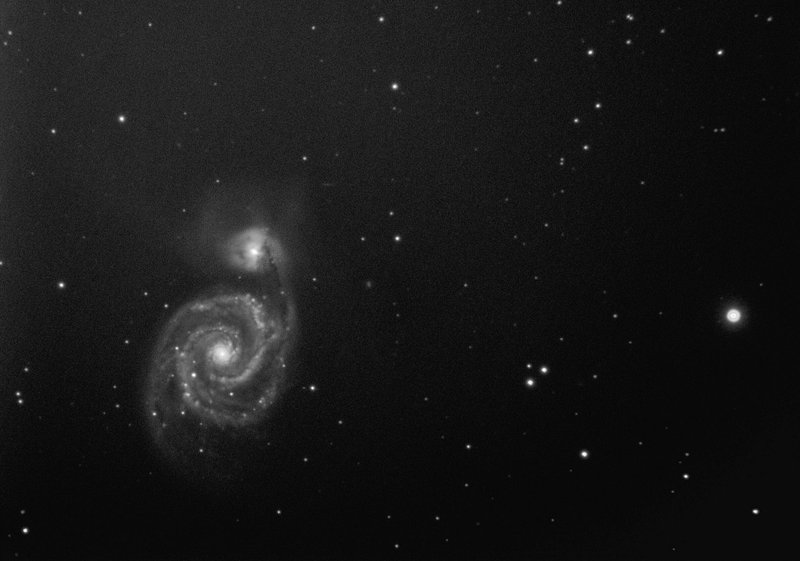
What they look like. A spiral galaxy is a thin rotating disk with a bright central bulge and arms curving outward. The subtype letter tells you how tightly the arms wind and how big the bulge is. Sa galaxies have a large bulge and tight, smooth arms. Sc galaxies have a small bulge and loose, clumpy arms. Sb sits in between.
What they’re made of. Spirals carry a lot of gas and dust, and that fuel feeds ongoing star formation. The arms glow blue because they hold hot, young stars and glowing nebulae. The bulge and the surrounding halo hold older, redder stars. Dark matter makes up most of the total mass, which is why the outer stars orbit as fast as the inner ones.
How they likely formed. Spirals grew from large gas clouds that collapsed into a spinning disk and kept receiving fresh gas. The arms are not solid structures. They’re density waves, traffic jams of stars and gas that move through the disk, which is why arms can persist for billions of years without winding up and vanishing.
Barred spirals. Roughly two-thirds of spirals have a bar, a straight band of stars running through the center. Bars act as gas pipelines, pushing material toward the core where it can fuel star birth or a central black hole. They also tend to appear in older, settled disks, so a bar is a sign of a galaxy that has been calm for a while.
Named examples. The Milky Way is a barred spiral, usually placed around SBbc, and about 100,000 light-years across. Andromeda (M31), 2.5 million light-years away, is a spiral with a large bulge, around Sb. Astronomers expect it to merge with the Milky Way, though a 2025 reanalysis of the data put the odds of a collision within the next 10 billion years closer to a coin flip than a certainty.
Elliptical galaxies
What they look like. Ellipticals are smooth, featureless balls of stars. The number after the E measures flattening: E0 looks perfectly round, E7 looks like a flat lens seen from the side. The figure is the shape as we see it, not necessarily the true 3D shape, since a football looks round when you view it end-on.
What they’re made of. Old, red stars, with almost no cool gas and dust left to make new ones. Their stars move on randomly oriented orbits instead of spinning in one neat plane, which is the key structural difference from a spiral. Stars here are often more than 10 billion years old.
How they likely formed. The leading explanation is mergers. When two large galaxies collide, the orderly disks are scrambled, much of the gas is burned in a burst of star formation or blown out, and what’s left relaxes into a smooth ellipsoid. That’s why the biggest ellipticals sit at the centers of galaxy clusters, where collisions are common.
Named example. M87, in the Virgo Cluster about 55 million light-years away, is a giant elliptical with a supermassive black hole. It was the first black hole ever imaged, by the Event Horizon Telescope in 2019. A jet of particles streams out of its core for thousands of light-years. The largest ellipticals, like IC 1101, may span several million light-years and hold trillions of stars.
Lenticular galaxies
What they look like. A lenticular galaxy (S0) has a bulge and a disk like a spiral, but no arms. The name comes from the lens shape you see when one is edge-on. They sit at the junction of Hubble’s fork, between ellipticals and spirals.
What they’re made of. Mostly old stars, with little gas and dust and little star formation. They look like spirals that stopped working.
How they likely formed. Two routes are popular. A spiral can lose its gas, either stripped away as it plows through a cluster’s hot intergalactic medium or used up in a final burst of star formation, which leaves a disk with nothing to build arms from. Or a minor merger can wash out the arms. Lenticulars are most common in dense clusters, which supports the stripping idea.
Named example. The Spindle Galaxy (NGC 5866), about 44 million light-years away in Draco, is seen almost perfectly edge-on. A dark dust lane cuts across a bright, thin disk. Even this lane is unusual for an S0, and some astronomers argue for a different classification, a good reminder that galaxy types are bins, not hard boundaries.
Irregular galaxies
What they look like. No bulge, no disk, no symmetry. Irregulars are lumpy and ragged, often small, and make up only a small fraction of bright galaxies. Hubble used the label for anything that didn’t fit his fork.
What they’re made of. Lots of gas, plenty of young blue stars, and active star-forming regions. They are often low in heavy elements, so they look a bit like the first galaxies in the early universe.
How they likely formed. Some were always shapeless. Others had a form once and lost it to gravity from a larger neighbor. Their gas stays available because they’re too small and quiet to have used it up.
Named examples. The Large and Small Magellanic Clouds, satellites of the Milky Way about 160,000 and 200,000 light-years away, are the classic irregulars. Both are visible to the naked eye from the Southern Hemisphere. The Large Cloud hosts the Tarantula Nebula, the most active star-forming region in our neighborhood, and it was the home of Supernova 1987A. Careful studies show hints of a bar and a spiral arm in the LMC, so even the textbook irregular blurs the lines.
Peculiar and interacting galaxies
What they look like. Tails, bridges, shells, loops and double nuclei. These galaxies are in the middle of a collision or just recovering from one.
What they’re made of. Whatever the parent galaxies had, now churned together. Gas gets compressed during a collision and triggers a starburst, a short period of star formation far faster than normal.
How they likely formed. Gravity. Two galaxies pass close, tidal forces pull out long streams of stars and gas, and the pair eventually merges. Stars rarely collide themselves because the spaces between them are enormous.
Named example. The Antennae Galaxies (NGC 4038 and 4039), in Corvus about 45 million light-years away, are two spirals mid-merger. Long tails curve away like insect feelers, and bright knots of newborn star clusters dot the overlapping region. Also look at the Whirlpool Galaxy (M51), a spiral whose grand arms are shaped by a smaller companion passing close.
Dwarf, ring and ultra-diffuse galaxies
These categories barely appear in basic guides, but they fill in much of the real galaxy population.
- Dwarf galaxies hold from a few thousand to a few billion stars, and they’re the most numerous galaxies in the universe. They come as dwarf ellipticals, dwarf irregulars and dwarf spheroidals. Dozens orbit the Milky Way.
- Ring galaxies have a bright ring of young stars around a core, usually after one galaxy punched through another. Hoag’s Object, about 600 million light-years away, has a blue ring around a yellow core with a gap of dark space between them.
- Ultra-diffuse galaxies are as wide as the Milky Way but have hundreds of times fewer stars, so they’re extremely faint. Dragonfly 44 in the Coma Cluster appears to be mostly dark matter.
Active galaxies: Seyferts, quasars and blazars
An active galaxy is any galaxy whose core outshines its stars. The source is a supermassive black hole pulling in gas, which heats up and radiates across the spectrum. Active galaxies aren’t a shape; they’re a phase, and a galaxy of almost any type can have one. NASA’s overview of galaxy types treats them as a separate group for this reason.
- Seyfert galaxies are mostly spirals with a bright, star-like nucleus, identified by Carl Seyfert in 1943. M77 (NGC 1068), about 47 million light-years away, is the standard example, and it’s within reach of a small telescope.
- Quasars are the extreme end, with cores that can outshine hundreds of galaxies. The nearby quasar 3C 273, roughly 2.4 billion light-years away, can be seen in a mid-sized backyard telescope, which means you are seeing light that left it before Earth had complex animals.
- Blazars are active galaxies whose jets point almost directly at us, so they look brighter and more variable than they are.
The flavors differ mostly in viewing angle and how fast the black hole is feeding. A Seyfert, a quasar and a blazar could be the same type of object seen from different directions or at different times.
Why galaxies look different: mergers and gas
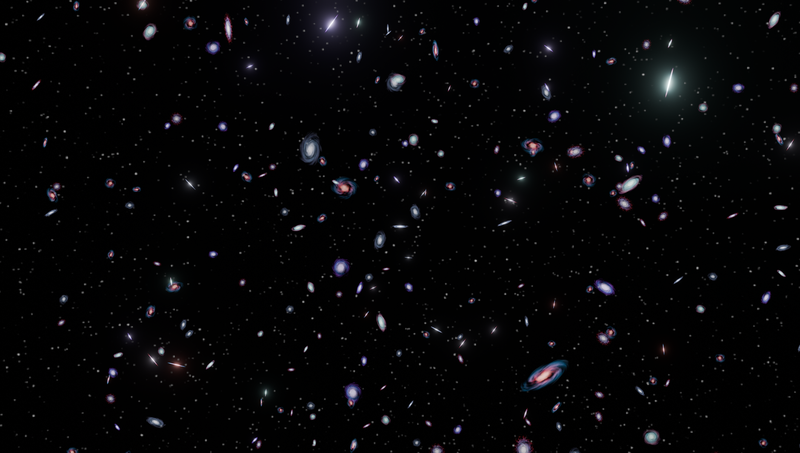
Three things explain most of the table above.
Gas supply. Spirals and irregulars still have gas, so they still make stars and stay blue. Ellipticals and lenticulars ran out or lost theirs, so their stars age and redden with nothing replacing them.
Mergers. A merger between two similar-sized spirals tends to wreck both disks and leave an elliptical. Simulations back this up, and the sky shows examples at every stage. A smaller galaxy falling into a bigger one usually leaves the bigger disk intact. The Milky Way absorbed a dwarf galaxy known as Gaia-Enceladus roughly 10 billion years ago and kept its spiral shape.
Environment. Crowded clusters favor ellipticals and lenticulars, since collisions are frequent and hot cluster gas strips disks. Isolated galaxies in sparse regions favor spirals. Astronomers call this the morphology-density relation.
Put together: galaxies are not fixed species. A spiral can become a lenticular or an elliptical, and the reverse path, an elliptical regrowing a disk from fresh gas, is rarer but possible. The SUNY astronomy course text gives a good academic walk-through of the same ideas.
How to see galaxy types yourself
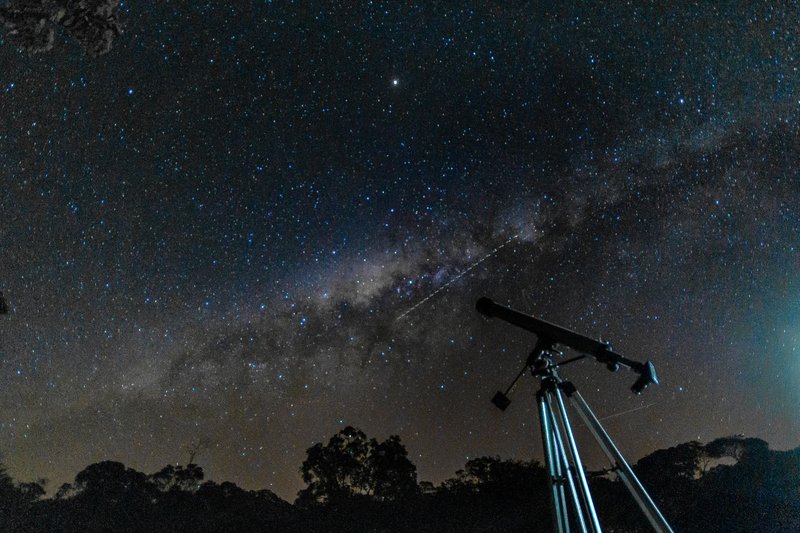
You don’t need a big telescope to see most of the types. You need dark skies and patience.
- Spiral: Andromeda (M31) is visible to the naked eye from a dark site as a faint oval smudge, and binoculars show it easily. Triangulum (M33) is a harder binocular target. To see arms in the Whirlpool (M51), plan on an 8-inch telescope under dark skies.
- Elliptical: M87 and its Virgo Cluster neighbors show as small round glows in a 6-inch telescope. Andromeda’s companions M32 and M110 are ellipticals you can see in the same field as M31.
- Lenticular: The Spindle Galaxy shows as a thin streak in a 6 to 8-inch telescope.
- Irregular: The Magellanic Clouds are bright naked-eye patches in the Southern Hemisphere. M82, the Cigar Galaxy, in Ursa Major, is a starburst galaxy with a distorted look that shows up in binoculars next to its neighbor M81.
- Active: M77 in a 4 to 6-inch telescope, and 3C 273 in an 8-inch or larger telescope with a detailed star chart.
Every galaxy except a few Local Group neighbors looks like a gray smudge by eye. Photographs get their color from long exposures, so don’t expect the Hubble look at the eyepiece.
FAQ
What is the most common type of galaxy? It depends on how you count. Among bright galaxies, spirals dominate at about 60%. By total number, dwarf galaxies, mostly dwarf ellipticals and dwarf irregulars, are far more numerous but too faint to notice.
Which type is the Milky Way? A barred spiral, roughly SBbc on Hubble’s scheme. The bar was confirmed in the 2000s using infrared surveys, because dust hides the center at visible wavelengths.
What is the difference between a spiral and an elliptical galaxy? Spirals are flat, rotating, gas-rich and blue in the arms, and they’re still forming stars. Ellipticals are rounded, nearly gas-free, red and made of old stars on random orbits. Mergers and gas loss account for most of the gap.
What is the difference between a spiral and a barred spiral? A barred spiral has a straight bar of stars through its center with the arms starting at the bar ends. A regular spiral has arms that wind out directly from the bulge. Most spirals show at least a weak bar when observed in infrared.
What is a lenticular galaxy? A disk galaxy with a bulge but no spiral arms and little gas, classified S0. It’s the transition type between ellipticals and spirals on the Hubble fork.
Can a galaxy change type? Yes. Mergers can turn spirals into ellipticals, and gas stripping can turn spirals into lenticulars. Classification is a snapshot of one stage.
Types of galaxies: the short version
The main types of galaxies are spiral, barred spiral, elliptical, lenticular and irregular, with peculiar and active galaxies as special cases. Spirals are gas-rich disks with young stars in their arms. Ellipticals are old, red and gas-poor. Lenticulars are disks with the arms gone. Irregulars are small, blue and shapeless. The differences trace back to gas, mergers and neighborhood, so a galaxy’s shape is a record of what has happened to it. Next time you spot the faint smear of Andromeda, you’re looking at a spiral that will probably merge with our own.