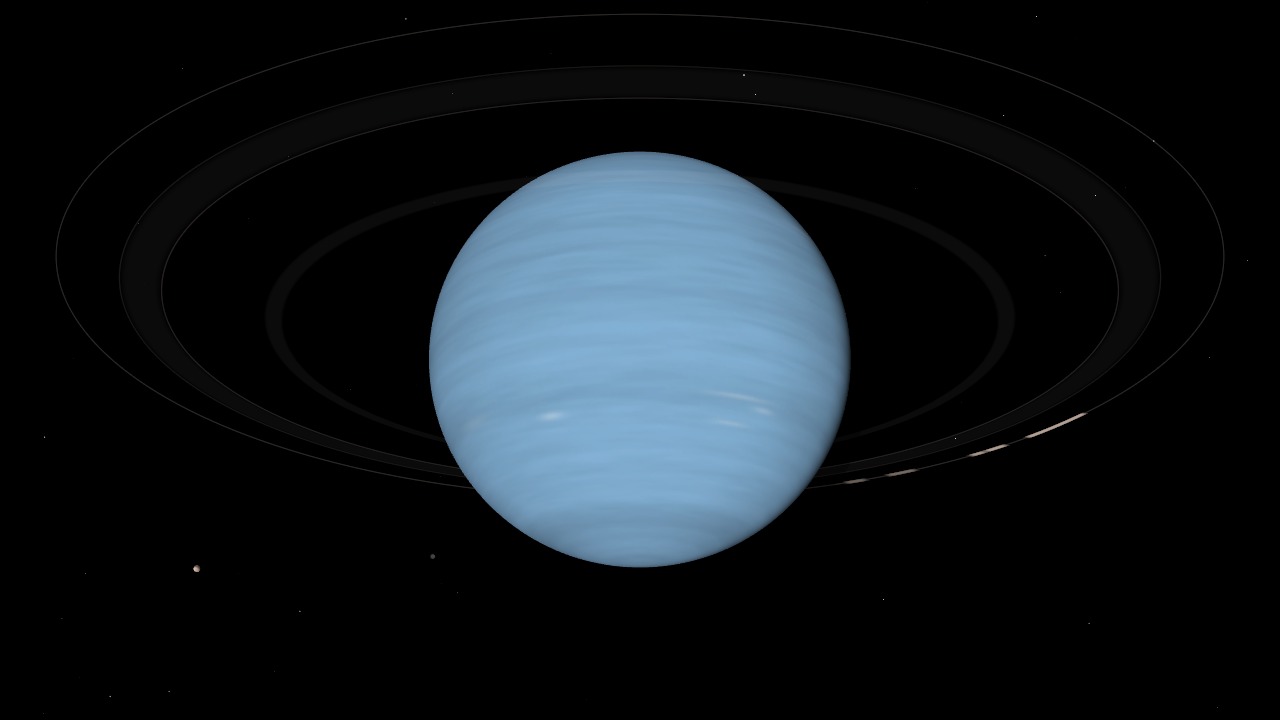
Neptune in 3D
This is an interactive 3D model of Neptune with its five rings, the five bright arcs in the outermost ring and its three largest moons: Proteus, Triton and Nereid. The rings are drawn at their real radii, from the faint Galle ring 41,900 km (26,035 mi) from the planet’s centre to the Adams ring at 62,933 km (39,105 mi). The moons sit where they really are on the date you choose. Triton, by far the largest, orbits backwards. Nereid swings out to 390 Neptune radii and back every 360 days. The 3D space models page has the Moon, Mars, Venus, Mercury, Jupiter, Saturn and Uranus, Neptune’s twin among the ice giants.
Two parts of the model are reconstructions rather than photographs, and both are labelled as such. Neptune’s cloud map is artistic. No spacecraft has mapped the whole planet, and its look changes as storms come and go, so the model shows a smooth pale blue-green globe with faint bands and a few bright methane clouds at the latitudes where Voyager 2 and Hubble saw them. The colour follows the 2024 study by Irwin and colleagues, which found that Neptune is only slightly bluer than Uranus. Proteus and Nereid have no global maps either, because Voyager 2 saw Proteus only at low resolution and Nereid as a few pixels. Their textures are neutral gray surfaces matched to their measured reflectivity. Triton’s map is real: it is the USGS mosaic built from Voyager 2 images.
How to use the Neptune model
- Move: drag to rotate, scroll or pinch to zoom. Zoom in on the rings to see them separate, or pull back to see Triton’s orbit and then Nereid’s.
- Click a ring or an arc: the camera flies to it and shows its radius, width, who found it and when. The five arcs sit in the Adams ring and move around it with time.
- Rings panel: lists the five rings from the innermost to the outermost, with the five arcs indented under Adams. Click a name to highlight it.
- Click a moon: the camera flies to it and shows its size, its distance from Neptune, its orbit time and its surface.
- Moons panel: System view fits Triton’s whole orbit on screen. Nereid’s orbit pulls back far enough to fit Nereid’s long ellipse. View from Earth shows Neptune the way a telescope does today.
- Time: move the clock forward or back. The arcs circle Neptune in 10.5 hours, so you can watch them travel along the ring.
- Neptune card and seasons: click the planet to see the latitude the Sun is over now, the season, the length of the day and the winds.
- Layers, search and share: toggle rings, moons, orbit trails, the latitude grid and day and night, type a name to fly to it or copy a link to the current view and date.
The rings of Neptune
Neptune has five main rings: Galle, Le Verrier, Lassell, Arago and Adams. Each carries the name of a person tied to the planet’s discovery or early study. Galle and Le Verrier found Neptune in 1846, William Lassell discovered Triton that year, John Couch Adams predicted Neptune’s position independently of Le Verrier, and Arago was the French astronomer who urged Le Verrier to search. Voyager 2 imaged all five in August 1989. The outermost, the Adams ring, holds the five bright arcs that have puzzled astronomers since 1984.
The rings are dark and thin. Two of the five, Galle and Lassell, are broad sheets of fine dust with an optical depth of about 0.0001, which means they block one part in ten thousand of the light passing through. The model brightens them so you can find them.
| Ring | Radius from centre | Width | Type |
|---|---|---|---|
| Galle | 41,900 km (26,035 mi) | about 2,000 km | Dusty |
| Le Verrier | 53,200 km (33,057 mi) | about 100 km | Narrow |
| Lassell | 53,200 to 57,200 km (33,057 to 35,542 mi) | about 4,000 km | Dusty |
| Arago | 57,200 km (35,542 mi) | under 100 km | Narrow |
| Adams | 62,933 km (39,105 mi) | about 15 km in the arcs (15 to 50 km) | Narrow |
The Le Verrier ring is a narrow band with a large share of dust. The small moon Despina orbits just inside it at 52,526 km (32,639 mi) and may confine its inner edge. The Lassell ring is a wide, uniform plateau of dust that extends outward from Le Verrier to 57,200 km. At its outer edge sits the narrow Arago ring, which some authors treat as part of Lassell. The Adams ring is the outermost and the most interesting.
The Adams ring arcs
Most of the Adams ring is faint, but it has five bright clumps of material called arcs. They are named Fraternité, Égalité 1, Égalité 2, Liberté and Courage, after the French Revolution motto Liberté, Égalité, Fraternité with Courage added. In the arcs the ring is about 30 times denser than elsewhere, with an optical depth near 0.1 against 0.003 for the ring as a whole. The model draws them as bright segments and the rest of the ring as a faint line.
They were found in 1984, before anyone had seen the rings. When Neptune passed in front of a star, the starlight dimmed on one side of the planet and not on the other. That meant something was blocking the light, but it did not cover the whole circle. Voyager 2 settled the question in 1989 by photographing a complete, faint ring with the bright arcs inside it.
| Arc | Length | Notes |
|---|---|---|
| Fraternité | 10 degrees (about 11,000 km) | Longest and brightest, the trailing end of the group. Stable since Voyager 2. |
| Égalité 1 | 3 degrees (about 3,300 km) | About 10 degrees ahead of Fraternité. Seen again by the VLT in 2016. |
| Égalité 2 | 2 degrees (about 2,200 km) | About 3 degrees ahead of Égalité 1. |
| Liberté | 4 degrees (about 4,400 km) | About 26 degrees ahead of Fraternité. Faded to about 30 percent of its Voyager brightness by 2003 and was essentially gone by 2009. |
| Courage | 2.7 degrees (about 3,000 km) | The leading arc. Flared in 1998, jumped about 8 degrees forward by 2003 and had faded away by 2009. |
All five fit inside about 40 degrees of a ring that is 360 degrees around, so they cover about a ninth of the circumference. They travel around Neptune together, once every 10.5 hours, which is faster than the planet spins. The model moves them at that rate. Their positions in the model are approximate. They come from Very Large Telescope images carried forward at the published rate. Courage and Liberté are placed where Voyager 2 saw them in 1989, so Courage may now sit about 8 degrees further ahead and the present position of Liberté is uncertain.
Why the arcs persist
Arcs should not exist. Ring particles orbiting at slightly different speeds spread into a complete circle quickly, and the Adams ring arcs have survived for at least 40 years. Something holds them in place. The prime suspect is Galatea, a small moon that orbits 980 km (609 mi) inside the Adams ring and drives 42 radial distortions of about 30 km in the ring. In 1991 Carolyn Porco proposed that a resonance with Galatea, in which Galatea goes around Neptune 43 times for every 42 trips the ring material makes, traps the arcs in place.
That explanation has run into trouble. Very Large Telescope observations, most recently by Souami and colleagues in 2022, show that the arcs’ positions do not match the 42:43 resonances with Galatea and that no 42:43 corotation model explains how the material stays clumped. Other proposals include a different Galatea resonance (Namouni and Porco, 2002), a three-body resonance involving Galatea and Larissa, and small unseen moons sharing the arcs’ orbit. None has won out. The same observations confirm that Fraternité and Égalité are stable, while Liberté and Courage keep fading, so the arc system is changing in front of us. Our guide to Jovian planets and their rings compares Neptune’s rings with those of Jupiter, Saturn and Uranus.
Triton
Triton is Neptune’s largest moon and the seventh largest in the Solar System. It is 2,705 km (1,681 mi) across, bigger than Pluto, and it orbits Neptune backwards. The direction is called retrograde: Triton circles the planet the opposite way to Neptune’s spin, in an orbit tilted 157.3 degrees to the equator. That is the same as an orbit running backwards and leaning 22.7 degrees from the equator. It lies 354,800 km (220,462 mi) from Neptune, a little closer than the Moon is to Earth, and one lap takes 5.88 days. Open the Triton is orbiting Neptune the wrong way fact for the short version, or Triton facts and characteristics for the full profile.
The backwards orbit is the evidence that Triton did not form around Neptune. A moon that grows from the disc of material around its planet orbits in the planet’s spin direction and close to its equator. Triton most likely began as a Kuiper Belt object, one of the icy bodies beyond Neptune, and Neptune captured it. Triton is larger than Pluto and has a similar make-up of rock and ice, which fits that origin. One leading idea is that Triton arrived as half of a binary pair and Neptune’s gravity pulled it away from its partner. The capture would have been violent. It probably threw out or destroyed whatever moons Neptune had, and the stretched orbit of Nereid is thought to be a leftover of that upheaval.
Geysers and ice
Voyager 2 flew past Triton in August 1989 and found one of the coldest surfaces in the Solar System: about 38 K (-235 °C). It is covered in nitrogen, water and carbon dioxide ices over a rock and ice interior, with a bright south polar cap. Voyager 2 saw dark plumes of icy material rising more than 8 km (5 mi) above the surface, which makes Triton one of the few worlds known to have active geysers. It also has a thin nitrogen atmosphere. The surface is young and has few craters, so something keeps resurfacing it.
The model uses the Voyager 2 mosaic from the USGS. Voyager 2 arrived in southern summer, so the north of Triton was in darkness and unimaged: about 39 percent of the globe. That area is shown as plain gray. Triton keeps one face toward Neptune, and the model rotates it that way. See space missions to Triton for the only flyby and proposed returns.
Triton’s slow fall
Triton is spiralling inward. Because it orbits against Neptune’s spin, the tides it raises on the planet drag on it and pull it closer by a tiny amount each year. In the end Triton will reach the distance where Neptune’s tides are stronger than the moon’s own gravity, and it will be torn apart. The debris would spread into a new ring around Neptune. The timing depends on the model. Older estimates give about 3.6 billion years, and newer work puts it far later, so the event is billions of years away in either case.
Proteus and Nereid
Neptune has 16 known moons. Triton, Proteus and Nereid are the three the model shows, and they are the only ones large enough to matter at this scale. The other 13 are six small inner moons (Naiad, Thalassa, Despina, Galatea, Larissa and Hippocamp) and seven distant irregular moons. The newest two, S/2002 N5 and S/2021 N1, were announced in February 2024.
| Moon | Diameter | Distance from Neptune | One orbit takes | Found |
|---|---|---|---|---|
| Proteus | about 420 km (261 mi) | 117,600 km (73,073 mi) | 1.12 days | 1989, Voyager 2 |
| Triton | 2,705 km (1,681 mi) | 354,800 km (220,462 mi) | 5.88 days, backwards | 1846, Lassell |
| Nereid | about 340 km (211 mi) | 1.37 to 9.65 million km (0.85 to 6.0 million mi) | 360 days | 1949, Kuiper |
Proteus
Proteus is Neptune’s second-largest moon, about 420 km across, and it is larger than Nereid. Earth-based telescopes missed it for 143 years because it is very dark, reflecting about 10 percent of the light that hits it, and it sits close to Neptune’s glare. Voyager 2 found it in June 1989. It is about as big as a moon can get without gravity pulling it into a sphere, so it is lumpy, with radii of 220 by 208 by 202 km. It orbits 117,600 km from Neptune’s centre, 4.7 Neptune radii, almost exactly over the equator. Its mass is uncertain by about a factor of two.
Nereid
Nereid has one of the most stretched orbits of any moon in the Solar System. Its eccentricity is 0.751. At its closest it is 1.37 million km (0.85 million mi) from Neptune, 55 Neptune radii, and at its farthest 9.65 million km (6.0 million mi), 390 radii and about 25 times the distance from Earth to the Moon. The distance changes by a factor of seven over each 360-day lap. Gerard Kuiper discovered it on 1 May 1949. Its radius is about 170 km, give or take 25 km, because Voyager 2 passed 4.7 million km (2.9 million mi) away and saw only a few pixels. Its brightness varies, which suggests it tumbles chaotically. The model draws it with one face toward Neptune. Use the Nereid’s orbit button to see the whole ellipse beside Triton’s tight circle.
Neptune’s seasons and tilt
Neptune is tilted 28.32 degrees, a little more than Earth’s 23.4 degrees, so it has seasons like ours. They are slow. One trip around the Sun takes 164.8 Earth years, which makes each season about 41 years long. In 2011 Neptune completed its first full orbit since its discovery. The Sun was over its far southern hemisphere around 2005, about 29 degrees south at the southern summer solstice. In late 2026 it is about 20 degrees south, moving slowly north. It will cross the equator in spring 2046, which is the equinox, when the southern hemisphere begins its autumn. Voyager 2 flew past in the southern summer, which is why it saw Triton’s south and not its north.
Open the Neptune card in the model to see the latitude of the Sun for any date you set. In the model, north means the IAU north pole, and in 2026 that pole is tipped away from the Sun.
The planet rotates faster than any season passes. A day lasts about 16 hours: 16 h 6.6 min from the radio signal Voyager 2 recorded in 1989, and 15 h 57 min 59 s from Hubble tracking of cloud features (Karkoschka, 2011). Neptune has the fastest winds in the Solar System, reaching about 2,100 km/h (1,305 mph). Our fact on Neptune’s winds has more, and is Neptune hot or cold covers its temperatures. The upper atmosphere reaches a minimum of about -218 °C and the temperature at the 1 bar level is about -201 °C.
Voyager 2 photographed a storm called the Great Dark Spot, roughly the size of Earth. It had gone when Hubble looked in 1994, so the model shows no dark spot.
How big is Neptune
Neptune is 49,528 km (30,775 mi) across at the equator, almost four times the width of the Earth. Its equatorial radius is 24,764 km (15,388 mi) and its polar radius is 24,341 km (15,125 mi), a little flattened by its spin. Its mass is 1.024 × 1026 kg, 17.1 times Earth’s, and its average density is 1.64 times that of water, lower than Earth’s. It is an ice giant: a hydrogen and helium atmosphere over a deep mantle of water, ammonia and methane ices around a small rocky core. Methane in the upper atmosphere absorbs red light, which gives Neptune its colour.
Neptune orbits an average of 4.5 billion km (2.8 billion mi) from the Sun, 30 times Earth’s distance. Sunlight takes about 4 hours 10 minutes to arrive. The planet was found on 23 September 1846 by Johann Galle and Heinrich d’Arrest at the Berlin Observatory, in the place that Urbain Le Verrier had calculated from irregularities in Uranus’s orbit. See how far sunlight travels to Neptune, the list of characteristics of Neptune and Earth and Neptune: differences and similarities. Work out your age with the Neptune age calculator or see your weight with the weight on Neptune calculator.
Seeing Neptune yourself
Neptune shines at about magnitude 7.8, too faint for the naked eye. It reached opposition, when it is closest to Earth and up all night, on 26 September 2026, and in 2026 it sits in Pisces. Opposition comes a few days later each year, so it falls in late September or early October for the next several years. Use a star chart app to find the exact spot. Here is what to expect with each kind of instrument:
- Binoculars (10×50): a faint star-like point with a bluish tint. Compare it with a chart to confirm which point it is, because it looks like any other star.
- 60 to 100 mm telescope at 100x or more: a tiny blue-gray disc about 2.4 arcseconds wide. That is the sign it is a planet and not a star. No bands or spots are visible.
- 200 mm telescope under a dark sky: the same small disc with a clearer colour, and Triton as a faint speck beside it at about magnitude 13.5.
Proteus and Nereid are far too faint for amateur telescopes, and so are the rings. Only Voyager 2, Hubble, the large ground-based telescopes and the James Webb Space Telescope have imaged them. The Webb image from 2022 was the sharpest view of the rings since Voyager 2. If you want to try for Neptune, a telescope with 100 mm or more of aperture and a Go-To mount makes finding it easy. For help choosing, use the telescope finder or read the guide to the best telescopes for viewing planets. For the naked-eye question, see Neptune without a telescope.
Voyager 2 is the only spacecraft to visit. It passed Neptune on 25 August 1989 and found six new moons, the rings in full, the Great Dark Spot and Triton’s geysers. Its story is in mysteries of the Voyager probes.
Questions people ask
Is there an interactive 3D model of Neptune?
Yes. This page is an interactive 3D model of Neptune with its five rings, the five bright arcs in the Adams ring and its three largest moons, Proteus, Triton and Nereid. The rings and moons sit at their real positions for any date you choose. You can click any of them to fly to it, watch Triton orbit backwards and see the Sun's latitude on Neptune and the current season.
How many rings does Neptune have?
Neptune has five main rings: Galle, Le Verrier, Lassell, Arago and Adams. Galle and Lassell are broad sheets of dust, and Le Verrier, Arago and Adams are narrow. The outermost, the Adams ring, is 62,933 km (39,105 mi) from the planet's centre and holds five bright arcs named Fraternite, Egalite 1, Egalite 2, Liberte and Courage. Voyager 2 imaged the complete rings in August 1989.
How many moons does Neptune have?
Neptune has 16 known moons as of October 2026. Triton is by far the largest at 2,705 km (1,681 mi) across. Proteus is second at about 420 km (261 mi), then Nereid at about 340 km (211 mi). The rest are six small inner moons and seven distant irregular moons. The newest two, S/2002 N5 and S/2021 N1, were announced in February 2024.
Why does Triton orbit backwards?
Triton did not form around Neptune. It orbits in the opposite direction to Neptune's spin, in an orbit tilted 157.3 degrees to the planet's equator, which a moon formed from the planet's own disc could not do. Triton was most likely a Kuiper Belt object that Neptune captured. Tides from the backwards orbit are slowly pulling it inward.
What are Nereid and Proteus?
Proteus and Nereid are Neptune's second and third largest moons. Proteus is a dark, lumpy moon about 420 km (261 mi) across that orbits 117,600 km (73,073 mi) from Neptune once every 1.12 days. Voyager 2 found it in 1989. Nereid is about 340 km (211 mi) across and has one of the most stretched orbits of any moon: it ranges from 1.37 million km to 9.65 million km from Neptune over 360 days. Gerard Kuiper discovered it in 1949.
What are the arcs in Neptune's rings?
The arcs are five bright clumps of ring material inside the Adams ring: Fraternite, Egalite 1, Egalite 2, Liberte and Courage. Together they cover about 40 degrees of the ring. Normally ring material spreads into a full circle, so something confines them, and the small moon Galatea is the leading suspect. Liberte and Courage have faded since Voyager 2 saw them in 1989, while Fraternite and Egalite are stable.
What is special about Triton?
Triton is the seventh largest moon in the Solar System and bigger than Pluto. It orbits Neptune backwards, has a surface of nitrogen, water and carbon dioxide ices at about -235 degrees C and a thin nitrogen atmosphere. In 1989 Voyager 2 saw geysers on it throwing material more than 8 km (5 mi) above the surface. Billions of years from now Triton will spiral close enough to Neptune to be torn apart.
Can you see Neptune from Earth?
Not with the naked eye. Neptune shines at about magnitude 7.8, so binoculars show it as a faint star-like point and a small telescope at 100 times magnification shows a tiny blue-gray disc. It was at opposition on 26 September 2026 in Pisces. Triton needs a telescope of about 200 mm under a dark sky. Neptune's rings and its other moons cannot be seen from a backyard.
Where the data comes from
- Neptune’s clouds: an artistic map based on published colour and brightness observations, including the 2024 colour study by Irwin and colleagues and Voyager 2 and Hubble images. The map has no real longitude anchor and no Great Dark Spot.
- Triton’s surface: the USGS Astrogeology Voyager 2 global colour mosaic, used for brightness only. The unimaged north is filled with the mean tone of the imaged terrain.
- Proteus and Nereid surfaces: artistic textures. No global maps exist. Only their reflectivity is real.
- Rings and arcs: radii and widths from the PDS Ring-Moon Systems Node and de Pater, Renner, Showalter and Sicardy (2018). Arc positions come from Renner and colleagues (2014) and Souami and colleagues (2022), carried to today at the published mean motion. The brightness of the rings is exaggerated.
- Moon facts: NASA JPL Solar System Dynamics satellite physical parameters and mean orbital elements, with the NASA NSSDC satellite fact sheet.
- Planet facts and moon names: NASA JPL, the NASA NSSDC Neptune fact sheet and the IAU. The day length is from Karkoschka (2011).
- Positions, lighting, seasons and rotation: calculated from the VSOP87 planetary theory and the IAU rotation model for Neptune, and checked against JPL Horizons.
Data verified 2026-10-16. The same kind of model exists for Jupiter, Saturn, the Moon, Mars, Venus and Mercury.