TLDR
- Astronomers sort galaxies into four main shape types: spiral (including barred spiral), elliptical, lenticular and irregular.
- Active galaxies (Seyferts, quasars, blazars) are a separate label. They describe what the central black hole is doing, not the galaxy’s shape.
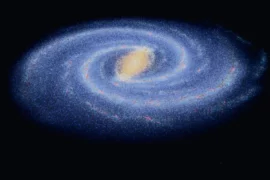
- Spirals are the most common bright galaxies nearby. The Milky Way is a barred spiral.
- Some sources count three types because they fold lenticulars into spirals or ellipticals.
- The Hubble “tuning fork” is a sorting chart, not a life cycle.
Table of Contents
- Types of galaxies at a glance
- Spiral galaxies
- Elliptical galaxies
- Lenticular galaxies
- Irregular galaxies
- Active galaxies: a different kind of label
- How the Hubble tuning fork works
- Why some sources say three types and others say four
- Do galaxies change type?
- What JWST changed
- Which galaxies can you see from your backyard?
- FAQ
Types of galaxies at a glance
The quickest way to tell galaxy types apart is to ask three questions. Does it have a flat disk? Does it have arms? Is it still making stars? The table answers all three for each type.
| Type | Shape | Stars | Gas and dust | Star formation | Rough share of bright nearby galaxies | Famous example |
|---|---|---|---|---|---|---|
| Spiral | Flat disk, central bulge, arms | Old yellow bulge, young blue arms | Plenty | Active, mostly in the arms | 60% or more | Andromeda, Milky Way |
| Elliptical | Smooth ball or stretched oval | Mostly old, red-yellow | Very little | Almost none | 10-20% | M87 |
| Lenticular | Disk and bulge, no arms | Mostly old | Little | Little or none | 10-15% | Spindle Galaxy (NGC 5866) |
| Irregular | No defined shape | Young and blue | Plenty | Vigorous | 5% or less | Large Magellanic Cloud |
The shares are approximate and shift with how a survey counts. Count every galaxy, faint dwarfs included, and small dwarf ellipticals and dwarf irregulars outnumber everything else. They’re just too dim to show up in a bright-galaxy count.
Spiral galaxies
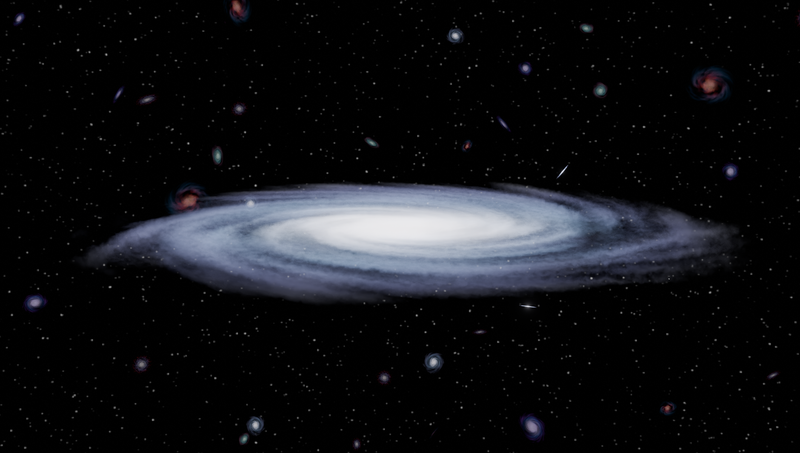
A spiral galaxy is a rotating disk with a bulge of old stars in the middle and bright arms curling outward. The arms look blue because they hold young, hot stars and the gas clouds that are forming new ones. The bulge looks yellow because its stars are old. A faint halo of ancient stars and globular clusters surrounds the whole thing.
The arms aren’t solid structures. They’re density waves, regions where stars and gas bunch up as they orbit, a bit like a traffic jam on a highway. Cars move through the jam, and stars move through the arms.
Barred spirals have a straight bar of stars running through the center, with the arms starting at the bar’s ends. Roughly two-thirds of spirals have one. The bar acts as a conveyor, funneling gas toward the core.
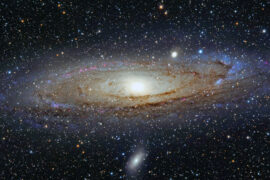
Famous example: the Milky Way is a barred spiral, about 100,000 light-years across, with our Sun sitting in a minor arm segment called the Orion Spur. Andromeda (M31), 2.5 million light-years away, is the big spiral next door.
Elliptical galaxies
Elliptical galaxies are smooth, featureless balls of stars. No arms, no disk, no dust lanes. The stars orbit the center in random directions, like bees around a hive, rather than marching around in a single plane the way spiral stars do.
They hold mostly old, red-yellow stars and almost no cold gas, so very little new star formation happens. Size varies enormously. Dwarf ellipticals contain a few million stars. Giants contain trillions and tend to sit at the centers of galaxy clusters.
Famous example: M87, a giant elliptical in the Virgo Cluster about 53 million light-years away. Its central black hole was the subject of the first image of a black hole, released by the Event Horizon Telescope in 2019.
Lenticular galaxies
Lenticular galaxies (named for their lens shape, classed S0) sit between spirals and ellipticals. They have a flat disk and a central bulge like a spiral, but the arms are gone. Most of the gas is gone too, so the disk is smooth and star formation has mostly stopped.
They’re the hardest type to spot in photos. Face-on, a lenticular looks like a fuzzy ellipse. Edge-on, it can pass for a thin spiral.
Famous example: the Spindle Galaxy (NGC 5866), about 44 million light-years away, seen edge-on with a sharp dust lane across its middle. The Sombrero Galaxy (M104) is a borderline case that catalogs have labeled as both a spiral and a lenticular, thanks to its huge bulge and tightly wound disk.
Irregular galaxies
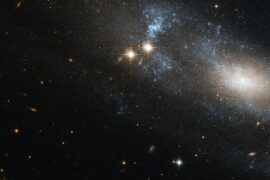
Irregular galaxies don’t fit any of the other shapes. They’re lumpy and asymmetric, usually smaller than spirals, and full of gas. That gas fuels fast star formation, so irregulars often look blue and knotted with bright star-forming regions.
Many got their messy look from gravity. A close pass by a larger neighbor can pull a small galaxy out of shape.
Famous example: the Large Magellanic Cloud, about 160,000 light-years away and visible to the naked eye from the Southern Hemisphere. It hosts the Tarantula Nebula, the most active star-forming region in our corner of the universe. Its slight bar-like structure is why some astronomers call it a barred irregular.
Active galaxies: a different kind of label
Active galaxies aren’t a fifth shape. A galaxy can be spiral, elliptical or irregular and still be “active,” meaning its center outshines the rest of the galaxy because a supermassive black hole is swallowing gas. The three names you’ll see most:
- Seyfert galaxies: spirals with unusually bright, star-like cores. Carl Seyfert described the first group in 1943.
- Quasars: the most luminous objects of this kind, bright enough to be seen across most of the observable universe. 3C 273, about 2.4 billion light-years away, is the brightest quasar in our sky.
- Blazars: active galaxies whose jet happens to point almost straight at Earth, which makes them look extra bright and variable.
NASA’s overview of galaxy types lists active galaxies alongside the shape-based types, which is a common source of the confusion about how many categories exist.
How the Hubble tuning fork works
Edwin Hubble published his classification scheme in the 1920s and drew it as a fork in 1936. The handle is the ellipticals, and the two prongs are the spirals and barred spirals. The OpenStax Astronomy textbook walks through the same sequence.
Ellipticals: E0 to E7. The number describes how stretched the galaxy looks in the sky. E0 is round. E7 is a long, flattened oval. The number is 10 times (1 minus the ratio of the short axis to the long axis), so it describes the view from Earth, not the true shape. An elongated galaxy pointed at us can look like an E0.
Spirals: Sa, Sb, Sc. The letter describes how tightly the arms wind and how big the bulge is.
- Sa: big bulge, tight arms.
- Sb: medium bulge, moderate arms.
- Sc: small bulge, loose and open arms.
Barred spirals use the same letters with a B: SBa, SBb, SBc. The Milky Way falls around SBb or SBc.
S0 (lenticulars) sits at the junction where the handle splits into the prongs. Irr (irregulars) sits off the fork.
Why some sources say three types and others say four
Hubble’s original scheme had ellipticals and spirals. He added the S0 class in 1936 as a hypothetical transition type, and later observations confirmed lenticulars exist. Some popular sources still skip them and list spiral, elliptical and irregular. Others fold lenticulars into the ellipticals because both look smooth and old. Four is the standard in professional classification, since a lenticular has a real disk and an elliptical doesn’t.
Do galaxies change type?
Yes, but not by following the fork from left to right.
Hubble called ellipticals “early type” and spirals “late type” because he thought galaxies might evolve along the fork. That idea is wrong, though the names stuck. The tuning fork sorts galaxies by appearance. It isn’t a timeline.
What does change a galaxy is what happens to it:
- Mergers. When two spirals collide, their orderly rotation gets scrambled. Gas piles into the center and triggers a burst of star formation that uses most of it up. The end result is often an elliptical. The Antennae Galaxies, two colliding spirals about 60 million light-years away in Corvus, are caught in the middle of this process.
- Gas loss. A spiral that loses or burns through its gas stops forming stars, its arms fade and it becomes a lenticular.
- Tidal damage. A close encounter can strip or distort a small spiral into an irregular.
The Milky Way and Andromeda are on course for a future encounter, though recent Hubble measurements make the collision less certain than the older “guaranteed in 4 billion years” version.
What JWST changed
Before the James Webb Space Telescope, astronomers expected the earliest galaxies to be small, clumpy and irregular. JWST found a more varied picture, including galaxies with settled disks and even bars when the universe was only a couple of billion years old. A bar means a galaxy had already organized itself, which is earlier than most models predicted. Classification is still being worked out for these distant galaxies, since the light that reaches us was emitted in a different part of the spectrum and makes them look different from nearby ones.
Which galaxies can you see from your backyard?
You can see more than most people expect.
- Andromeda (M31): a faint, elongated smudge to the naked eye under dark skies. Binoculars show the bright core. It’s the farthest thing most people can see without a telescope.
- Triangulum (M33): a face-on spiral. Binoculars under very dark skies work, but it’s fainter than Andromeda.
- M81 and M82: a pair in Ursa Major, visible in binoculars or a small telescope.
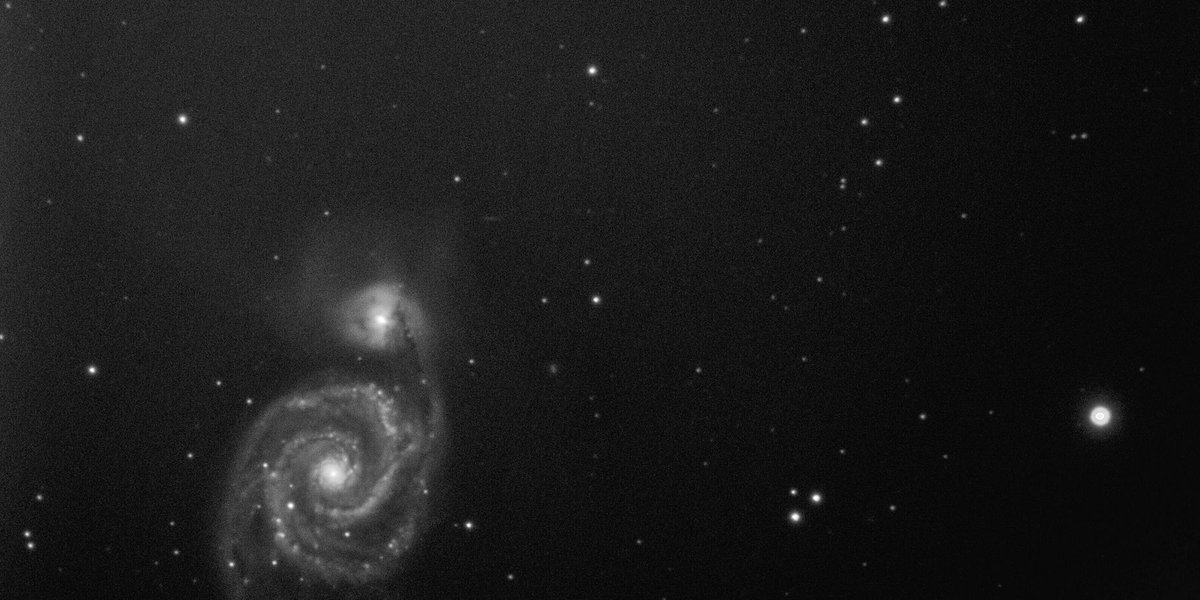
- Whirlpool (M51): a small telescope hints at the core and the companion galaxy beside it.
- Magellanic Clouds: two irregulars, visible to the naked eye from the Southern Hemisphere.
Dark skies matter more than telescope size. Light pollution wipes out faint galaxies faster than anything else.
FAQ
What type of galaxy is the Milky Way?
A barred spiral, roughly SBb or SBc on the Hubble scale. A central bar of stars sits inside a disk with several arms.
What is the most common type of galaxy?
It depends on what you count. Among bright galaxies near us, spirals are the most common. Counting all galaxies including faint dwarfs, dwarf ellipticals and dwarf irregulars outnumber the rest.
How many types of galaxies are there?
Four main shape types: spiral, elliptical, lenticular and irregular. Active galaxies are a separate classification based on central activity, and barred spirals are a subtype of spirals.
Can galaxies change from one type to another?
Yes. Mergers can turn spirals into ellipticals, gas loss can turn spirals into lenticulars, and close encounters can distort a galaxy into an irregular. The Hubble fork isn’t an evolutionary sequence.
What’s the difference between a spiral and a barred spiral?
In a barred spiral the arms start from the ends of a straight bar of stars through the center. In an ordinary spiral they curl out directly from the bulge.
How many galaxies are there?
Estimates run from hundreds of billions to a couple of trillion in the observable universe, depending on how many faint dwarfs are counted. National Geographic’s galaxy primer covers the basics for newcomers.