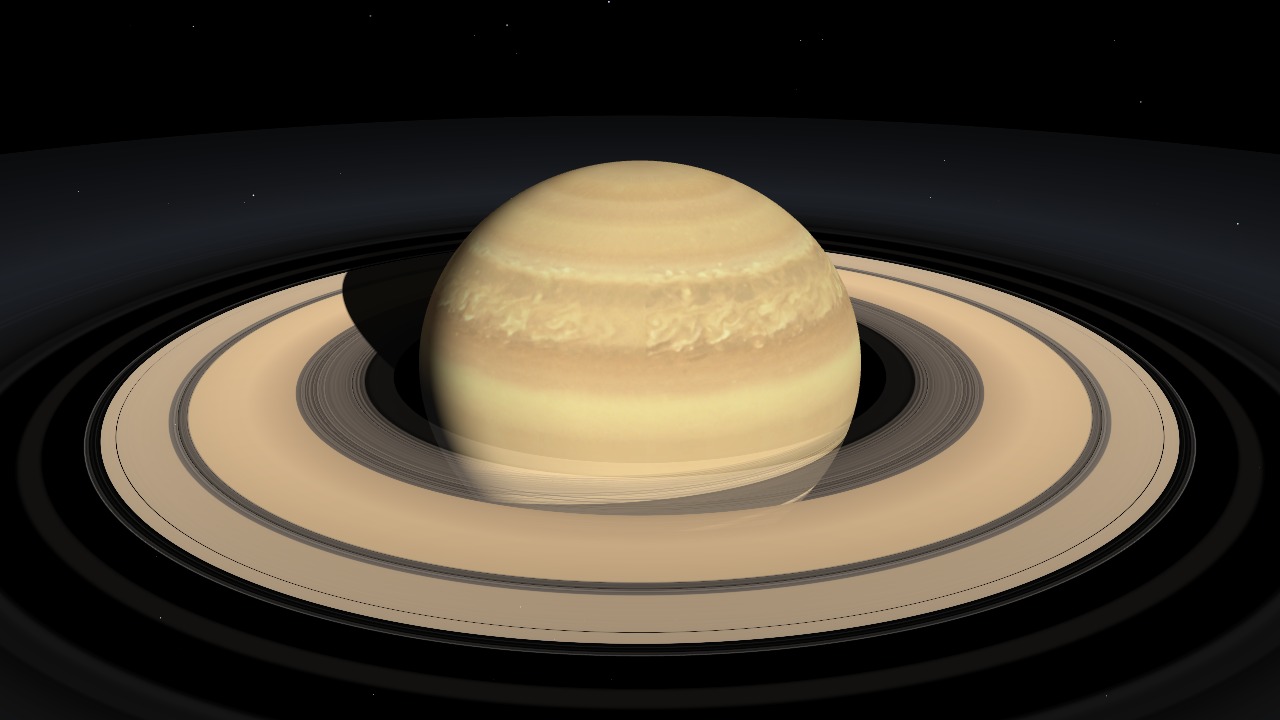
Saturn’s rings in 3D
This is an interactive 3D model of Saturn and its rings. The rings are built from optical-depth measurements made by the Cassini spacecraft, so every ring, gap and ringlet sits at its real distance from the planet and lets through as much light as the real one does. All the rings and gaps named by the International Astronomical Union are labelled, from the faint D ring that almost touches the clouds to the E ring, which reaches about eight times Saturn’s radius. Sunlight falls where it falls today: the planet throws its shadow across the rings, and the rings throw striped shadows onto the clouds. Set the clock to any date to see how tilted the rings look from Earth that night. Saturn itself is covered in the characteristics of Saturn post. The Moon, Mars, Venus and Mercury have their own models on the 3D space models page.
How to use the Saturn model
- Move: drag to rotate, scroll or pinch to zoom. You can fly down to the cloud tops or pull back to see the whole ring system.
- Click a ring: click any ring or gap to see its size, how it was found, who it is named after and what keeps it in shape.
- Rings panel: lists every ring, division, gap and ringlet from the inside out. Click one to fly to it and highlight it.
- Ring tilt: the chart in the rings panel shows how far the rings open toward Earth from 2015 to 2040. Click a date on the chart to jump there, or press View from Earth to see Saturn the way a telescope shows it.
- Time: move the clock forward or back to change the lighting, the shadows and the tilt.
- Layers: toggle the rings, the main ring names, the smaller gaps and ringlets, the latitude and longitude grid, and day and night.
- Search: type the name of any ring or gap to fly to it.
- Share: copy a link to the current view.
Saturn’s rings from the inside out
Saturn’s rings are named with letters in the order they were discovered, which is why they run D, C, B, A, F, G, E outward from the planet. The three bright rings you see in a telescope are the C, B and A rings. Together with the faint D ring they make up the main rings, which are about 70,000 km wide but in most places only about 10 m thick. Outside them the rings turn into thin, dusty bands that no telescope on Earth shows in normal light.
| Ring | Distance from Saturn’s centre | Width | Discovered |
|---|---|---|---|
| D ring | 66,900 to 74,490 km | 7,600 km | Confirmed by Voyager 1, 1980 |
| C ring | 74,490 to 91,980 km | 17,500 km | William and George Bond, and William Dawes, 1850 |
| B ring | 91,980 to 117,570 km | 25,600 km | Christiaan Huygens described the ring in 1659 |
| Cassini Division | 117,570 to 122,050 km | 4,500 km | Giovanni Cassini, 1675 |
| A ring | 122,050 to 136,770 km | 14,700 km | Christiaan Huygens, 1659 |
| Roche Division | 136,770 to 139,380 km | 2,600 km | Voyager, 1980 (named in 2007) |
| F ring | about 140,220 km | a few hundred km | Pioneer 11, 1979 |
| Janus/Epimetheus ring | 149,000 to 154,000 km | 5,000 km | Cassini, 2006 |
| G ring | 166,000 to 173,200 km | 7,200 km | Pioneer 11 and Voyager 1, 1979 to 1980 |
| E ring | 180,000 to about 480,000 km | 300,000 km | Walter Feibelman, 1966 |
The B ring is the brightest and most massive. In places it is so packed that almost no starlight gets through it. The C ring inside it is darker and thinner, which is why it was once called the crepe ring. The A ring is the outer bright ring, cut by two narrow gaps near its outer edge. The F ring is a narrow, knotted strand that changes shape from week to week. The E ring is made of ice grains sprayed out of geysers at the south pole of the moon Enceladus, and it is brightest along Enceladus’ orbit.
Gaps, divisions and the moons that carve them
The rings are not a solid sheet. They are billions of pieces of water ice, from dust grains to blocks the size of a house, each on its own orbit around Saturn. Small moons and the steady pull of larger ones push those orbits around, and that is what opens the gaps.
- Cassini Division is the dark band between the A and B rings, about 4,500 km wide. It is not empty: it holds a thin ring of its own with several gaps inside. Its inner edge is set by the moon Mimas. A particle there goes around Saturn exactly twice for every orbit of Mimas, so it gets the same tug at the same point again and again until it is pushed out of that orbit.
- Encke Gap, about 320 km wide in the outer A ring, is kept open by the moon Pan, which orbits inside it and sweeps it clear.
- Keeler Gap, only about 35 km wide near the outer edge of the A ring, is cleared the same way by the moon Daphnis. Daphnis raises waves in the gap edges that Cassini photographed casting shadows.
- The F ring is held in place by two shepherd moons, Prometheus inside it and Pandora outside it. Prometheus pulls streamers out of the ring every time it passes.
- The C ring holds the Colombo Gap and the Maxwell Gap, each with a narrow ringlet running through it. The Maxwell Gap is named after James Clerk Maxwell, who showed in 1859 that the rings must be made of separate particles, because a solid ring would be torn apart.
Turn on the gaps layer to see all of them. Cassini also found propellers, small disturbances in the A ring made by moonlets too small to see directly, and spokes, dark smudges across the B ring that come and go with Saturn’s seasons. The full list of Saturn’s moons is on the Saturn moons page.
How big and how thin are Saturn’s rings?
The main rings stretch about 273,000 km from one edge of the A ring to the other, about 70 percent of the distance from Earth to the Moon. Saturn itself is 120,536 km across at the equator, about nine and a half times Earth’s width. Yet the main rings are typically only about 10 m thick. A scale model with rings as wide as a football field would have rings far thinner than a sheet of paper. In 2017, during its final orbits, Cassini flew between the rings and the planet and measured how hard the rings pulled on it. That gave their mass: about 15 million billion tonnes, or about 40 percent of the mass of the small moon Mimas. Squeezed together, all that ice would make a moon about 300 km across.
The rings are more than 95 percent water ice. Their age is still argued over. Cassini found them clean and bright, with little of the dark dust that falls on them all the time, which pointed to rings only a few hundred million years old. A 2024 study argued that the incoming dust may be vaporised and blown away on impact, which would let the rings be as old as Saturn. Either way, they are not permanent. Ice is raining from the rings onto Saturn, and the why is Saturn losing its rings post explains how long they might last. Could you stand on them? The can you walk on Saturn’s rings post answers that.
Why Saturn’s rings disappear from view
Saturn is tilted by 26.7 degrees, and its rings lie over its equator, so they tilt with it. As Saturn goes around the Sun once every 29.5 years, we see the rings from above, then edge-on, then from below, then edge-on again. Because the rings are so thin, they almost vanish when they are edge-on to Earth. That happens twice per Saturn orbit, about every 13 to 16 years.
The last time was on 23 March 2025, when the rings shrank to a thin line. On 6 May 2025 the Sun crossed the ring plane too, at Saturn’s equinox, and began lighting the southern face of the rings. Since then the rings have been opening toward Earth with their southern face on show. At the opposition of 4 October 2026 they were tilted about 7 degrees. They will open to about 27 degrees around 2032 and close again for the next edge-on views in October 2038, April 2039 and July 2039. The tilt chart in the rings panel shows the whole cycle, and View from Earth shows the rings at the angle we see them on any date.
How Cassini mapped the rings
Galileo saw Saturn’s rings in 1610 but his telescope was too small to make sense of them; he described the planet as having ears. Christiaan Huygens worked out in 1659 that they were a flat ring that does not touch the planet. Pioneer 11 in 1979 and Voyager 1 and 2 in 1980 and 1981 found the F and G rings and showed that the rings are made of thousands of ringlets. Cassini orbited Saturn from 2004 to 2017. One of its best tools for the rings was simple: it watched stars and its own radio signal shine through them. How much light gets through at each distance from Saturn gives the optical depth, a measure of how much material the ring holds. Those profiles are what set the brightness and transparency of the rings in this model. Cassini ended its mission on 15 September 2017 by diving into Saturn’s atmosphere.
Seeing Saturn’s rings through a telescope
Any telescope that magnifies about 25 times will show the rings. Binoculars only stretch Saturn into an oval. Here is what to expect with each size:
- 50 to 70 mm refractor: the rings and the shadow of the planet on them, and the moon Titan as a faint star nearby.
- 100 to 130 mm: the Cassini Division on a steady night at 100 to 150 times, the darker belts on the clouds, and three or four more moons (Rhea, Dione, Tethys and, at times, Iapetus).
- 150 to 200 mm and larger: the dusky C ring inside the B ring, the difference in brightness between the A and B rings, and the shadow of the rings on the clouds. The Encke Gap is at the limit of large amateur telescopes and needs the rings well open and very steady air.
The rings are still narrow in 2026, so the Cassini Division is harder to see than it will be in a few years. Saturn is bright and easy to find in autumn evening skies near its opposition. To pick a telescope that will show it well, use the telescope finder or read our guide to the best telescopes for viewing planets. More on what to expect is in can you see Saturn with a telescope.
Questions people ask
Is there an interactive 3D model of Saturn's rings?
Yes. This page is an interactive 3D model of Saturn with its rings built from Cassini measurements. Every named ring, division, gap and ringlet sits at its real distance from the planet, the shadows match the real position of the Sun, and you can set any date to see how tilted the rings look from Earth.
How many rings does Saturn have?
Saturn has seven main rings, named with letters in the order they were found: D, C, B, A, F, G and E from the inside out. Each one is made of hundreds to thousands of narrow ringlets, and there are also faint rings and arcs linked to small moons, such as the Janus/Epimetheus ring and the Methone and Anthe arcs.
What are Saturn's rings made of?
More than 95 percent water ice, with a little rock and dust. The pieces range from grains smaller than sand to blocks several metres across, and each one orbits Saturn on its own.
How thick are Saturn's rings?
The main rings are about 70,000 km wide but typically only about 10 m thick. Near some ring edges, waves raised by moons stand up to a few kilometres high, which Cassini saw as shadows at Saturn's 2009 equinox.
Why did Saturn's rings disappear in 2025?
On 23 March 2025 Earth passed through the plane of Saturn's rings, so we saw them edge-on. The rings are so thin that from edge-on they almost vanish in a telescope. This happens twice in each 29.5-year orbit of Saturn. The next edge-on views are in October 2038, April 2039 and July 2039.
When will Saturn's rings be most visible again?
The rings are opening again after the 2025 edge-on view. They were tilted about 7 degrees toward Earth at the October 2026 opposition and will open to about 27 degrees, their widest, around 2032, showing their southern face.
What is the Cassini Division?
The Cassini Division is the dark band, about 4,500 km wide, between Saturn's A and B rings. Giovanni Cassini found it in 1675. It is not empty but holds much less material than the rings on either side. Its inner edge is set by the moon Mimas, whose regular pull clears particles out of orbits that go around Saturn twice for each orbit of Mimas.
Can you see Saturn's rings with a small telescope?
Yes. Any telescope that magnifies about 25 times shows the rings, and a 50 to 70 mm telescope also shows Titan, Saturn's largest moon. A 100 mm or larger telescope at 100 to 150 times shows the Cassini Division on a steady night.
How old are Saturn's rings?
Scientists disagree. Cassini found the rings clean and bright, which suggested an age of a few hundred million years. A 2024 study argued that dust hitting the rings may be vaporised instead of darkening them, so they could be as old as Saturn, about 4.5 billion years.
Where the data comes from
- Planet colour: Cassini Imaging Science Subsystem global colour map of Saturn (Li et al. 2023), from the NASA Planetary Data System. The polar caps and the strip hidden behind the rings are filled in, so the north polar hexagon is not shown.
- Ring brightness and transparency: Cassini radio occultation optical-depth profile (Rev 7, 2005) for the main rings and Cassini ultraviolet stellar occultations for the F ring, from the PDS Ring-Moon Systems Node. The D ring is too faint to measure this way, so it is drawn at its real radii with a smooth profile.
- Ring colour: set by hand to match Cassini natural-colour images. The faint G and E rings are drawn brighter than they are, or they would be invisible.
- Ring names and radii: IAU Gazetteer of Planetary Nomenclature and the PDS Ring-Moon Systems Node table of Saturn’s rings.
- Planet facts: NASA Saturn fact sheet and NASA Science (293 confirmed moons as of August 2026).
- Tilt, lighting and rotation: calculated from the VSOP87 planetary theory and the IAU rotation model for Saturn, and checked against JPL Horizons.
Data verified 2026-10-11. The same kind of model exists for the Moon, Mars, Venus and Mercury. To compare Saturn with its neighbour, read Jupiter and Saturn: differences and similarities.