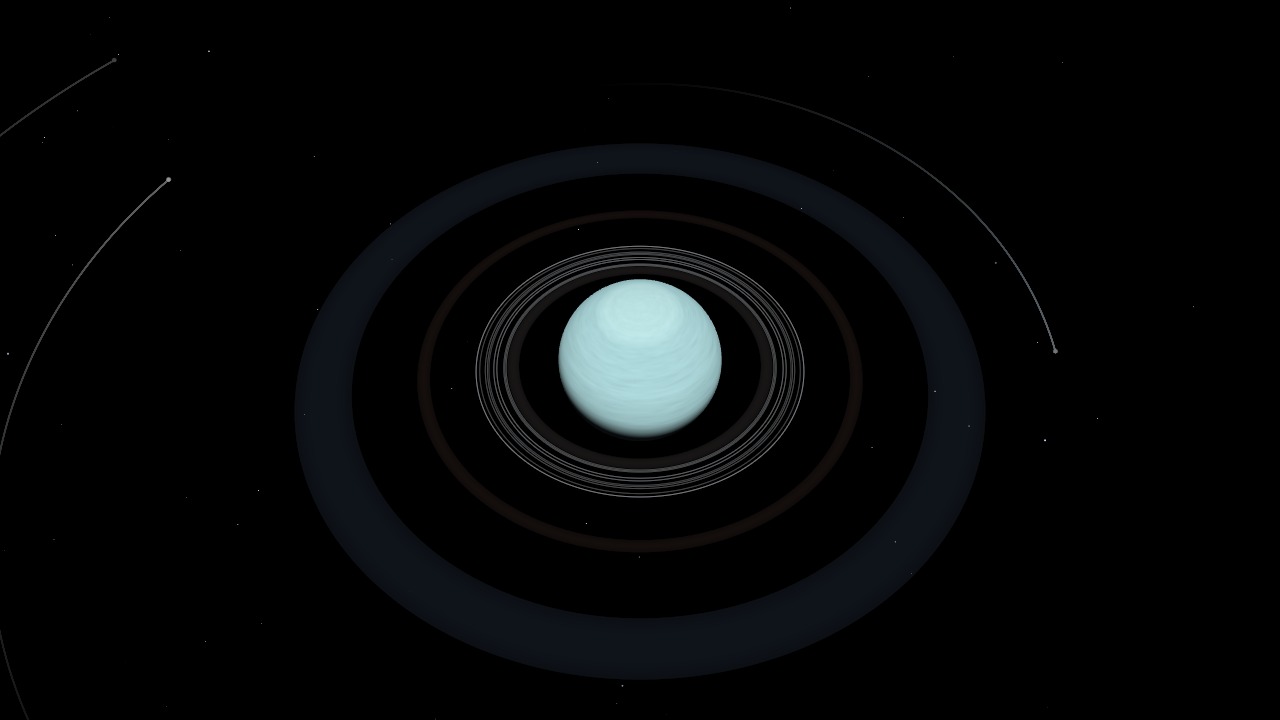
Uranus in 3D
This is an interactive 3D model of Uranus with its 13 rings and its five major moons: Miranda, Ariel, Umbriel, Titania and Oberon. The rings are drawn at their real radii, from the dusty zeta ring 39,600 km from the planet’s centre to the faint mu ring at 97,700 km, and you can click each one. The moons sit where they really are on the date you choose, so you can watch them circle the planet, cast shadows on its clouds and slip into its shadow. Uranus is tipped on its side, and the model shows which pole faces the Sun on any date. The Uranus cloud map is an artistic reconstruction: Uranus looks almost featureless in visible light, so the model shows it as a smooth pale blue-green globe with a brighter cap over the sunlit pole. The 3D space models page has the Moon, Mars, Venus, Mercury, Jupiter and Saturn.
How to use the Uranus model
- Move: drag to rotate, scroll or pinch to zoom. Zoom in on the rings to see them separate, or pull back to see the orbits of all five moons.
- Click a ring: the camera flies to it and shows its radius, width, who found it and when.
- Rings panel: lists all 13 rings from the innermost to the outermost. Click a name to highlight that ring.
- Click a moon: the camera flies to it and shows its size, its distance from Uranus, its orbit time and its surface.
- Moons panel: lists the five moons with their distance from Uranus right now. System view shows all five orbits. View from Earth shows Uranus the way a telescope does today, with the rings and orbits seen almost face-on like a bullseye.
- Time: move the clock forward or back to watch the moons go around. Miranda circles Uranus in 34 hours, so an hour or two makes a visible difference.
- Uranus card and seasons: click the planet to see the latitude the Sun is overhead now, the season, and the dates of the next solstice and equinox.
- Layers: toggle the rings, ring names, moons, orbit trails, latitude grid and day and night.
- Search and share: type a ring or moon name to fly to it, or copy a link to the current view, including the date.
The rings of Uranus
Uranus has 13 known rings. Ten of them are narrow, dark bands only a few kilometres wide. The other three, zeta, nu and mu, are broad and made mostly of dust. They were discovered on 10 March 1977, by accident. Astronomers James Elliot, Edward Dunham and Douglas Mink flew NASA’s Kuiper Airborne Observatory to watch Uranus pass in front of a star, hoping to measure the planet’s atmosphere. The star dimmed briefly several times before Uranus reached it, and again in the same pattern after it passed. Something thin and dark was blocking the starlight on both sides of the planet. That first occultation revealed nine rings. Voyager 2 found the faint lambda ring and the broad zeta ring in 1986, and Hubble photographs taken in 2003 and 2005 revealed two more, the nu and mu rings, far outside the others.
The model’s ring brightness is exaggerated. The rings reflect only about 2 percent of the light that hits them, about as dark as charcoal, so in a real photograph they nearly vanish against space. The ring particles are probably ice darkened by radiation and carbon-rich compounds. The model draws every narrow ring as at least a thin line so you can find it.
| Ring | Radius from centre | Width | Type |
|---|---|---|---|
| Zeta (1986U2R) | 39,600 km (24,600 mi) | about 3,500 km | Dusty |
| 6 | 41,838 km (25,997 mi) | 1.5 km | Narrow |
| 5 | 42,234 km (26,243 mi) | 2.3 km | Narrow |
| 4 | 42,571 km (26,452 mi) | 2.3 km | Narrow |
| Alpha | 44,718 km (27,786 mi) | 8.5 km | Narrow |
| Beta | 45,661 km (28,372 mi) | 9.5 km | Narrow |
| Eta | 47,176 km (29,314 mi) | 1.6 km | Narrow |
| Gamma | 47,627 km (29,594 mi) | 2.2 km | Narrow |
| Delta | 48,300 km (30,012 mi) | 4.6 km | Narrow |
| Lambda | 50,024 km (31,083 mi) | 2.3 km | Narrow |
| Epsilon | 51,149 km (31,783 mi) | 20 to 96 km | Narrow |
| Nu | 67,300 km (41,818 mi) | about 3,800 km | Dusty |
| Mu | 97,700 km (60,708 mi) | about 17,000 km | Dusty |
The epsilon ring is the brightest and most massive. It lies 51,149 km from the planet’s centre, 2.0 Uranus radii out, and it is not a perfect circle: its width swings from about 20 km at its closest point to about 96 km at its farthest, and its distance from Uranus changes by roughly 800 km around the ring. The small moons Cordelia and Ophelia orbit just inside and just outside it. Their gravity keeps the ring’s particles from spreading out, which is why they are called shepherd moons. The other narrow rings have no known shepherds, and nobody has yet explained what holds rings only 2 km wide so sharp.
The two outer rings are different. The nu ring is red and the mu ring is blue. The mu ring is made of fine dust, and it is blue for the same reason as Saturn’s E ring: tiny grains scatter blue light. The mu ring sits along the orbit of the small moon Mab, and impacts on Mab are the likely source of its dust, the way Enceladus feeds Saturn’s E ring. The model brightens these dust rings when the Sun is behind them, as Voyager 2 saw after it passed the planet and looked back. Seen against the Sun, the narrow rings go dark and the dust glows. A comparison of all four giant planets’ rings is in Jovian planets and their rings.
The moons of Uranus
Uranus has 29 confirmed moons (as of October 2026). Five are large enough to be round and are called the major moons. Fourteen small inner moons orbit among the rings, and ten distant irregular moons are most likely captured objects. The newest, S/2025 U1, is about 10 km across and orbits between Ophelia and Bianca. It was found in February 2025 in images from the James Webb Space Telescope and announced in August 2025. It has no name yet.
William Herschel found Titania and Oberon in 1787, six years after he discovered Uranus on 13 March 1781. William Lassell found Ariel and Umbriel in 1851, and Gerard Kuiper found Miranda in 1948. Every Uranian moon is named for a character in Shakespeare or in Alexander Pope’s poem The Rape of the Lock. Titania and Oberon are the fairy queen and king of A Midsummer Night’s Dream, Miranda comes from The Tempest, and Ariel and Umbriel are sprites in Pope’s poem. All five orbit in the plane of Uranus’s equator, so the whole system is tipped on its side with the planet. Our guide to NASA missions to Uranus covers what Voyager 2 saw of them.
| Moon | Diameter | Distance from Uranus | One orbit takes | Found |
|---|---|---|---|---|
| Miranda | 472 km (293 mi) | 129,846 km (80,683 mi) | 1.41 days | 1948, Kuiper |
| Ariel | 1,158 km (719 mi) | 190,929 km (118,638 mi) | 2.52 days | 1851, Lassell |
| Umbriel | 1,169 km (727 mi) | 265,986 km (165,276 mi) | 4.14 days | 1851, Lassell |
| Titania | 1,578 km (980 mi) | 436,298 km (271,103 mi) | 8.71 days | 1787, Herschel |
| Oberon | 1,523 km (946 mi) | 583,511 km (362,577 mi) | 13.46 days | 1787, Herschel |
Miranda
Miranda is the smallest and innermost of the five, with a diameter of 472 km, about one seventh the width of our Moon. Its surface is a patchwork. Voyager 2 saw ancient cratered plains next to three oval regions called coronae, which are grooved and ridged and look younger. Cliffs run across it, including Verona Rupes, which Voyager images show is about 20 km tall, the tallest known cliff in the Solar System. No other small world looks so broken up. Miranda is also the fastest of the five. The model shows it making a full circuit of Uranus in 34 hours.
Ariel
Ariel is the brightest of the five moons and has the youngest-looking surface, with fewer craters than its neighbours and a network of deep canyons. Some canyons are hundreds of kilometres long, and smooth floors in them suggest that ice once flowed up from inside the moon and filled the valleys. Ariel is only slightly smaller than Umbriel, yet it looks nothing like it. See the full story in NASA missions to Ariel.
Umbriel
Umbriel is the darkest of the major moons. It reflects roughly half as much sunlight as Ariel. Its surface is old and heavily cratered, with almost no sign of the activity seen on Ariel. One feature stands out: a bright ring on the floor of a crater called Wunda, which shows up in Voyager images like a pale coin. Nobody knows what the material is. The moon has its own page in NASA missions to Umbriel.
Titania
Titania is the largest moon of Uranus, 1,578 km across, and the eighth largest moon in the Solar System. Its surface carries both craters and long canyons, including Messina Chasmata, a fault system about 1,500 km long. Titania is about 1.7 times as dense as water, so it is probably a mix of rock and ice. Check space missions to Titania for the history of how little we know about it.
Oberon
Oberon is the outermost of the five and the second largest, 1,523 km across. It is old and covered with big craters, and many have dark floors, which suggests dark material welled up from inside after impacts. Voyager 2 also saw a tall mountain on its limb, rising several kilometres above the surface. Oberon takes 13.5 days to orbit Uranus, the slowest of the five. The model shows it 22.8 Uranus radii from the planet, so use System view to fit it in the frame.
Why Uranus spins on its side
Uranus’s axis is tilted 97.77 degrees from the plane of its orbit. Earth is tilted 23.4 degrees. Uranus rolls around the Sun like a ball on its side, with the poles taking turns pointing nearly straight at the Sun. The usual explanation is a giant collision early in the Solar System’s history, when an object perhaps several times the mass of the Earth hit the young planet and knocked it over. The moons and rings formed in the disc of debris afterward, which is why they orbit in the same tilted plane. Other explanations exist and none is settled. Read more in Uranus rolls around the Sun on its side.
The tilt gives Uranus the most extreme seasons of any planet. One orbit takes 84 Earth years, so each pole gets about 42 years of continuous sunlight, then about 42 years of continuous night. At a solstice, the Sun stands nearly overhead at a pole, about 82 degrees from the equator. At an equinox the Sun is over the equator and every part of the planet has a day-night cycle of about 17 hours. The last equinox was in December 2007. The pole now in sunlight is the one the IAU calls north, and it is heading toward its summer solstice in 2030, when the Sun will stand over 82 degrees north. Open the Uranus card in the model to see the exact solstice and equinox dates for any year.
A common source of confusion is that Uranus has two north poles. By the IAU rule, the north pole is the one on the north side of the Solar System’s invariable plane, which is the same side as Earth’s north. By the right-hand rule, used for every other planet, the north pole is the one around which the planet turns counterclockwise. Uranus rotates in the opposite direction to most planets, which swaps the two. In 1986, when Voyager 2 flew by, the pole facing the Sun was the one the right-hand rule calls north and the IAU now calls south. Older books and the NASA Voyager reports describe it as the north pole. The model uses the IAU naming: north is the pole that is sunlit in 2026.
A day on Uranus lasts 17 hours 14 minutes 52 seconds. Voyager 2 measured 17 hours 14 minutes 24 seconds from radio signals in 1986. In 2025 a team led by Laurent Lamy tracked the planet’s auroras in Hubble images taken from 2011 to 2022 and measured the longer figure, which is accurate to a fraction of a second. It is 28 seconds longer than the Voyager value. The model uses the Hubble figure.
How big is Uranus
Uranus is 51,118 km (31,763 mi) across at the equator, which is four times the width of the Earth. Its radius is 25,559 km (15,882 mi). It is slightly flattened by its spin, and the radius from centre to pole is 24,973 km (15,518 mi). About 63 Earths would fit inside it, yet its mass is only 14.5 times that of Earth because it is made mostly of water, ammonia and methane ices around a small rocky core under a hydrogen and helium atmosphere. Its average density is 1.27 times that of water, much lower than Earth’s. The methane in the upper atmosphere absorbs red light and gives Uranus its blue-green colour.
Uranus orbits at an average of 2.87 billion km (1.78 billion mi) from the Sun, 19.2 times farther than Earth. Sunlight takes about 2 hours 40 minutes to arrive. At minus 224 degrees Celsius (49 K) in its upper atmosphere, Uranus has the coldest planetary atmosphere measured, colder than Neptune’s although Neptune is farther from the Sun. Our facts about Uranus, unique characteristics of Uranus and Uranus facts for kids go through the rest. See how it stacks up against home in Earth and Uranus: differences and similarities, work out your age with the Uranus age calculator or see what you would weigh with the weight on Uranus calculator.
Seeing Uranus yourself
Uranus shines at about magnitude 5.7, just inside the limit of the naked eye. Under a truly dark sky with no Moon, a sharp-eyed observer who knows exactly where to look can see it as a faint star, but it is easy to miss. William Herschel was not the first to see it; astronomers had logged it as a star many times before 1781. In 2026 Uranus is in Taurus, and it is at opposition, closest to Earth and up all night, in November. A star chart app or the model’s View from Earth helps you find the right patch of sky. Here is what to expect with each kind of instrument:
- Binoculars (10×50): a blue-green star-like point that does not twinkle as much as the stars around it. Compare it with a chart to confirm which point it is, because it looks like any other star.
- 60 to 90 mm telescope at 100x: a tiny, round, pale blue-green disc about 3.7 arcseconds wide. That is the first sign it is a planet and not a star. No belts or bands are visible.
- 150 to 200 mm telescope: the same small, even disc, but with a stronger colour. On a steady night you may notice slight darkening at the edge. Titania and Oberon, at about magnitude 14, show up as faint specks beside the planet in 200 mm and larger telescopes under dark skies.
- 250 mm and larger: Ariel and Umbriel can be glimpsed on a steady night, though they sit close to the planet’s glare. Miranda, near magnitude 16, is a target for 300 mm and bigger with an occulting bar or very good seeing.
The rings of Uranus cannot be seen in any amateur telescope. They are too dark and too narrow. Only Voyager 2, Hubble, Keck and Webb have imaged them. If you want to see Uranus, a telescope with 100 mm or more of aperture, a steady mount and a decent 8 to 10 mm eyepiece gives a clear disc, and a Go-To mount makes finding it easy. To pick a telescope that shows it, use the telescope finder or read our guide to the best telescopes for viewing planets.
Missions to Uranus
Voyager 2 is the only spacecraft that has visited Uranus. It passed within about 81,500 km of the cloud tops on 24 January 1986, discovered 10 new moons and two rings, measured the magnetic field and photographed the five major moons. Almost everything we know about Miranda, Ariel, Umbriel, Titania and Oberon comes from that single flyby, which imaged mainly the hemisphere facing the Sun at the time, which was the southern one. Since then, Hubble, Keck and the James Webb Space Telescope have watched the planet, its auroras, its rings and its storms. The story of the probe is in mysteries of the Voyager probes.
The U.S. planetary science Decadal Survey for 2023 to 2032 ranked the Uranus Orbiter and Probe as the highest priority for a new flagship mission. The concept is a spacecraft that goes into orbit around Uranus and drops a probe into its atmosphere. The survey estimated the cost at $4.2 billion and recommended a launch in 2031 or 2032, with a Jupiter gravity assist and a cruise of about 13 years. Arrival would be in the 2040s. At the time of writing the mission is a recommendation. NASA has not built it, and its launch date depends on future budgets. Every mission flown or planned is in NASA missions to Uranus.
Questions people ask
Is there an interactive 3D model of Uranus?
Yes. This page is an interactive 3D model of Uranus with all 13 of its rings drawn at their real radii and its five major moons, Miranda, Ariel, Umbriel, Titania and Oberon, at their real positions for any date you choose. You can click a ring or a moon to fly to it and see the planet's sideways tilt and current season.
How many rings does Uranus have?
Uranus has 13 known rings. Ten are narrow, dark bands only a few kilometres wide, including the bright epsilon ring 51,149 km from the planet's centre. Three are broad and dusty: zeta, nu and mu. Elliot, Dunham and Mink discovered the first nine on 10 March 1977 when the rings blocked the light of a star behind Uranus.
How many moons does Uranus have?
Uranus has 29 confirmed moons as of October 2026. Five are large and round: Miranda, Ariel, Umbriel, Titania and Oberon. The newest, S/2025 U1, is about 10 km across and was found with the James Webb Space Telescope in 2025. It has no name yet.
Why is Uranus tilted on its side?
Uranus's axis is tilted 97.77 degrees from its orbit. The leading explanation is a giant impact early in the Solar System's history that knocked the planet over. As a result each pole gets about 42 years of sunlight followed by 42 years of darkness during the planet's 84-year orbit.
Which is the largest moon of Uranus?
Titania. It is 1,578 km (980 mi) across, a little larger than Oberon at 1,523 km. William Herschel discovered both in 1787. Titania is the eighth largest moon in the Solar System.
Can you see Uranus without a telescope?
Barely. Uranus shines at about magnitude 5.7, so under a very dark sky with no Moon a sharp-eyed observer can see it as a faint star if they know where to look. Binoculars show it as a blue-green point, and a small telescope at about 100 times magnification shows a tiny pale disc. Its moons need telescopes of 200 mm or larger, and its rings cannot be seen from a backyard.
What colour is Uranus and why?
Uranus is pale blue-green. Methane in its upper atmosphere absorbs red light and lets blue and green light reflect back out. In ordinary visible light the planet looks almost featureless, with only faint bands and a slightly brighter cap over the pole that faces the Sun.
Has any spacecraft visited Uranus?
Only Voyager 2, which flew past on 24 January 1986 at about 81,500 km from the cloud tops. It discovered 10 moons and two rings and photographed the five major moons. NASA's Decadal Survey ranked a Uranus orbiter and atmospheric probe as its top priority for a new flagship mission, but no such spacecraft has been built.
Where the data comes from
- Uranus’s clouds: an artistic map based on published colour and brightness observations, including the 2024 true-colour study by Irwin and colleagues and Hubble images of the brighter north polar cap. The planet is nearly featureless in visible light.
- Moon surfaces: Voyager 2 mosaics of Miranda, Ariel, Umbriel, Titania and Oberon from the USGS Astrogeology Science Center. Voyager imaged mainly the southern hemispheres, so the unseen areas are filled in with a neutral tone.
- Rings: radii and widths from the PDS Ring-Moon Systems Node, with discovery details from Elliot, Dunham and Mink (1977) and Showalter and Lissauer (2006). The brightness of the rings is exaggerated.
- Moon facts: NASA JPL Solar System Dynamics satellite physical parameters and mean orbital elements.
- Planet facts and moon names: NASA JPL Solar System Dynamics and the IAU. The 2025 day length is from Lamy and others in Nature Astronomy.
- Positions, lighting, seasons and rotation: calculated from the VSOP87 planetary theory and the IAU rotation model for Uranus, and checked against JPL Horizons.
Data verified 2026-10-16. The same kind of model exists for Jupiter, Saturn, the Moon, Mars, Venus and Mercury.