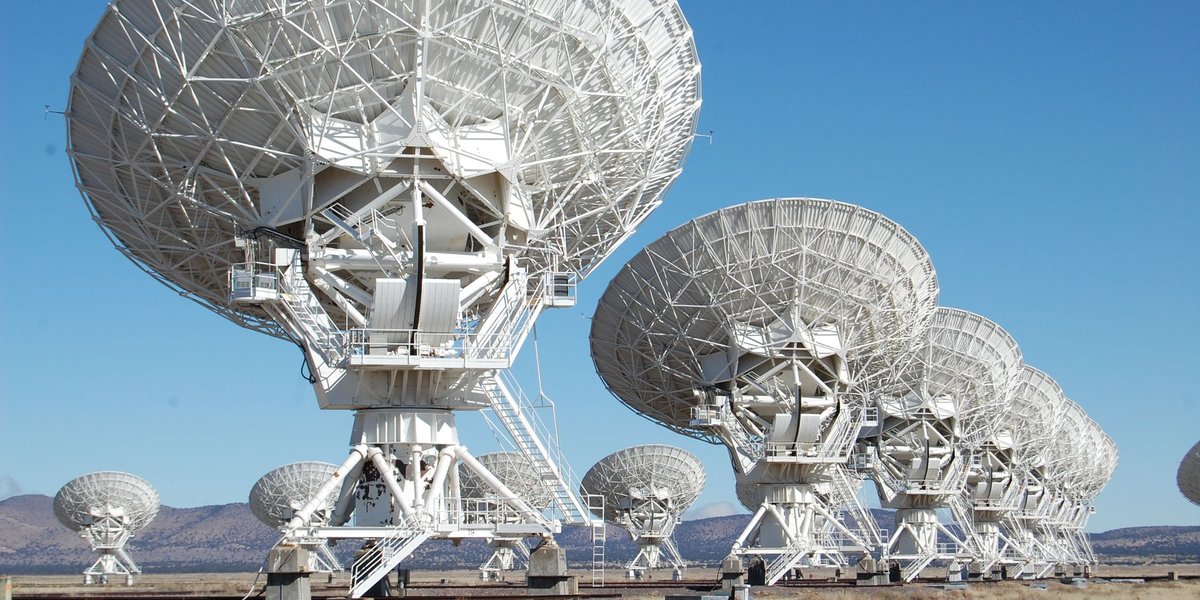
For years, Australia’s Parkes radio telescope kept catching mysterious bursts of radio noise. Astronomers called them perytons and wrote papers about them. In 2015 the culprit turned out to be a microwave oven in the staff kitchen, and the bursts only appeared when someone opened the door before the timer ran out.
Tucked inside that embarrassment was a real signal. The microwave was fake. The fast radio bursts were not, and they remain one of the best open puzzles in astronomy.
Table of contents
- TLDR
- What fast radio bursts are
- Quick facts
- Mystery 1: What produces them?
- Mystery 2: Why do some repeat and most don’t?
- Mystery 3: Why do some bursts keep a calendar?
- Mystery 4: Why do they turn up in old galaxies?
- What we know vs. what we don’t
- Are fast radio bursts aliens?
- The bursts are also a tool
TLDR
Fast radio bursts (FRBs) are flashes of radio waves that last about a millisecond and come from other galaxies. Thousands have been detected. At least some are produced by magnetars, which are neutron stars with extreme magnetic fields, but that can’t explain every burst. Nobody knows why some sources repeat and others appear once, and there’s no evidence they’re aliens.
What fast radio bursts are
An FRB is a very short, very bright pulse of radio energy. Most last a few milliseconds. The first one on record, the Lorimer burst, sat in Parkes data from 2001 until an undergraduate, David Narkevic, spotted it while rechecking the archive. The team published it in Science in 2007.
The burst’s distance came from an effect called dispersion. Radio waves travel through free electrons in space, and the lower frequencies arrive slightly later than the higher ones. The more gas the signal crosses, the bigger the delay. The Lorimer burst had a delay far too large for anything in our galaxy, even though the telescope was pointed near the Small Magellanic Cloud. The signal had crossed intergalactic space, a distance of well over a billion light-years.
That’s what made it hard to believe. Perytons had taught everyone to distrust short radio pulses, and the history of strange radio signals from space is full of false alarms. It took further bursts, found at Parkes in 2013, to convince astronomers that the signal was cosmic.
Quick facts
- Duration: about a millisecond, sometimes less
- Distance: from a few million to roughly 8 billion light-years
- Detected so far: thousands, mostly by the CHIME telescope in Canada
- Rate: estimates put it at thousands per day across the whole sky
- First found: 2007 (Lorimer burst, recorded in 2001 data)
- First repeater: FRB 121102, reported in 2016
- First FRB-like burst inside the Milky Way: April 2020, from magnetar SGR 1935+2154
Mystery 1: What produces them?
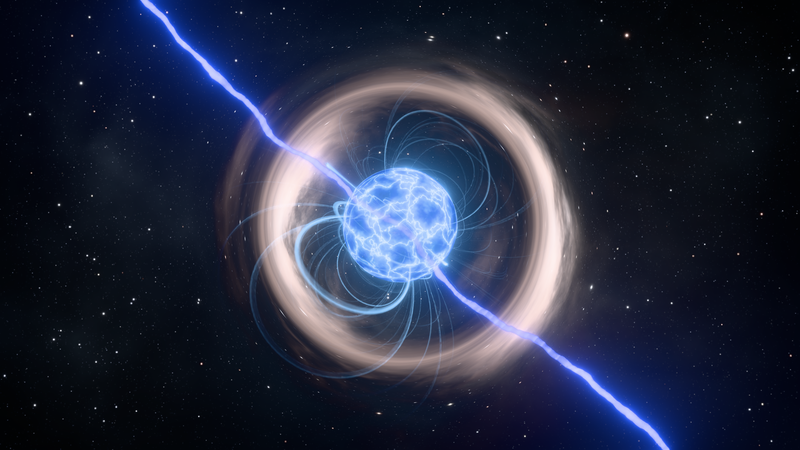
The leading answer is a magnetar. These are neutron stars, the collapsed cores of massive stars, with magnetic fields hundreds of trillions of times stronger than Earth’s. They flare, crack and release energy in violent bursts. The magnetar hypothesis has an actual observation behind it.
On April 28, 2020, a magnetar in our own galaxy called SGR 1935+2154 fired off a radio burst. Both the CHIME telescope and a small US experiment called STARE2 detected it, and X-ray satellites saw a flare at the same moment. The CHIME team’s Nature paper described a pulse brighter than any radio flash seen from a magnetar before. It was still weaker than a typical extragalactic FRB.
That gap is where the argument lives. One magnetar can produce a burst that looks like an FRB. Whether all FRBs come from magnetars, or whether the most energetic ones need something else, is unresolved. Competing ideas include young pulsars with giant pulses, neutron stars in binary systems, and collisions between compact objects.
Mystery 2: Why do some repeat and most don’t?
In 2012 the Arecibo telescope caught a burst that astronomers later named FRB 121102. In 2016 it fired again, and again. It was the first repeating fast radio burst, and it ruled out any model where the source is destroyed in the explosion.
Astronomers pinned it to a dwarf galaxy about 3 billion light-years away. Since then, China’s FAST telescope recorded 1,863 bursts from another repeater, FRB 20201124A, in just 82 hours of observing.
Yet most FRBs have been seen once. Are they a different kind of object? CHIME’s data hints that they might be. Repeaters tend to produce longer pulses that occupy a narrower slice of the radio spectrum, while one-off bursts are shorter and broader. That points to two physical processes, or at least two different environments.
The simpler alternative is that every FRB source repeats and we just haven’t waited long enough. A source with long quiet spells would look like a one-off. We can’t rule that out yet, and it matters, because it decides whether there are two populations or one.
Mystery 3: Why do some bursts keep a calendar?
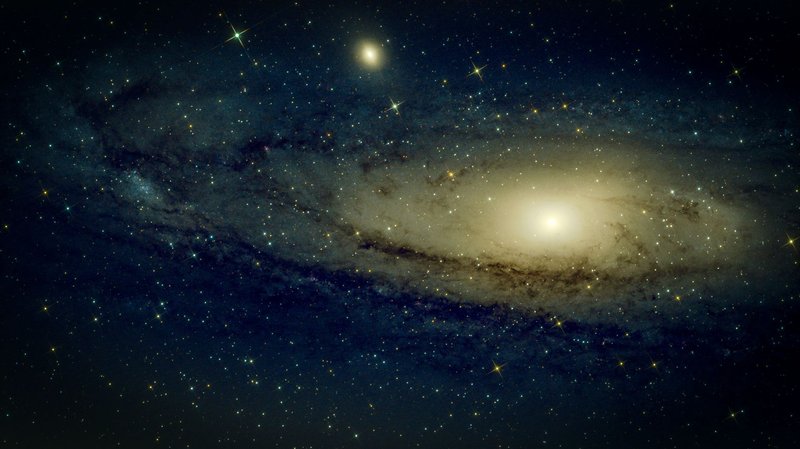
In 2020, CHIME reported that FRB 20180916B delivers bursts in a regular cycle of 16.35 days: about four days of activity, then about twelve of silence. It lives in the arm of a spiral galaxy roughly 500 million light-years away. A little later, researchers found that FRB 121102 follows a slower cycle of about 157 days. The CHIME periodicity paper was one of the strongest clues that at least some FRB sources sit in orbit around something.
A regular beat suggests geometry. A star might orbit a companion, with its wind periodically blocking the signal. A neutron star might precess like a wobbling top, sweeping its beam across us every few weeks. Neither model fits every source, and several repeaters show no clear period at all.
Mystery 4: Why do they turn up in old galaxies?
Magnetars are young. They form in supernovae and fade within thousands of years. So the magnetar theory predicts FRBs in galaxies busy making massive stars.
The localizations haven’t cooperated. In 2021 astronomers traced a repeater, FRB 20200120E, to a globular cluster around the galaxy M81, about 12 million light-years away. Globular clusters hold stars billions of years old, with almost no new massive stars forming. In 2025, another repeater was placed in an elliptical galaxy that has nearly stopped forming stars.
If magnetars made these, they did it through a route that doesn’t need a fresh supernova. One idea is that two white dwarfs or neutron stars merged, or that a white dwarf collapsed, leaving a magnetar in an old population. That would explain the old hosts, but it remains a proposal, not a measurement.
What we know vs. what we don’t
| Question | What we know | What we don’t |
|---|---|---|
| Where do they come from? | Other galaxies, confirmed by dispersion and localization | Whether every host type produces the same kind of burst |
| What powers them? | At least one magnetar in the Milky Way has produced an FRB-like burst | Whether magnetars explain the brightest bursts |
| Do they repeat? | Some repeat, with hundreds of bursts in some cases | Whether one-off sources are really repeaters in disguise |
| Is there a pattern? | Two sources show cycles of about 16 and 157 days | What causes the cycles, and why most sources show none |
| What kind of galaxy hosts them? | Star-forming spirals, dwarf galaxies, and old systems | How old galaxies make the source objects |
Are fast radio bursts aliens?
No evidence points that way. A few researchers have floated the idea of a technology-powered beam, mostly as a thought experiment. But one FRB-like burst has been traced to a known magnetar, and other bursts come with surrounding gas and magnetic fields that astronomers can measure. Natural physics is explaining more of them each year. Any claim of a message has to beat that simpler account, and none has.
The bursts are also a tool
The mystery of what FRBs are has a practical payoff. Because dispersion measures how much gas a burst passed through, FRBs act as scales for the invisible matter between galaxies. In a 2020 Nature study, astronomers used localized bursts to account for the universe’s “missing” ordinary matter, a gas too thin and too hot to see directly. The result matched cosmological predictions.
That’s the kind of work the next generation of telescopes is built for. CHIME and its outriggers can now fix a burst’s position to a precise patch of sky, and each new localization puts a face on a source that used to be a dot of noise.
The microwave oven was a false alarm. The mysteries of fast radio bursts are not, and they still have no complete explanation.