
Updated November 2026 by Elena Stone
Telescope magnification is the telescope’s focal length divided by the eyepiece’s focal length. A 650 mm telescope with a 25 mm eyepiece magnifies 650 / 25 = 26×. Swap in a 10 mm eyepiece and it magnifies 65×. Add a 2× Barlow lens and the 10 mm eyepiece gives 130×.
Pick your telescope below, add the eyepieces you own and set your Barlow if you have one. The calculator gives the magnification of every eyepiece, the exit pupil, the true field of view and the range of power your aperture can use. It marks each eyepiece on a power ladder, shows Jupiter, Saturn and the Moon at that magnification, and names the focal lengths missing from your kit.
Loading eyepieces…
Your eye, the air and the focuser
25 mm eyepiece, 52°
A 650 mm telescope with a 25 mm eyepiece magnifies 26×. This 130 mm telescope's useful range runs from 22× to 260×.
Exit pupil 5.0 mm: richest field: large nebulae, star fields, big clusters
Power ladder
Every eyepiece on one scale. Tap a marker to make it the active eyepiece.
Drawing the ladder…
Each marker is one eyepiece. The hatched zone is more power than tonight’s air allows.
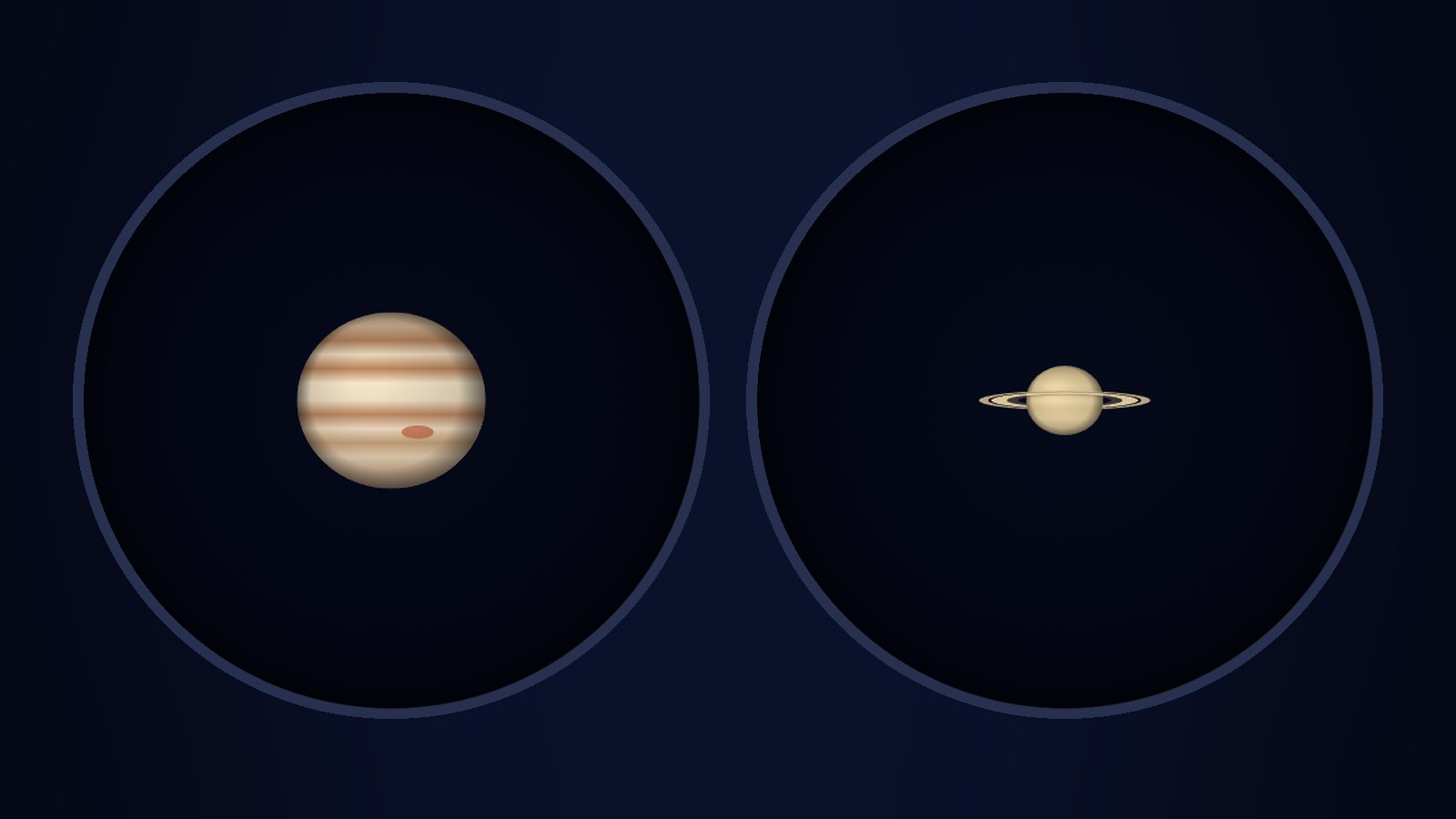
What it looks like at this power
Drawn to scale inside the eyepiece's apparent field.
Drawn to scale: the circle is your eyepiece's apparent field. The Moon is a full disc from NASA imagery; planet detail is typical, not tonight's.
Your eyepieces
| Eyepiece | Power | Exit pupil | True field |
|---|---|---|---|
| 25 mm52° apparent field | 26× | 5.0 mm | 2.0° |
| Richest field: large nebulae, star fields, big clusters | |||
| 10 mm52° apparent field | 65× | 2.0 mm | 0.8° |
| Deep sky: galaxies, clusters, the whole Moon | |||
What is missing from your kit
Checking your kit…
As an Amazon Associate this site earns from qualifying purchases. The links search Amazon for that focal length; the choice of brand is yours.
Work backwards
Type a power to get the eyepiece you need.
Type an exit pupil to get the eyepiece you need.
How to use the telescope magnification calculator
- Choose your telescope from the list, or pick Custom and enter the aperture and focal length. Both are printed on the tube or in the manual, usually as “D = 130 mm, F = 650 mm” or “130/650”. Inches work too.
- Add your eyepieces. The number printed on the barrel is the focal length in millimeters. Most telescopes ship with a 25 mm and a 10 mm, and the calculator loads the stock pair when you choose a telescope.
- Set the Barlow or reducer if you use one. A 2× Barlow doubles every magnification. A 0.63× focal reducer on a Schmidt-Cassegrain cuts it by a third.
- Read the verdict. Each eyepiece gets a label for what it shows best, based on its exit pupil, and a warning if it pushes past the useful limit of your aperture or of tonight’s air.
The Advanced panel sets your age band (the pupil of the eye shrinks with age, which raises the lowest useful magnification), the seeing and the focuser size. Print cheat sheet gives a one-page table of your kit to keep in the eyepiece case. The link icon copies a URL that reopens the calculator with your telescope and eyepieces, and the field of view calculator opens with the same setup.

Telescope magnification formula
The formula has one division:
Magnification = telescope focal length / eyepiece focal length
Both focal lengths must be in the same unit. The result has no unit, only a “×”. With a Barlow lens or a focal reducer in the light path, multiply the telescope’s focal length by the Barlow factor first:
Magnification = (telescope focal length × Barlow factor) / eyepiece focal length
| Telescope | Eyepiece | Barlow | Calculation | Magnification |
|---|---|---|---|---|
| 130 mm reflector, 650 mm focal length | 25 mm | none | 650 / 25 | 26× |
| 130 mm reflector, 650 mm | 10 mm | none | 650 / 10 | 65× |
| 130 mm reflector, 650 mm | 10 mm | 2× | 650 × 2 / 10 | 130× |
| 8-inch Dobsonian, 1200 mm | 25 mm | none | 1200 / 25 | 48× |
| 8-inch Schmidt-Cassegrain, 2032 mm | 25 mm | 0.63× reducer | 2032 × 0.63 / 25 | 51× |
| 70 mm refractor, 700 mm | 4 mm | 3× | 700 × 3 / 4 | 525× |
The last row is the “525× power” printed on many beginner telescope boxes. The arithmetic is right. The image is not usable, for the reasons in the maximum magnification section below.
If you know the focal ratio instead of the focal length, multiply it by the aperture: an f/5 telescope with a 130 mm mirror has a focal length of 5 × 130 = 650 mm. You can find the focal length of most models in our guide to telescope focal length and in how to read telescope specs.
Telescope eyepiece magnification chart
The chart gives the magnification of six common eyepiece focal lengths in ten popular telescopes, with each telescope’s useful range. Values are rounded to the nearest whole number. Find your telescope’s row, or use the calculator for any other combination.
| Telescope | 32 mm | 25 mm | 20 mm | 15 mm | 10 mm | 6 mm | Minimum | Max useful |
|---|---|---|---|---|---|---|---|---|
| Celestron Travel Scope 7070 mm f/5.7, 400 mm | 13× | 16× | 20× | 27× | 40× | 67× | 12× | 140× |
| Celestron Travel Scope 8080 mm f/5, 400 mm | 13× | 16× | 20× | 27× | 40× | 67× | 13× | 160× |
| Celestron Inspire 100AZ100 mm f/6.6, 660 mm | 21× | 26× | 33× | 44× | 66× | 110× | 17× | 200× |
| Celestron StarSense Explorer 114 Tabletop114 mm f/3.9, 450 mm | 14× | 18× | 23× | 30× | 45× | 75× | 19× | 228× |
| Celestron StarSense Explorer 130 Tabletop130 mm f/5, 650 mm | 20× | 26× | 33× | 43× | 65× | 108× | 22× | 260× |
| Celestron StarSense Explorer 150 Tabletop150 mm f/5, 750 mm | 23× | 30× | 38× | 50× | 75× | 125× | 25× | 300× |
| Celestron StarSense Explorer 8" Dobsonian203 mm f/5.9, 1200 mm | 38× | 48× | 60× | 80× | 120× | 200× | 34× | 406× |
| Sky-Watcher Classic 200P Dobsonian203 mm f/5.9, 1200 mm | 38× | 48× | 60× | 80× | 120× | 200× | 34× | 406× |
| Sky-Watcher Classic 250P Dobsonian254 mm f/4.7, 1200 mm | 38× | 48× | 60× | 80× | 120× | 200× | 42× | 508× |
| Sky-Watcher Flextube 300P Dobsonian305 mm f/4.9, 1500 mm | 47× | 60× | 75× | 100× | 150× | 250× | 51× | 610× |
Magnification = telescope focal length / eyepiece focal length. Struck-through figures are above the maximum useful power (2× the aperture in mm); italic figures give an exit pupil wider than a 6 mm pupil can use.
Two patterns stand out. A long focal length telescope, such as a Maksutov or a Schmidt-Cassegrain, gets high power from ordinary eyepieces and struggles to go low. A short focal length telescope, such as a tabletop reflector or a short refractor, gives wide low-power views and needs short eyepieces or a Barlow for the planets.
Maximum useful magnification
The maximum useful magnification of a telescope is about 2× per millimeter of aperture, or 50× per inch. A 130 mm telescope tops out near 260×. An 8-inch (203 mm) telescope tops out near 400×. A 70 mm refractor tops out near 140×.
Past that point the image gets bigger without getting sharper. Aperture sets how much detail the telescope collects (the telescope resolution calculator gives the figure in arcseconds), and magnification only spreads that detail over a larger angle. At 2× per millimeter the finest detail is already large enough for the eye to see. More power makes it dimmer and softer.
The air sets a second, lower limit on most nights. Turbulence in the atmosphere, called seeing, blurs everything to 2 or 3 arcseconds on an average night. Under those conditions most telescopes give their best views between 150× and 250×, whatever their size. Steady nights allow 300× and more. The calculator shows both limits and marks the zone above the seeing limit on the power ladder.
That is why a 70 mm telescope sold as “525×” disappoints. Its useful maximum is 140×. At 525× Jupiter is a large, dim, grey smudge that drifts out of the field in a few seconds. The 4 mm eyepiece and the 3× Barlow that produce that number are the parts of the kit to replace first.
Minimum magnification and exit pupil
The exit pupil is the width of the beam of light that leaves the eyepiece. It equals the aperture divided by the magnification, or the eyepiece focal length divided by the focal ratio:
Exit pupil (mm) = aperture / magnification = eyepiece focal length / focal ratio
A 130 mm telescope at 65× has an exit pupil of 130 / 65 = 2 mm. The exit pupil predicts how bright and how sharp the view will look better than the magnification does, and it works the same way in every telescope:
| Exit pupil | Best for |
|---|---|
| 5 to 7 mm | Lowest power: large nebulae, the Milky Way, big star clusters. Brightest view, widest field. |
| 2 to 4 mm | Galaxies, most clusters, the whole Moon |
| 1 to 2 mm | Moon detail, globular clusters, planetary nebulae |
| 0.5 to 1 mm | Jupiter, Saturn, Mars, close double stars |
| Under 0.5 mm | Double stars on very steady nights. Dim, and floaters in the eye become visible. |
The minimum useful magnification is the power that makes the exit pupil as wide as your dark-adapted eye pupil: aperture / 7 for a young eye, aperture / 5 for most people over 50. Below it, part of the light misses your pupil. In a reflector or a Schmidt-Cassegrain the shadow of the secondary mirror can also show as a dark spot in the middle of the field. For a 130 mm telescope the minimum is about 19× for a 7 mm pupil and 26× for a 5 mm pupil.
What magnification do you need for planets, the Moon and deep sky?
Each type of target has a power range where it looks best. The table gives the range, the exit pupil it corresponds to and the eyepiece that delivers it in two common telescopes: a 130 mm f/5 reflector and an 8-inch f/6 Dobsonian.
| Target | Exit pupil | 130 mm f/5 reflector (650 mm) | 8-inch Dobsonian (1200 mm) |
|---|---|---|---|
| The whole MoonNeeds a true field of about 0.6 degrees or more. | 2.5–5.0 mm | 26–52×12.5–25 mm eyepiece | 41–81×14.8–29.6 mm eyepiece |
| Moon detail: craters, rillesRaise the power until the seeing softens the shadows. | 0.7–1.5 mm | 87–186×3.5–7.5 mm eyepiece | 135–290×4.1–8.9 mm eyepiece |
| JupiterBelts and the four large moons show from about 100x. | 0.5–1.0 mm | 130–260×2.5–5 mm eyepiece | 203–406×3–5.9 mm eyepiece |
| SaturnRings from 50x, the Cassini Division from about 150x on a steady night. | 0.5–0.9 mm | 144–260×2.5–4.5 mm eyepiece | 226–406×3–5.3 mm eyepiece |
| Mars at oppositionThe disc stays under 25 arcseconds: it takes the highest power the air allows. | 0.35–0.6 mm | 217–260×2.5–3 mm eyepiece | 338–406×3–3.5 mm eyepiece |
| VenusBright and low-contrast: extra power only magnifies the glare. | 1.0–2.0 mm | 65–130×5–10 mm eyepiece | 102–203×5.9–11.8 mm eyepiece |
| Double starsWide pairs need little; tight pairs need the air to cooperate. | 0.4–1.0 mm | 130–260×2.5–5 mm eyepiece | 203–406×3–5.9 mm eyepiece |
| Large clusters and the PleiadesNeeds a true field of 1.5 degrees or more. | 3.0–6.0 mm | 22–43×15–30 mm eyepiece | 34–68×17.7–35.5 mm eyepiece |
| GalaxiesLow power keeps the surface brightness up; M31 wants a wide field. | 1.5–4.0 mm | 33–87×7.5–20 mm eyepiece | 51–135×8.9–23.6 mm eyepiece |
| Globular clustersHigher power resolves the outer stars. | 0.8–1.5 mm | 87–163×4–7.5 mm eyepiece | 135–254×4.7–8.9 mm eyepiece |
| Planetary nebulaeSmall and bright: they take more power than other nebulae. | 0.7–1.5 mm | 87–186×3.5–7.5 mm eyepiece | 135–290×4.1–8.9 mm eyepiece |
| Star fields and the Milky WayThe widest field and the biggest exit pupil you have. | 4.0–6.0 mm | 22–33×20–30 mm eyepiece | 34–51×23.6–35.5 mm eyepiece |
Powers are capped at 2× the aperture in mm and floored at the minimum useful power for a 6 mm pupil. On an average night the air stops you near 200×.
Start every target at low power, center it, then step up one eyepiece at a time. Stop when the image stops gaining detail. On the planets that point changes from night to night with the seeing, so it pays to own two or three eyepieces in the 0.5 to 1 mm exit pupil range rather than one very short one. Our picks for that range are in the best eyepieces for planets.
How a Barlow lens or focal reducer changes magnification
A Barlow lens sits between the telescope and the eyepiece and multiplies the focal length of the telescope. A 2× Barlow turns a 650 mm telescope into a 1300 mm one, so every eyepiece gives double the magnification, half the exit pupil and half the true field of view. A 25 mm and a 10 mm eyepiece with a 2× Barlow give four magnifications: 26×, 52×, 65× and 130× in a 650 mm telescope.
A Barlow does not raise the maximum useful magnification. That limit belongs to the aperture. It also works best with longer eyepieces: a 2× Barlow on a 12 mm eyepiece gives the same power as a 6 mm eyepiece with more eye relief, which is easier to look through. Plan the kit so the Barlowed powers fall between the plain ones instead of on top of them. Our Barlow lens buying guide covers which factor suits which kit.
A focal reducer does the opposite. The common 0.63× reducer for Schmidt-Cassegrain telescopes turns an f/10 telescope into f/6.3, lowering every magnification by 37% and widening the field by 59%. It is the only way to get a wide view of the Pleiades or the Andromeda Galaxy through an 8-inch SCT.
Which eyepieces do you need?
Three or four eyepieces cover almost everything if their exit pupils are spread across the range. A practical kit for any telescope:
- Low power, 4 to 6 mm exit pupil: for finding targets, star fields and large clusters. Usually the 25 mm or 32 mm eyepiece.
- Medium power, about 2 to 3 mm: for galaxies, most clusters and the whole Moon.
- High power, about 1 mm: for the Moon and planets on an average night.
- Highest power, 0.6 to 0.7 mm: for the planets and double stars on steady nights.
To turn an exit pupil into an eyepiece focal length, multiply it by the focal ratio. An f/5 telescope wants roughly 30 mm, 15 mm, 5 mm and 3.5 mm eyepieces. An f/10 telescope wants 40 mm, 25 mm, 10 mm and 7 mm. The gap finder in the calculator does this for your telescope and your eyepieces, including any Barlow, and names the focal lengths that would fill the holes. A zoom eyepiece covers the middle of the range in one barrel, and the best budget telescope eyepieces fill single gaps without spending much.
Frequently asked questions
How do you calculate the magnification of a telescope?
Divide the telescope's focal length by the eyepiece's focal length, both in millimeters. A telescope with a 1200 mm focal length and a 25 mm eyepiece magnifies 1200 / 25 = 48×. With a 2× Barlow lens, multiply the telescope's focal length by 2 first: 2400 / 25 = 96×.
What is the maximum magnification of a telescope?
The maximum useful magnification is about 2× per millimeter of aperture, or 50× per inch. A 130 mm telescope reaches about 260× and an 8-inch telescope about 400×. Atmospheric turbulence lowers the practical limit to 150× to 250× on most nights, whatever the telescope's size.
Is 525× magnification real on a small telescope?
The number is real arithmetic but not a usable view. A 70 mm telescope with a 700 mm focal length, a 4 mm eyepiece and a 3× Barlow gives 700 × 3 / 4 = 525×. Its useful maximum is 2 × 70 = 140×. At 525× the image is dim, blurred and hard to keep in the field.
What magnification do I need to see Saturn's rings?
Saturn's rings show as separate from the planet at about 25× to 30×. At 100× to 150× a 4-inch or larger telescope shows the gap between the planet and the rings clearly, and on a steady night the Cassini Division appears as a thin dark line in the rings.
What magnification is best for Jupiter?
Jupiter looks best between about 120× and 200× in most backyard telescopes, an exit pupil near 1 mm. The four Galilean moons show at 10×, the two main cloud belts at 40× to 50×, and the Great Red Spot and festoons at 120× and above on a steady night.
Does a Barlow lens double magnification?
Yes. A 2× Barlow doubles the magnification of every eyepiece used with it, and halves the exit pupil and the true field of view. It does not raise the telescope's maximum useful magnification, which is set by the aperture.
What is exit pupil and why does it matter?
Exit pupil is the width of the beam of light leaving the eyepiece: aperture divided by magnification. It predicts brightness and sharpness in any telescope. Around 5 to 7 mm suits wide deep-sky views, 2 to 3 mm galaxies and clusters, about 1 mm planets, and below 0.5 mm the view turns dim and soft.
What does the number on an eyepiece mean?
The number in millimeters is the eyepiece's focal length. A smaller number gives more magnification: in a 650 mm telescope a 25 mm eyepiece gives 26× and a 10 mm eyepiece gives 65×. Some eyepieces also list the apparent field in degrees, which sets how wide the view looks.
What is the lowest magnification I should use?
The lowest useful magnification is the aperture divided by the width of your dark-adapted pupil: about aperture / 7 for young eyes and aperture / 5 for most people over 50. For a 130 mm telescope that is 19× to 26×. Below it, part of the light misses your eye.
Is higher magnification better on a telescope?
No. Aperture decides how much detail a telescope shows. Magnification only makes the image larger. Most objects look best at moderate power: galaxies and clusters at 40× to 120×, the planets at 120× to 250×. Past the useful limit the view gets dimmer and blurrier.
More telescope calculators
- Telescope field of view calculator: how much sky each eyepiece shows, drawn to scale on real star fields, plus camera framing.
- Telescope resolution calculator: the finest detail your aperture can show, with the double stars and lunar craters it can split.
- Telescope view simulator: what the Moon, planets and deep-sky objects look like through a given telescope and eyepiece.
- Telescope finder: answer a few questions and get a telescope matched to what you want to see.
- How to increase the magnification of a telescope