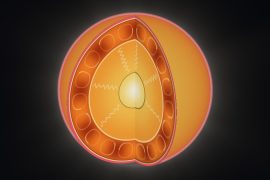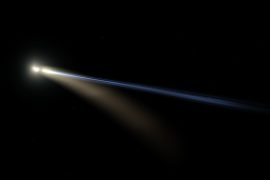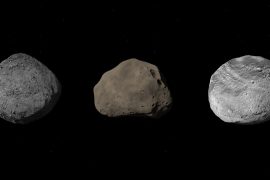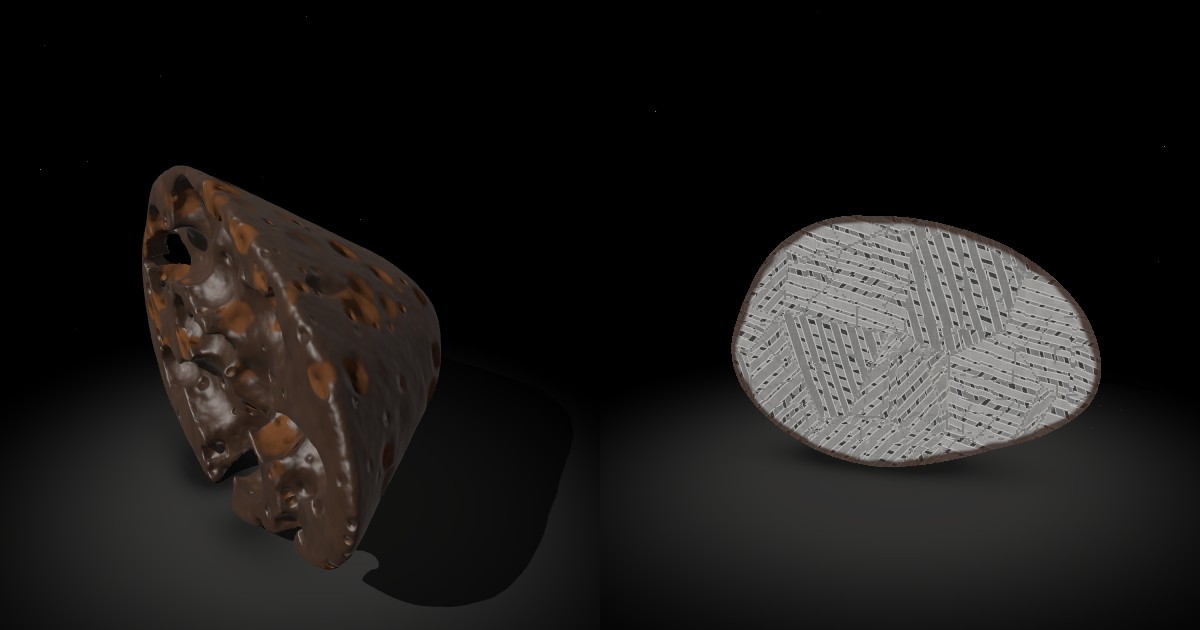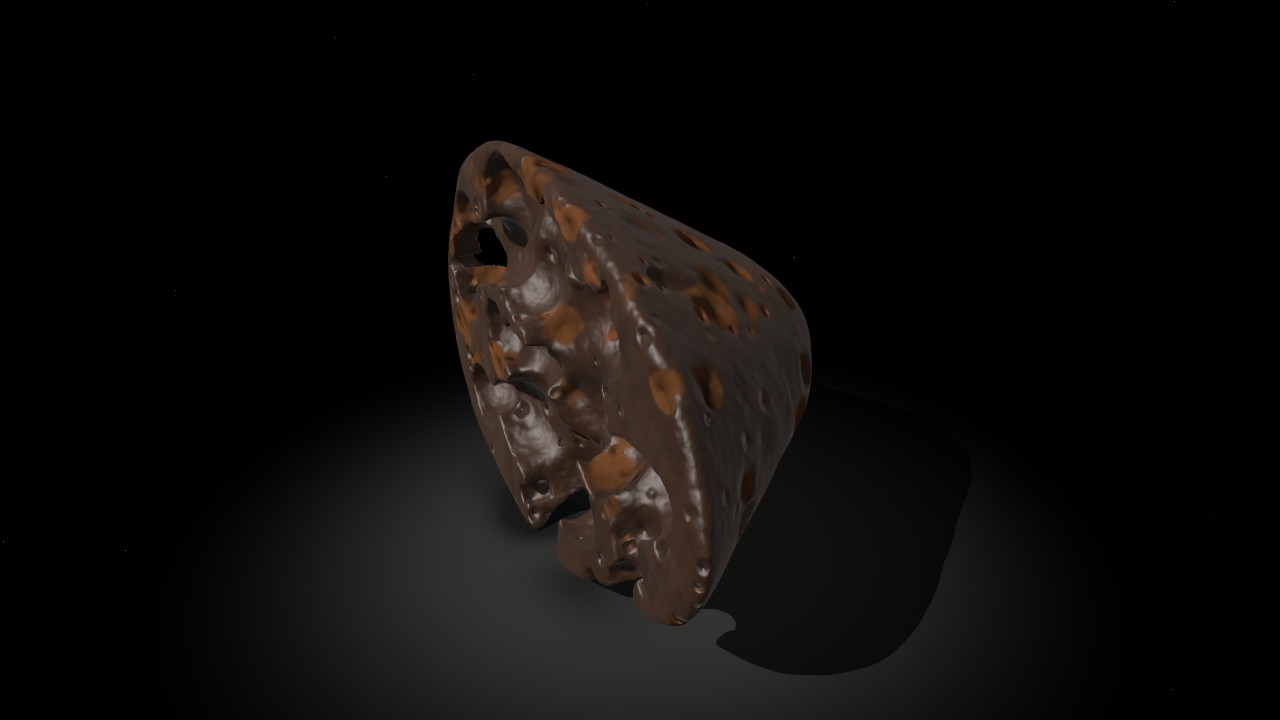
A meteorite is a piece of space rock that survives the fall and lands on Earth. The streak of light it makes on the way down is the meteor. The model above shows three real meteorites in 3D: Willamette, a 15.5-ton iron from Oregon; Hoba, a 60-tonne iron in Namibia and the largest known meteorite; and the main fragment of the Chelyabinsk meteorite, a stone raised from a Russian lake in 2013. Switch between them, press Cut open to see inside and use Size compare to stand a 1.75 m adult next to each one.
Each meteorite has its own section below. For more space rocks, see famous meteorites and space rocks that hit Earth. For small bodies that have not fallen, open the asteroid 3D model or the comet 3D model. All the models on this site are on the 3D space models page.
How do I use the meteorite 3D model?
- Pick a meteorite: the Willamette, Hoba and Chelyabinsk buttons switch the model. The strip along the bottom lists its class, mass, size, where it was found or fell, where it is now and what it is made of.
- Move: drag to rotate and scroll or pinch to zoom. On a phone, tap Explore first. Until you do, swiping scrolls the page.
- Cut open: slices the rock in half and shows the inside. Willamette shows a crystal pattern, Hoba shows plain metal and Chelyabinsk shows round grains, metal flecks and dark veins. The patterns are drawn enlarged so they are visible at this scale, and the model says by how much.
- Size compare: stands a 1.75 m (5 ft 9 in) adult figure next to the meteorite at true scale.
- Spin: a slow turntable, on or paused. Meteorites do not rotate on the ground. The turntable is there so you can see every side.
- Share: each meteorite has its own link, so you can send someone straight to Hoba.
There is no falling animation. A meteor is a streak of light, not an object, so a meteor 3D model has to show the rock behind it. The Chelyabinsk fragment is that rock, and the next section explains how it got from space to a lake bed.
Meteor vs meteorite: the difference between a meteoroid, a meteor and a meteorite
A meteoroid is a rock moving through space, a meteor is the light it makes in the atmosphere and a meteorite is whatever lands. NASA defines a meteoroid as a space rock ranging from a dust grain to a small asteroid. The International Astronomical Union capped the size in 2017 at 30 micrometers to 1 meter across. A larger body is an asteroid. Most of a meteoroid burns away: NASA says less than 5 percent of the original object usually makes it to the ground.
| Term | What it is | Chelyabinsk, 15 February 2013 |
|---|---|---|
| Meteoroid | A rock in space | An object about 18 to 20 m (60 to 66 ft) across and roughly 10,000 tonnes |
| Meteor | The streak of light as it burns in the air | A fireball that crossed the sky at about 19 km/s (68,000 km/h) and peaked in brightness over the Chelyabinsk region at about 09:20 local time |
| Meteorite | A piece that reaches the ground | Fragments scattered across the region, including the 570 kg main mass raised from Lake Chebarkul on 16 October 2013 |
The Chelyabinsk object also broke apart in the air. Its brightest point came at 23 to 30 km (14 to 19 mi) up, depending on the study, and it released the energy of about 440 to 500 kilotons of TNT. The shock wave broke windows across the city. Russian authorities counted 1,491 people who sought medical help, mostly for glass cuts, and more than 7,200 damaged buildings. Of the original 10,000 tonnes, only a few tonnes reached the ground, about 0.05 percent. See how meteors are formed for the physics of the glow, and meteor shower tonight for what you can see overhead now.
Willamette meteorite
The Willamette meteorite is a 15.5-ton iron meteorite found in Oregon in 1902. It is the largest meteorite found in the United States and long ranked as the sixth largest in the world, according to the American Museum of Natural History in New York, where it has been on display since 1906. It measures about 3 m (10 ft) long, 2 m (6.5 ft) high and 1.3 m (4.25 ft) deep. The AMNH ton is a short ton, so the mass in metric units is about 14.1 tonnes (14,150 kg).
Ellis Hughes found it on land owned by the Oregon Iron and Steel Company near Oregon City. Hughes moved it about 1,200 m (3/4 mi) to his own property over roughly 90 days, and the Oregon Supreme Court later ruled that the company was its owner. In 1905 Sarah Tappan Hoadley bought it and donated it to the museum. Long before that, the Clackamas Chinook knew it as Tomanowos, which means spirit power. Water that collected in its hollows was used in ceremonies. Under a 2000 agreement the museum keeps the meteorite on display, and the Confederated Tribes of the Grand Ronde hold an annual private ceremony there.
Why is the Willamette meteorite full of holes?
The holes are weathering pits that formed on the ground. AMNH explains that the smooth surface melted during the blazing entry through the air, while rainwater reacting with iron sulfide inside the rock made sulfuric acid that etched the large cavities over centuries after it landed. The model shows both: rounded, melted surfaces and deep pits.
What does the inside of the Willamette look like?
Willamette is a medium octahedrite, a class that normally shows a bold crystal pattern when sliced and etched. Its composition is more than 91 percent iron and 7.62 percent nickel. Press Cut open on Willamette and the model draws that pattern, enlarged. The real Willamette is a special case. AMNH reports that it once had a pattern like the one in the Owens Valley meteorite, but impacts between asteroids in space reheated the metal and it recrystallized, so only traces of the original pattern remain. The model shows the clean version a medium octahedrite is known for, not Willamette’s own damaged one. The section on the inside of a meteorite explains how the pattern forms.
Hoba meteorite
The Hoba meteorite is the largest known meteorite, an iron slab of about 60 tonnes that lies where it fell near Grootfontein in northern Namibia. It measures about 2.7 x 2.7 x 0.9 m (8.9 x 8.9 x 3 ft) and is about 84 percent iron and 16 percent nickel, with traces of cobalt. Farmer Jacobus Hermanus Brits hit it with his plow in 1920 and heard a loud metallic scrape. An early estimate put it at 66 tonnes. Erosion, sampling and vandalism have worn it down since, so the figure now quoted is more than 60 tonnes.
Hoba has never been moved. It is too heavy to shift, and it was declared a national monument on 15 March 1955. It has about four times the mass of the Willamette. Switch on Size compare and Hoba is 2.7 m on a side, wider than the figure is tall, and only 0.9 m thick, about half the figure’s height. Hoba fell less than 80,000 years ago and left no preserved crater. It is estimated to have slowed in the air to a few kilometers per second, and a slow strike excavates little.
What is an ataxite?
An ataxite is an iron meteorite with so much nickel that it shows no crystal pattern when etched. Hoba is a IVB ataxite. At 16 percent nickel it holds more than twice the nickel of the Willamette. None of the roughly 50 iron meteorites seen to fall is an ataxite, so the class is rare. Cut Hoba open in the model and you see plain, fine-grained metal with no bands. That is correct: its crystals are microscopic.
Chelyabinsk meteor and meteorite
The Chelyabinsk meteorite is an LL5 ordinary chondrite, a stone, from the fireball over Chelyabinsk, Russia, on 15 February 2013. The model shows its main mass, the largest piece, which divers raised from the bed of Lake Chebarkul on 16 October 2013. The piece weighed about 570 kg (1,257 lb) on the scale before it failed, and later estimates put it near 654 kg (1,442 lb). It broke into three parts during the lift. It had punched a hole in the lake ice on the day of the fall, and a magnetic survey found it in June 2013.
Ordinary chondrites are the most common meteorites, and Chelyabinsk was classified LL5, shock stage S4, weathering grade W0. LL is the low-iron, low-metal group of ordinary chondrites. It contains about 10 percent iron. S4 means strongly shocked, which fits the dark veins of melted rock inside it. W0 means no visible weathering. The surface is a black crust with shallow thumbprint dimples. Cut it open in the model and the inside is pale grey and crowded with round grains.
What is inside a meteorite?
Inside a meteorite are crystals, grains or both, and the pattern tells you which kind of body it came from. Press Cut open on each of the three to compare. All the patterns in the model are drawn enlarged, because the real ones are far smaller than the rock.
- Widmanstatten pattern: crossing bands of two nickel-iron crystals, kamacite and taenite, that appear when an iron meteorite is sliced, polished and etched with acid. Kamacite has less nickel and grows in plates through taenite as the metal cools, at only 100 to 10,000 degrees Celsius per million years. It forms only deep inside a body that takes millions of years to cool, so iron on Earth never makes it. AMNH says any metal showing this pattern on Earth is definitely from a meteorite. William Thomson saw it in 1804 and Alois von Widmanstatten in 1808. The bands in Willamette are about 1 mm wide, which is why the model enlarges them.
- Plain metal: Hoba’s ataxite has crystals too small to see. AMNH shows the same in the Tinnie meteorite, also IVB, as microscopic crystals “as in ordinary steel”.
- Chondrules: round grains of rock, from a few micrometers to over 1 cm across, that formed as molten droplets in space before they were packed into an asteroid. They date from about 4.56 billion years ago, near the start of the Solar System. Ordinary chondrites such as Chelyabinsk are 60 to 80 percent chondrules.
- Metal flecks and shock veins: bright flecks of iron-nickel metal and brassy troilite sit between the chondrules. Veins of black melt cut the rock where past collisions in space shocked it.
- Fusion crust: the thin black skin that forms when the outer layer melts in the air. It is usually less than 1 mm thick and the inside stays cold. A freshly fallen stone has a black, glassy crust, and weathering dulls it to brown.
Types of meteorites
The three types of meteorites are stony, iron and stony-iron. Among meteorites seen to fall, about 94.6 percent are stony, about 4.4 percent are iron and 1 percent are stony-iron, in a count of 1,102 falls through June 2012. NASA reports that more than 50,000 meteorites are known and 99.8 percent come from asteroids. The rest come in about equal shares from Mars and the Moon.
| Type | Made of | Share of falls | In the model |
|---|---|---|---|
| Stony | Silicate rock. Most are chondrites, packed with chondrules, and ordinary chondrites are 80 percent of classified falls. Achondrites are stones without chondrules. | About 94.6% | Chelyabinsk (LL5 chondrite) |
| Iron | Iron-nickel metal from the core of a broken asteroid | About 4.4% | Willamette (IIIAB octahedrite) and Hoba (IVB ataxite) |
| Stony-iron | Rock and metal mixed. Pallasites hold centimeter-sized olivine crystals in metal. | About 1% | None |
Irons are rare among falls but common among finds, which is why two of the three meteorites in the model are metal. NASA notes that irons are heavier and easier to tell from Earth rocks, and Washington University adds that they are more massive and catch people’s attention. Many were found by farmers plowing. Of 25,000 meteorites found when AMNH wrote its exhibit text, only about 600 were iron.
Iron meteorite: where it comes from and how it is classified
An iron meteorite is a piece of the metal core of an asteroid that melted, separated into layers and was later broken apart by collisions. AMNH describes the process: a large asteroid with a molten interior suffers a catastrophic collision that blasts out part of its iron core, and the pieces reach Earth after millions of years in space. Irons are classed by crystal pattern into hexahedrites (very little nickel and one giant crystal), octahedrites (the Widmanstatten pattern, like Willamette) and ataxites (nickel-rich with no visible pattern, like Hoba).
For specific examples across all three types, see examples of meteorites and the most famous meteorites.
How to identify a meteorite
You cannot tell from one test, because almost every sign of a meteorite also appears on some Earth rock. A rock that passes several of the checks below is worth sending to an expert. Run these checks in order.
- Fusion crust: look for a thin black, glassy or dull coating on the outside. The University of Nevada, Reno calls it a tell-tale sign. Desert varnish on Earth rocks can imitate it.
- Thumbprints: shallow dimples called regmaglypts are common on irons. The same source says that dimples without a fusion crust mean the rock is not a meteorite.
- Weight: a meteorite feels heavy for its size because most contain metal. Many Earth rocks are dense too, so weight alone proves nothing.
- Magnet: most meteorites contain iron and attract a magnet. USGS notes that a stony meteorite may only move a magnet hanging on a string. Many Earth rocks are magnetic as well, so a magnet is a filter, not a test.
- Streak: rub the rock on a streak plate or unglazed white tile. A meteorite typically leaves no streak. Hematite leaves a rusty-red streak and magnetite a dark grey one, and both are often mistaken for meteorites.
- No bubbles: slag, the usual look-alike, is glassy and full of small holes from gas bubbles. A meteorite is neither.
- Inside: a fresh broken face of a stone often shows metal flecks and sometimes chondrules. An etched face of an iron shows a Widmanstatten pattern, or a plain silvery metal for an ataxite.
If a rock passes, take photographs and a location, and contact a university meteorite lab or museum before you cut or grind it. Strong magnets can change a meteorite’s magnetic properties, which matters to researchers. The 3D model is a useful reference for what to expect: a black crusted stone with shallow dimples looks like Chelyabinsk, and a heavy, rusty, pitted lump of metal looks like Hoba or Willamette.
How do Willamette, Hoba and Chelyabinsk compare?
| Willamette | Hoba | Chelyabinsk (main mass) | |
|---|---|---|---|
| Type | Iron, IIIAB medium octahedrite | Iron, IVB ataxite | Stony, LL5 ordinary chondrite |
| Mass | 15.5 tons (about 14.1 tonnes) | About 60 tonnes | About 570 kg |
| Size | 3 x 2 x 1.3 m | 2.7 x 2.7 x 0.9 m | About 1 m long |
| Found or fell | Found 1902, Oregon | Found 1920, Namibia | Fell 15 February 2013, Russia |
| Where it is | American Museum of Natural History, New York | Where it fell, never moved | Raised from Lake Chebarkul |
| Nickel | 7.6% | About 16% | A stone with about 10% iron |
| Inside | Medium Widmanstatten pattern, mostly lost to reheating | No visible pattern | Chondrules, metal flecks, shock veins |
Hoba has about four times the mass of Willamette and about 105 times the mass of the Chelyabinsk fragment. The Chelyabinsk main mass is about 0.006 percent of the roughly 10,000 tonnes that entered the atmosphere, which shows how much of a fall never reaches the ground. Switch on Size compare to see the other end of the scale, a slab that dwarfs the adult figure.
Questions people ask
Is there a 3D model of a meteorite?
Yes. This page has an interactive 3D model of three real meteorites: Willamette, Hoba and the main mass of the Chelyabinsk meteorite. Drag to rotate and zoom, press Cut open to see the inside of each rock, and use Size compare to stand a 1.75 m adult next to it at true scale. The patterns inside are drawn enlarged so they are visible, and the model says by how much.
What is the difference between a meteor and a meteorite?
A meteor is the streak of light made when a space rock burns in the atmosphere, and a meteorite is a piece that reaches the ground. The rock itself, while it is still in space, is a meteoroid. NASA says less than 5 percent of the original object usually makes it to the ground. In the Chelyabinsk event of 15 February 2013, the meteoroid was about 18 to 20 m across, the meteor was the fireball over Russia, and the meteorites were the fragments found afterward.
What is a meteoroid?
A meteoroid is a solid object moving through space that is smaller than an asteroid. NASA describes meteoroids as space rocks ranging from dust grains to small asteroids, and the International Astronomical Union set the size range at 30 micrometers to 1 meter in 2017. A meteoroid becomes a meteor when it enters the atmosphere and a meteorite if a piece lands.
What does the inside of a meteorite look like?
It depends on the type. An iron meteorite such as Willamette is solid nickel-iron metal that shows a crossing crystal pattern, the Widmanstatten pattern, when sliced and etched with acid. A nickel-rich iron such as Hoba shows plain, fine-grained metal with no visible pattern. A stony meteorite such as Chelyabinsk is pale grey rock packed with round grains called chondrules, with flecks of metal and dark veins of melted rock, under a thin black fusion crust.
What is the largest meteorite ever found?
The Hoba meteorite in Namibia is the largest known meteorite, an iron slab of about 60 tonnes measuring roughly 2.7 x 2.7 x 0.9 m (8.9 x 8.9 x 3 ft). Farmer Jacobus Hermanus Brits found it in 1920 while plowing, and it has never been moved. An early estimate of 66 tonnes has dropped as erosion, sampling and vandalism wore it down.
How can you tell if a rock is a meteorite?
No single test proves it, but a meteorite usually has a thin black fusion crust, feels heavy for its size, attracts a magnet and leaves no streak on a streak plate. It does not have gas bubbles like slag does. Dimples without a fusion crust mean the rock is not a meteorite. A rock that passes these checks should go to a university meteorite lab or museum for confirmation.
What are the types of meteorites?
The three types are stony, iron and stony-iron. Of 1,102 meteorites seen to fall through June 2012, about 94.6 percent were stony, about 4.4 percent were iron and 1 percent were stony-iron. Most stony meteorites are chondrites, which contain chondrules. Irons are pieces of the metal core of a broken asteroid, and stony-irons such as pallasites mix rock and metal.
What is an iron meteorite?
An iron meteorite is a piece of the metal core of an asteroid, made mostly of iron and nickel. AMNH explains that a large asteroid with a molten interior was struck in a catastrophic collision and part of its iron core was thrown out, then reached Earth after millions of years. Willamette and Hoba are both iron meteorites. Irons are rare among falls but common among finds because they are heavy and stand out.
What was the Chelyabinsk meteor?
The Chelyabinsk meteor was a fireball that exploded over the Chelyabinsk region of Russia on 15 February 2013. The object was about 18 to 20 m across, entered at about 19 km/s and released roughly 440 to 500 kilotons of TNT in energy. The shock wave broke windows across the region, and 1,491 people sought medical help, mostly for glass cuts. The recovered meteorites are LL5 ordinary chondrites, and the main mass was raised from Lake Chebarkul on 16 October 2013.
Where the data comes from
- Willamette: the American Museum of Natural History pages on the Willamette meteorite and iron crystals, and the Willamette Meteorite article for dimensions, composition and the 1902 recovery.
- Hoba: the Hoba meteorite article, which cites the Meteoritical Bulletin Database and Spencer and Hey (1932), and Wikipedia’s ataxite entry.
- Chelyabinsk: Popova and colleagues (2013), Chelyabinsk Airburst, Damage Assessment, Meteorite Recovery, and Characterization, Science 342; NASA’s additional details on the fireball; and the Chelyabinsk meteor article for the recovery and classification.
- Definitions and types: NASA meteor and meteorite facts, Washington University meteorite statistics and meteorite fall statistics.
- Identification: the University of Nevada, Reno guide and the USGS meteorite FAQ.
Data verified November 2026. To compare these with bodies that have not fallen, open the asteroid 3D model or read famous asteroids.