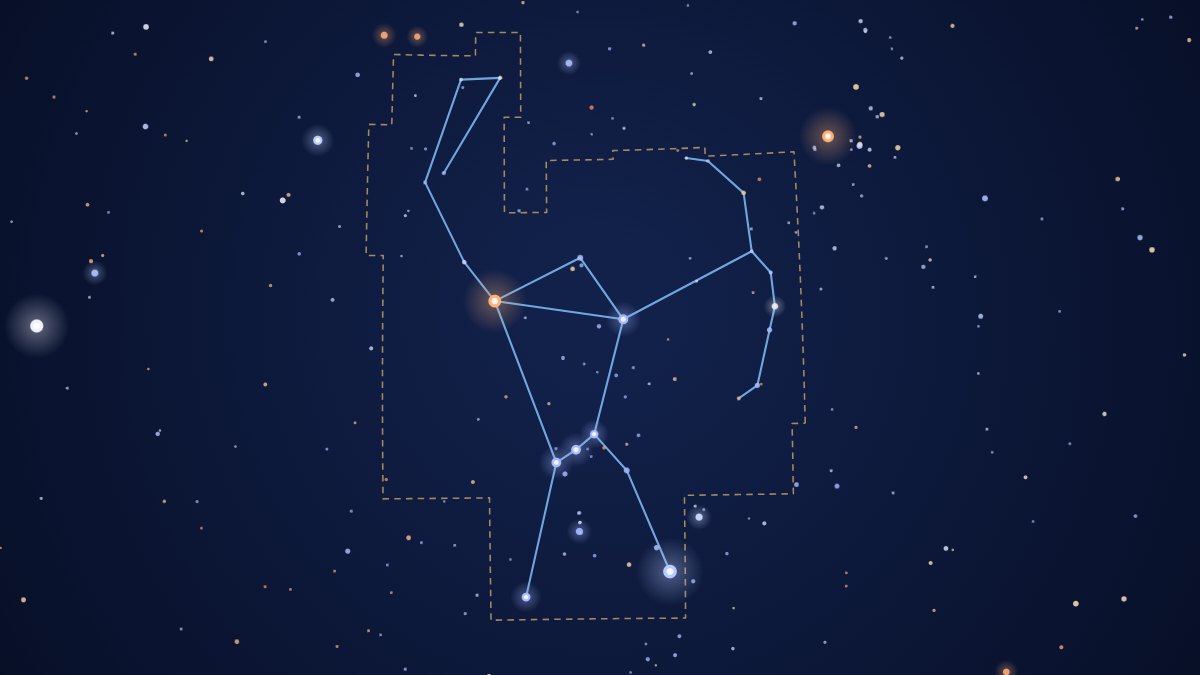
This constellation identification quiz shows you a patch of the real night sky and asks which constellation it is. Each round has 10 questions. Pick a level and start.
Constellation quiz
Ten star patterns. Name each constellation. Pick a level, then press Start.
Loading the sky...
How to play the constellation game
Every question is drawn from star positions and brightnesses measured by the Hipparcos satellite, so the pattern on screen matches what you see outside on a dark night. Brighter stars are drawn larger. Star colours follow the real colour of each star: Betelgeuse is orange, Rigel is blue-white.
After each answer the stick figure and the official boundary of the constellation appear, along with its brightest star, the month it is best seen in the evening and a link to the full list of its stars. You get 10 points for each correct answer. Your best score on each level is saved in your browser.
The three levels
- Easy: the 20 best-known constellations, with the stick-figure lines drawn and four names to choose from. Start here if you have never looked for a constellation.
- Medium: about 45 constellations, including all 12 of the zodiac. Only the stars are shown. The Show lines button draws the figure, but the question is then worth 5 points instead of 10.
- Hard: all 88 constellations. You see a wide field of stars down to the faintest ones visible without a telescope, turned at a random angle, and you type the name. The constellation is always in the middle of the chart. A first-letter hint is available for half points. Common names work too: type “Big Dipper” for Ursa Major or “Southern Cross” for Crux.
Hard mode turns the sky because the real sky turns. Orion rises on its side, stands upright when it is due south and sets tilted the other way. Seen from Australia it is upside down compared with the view from the United States. You recognise a constellation by the shape of its stars, not by which way up it is.
How to identify constellations
Experienced stargazers do not memorise 88 shapes one by one. They learn a few bright patterns and use them as signposts to find the rest. The same method works in this quiz.
Find the asterisms first. An asterism is a pattern of stars that is not a constellation by itself. The Big Dipper is part of Ursa Major. The Teapot is the brightest part of Sagittarius. The Great Square is the body of Pegasus. These shapes are brighter and simpler than the full constellations, so they are what you notice first.
Look for the brightest star. Most constellations have one star that stands out. Sirius in Canis Major is the brightest star in the night sky. Red Antares marks the heart of Scorpius. Vega in Lyra sits next to a small, faint parallelogram. On Medium and Hard, find the brightest star on screen first and ask which constellation it belongs to.
Star-hop from the patterns you know. The two stars at the end of the Big Dipper’s bowl, Dubhe and Merak, point to Polaris, the last star in the handle of the Little Dipper. Follow the curve of the Dipper’s handle to reach Arcturus in Boötes, then continue to Spica in Virgo (“arc to Arcturus, spike to Spica”). Orion’s Belt points down to Sirius and up to Aldebaran in Taurus.
We cover these and other methods in 8 ways to identify constellations. For the northern sky through the year, see the guide to northern hemisphere constellations and the circumpolar constellations that never set.
The 20 easy constellations and how to recognise each one
These are the constellations on the Easy level. Learn the clue in the second column and you will pass Easy on your first try.
| Constellation | What gives it away |
|---|---|
| Orion | Three stars in a short straight line (the Belt) between orange Betelgeuse and blue-white Rigel |
| Ursa Major | The Big Dipper: a bowl of four stars and a bent handle of three |
| Ursa Minor | A smaller, fainter dipper with Polaris, the North Star, at the end of its handle |
| Cassiopeia | Five stars in a W or M shape, across Polaris from the Big Dipper |
| Cygnus | A large cross (the Northern Cross) with Deneb at the top |
| Leo | A backward question mark (the Sickle) ending at Regulus, plus a triangle for the hind legs |
| Scorpius | Red Antares and a long tail that curls up into a stinger |
| Gemini | Two parallel lines of stars headed by the bright pair Castor and Pollux |
| Taurus | A V of stars (the Hyades) with orange Aldebaran at one tip and the Pleiades cluster nearby |
| Canis Major | Sirius, the brightest star in the night sky, at the dog’s neck |
| Lyra | Brilliant Vega next to a small parallelogram of faint stars |
| Aquila | Altair with a fainter star close on each side, in a short line |
| Sagittarius | The Teapot: a lid, a spout and a handle made of eight stars |
| Crux | Four bright stars in a small cross. It is the smallest of the 88 constellations |
| Andromeda | Two chains of stars fanning out from one corner of the Great Square |
| Pegasus | The Great Square, four stars of similar brightness in a big empty box |
| Perseus | A curved chain of stars between Cassiopeia and the Pleiades, with Algol in one leg |
| Boötes | A kite shape with Arcturus at its narrow end |
| Draco | A long winding line of faint stars between the two Dippers, ending in a four-star head near Vega |
| Virgo | A wide Y of stars with Spica at the bottom |
Medium adds the rest of the zodiac and well-known constellations such as Auriga, Hercules, Canis Minor and Corona Borealis. Hard adds the small and faint ones that even regular stargazers rarely name, such as Lynx, Camelopardalis, Microscopium and Mensa. The full set is in our list of the 88 modern constellations.
Using the quiz as a constellation test
Teachers can use the quiz as a quick constellation test in class. Put it on a projector and let the class vote on each answer, or have students play a round on their own devices and report their score. Every round picks a new set of 10 constellations, so students cannot copy answers from a neighbour.
- Elementary school: Easy. The lines are drawn and the shapes match the pictures in most children’s books.
- Middle school: Medium, which covers the zodiac constellations that come up in lessons about the ecliptic.
- High school and astronomy clubs: Hard.
For a paper version, our printable space quiz has six grade levels with answer keys. Students who know the shapes can then try to recall names without any pictures: name all 88 constellations or the shorter 12 zodiac constellations quiz.
Where the star maps come from
The quiz draws every chart in your browser from star catalogue data. No pictures are used. Star positions, brightness and colour come from XHIP, the extended Hipparcos compilation (Anderson and Francis, 2012). The boundaries are the official IAU boundaries from the Davenhall and Leggett catalogue. The stick figures follow the IAU constellation charts. All three were prepared by Olaf Frohn for the open-source d3-celestial project.
The International Astronomical Union defines each constellation as an area of sky with fixed borders, not as a figure. The lines are tradition, so another star chart may connect the same stars differently. If a figure in the quiz looks unfamiliar, check the boundary in the reveal: the stars inside it belong to that constellation no matter how they are joined.
Want another game? Try Guess the Space Photo, three NASA and ESA images a day.
Frequently asked questions
How many constellations are there?
There are 88 official constellations. The International Astronomical Union adopted the list in 1922 and fixed the boundaries between them in 1930, so every point in the sky belongs to exactly one constellation.
What is the easiest constellation to identify?
Orion. Its Belt of three evenly spaced stars in a short straight line has no lookalike anywhere else in the sky, and the bright stars Betelgeuse and Rigel sit on either side of it. In the northern sky the Big Dipper in Ursa Major is just as easy and is visible all year from most of the US and Europe.
Are the constellation lines official?
No. The IAU defines only the boundary of each constellation. The lines that join the stars are tradition, and different books and apps draw some figures differently. This quiz uses the figures from the IAU constellation charts.
Why are the stars turned at an angle on Hard?
Because the sky turns. A constellation rotates as it crosses the sky during the night, and it looks upside down from the other hemisphere. Hard mode trains you to recognise the pattern at any angle, the way you will meet it outdoors.
Can I use this quiz as a constellation test for a class?
Yes. It is free, needs no sign-up and picks a new set of 10 constellations every round. Easy suits elementary school, Medium covers the zodiac for middle school and Hard covers all 88 for high school and astronomy clubs.