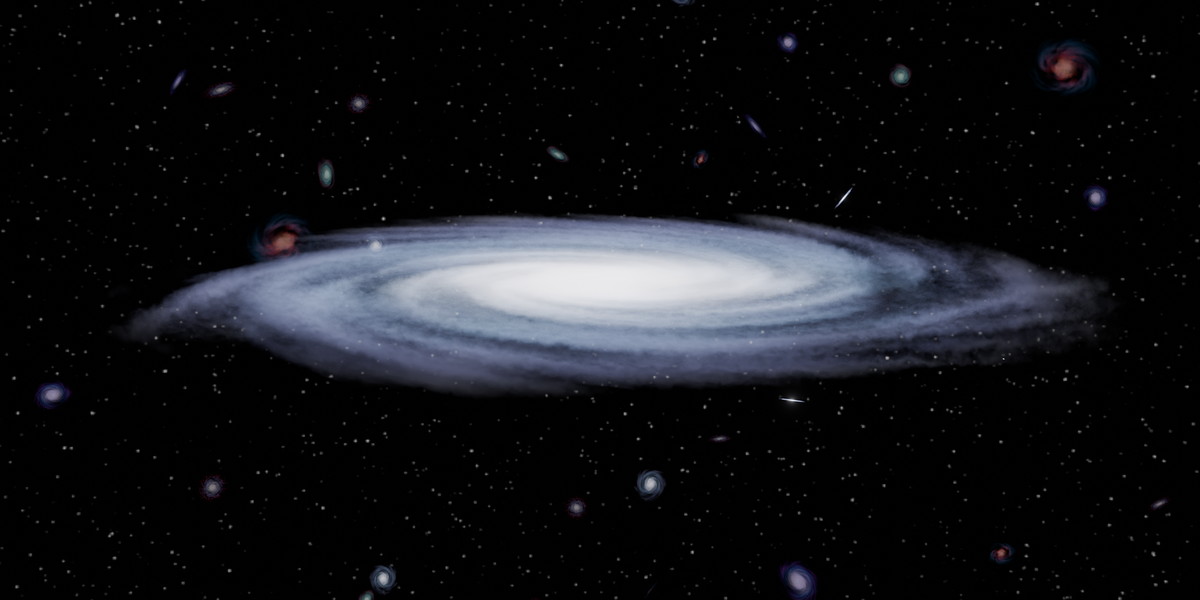
The Local Group is the patch of universe we happen to live in: a gravitationally bound cluster of galaxies roughly 10 million light-years across, anchored by two heavyweight spirals and padded out with somewhere north of 100 much smaller ones. It’s not the biggest structure in the cosmos — not even close — but it’s the one we can study in the most detail, because we’re standing inside it.
Table of Contents
- What Actually Counts as a Local Group Galaxy
- TLDR
- The Three Big Spirals
- The Magellanic Clouds and the Milky Way’s Other Satellites
- Andromeda’s Entourage
- The Full Roster: A Table of Local Group Galaxies
- Where the Local Group Fits in the Bigger Picture
- Will the Milky Way and Andromeda Actually Collide?
- Spotting Local Group Galaxies for Yourself
What Actually Counts as a Local Group Galaxy
Membership isn’t about proximity to the Milky Way specifically — it’s about being caught in the same gravitational well as everything else in the cluster. That well is dominated by two galaxies, the Milky Way and Andromeda (M31), which together account for the vast majority of the group’s mass. Everything else — dozens of dwarf spheroidals, dwarf irregulars, and a handful of oddballs that don’t fit either category cleanly — orbits one of those two centers of gravity, or drifts somewhere in between.
TLDR
The Local Group has three major spiral galaxies (Milky Way, Andromeda, Triangulum) and more than 100 confirmed smaller members, most of them faint dwarf galaxies still being discovered. The whole structure spans about 10 million light-years. Andromeda sits roughly 2.5 million light-years away and is the group’s largest galaxy. The long-assumed head-on collision between the Milky Way and Andromeda, once treated as a near-certainty in 4 to 5 billion years, was downgraded by a 2025 study to roughly a coin flip.
The Three Big Spirals
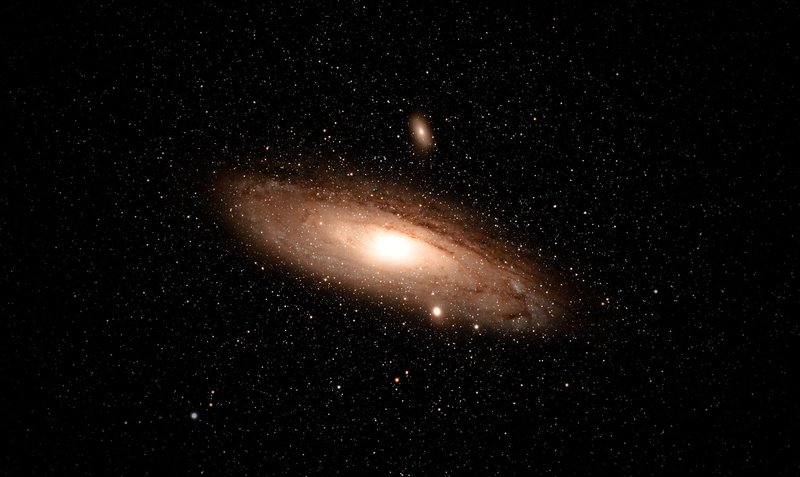
Three spirals do the heavy lifting in the Local Group, and they’re not equals. Andromeda is the biggest, spanning about 260,000 light-years — more than double the Milky Way’s own 100,000-light-year disk — and it sits roughly 2.5 million light-years away, making it the most distant object most people can see with the naked eye, a dim smudge in a dark autumn sky.
The Milky Way comes in second by size but likely holds its own on mass once you account for its dark matter halo — a point astronomers still argue about, because you can’t exactly step outside and weigh it.
Triangulum (M33) is the runt of the trio at about 60,000 light-years across, sitting some 3 million light-years out. It’s the faintest of the three to spot visually, but it’s also the one with the least drama — its spiral structure looks largely undisturbed, which tells astronomers it hasn’t had a serious close encounter in a very long time. That may not last: some models put it in play as a bystander, or eventual participant, in the Milky Way-Andromeda story.
The Magellanic Clouds and the Milky Way’s Other Satellites
The Large and Small Magellanic Clouds are the Milky Way’s most famous satellites, visible to the naked eye from the Southern Hemisphere as two smudgy patches that look like they broke off the Milky Way itself — which, in a sense, they’re in the process of doing. The LMC is close, only about 160,000 light-years out, and it’s massive enough that recent research credits it with measurably tugging on the Milky Way–Andromeda relationship (more on that below).
Beyond the Clouds, the Milky Way trails a swarm of much fainter dwarf spheroidals: Sagittarius, Draco, Ursa Minor, Sculptor, Fornax, Carina, Sextans, Leo I, and Leo II are the classical set, most discovered decades ago on photographic plates. The Sagittarius Dwarf is the closest of the bunch and is actively being shredded by the Milky Way’s tides — its stars are stretched into a stream that wraps around our galaxy more than once. Since the early 2000s, wide-field surveys like the Sloan Digital Sky Survey and the Dark Energy Survey have added dozens more, mostly ultra-faint dwarfs so dim they were invisible to older instruments. That census still isn’t finished.
Andromeda’s Entourage
Andromeda runs its own satellite system, and it’s crowded. M32 and M110 are the two most visible companions, both bright enough to see in a backyard telescope alongside M31 itself. M32 is a compact elliptical that some astronomers think used to be a full spiral galaxy before Andromeda stripped most of its outer disk away in a past merger — a genuinely violent origin story hiding inside an unremarkable-looking blob.
Further out, NGC 147 and NGC 185 form a paired set of dwarf spheroidals, and a long list of numbered Andromeda dwarfs (Andromeda I through Andromeda XXXIV and counting) fills out the rest, most of them found only in the last 20 years through deep imaging surveys.
The Full Roster: A Table of Local Group Galaxies
No single source lists every confirmed member with type and distance in one place — most explainers stop at the famous dozen. Here’s a working roster of the most significant and best-studied members. Distances are approximate, measured from the Milky Way in millions of light-years.
| Galaxy | Type | Distance (million ly) | Notes |
|---|---|---|---|
| Milky Way | Barred spiral | 0 | Home galaxy, ~100,000 ly across |
| Andromeda (M31) | Spiral | 2.5 | Largest Local Group galaxy |
| Triangulum (M33) | Spiral | 3.0 | Third-largest, faintest of the big three |
| Large Magellanic Cloud | Irregular | 0.16 | Milky Way’s largest satellite |
| Small Magellanic Cloud | Irregular | 0.2 | LMC’s companion |
| Sagittarius Dwarf Spheroidal | Dwarf spheroidal | 0.07 | Closest MW satellite, being tidally shredded |
| Ursa Minor Dwarf | Dwarf spheroidal | 0.2 | Classical MW satellite |
| Draco Dwarf | Dwarf spheroidal | 0.26 | Classical MW satellite |
| Sculptor Dwarf | Dwarf spheroidal | 0.29 | Classical MW satellite |
| Sextans Dwarf | Dwarf spheroidal | 0.29 | Classical MW satellite |
| Carina Dwarf | Dwarf spheroidal | 0.33 | Classical MW satellite |
| Fornax Dwarf | Dwarf spheroidal | 0.46 | Largest of the classical MW dwarfs |
| Leo II | Dwarf spheroidal | 0.71 | Classical MW satellite |
| Leo I | Dwarf spheroidal | 0.82 | Classical MW satellite |
| NGC 6822 (Barnard’s Galaxy) | Dwarf irregular | 1.6 | Isolated, low dust content |
| Phoenix Dwarf | Dwarf irregular/spheroidal | 1.4 | Transitional-type dwarf |
| IC 10 | Dwarf irregular (starburst) | 2.2 | Closest known starburst galaxy |
| Andromeda II | Dwarf spheroidal | 2.2 | M31 satellite |
| NGC 185 | Dwarf spheroidal | 2.1 | Paired with NGC 147 |
| Andromeda I | Dwarf spheroidal | 2.4 | First numbered Andromeda dwarf, found 1970 |
| NGC 147 | Dwarf spheroidal | 2.5 | M31 satellite |
| M32 | Compact elliptical | 2.65 | Likely a stripped former spiral |
| Leo A | Dwarf irregular | 2.6 | Very low metal content |
| M110 | Dwarf elliptical | 2.7 | M31’s brightest satellite |
| IC 1613 | Dwarf irregular | 2.3 | Isolated, minimal internal dust |
| Tucana Dwarf | Dwarf spheroidal | 2.9 | Isolated, no gas detected |
| WLM (Wolf-Lundmark-Melotte) | Dwarf irregular | 3.0 | One of the most isolated members |
| Pegasus Dwarf Irregular | Dwarf irregular | 3.0 | Near the group’s outer edge |
| Aquarius Dwarf | Dwarf irregular | 3.2 | Near the group’s outer edge |
Beyond this list sit dozens of ultra-faint dwarfs, most discovered through Sloan, Dark Energy Survey, and Gaia data in the last 15 years, some containing as few as a few hundred stars. They’re real galaxies by the technical definition — gravitationally bound, dark-matter dominated — they’re just too faint to have made most people’s radar.
Where the Local Group Fits in the Bigger Picture
Zoom out, and the Local Group is a minor suburb. It’s one of thousands of galaxy groups and clusters inside the Virgo Supercluster, which is itself just a lobe of the far larger Laniakea Supercluster — a structure roughly 500 million light-years across, mapped in 2014 by tracing how galaxies flow along shared gravitational contours rather than just measuring raw distance. The Local Group sits near the outer edge of Laniakea’s basin of attraction, gradually flowing, along with everything nearby, toward a gravitational anomaly nicknamed the Great Attractor.
Will the Milky Way and Andromeda Actually Collide?
For years, the Milky Way-Andromeda merger was treated as close to settled science: a head-on collision roughly 4 to 5 billion years from now, popularized in NASA visualizations of a night sky with Andromeda sprawled edge to edge. A 2025 study published in Nature Astronomy complicated that picture considerably.
The team, led by astronomer Till Sawala, ran 100,000 simulations incorporating updated Hubble and Gaia motion data for the Milky Way, Andromeda, Triangulum, and the Large Magellanic Cloud — the four most massive Local Group members — across 22 variables. The result: only about a 50% chance of a merger within the next 10 billion years, and barely a 2% chance it happens on the old 4-to-5-billion-year timeline. The LMC’s gravity turned out to nudge the Milky Way’s trajectory just enough to lower the odds, while Triangulum’s pull works in the opposite direction, making a collision slightly more likely. It’s genuinely a coin flip, decided by galaxies most explainers don’t even factor in.
Spotting Local Group Galaxies for Yourself
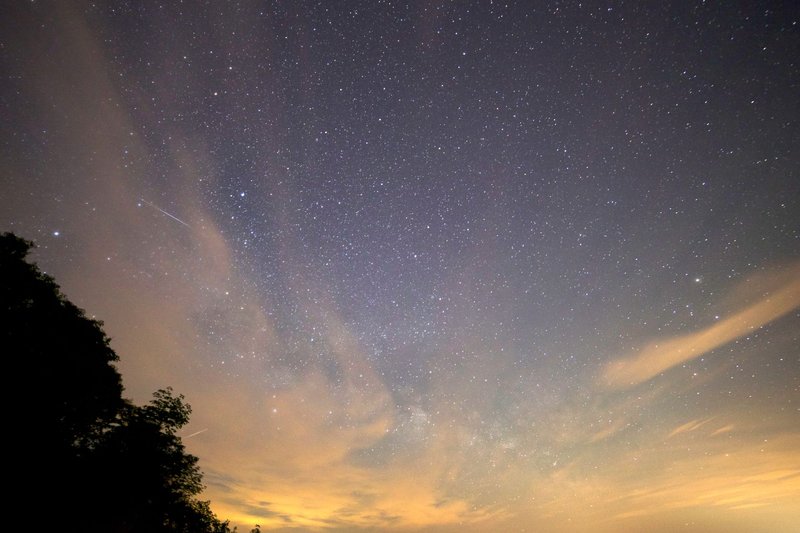
You don’t need a research-grade telescope to see a chunk of this list. Andromeda is visible to the naked eye under dark skies, a faint oval smudge in the constellation of the same name, best around autumn evenings in the Northern Hemisphere. Binoculars sharpen it into something unmistakably galaxy-shaped. Triangulum needs darker skies and patience — it’s larger on the sky than Andromeda but far dimmer per square degree, so light pollution kills it fast; a Bortle 4 sky or better is a realistic minimum.
From the Southern Hemisphere, the Magellanic Clouds don’t need a telescope at all — on a clear night away from city lights they’re obvious, hanging low and looking like two broken-off pieces of the Milky Way’s own glow. A basic 8-inch telescope will pull in M32 and M110 as small companions flanking Andromeda’s core, and on an exceptionally dark, transparent night, some observers report picking out NGC 185 and NGC 147 as faint smudges further out. Everything past that — the classical dwarf spheroidals, the ultra-faint dwarfs — belongs to survey telescopes and long-exposure astrophotography rather than a night with binoculars, but knowing they’re out there changes how you look at that patch of sky.
Enjoyed this article?
Get daily 10-minute PDFs about astronomy to read before bed!
Sign up for our upcoming micro-learning service where you will learn something new about space and beyond every day while winding down.