Updated October 2026 by Elena Stone
The next solar eclipse is the annular solar eclipse on February 6, 2027, seen from South America, Antarctica and western and southern Africa. The next lunar eclipse is the penumbral lunar eclipse on February 20, 2027.
The tool below shows which eclipses you can see from where you live, at what local time and how much of the Sun will be covered. It guesses your place from your time zone. Tap Change to pick a city or use your exact location.
Showing eclipses for your location
Or let your browser share where you are. The place stays on your device.
Next eclipse you can see from here
Your result appears here
Choose where you are
- This card finds the next eclipse you can see from your own sky: the local start, peak and end times, and how much of the Sun or Moon is covered. It needs JavaScript. Without it, use the list and the calendar below.
Next eclipse anywhere
Annular solar eclipse (ring of fire)
February 6, 2027
Greatest eclipse in 116 days
- Greatest eclipse
- February 6, 2027, 15:59 UT
- Seen from
- South America, Antarctica and western and southern Africa
- Ring path crosses
- Chile, Argentina, Uruguay, Brazil, Ivory Coast, Ghana, Togo and Benin
- Longest ring
- 7 min 51 s
Eclipse map
Loading the map…
Eclipses in the next 5 years
Showing 23 of 23 eclipses
-
February 6, 2027
Annular Solar
Annular solar eclipse (ring of fire) in 116 days
Seen from: South America, Antarctica and western and southern Africa
Length: up to 7 min 51 s of ring
-
February 20, 2027
Penumbral Lunar
Penumbral lunar eclipse (faint) in 130 days
Seen from: the Americas, Europe, Africa and Asia
Length: faint shading only
-
July 18, 2027
Penumbral Lunar
Penumbral lunar eclipse (faint) in 278 days
Seen from: eastern Africa, Asia, Australia and the Pacific
Length: faint shading only
-
August 2, 2027
Total Solar
Total solar eclipse in 293 days
Seen from: Africa, Europe, the Middle East and western and southern Asia
Length: up to 6 min 23 s of totality
-
August 17, 2027
Penumbral Lunar
Penumbral lunar eclipse (faint) in 308 days
Seen from: the Pacific and the Americas
Length: faint shading only
-
January 12, 2028
Partial Lunar
Partial lunar eclipse in 456 days
Seen from: the Americas, Europe and Africa
Length: no totality
-
January 26, 2028
Annular Solar
Annular solar eclipse (ring of fire) in 470 days
Seen from: eastern North America, Central and South America, western Europe and northwestern Africa
Length: up to 10 min 27 s of ring
-
July 6, 2028
Partial Lunar
Partial lunar eclipse in 632 days
Seen from: Europe, Africa, Asia and Australia
Length: no totality
-
July 22, 2028
Total Solar
Total solar eclipse in 648 days
Seen from: southeastern Asia, the East Indies, Australia and New Zealand
Length: up to 5 min 10 s of totality
-
December 31, 2028
Blood moon Lunar
Total lunar eclipse (blood moon) in 810 days
Seen from: Europe, Africa, Asia, Australia and the Pacific
Length: 1 h 11 min of totality
-
January 14, 2029
Partial Solar
Partial solar eclipse in 824 days
Seen from: North America and Central America
Length: partial only
-
June 12, 2029
Partial Solar
Partial solar eclipse in 973 days
Seen from: the Arctic, Scandinavia, Alaska, northern Asia and northern Canada
Length: partial only
-
June 26, 2029
Blood moon Lunar
Total lunar eclipse (blood moon) in 987 days
Seen from: the Americas, Europe, Africa and the Middle East
Length: 1 h 41 min of totality
-
July 11, 2029
Partial Solar
Partial solar eclipse in 1002 days
Seen from: southern Chile and southern Argentina
Length: partial only
-
December 5, 2029
Partial Solar
Partial solar eclipse in 1149 days
Seen from: southern Argentina, southern Chile and Antarctica
Length: partial only
-
December 20, 2029
Blood moon Lunar
Total lunar eclipse (blood moon) in 1164 days
Seen from: the Americas, Europe, Africa and Asia
Length: 53 min 40 s of totality
-
June 1, 2030
Annular Solar
Annular solar eclipse (ring of fire) in 1327 days
Seen from: Europe, northern Africa, the Middle East, Asia, the Arctic and Alaska
Length: up to 5 min 21 s of ring
-
June 15, 2030
Partial Lunar
Partial lunar eclipse in 1341 days
Seen from: Europe, Africa, Asia and Australia
Length: no totality
-
November 25, 2030
Total Solar
Total solar eclipse in 1504 days
Seen from: southern Africa, southern Indian Ocean, the East Indies, Australia and Antarctica
Length: up to 3 min 44 s of totality
-
December 9, 2030
Penumbral Lunar
Penumbral lunar eclipse (faint) in 1518 days
Seen from: the Americas, Europe, Africa and Asia
Length: faint shading only
-
May 7, 2031
Penumbral Lunar
Penumbral lunar eclipse (faint) in 1667 days
Seen from: the Americas, Europe and Africa
Length: faint shading only
-
May 21, 2031
Annular Solar
Annular solar eclipse (ring of fire) in 1681 days
Seen from: Africa, southern Asia, the East Indies and Australia
Length: up to 5 min 26 s of ring
-
June 5, 2031
Penumbral Lunar
Penumbral lunar eclipse (faint) in 1696 days
Seen from: East Indies, Australia and the Pacific
Length: faint shading only
No eclipse in this list is visible from your place. Try All.
Times come from NASA eclipse data and are worked out for your place. A solar eclipse is only safe to look at through eclipse glasses or a solar filter.
When is the next solar eclipse?
The next solar eclipse anywhere on Earth is the annular solar eclipse on February 6, 2027. A solar eclipse is only seen from part of the planet, so the next one somewhere is often not the next one you can see. The first card in the tool answers that second question for your location.
The next total solar eclipse is on August 2, 2027. Its path of totality crosses Morocco, Spain, Algeria, Tunisia, Libya, Egypt, Sudan, Saudi Arabia, Yemen and Somalia.
Every year has between 2 and 5 solar eclipses. A total eclipse happens somewhere on Earth about every 18 months, but any one place sees totality only about once every 375 years on average. That is why people travel to stand inside the path.
Next total solar eclipse: August 2, 2027
Total Solar August 2, 2027
On August 2, 2027, the Moon's shadow crosses the Strait of Gibraltar, North Africa and Arabia. Totality lasts up to 6 minutes 23 seconds, near Luxor in Egypt. No total solar eclipse between 2009 and 2114 lasts longer.
The path of totality is about 258 km wide. It reaches land in mid-morning on the coasts of southern Spain and northern Morocco, runs east across Algeria, Tunisia, Libya and Egypt, crosses the Red Sea to Saudi Arabia and Yemen and leaves land at the tip of Somalia. Totality lasts 4 minutes 39 seconds in Tarifa, 4 minutes 50 seconds in Tangier, 6 minutes 9 seconds in Benghazi, 6 minutes 20 seconds in Luxor and 5 minutes 59 seconds in Jeddah. Seville and Cairo are just outside the path and see 98% and 95% of the Sun covered.
The weather odds are among the best of any eclipse this century. August skies over Libya, Egypt and Saudi Arabia are almost always clear, and the Sun stands 82 degrees high at Luxor. In southern Spain the Sun is lower, about 38 degrees up in the morning sky, and haze or low cloud sometimes sits over the Strait.
The eclipse is not visible from the Americas. Outside the path it is partial across Europe, Africa, the Middle East and western Asia: about 86% of the Sun is covered in Madrid and 42% in London.
- Date (Universal Time)
- August 2, 2027, 10:06 UT
- Type
- Total solar eclipse
- Longest totality
- 6 minutes 23 seconds
- Path width
- 258 km at the widest
- Path crosses
- Morocco, Spain, Algeria, Tunisia, Libya, Egypt, Sudan, Saudi Arabia, Yemen and Somalia
- Partial eclipse seen from
- Africa, Europe, the Middle East and western and southern Asia
Best places to watch
| City | Country | Totality lasts | Maximum, local time |
|---|---|---|---|
| Luxor | Egypt | 6 min 20 s | 12:05 pm (EET) |
| Sohag | Egypt | 6 min 22 s | 12:01 pm (EET) |
| Benghazi | Libya | 6 min 9 s | 11:30 am (EET) |
| Abha | Saudi Arabia | 6 min 3 s | 1:37 pm (+03) |
| Jeddah | Saudi Arabia | 5 min 59 s | 1:25 pm (+03) |
| Sfax | Tunisia | 5 min 40 s | 10:11 am (CET) |
How to read the eclipse map
The map in the tool shows the path of any eclipse in the list. The dark band is the path of totality, where the Moon covers the whole Sun. For an annular eclipse, the band is where you see the full ring. Outside the band the eclipse is partial. The lines mark where 75%, 50% and 25% of the Sun is covered at the peak. Select an eclipse in the list to load its path, then tap World to see the whole Earth.
Solar and lunar eclipses in 2027 and 2028
Every eclipse in the next two calendar years, in date order. Dates are in Universal Time, so an eclipse late in the day in Europe can fall on the previous evening in the Americas. The tool converts every time to your own time zone.
| Date | Eclipse | Where you can see it | How long |
|---|---|---|---|
| February 6, 2027 | Annular solar eclipse (ring of fire) | South America, Antarctica and western and southern AfricaRing path: Chile, Argentina, Uruguay, Brazil, Ivory Coast, Ghana, Togo and Benin | up to 7 min 51 s of ring |
| February 20, 2027 | Penumbral lunar eclipse (faint) | the Americas, Europe, Africa and Asia | faint shading only |
| July 18, 2027 | Penumbral lunar eclipse (faint) | eastern Africa, Asia, Australia and the Pacific | faint shading only |
| August 2, 2027 | Total solar eclipse | Africa, Europe, the Middle East and western and southern AsiaPath: Morocco, Spain, Algeria, Tunisia, Libya, Egypt, Sudan, Saudi Arabia, Yemen and Somalia | up to 6 min 23 s of totality |
| August 17, 2027 | Penumbral lunar eclipse (faint) | the Pacific and the Americas | faint shading only |
| January 12, 2028 | Partial lunar eclipse | the Americas, Europe and Africa | no totality |
| January 26, 2028 | Annular solar eclipse (ring of fire) | eastern North America, Central and South America, western Europe and northwestern AfricaRing path: Ecuador, Peru, Brazil, Colombia, Suriname, French Guiana, Portugal, Spain and Morocco | up to 10 min 27 s of ring |
| July 6, 2028 | Partial lunar eclipse | Europe, Africa, Asia and Australia | no totality |
| July 22, 2028 | Total solar eclipse | southeastern Asia, the East Indies, Australia and New ZealandPath: Australia and New Zealand | up to 5 min 10 s of totality |
| December 31, 2028 | Total lunar eclipse (blood moon) | Europe, Africa, Asia, Australia and the Pacific | 1 h 11 min of totality |
When is the next lunar eclipse?
The next lunar eclipse is the penumbral lunar eclipse on February 20, 2027. The next total lunar eclipse, the kind that turns the Moon red and gets called a blood moon, is on December 31, 2028.
A lunar eclipse is seen from the whole night side of Earth at once, so it reaches far more people than a solar eclipse. If the Moon is above your horizon while it passes through Earth’s shadow, you can see it. The tool checks the Moon’s height at each stage of the eclipse for your location.
Not every lunar eclipse is worth staying up for:
- Total: the whole Moon turns copper or deep red for up to about an hour and 45 minutes. This is the blood moon.
- Partial: Earth’s dark inner shadow takes a bite out of the Moon. The covered part looks dark grey or reddish.
- Penumbral: the Moon only passes through the faint outer shadow. It dims a little, and most people notice nothing.
Next eclipse visible from the USA
The next solar eclipse visible from the contiguous United States is the annular solar eclipse on January 26, 2028. These are the next eclipses, solar and lunar, that can be seen from at least part of the country:
- February 20, 2027 Penumbral lunar eclipse (faint). Seen from the Americas, Europe, Africa and Asia.
- August 17, 2027 Penumbral lunar eclipse (faint). Seen from the Pacific and the Americas.
- January 12, 2028 Partial lunar eclipse. Seen from the Americas, Europe and Africa.
- January 26, 2028 Annular solar eclipse (ring of fire). Seen from eastern North America, Central and South America, western Europe and northwestern Africa. Path: Ecuador, Peru, Brazil, Colombia, Suriname, French Guiana, Portugal, Spain and Morocco.
The next total solar eclipses in the United States come one year apart. On August 23, 2044, the path of totality crosses northern Montana and North Dakota at sunset, with the Sun only a few degrees above the horizon. On August 12, 2045, the path runs coast to coast from northern California to Florida, and the longest totality, just over 6 minutes, falls off the Florida coast near the Bahamas.
How to watch a solar eclipse safely
Looking at the Sun during a solar eclipse can burn the retina in seconds, and it does not hurt while it happens. Sunglasses do not protect you, even very dark ones. Use one of these:
- Eclipse glasses or a handheld solar viewer that meet the ISO 12312-2 standard. Buy them from a maker on the American Astronomical Society’s list of reputable vendors, and throw away any pair with scratches or holes.
- A solar filter that covers the front of your telescope or binoculars. Never look through a telescope, binoculars or a camera viewfinder while wearing eclipse glasses. The optics concentrate the sunlight and burn through the glasses. Never use a filter that screws into the eyepiece.
- A pinhole projector. A small hole in a piece of card throws an image of the eclipsed Sun onto a second card or the ground. The gaps between tree leaves do the same thing.
- Welding filters of shade 12 or darker. Lighter shades are not safe.
During totality, and only then, you can take the glasses off and look at the Sun. Put them back on as soon as the first bright point of sunlight returns. In an annular or partial eclipse, keep them on the whole time. A lunar eclipse is safe to watch with your eyes, binoculars or a telescope.
Eclipse glasses and solar filters
As an Amazon Associate we earn from qualifying purchases.
Every item below meets the ISO 12312-2 standard or is a full-aperture solar filter from a maker on the American Astronomical Society's reputable vendor list. Buy early: eclipse glasses sell out in the weeks before a big eclipse.
-
Celestron EclipSmart Solar Eclipse Glasses
Eclipse glasses, multi-pack
Card-frame glasses certified to ISO 12312-2. A pack covers a family or a classroom.
-
American Paper Optics Eclipser Eclipse Glasses
Eclipse glasses, bulk pack
The largest US maker of eclipse glasses and on the AAS vendor list. The cheapest way to buy for a group.
-
Celestron EclipSmart 10x42 Solar Binoculars
Solar binoculars
Binoculars with permanent solar filters built in. They show sunspots on any clear day, not only during eclipses.
-
Thousand Oaks Optical Solar Filter
Telescope solar filter
A full-aperture filter that fits over the front of the telescope. Order the size that matches your telescope's outside tube diameter.
-
Baader AstroSolar Safety Film
Solar filter film sheet
A sheet of certified filter film for making your own front filter for a telescope, binoculars or camera lens.
Why there isn’t an eclipse every month
The Moon’s orbit is tilted by about 5 degrees to Earth’s orbit around the Sun. At most new moons the Moon passes above or below the Sun as seen from Earth, and at most full moons it misses Earth’s shadow. An eclipse only happens when a new or full moon falls close to one of the two points where the orbits cross.
That alignment comes around twice a year, in windows called eclipse seasons that are about 173 days apart. Each season brings a solar eclipse and a lunar eclipse two weeks apart, and sometimes a third. Every year has at least 2 solar eclipses and, counting the faint penumbral kind, at least 2 lunar eclipses. The most eclipses possible in one year is 7.
Types of eclipses
A solar eclipse happens at new moon, when the Moon passes between the Sun and Earth. There are four kinds:
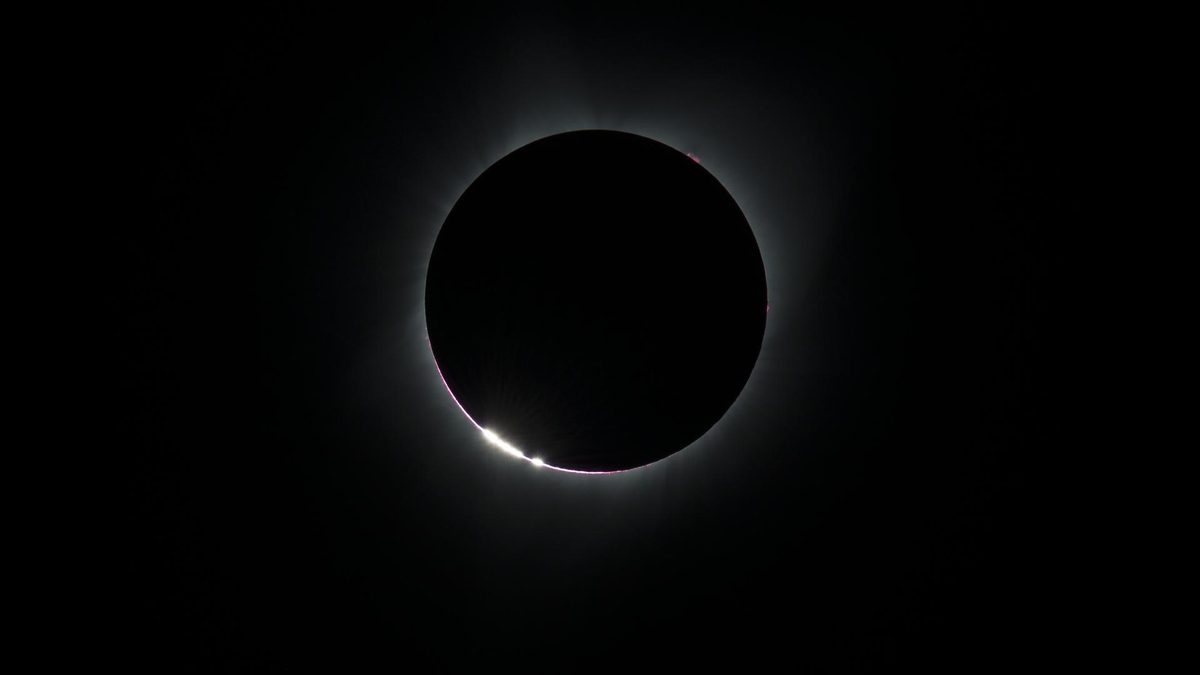
- Total: the Moon covers the whole Sun. The sky turns dark, stars and planets appear and the Sun’s outer atmosphere, the corona, shows as a white glow around the black disc.
- Annular: the Moon is near the far point of its orbit and looks slightly smaller than the Sun. It leaves a bright ring, often called the ring of fire.
- Partial: the Moon covers part of the Sun. Outside the central path, every total and annular eclipse is partial.
- Hybrid: total along part of the path and annular along the rest, because the curve of Earth brings some places close enough to the Moon’s shadow for totality.
A lunar eclipse happens at full moon, when Earth passes between the Sun and the Moon. It can be total, partial or penumbral, as described above. Our guide to the types of eclipses covers each one in more detail.
Frequently asked questions
When is the next solar eclipse?
The next solar eclipse is the annular solar eclipse on February 6, 2027, seen from South America, Antarctica and western and southern Africa. The next total solar eclipse is on August 2, 2027, with the path of totality crossing Morocco, Spain, Algeria, Tunisia, Libya, Egypt, Sudan, Saudi Arabia, Yemen and Somalia.
When is the next lunar eclipse?
The next lunar eclipse is the penumbral lunar eclipse on February 20, 2027. The next total lunar eclipse, or blood moon, is on December 31, 2028.
When is the next solar eclipse in the USA?
The next solar eclipse visible from the contiguous United States is the annular solar eclipse on January 26, 2028. The next total solar eclipses in the US are on August 23, 2044 (Montana and North Dakota) and August 12, 2045 (northern California to Florida).
Can I see the next eclipse from my home?
It depends on where you live. A solar eclipse is only visible from part of Earth, and a lunar eclipse only from places where the Moon is above the horizon. The tool on this page checks every upcoming eclipse for your city and shows the local times and how much of the Sun or Moon will be covered.
What is the longest total solar eclipse?
The longest total solar eclipse of the 21st century was on July 22, 2009, with 6 minutes 39 seconds of totality. The eclipse of August 2, 2027 lasts up to 6 minutes 23 seconds, and no total eclipse after it is longer until June 3, 2114. The longest totality possible is about 7 and a half minutes.
How often do eclipses happen?
Every year has between 2 and 5 solar eclipses and, counting the faint penumbral kind, between 2 and 5 lunar eclipses. A total solar eclipse happens somewhere on Earth about every 18 months, but any one place sees totality only about once every 375 years on average.
Why is there not an eclipse every month?
The Moon's orbit is tilted by about 5 degrees to Earth's orbit, so at most new and full moons the Moon passes above or below the Sun or Earth's shadow. Eclipses only happen when a new or full moon falls near the points where the two orbits cross, which happens twice a year.
What is a blood moon?
A blood moon is a total lunar eclipse. Earth blocks direct sunlight from the Moon, but sunlight bent through Earth's atmosphere still reaches it. The atmosphere scatters away blue light and lets red light through, so the Moon turns copper or deep red. The next one is on December 31, 2028.
Is there an eclipse today or tonight?
On the day of an eclipse, the tool on this page switches to a live view with the local start, peak and end times for your city. Otherwise it shows a countdown to the next one: the annular solar eclipse on February 6, 2027.
Do I need special glasses to watch a lunar eclipse?
No. A lunar eclipse is safe to watch with your eyes, binoculars or a telescope. Only a solar eclipse needs eclipse glasses that meet the ISO 12312-2 standard, or a solar filter over the front of your telescope or binoculars.