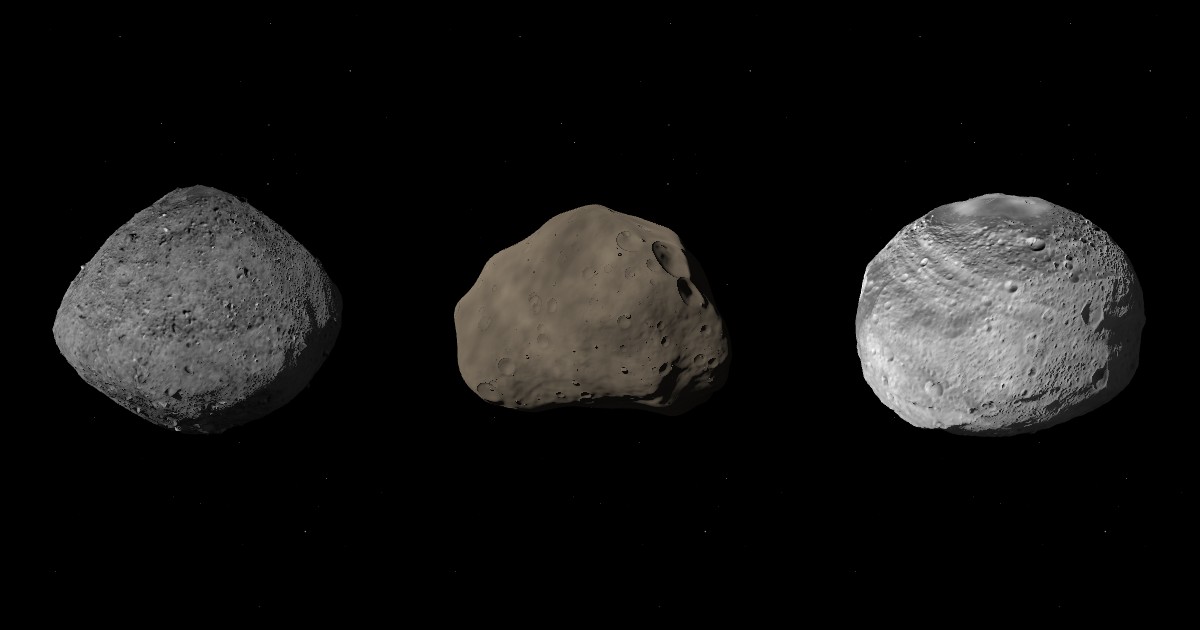
An asteroid looks like a lumpy, cratered rock, not a ball. The model above shows three real ones at their true shape: Bennu, a 490 m (1,600 ft) pile of rubble shaped like a spinning top; Apophis, an elongated 340 m (1,100 ft) rock that passes 32,000 km (19,900 mi) above Earth on April 13, 2029; and Vesta, a 525 km (326 mi) world with a crater 500 km (311 mi) wide. Switch between them, add the mission sites and put each one next to something you know: the Empire State Building for Bennu and Apophis, the state of Arizona for Vesta.
Each asteroid has its own section below. For a list of the best-known asteroids in the Solar System, see famous asteroids. For the other models on this site, including the Moon and Mars, see the 3D space models page.
How do I use the asteroid 3D model?
- Pick an asteroid: the Bennu, Apophis and Vesta buttons at the top left switch the model. The strip along the bottom shows its diameter, day length, gravity and type.
- Move: drag to rotate and scroll or pinch to zoom. On a phone, tap Explore first. Until you do, swiping scrolls the page.
- Mission sites: turns on markers for the places spacecraft touched or studied. Tap a marker for its date and a short description. Bennu has four, Vesta has five and Apophis has none because no spacecraft has been there.
- Size compare: places a true-scale Empire State Building (443 m, 1,454 ft) beside Bennu or Apophis and an outline of Arizona beside Vesta.
- Spin: the default speed is 1,000 times real time so you can see the rotation. Switch to real time to watch Bennu take 4.3 hours to turn once, or pause it to study one side.
What does Bennu look like?
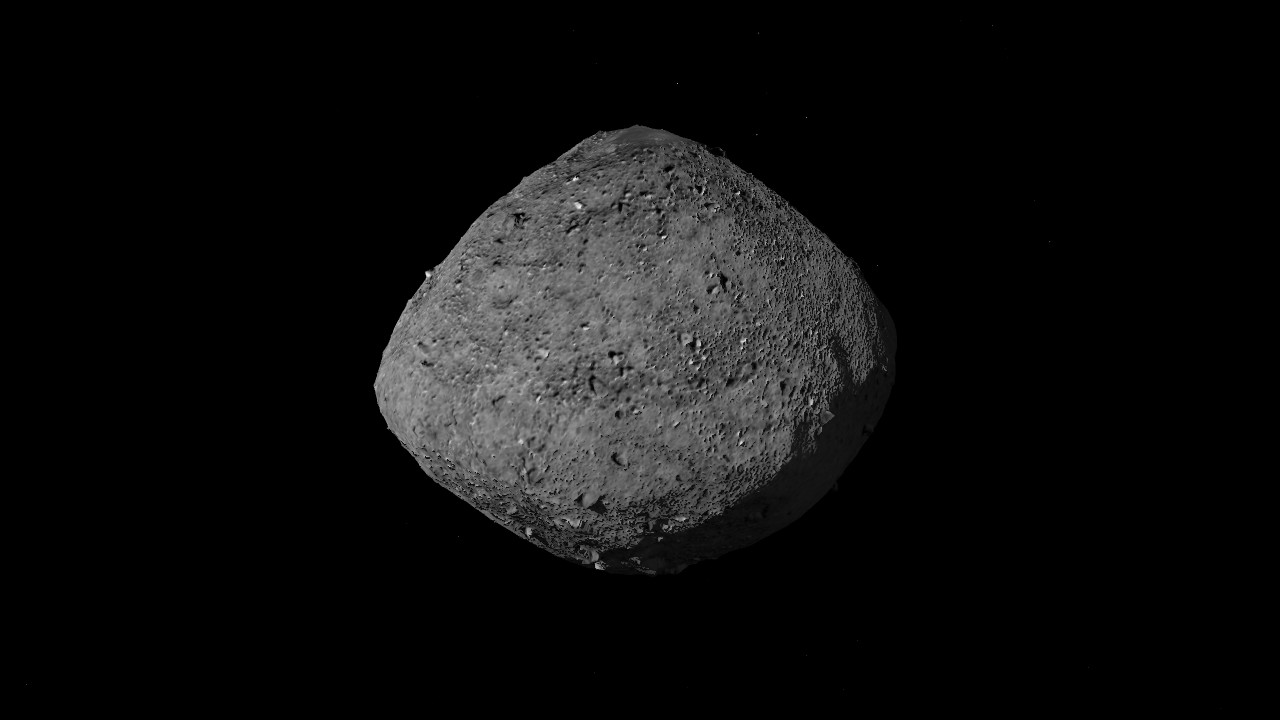
Bennu looks like a spinning top covered in boulders. It is 568 m (1,864 ft) long at its widest and 498 m (1,633 ft) from pole to pole, with a ridge around the equator and a surface of dark rock that reflects only a few percent of the sunlight that hits it. It is a B-type asteroid, a dark, carbon-rich kind (see the types of asteroids). LINEAR, a survey telescope in New Mexico, discovered it in 1999 as 1999 RQ36. It was renamed in 2013 for an Egyptian bird deity, after a naming contest won by a nine-year-old.
Bennu spins once every 4.3 hours, in the direction opposite to its orbit around the Sun. The model shows the real surface: it is built from the global mosaic taken by the OSIRIS-REx camera at about 5 cm per pixel. The largest boulder, Benben Saxum, is about 50 m (164 ft) across and sits in the southern hemisphere. Turn on Mission sites to find it.
Is Bennu a pile of rubble?
Yes. Bennu is a rubble pile: a loose heap of rock and dust with gaps between the pieces, and a density of only 1.19 g/cm3, a little denser than water. A collision broke up a larger parent asteroid and gravity pulled the pieces back together into Bennu. Gravity on the surface is about 0.00005 m/s2, roughly 1/200,000 of Earth. The speed needed to leave the surface is 0.19 m/s, slower than a walk. A 70 lb (32 kg) child would weigh less than a hundredth of an ounce. The page on asteroids that are piles of rubble covers how common this is, and how asteroids form explains where the pieces come from.
What did OSIRIS-REx collect from Nightingale?
OSIRIS-REx collected about 120 g (4.2 oz) of Bennu’s surface at Nightingale on October 20, 2020. Nightingale is a crater about 20 m (66 ft) wide in Bennu’s northern hemisphere, chosen because it held fine, loose grains the spacecraft could stir up with a burst of nitrogen gas. The arm sank into the surface and the spacecraft backed away with more material than expected. The sample capsule landed in the Utah desert in September 2023, and the first analyses found carbon-rich material and minerals that formed in contact with water. The model marks Nightingale, the backup site Osprey and a third candidate, Kingfisher.
Bennu is also one of the few asteroids with a published impact risk. NASA puts the chance of it hitting Earth in the year 2182 at 1 in 2,700, or 0.037 percent. In 2019 Bennu was seen throwing small pebbles into space, which made it behave a little like a comet; how comets differ from asteroids explains why that is unusual. Asteroids visited by spacecraft lists the other bodies we have been close to.
Is Apophis dangerous?
No. Apophis will not hit Earth in 2029, and NASA’s 2021 radar update ruled out an impact for at least the next 100 years. In 2004 early observations gave it a 2.7 percent chance of hitting Earth in 2029 and a rating of 4 on the 10-point Torino scale, the highest any asteroid has had, until more data removed the risk. It is 340 m (1,100 ft) across on average, large enough to cause regional destruction if it did hit, which is why it is still tracked. A real close call is in times Earth almost got hit by an asteroid.
What happens when Apophis passes Earth on April 13, 2029?
Apophis will pass about 32,000 km (19,900 mi) above Earth’s surface on April 13, 2029. That is inside the orbit of the geostationary satellites, which sit at 35,786 km (22,236 mi). An asteroid this size passes this close only rarely: scientists’ estimates range from once every 1,000 years to once every 7,500 years. Apophis will be bright enough to see with the naked eye from Europe and Africa. Earth’s gravity will change how it tumbles, and scientists want to see whether the pull alters its surface.
Apophis does not spin about one axis. It tumbles, with a lightcurve period of 30.56 hours, so it has no simple day length and the model’s spin control shows that period. NASA is redirecting OSIRIS-REx as OSIRIS-APEX to reach Apophis in 2029, and ESA’s Ramses mission is planned for the same encounter. No spacecraft has seen it up close yet.
Why does the Apophis surface look made up?
Because it is. Apophis has never been photographed from close range, so its surface is artistic: grey-brown noise on a shape that comes from radar. The shape is the Brozovic and colleagues (2018) model built from Arecibo and Goldstone radar data, published through the NASA Planetary Data System as a mesh of 3,996 triangles. The model here smooths that mesh to 15,984 triangles, so the outline is real and the detail on it is not. The credit line in the band says this. The shape gives real dimensions, 408 x 348 x 317 m (1,337 x 1,142 x 1,040 ft). For the surface of a rocky asteroid from real images, use Vesta or Bennu.
Why isn’t Vesta round?
Vesta is not round because two giant impacts took a bite out of its south pole. It measures about 564 x 569 x 468 km (350 x 354 x 291 mi) in the model, so it is 100 km shorter pole to pole than across the equator. Vesta is the second most massive object in the asteroid belt, holding about 9 percent of the belt’s mass, and it has a crust, mantle and metal core like a small planet. Scientists call such bodies protoplanets, and V-type asteroids like Vesta are the basaltic ones. It is the only asteroid that is sometimes bright enough to see without a telescope under dark skies.
Vesta spins once every 5.3 hours. Surface gravity is 0.25 m/s2, about 1/40 of Earth, so a 70 lb child would weigh under 2 lb, and the escape speed is 360 m/s (805 mph). The black patch at the top of the model is real: the north was in winter darkness when Dawn mapped Vesta, so there is no imagery above about 55 degrees north.
What is the Rheasilvia basin?
Rheasilvia is a crater about 500 km (311 mi) wide at Vesta’s south pole, nearly as wide as Vesta itself. Its central peak rises about 20 km (12 mi) above the floor, more than twice the height of Mount Everest. It sits on top of an older basin, Veneneia, about 400 km (249 mi) wide. Much of the debris from these impacts reached Earth, and meteorites called HEDs are pieces of Vesta. To find the peak, turn on Mission sites and tap Rheasilvia.
What are the Snowman craters on Vesta?
The Snowman craters are three craters in a row near Vesta’s equator: Marcia, Calpurnia and Minucia, from largest to smallest. Marcia is about 65 km (40 mi) wide and has bright and dark material on its rim and floor. NASA’s Dawn spacecraft orbited Vesta from July 2011 to September 2012, then left for the dwarf planet Ceres, making Dawn the first spacecraft to orbit two bodies in the asteroid belt. Claudia, a small crater, marks 0 degrees longitude on Vesta.
How do Bennu, Apophis and Vesta compare?
| Bennu | Apophis | Vesta | |
|---|---|---|---|
| Mean diameter | 490 m (1,608 ft) | 340 m (1,115 ft) | 525 km (326 mi) |
| Day length | 4.3 hours | 30.6 hours (tumbling) | 5.3 hours |
| Surface gravity | 0.00005 m/s2 (1/200,000 of Earth) | 0.00012 m/s2 (1/80,000 of Earth) | 0.25 m/s2 (1/40 of Earth) |
| Type | B-type rubble pile | Sq-type near-Earth asteroid | V-type protoplanet |
| Density | 1.19 g/cm3 | 2.6 g/cm3 (assumed) | 3.46 g/cm3 |
| Discovered | 1999, LINEAR | 2004, Tucker, Tholen and Bernardi | 1807, Heinrich Olbers |
| Mission | OSIRIS-REx, 2016 to 2023 | OSIRIS-APEX, planned for 2029 | Dawn, 2007 to 2018 |
| Surface in the model | Real imagery | Artistic | Real imagery |
Apophis’s gravity and escape speed are calculated from the radar model’s volume and an assumed density of 2.6 g/cm3, typical of its Sq type. Only a spacecraft visit can confirm it. The orbits differ too: Bennu and Apophis cross Earth’s neighborhood, while Vesta stays in the main belt. A third group, the Trojan asteroids, shares Jupiter’s orbit.
How big are these asteroids next to a building?
Bennu is taller than the Empire State Building and Apophis is slightly shorter. Bennu’s longest axis is 568 m against the building’s 443 m (1,454 ft), so the building reaches about four-fifths of the way up. Apophis is 408 m long, 35 m short of the building. Switch on Size compare and the building stands beside each on the same scale.
Vesta needs a different comparison. Arizona is 645 km (401 mi) from north to south, taller than Vesta is wide at 569 km (354 mi), and the Rheasilvia basin alone, at 500 km, is nearly as wide as the state. That is the difference between a small asteroid and a protoplanet: gravity on Bennu and Apophis is too weak to pull them round, while Vesta’s is strong enough to make it close to round, apart from its impact scars.
How are asteroid 3D models made?
Asteroid shape models come from two sources: spacecraft images and Earth-based radar. Where a spacecraft visited, the shape comes from imaging and laser ranging. For Bennu, OSIRIS-REx’s laser altimeter measured the surface and the team combined it with thousands of images into a model with a resolution of 0.88 m and 1.68 million vertices. We cut it to about 30,500 triangles so it loads on a phone. For Vesta, Dawn’s camera imaged the surface and German Aerospace Center (DLR) stereo mapping turned the images into a height map. The Vesta model here is built from that map, with the global mosaic wrapped over it.
Where no spacecraft has gone, scientists bounce radar off the asteroid when it passes near Earth. The echoes reveal the outline and rotation, and software fits a 3D model to them. That is how Apophis was modeled, and why its surface has no craters or boulders in the model. Brightness changes seen by telescopes, called lightcurves, refine the spin. A radar model gives the shape but not the surface, which is why spacecraft visits matter.
Questions people ask
Is there an interactive 3D model of an asteroid?
Yes. This page has an interactive 3D model of three real asteroids: Bennu, Apophis and Vesta. Drag to rotate and zoom, switch between them, mark the places where spacecraft collected samples or studied craters, and set each one beside the Empire State Building or the state of Arizona at true scale. Bennu and Vesta use real spacecraft imagery. Apophis has a radar shape and an artistic surface.
What does an asteroid look like?
Most asteroids are irregular, cratered rocks. Small ones such as Bennu (490 m, 1,600 ft) and Apophis (340 m, 1,100 ft) are lumpy and strewn with boulders, because their gravity is too weak to pull them round. Large ones such as Vesta (525 km, 326 mi) are closer to round but carry giant impact basins. Their surfaces are dark grey or brown, and many reflect only a few percent of sunlight.
Will Apophis hit Earth?
No. Apophis will pass about 32,000 km (19,900 mi) above Earth on April 13, 2029, closer than the satellites in geostationary orbit, and it will miss. NASA's 2021 radar update ruled out an impact for at least the next 100 years. Early data in 2004 had suggested a 2.7 percent chance of impact in 2029, which later observations removed.
How big is Bennu compared with the Empire State Building?
Bennu is taller than the Empire State Building. Its longest axis is 568 m (1,864 ft) and its mean diameter is 490 m (1,608 ft), while the building, including its antenna, is 443 m (1,454 ft) tall. Apophis is a little smaller than the building at 408 m (1,337 ft) long. Turn on Size compare in the model to see both beside the building at true scale.
What is a rubble pile asteroid?
A rubble pile is an asteroid made of loose rock, gravel and dust held together by weak gravity, not a single solid rock. Bennu is the best-studied example. Its density of 1.19 g/cm3 means much of its volume is empty space between pieces. Rubble piles form when an impact shatters a larger asteroid and the fragments drift back together.
Why isn't Vesta round?
Two giant impacts reshaped Vesta's south pole. The Rheasilvia basin, about 500 km (311 mi) wide, overlaps an older basin, Veneneia, about 400 km (249 mi) wide, and together they removed so much material that Vesta is flattened. It measures about 564 x 569 x 468 km (350 x 354 x 291 mi), roughly 100 km shorter from pole to pole than across the equator.
Is the Apophis surface in the model real?
No. Apophis has never been imaged up close, so the surface in the model is artistic. The shape is real: it comes from Arecibo and Goldstone radar data (Brozovic et al. 2018), with dimensions of 408 x 348 x 317 m (1,337 x 1,142 x 1,040 ft). The craters and boulders are not. Spacecraft are planned to reach Apophis in 2029 and will show what it looks like.
What did OSIRIS-REx bring back from Bennu?
OSIRIS-REx collected about 120 g (4.2 oz) of rock and dust from Bennu's Nightingale crater on October 20, 2020. Its capsule landed in the Utah desert in September 2023. Early analysis found carbon-rich material and minerals formed in contact with water, which supports the idea that asteroids like Bennu helped deliver water and organic compounds to the early Earth.
Where the data comes from
- Bennu: NASA Scientific Visualization Studio 5069: the OSIRIS-REx laser altimeter (OLA) v20 shape model and the global mosaic from the OCAMS camera. Shape: Daly et al. 2020. Credit NASA, Goddard and the University of Arizona.
- Apophis: the radar shape model of Brozovic et al. 2018, released in the NASA PDS Small Bodies Node archive. The surface is artistic, not imagery. Flyby facts: NASA Apophis exploration.
- Vesta: the Dawn global height map from DLR and USGS and the Dawn camera global mosaic. Credit NASA, JPL-Caltech, UCLA, MPS, DLR and IDA. Basin facts: Russell et al. 2012.
- Sites and names: the IAU Gazetteer of Planetary Nomenclature and the OSIRIS-REx candidate sample sites.
Data verified October 2026. NASA’s Psyche spacecraft is heading for a metal asteroid next; see 16 Psyche facts.