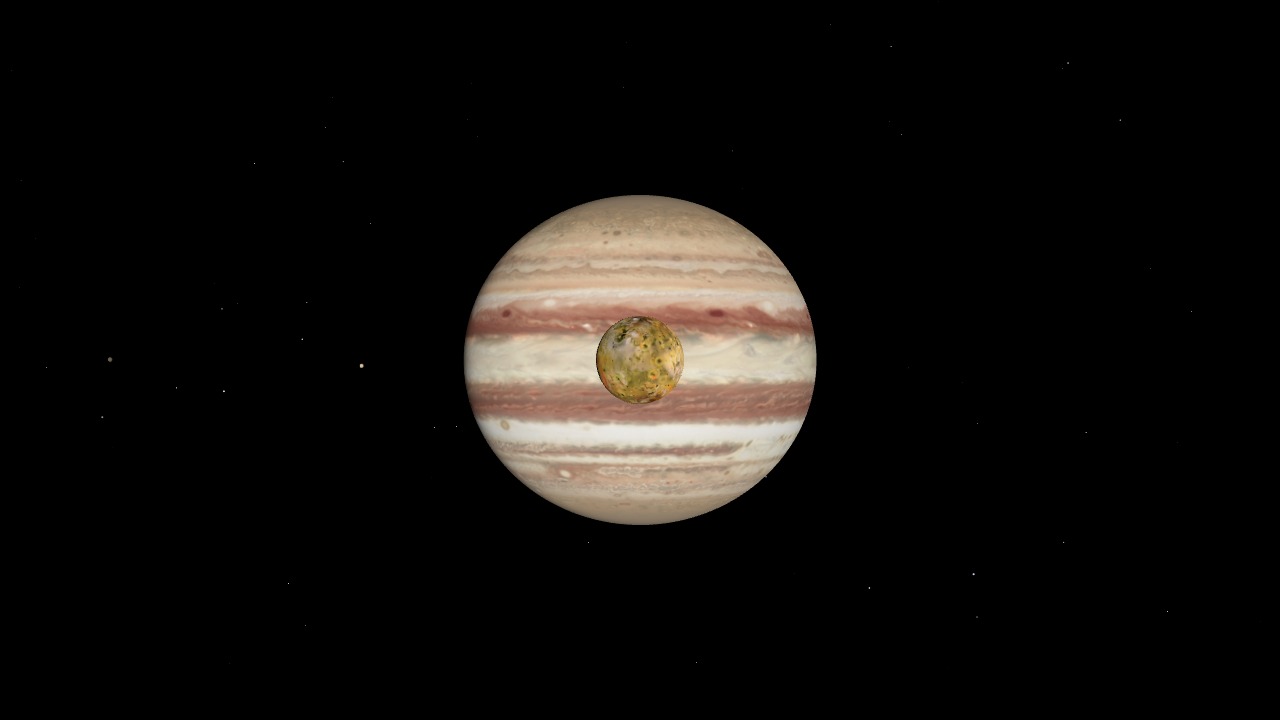
Jupiter and its moons in 3D
This is an interactive 3D model of Jupiter and its four largest moons: Io, Europa, Ganymede and Callisto. The moons sit where they really are on the date you choose, so the model shows them lined up beside the planet the way a telescope does, crossing in front of Jupiter, or vanishing into its shadow. When a moon passes between Jupiter and the Sun, its shadow falls on the cloud tops as a small black dot. The planet is wrapped in a global map made by the Hubble Space Telescope in December 2025, and every named cloud belt and zone is labelled, along with the Great Red Spot. Click a moon to fly to it and see its surface up close. The Moon, Mars, Venus, Mercury and Saturn have their own models on the 3D space models page.
How to use the Jupiter model
- Move: drag to rotate, scroll or pinch to zoom. Zoom in to the cloud tops or pull back to see the orbits of all four moons.
- Click a moon: the camera flies to it and shows its size, its distance from Jupiter, how long it takes to go around and what its surface is made of.
- Moons panel: lists the four moons with their distance from Jupiter right now and whether each one is crossing the planet, casting a shadow on it, hidden behind it or eclipsed in its shadow. System view shows all four orbits. View from Earth shows Jupiter and its moons the way they look through a telescope on that date.
- Bands panel: lists the belts and zones from the north pole to the south pole, plus the storms. Click one to turn it toward you and highlight it.
- Time: move the clock forward or back to watch the moons go around and their shadows cross the clouds. Io goes around once every 42 hours, so a few hours make a visible difference.
- Layers: toggle the band names, the storms, the moons, the orbit trails, the rings, the latitude grid and day and night.
- Search: type the name of a moon, a belt, a zone or a storm to fly to it.
- Share: copy a link to the current view, including the date.
Jupiter’s four largest moons
Galileo Galilei found the four large moons of Jupiter in January 1610 with a telescope that magnified about 20 times. They were the first moons found going around another planet, and they showed that not everything in the sky circles the Earth. They are called the Galilean moons after him. Their names come from Simon Marius, who saw them at about the same time and named them after figures linked to Zeus in Greek myth. A full list of all of them is in our post on the Galilean moons.
| Moon | Diameter | Distance from Jupiter | One orbit takes | Surface |
|---|---|---|---|---|
| Io | 3,643 km (2,264 mi) | 421,700 km (262,000 mi) | 1.77 days | Sulfur and lava, hundreds of active volcanoes |
| Europa | 3,122 km (1,940 mi) | 671,000 km (417,000 mi) | 3.55 days | Cracked water ice over a salty ocean |
| Ganymede | 5,268 km (3,273 mi) | 1,070,400 km (665,000 mi) | 7.15 days | Ice with dark, old regions and bright, grooved terrain |
| Callisto | 4,821 km (2,996 mi) | 1,882,700 km (1,170,000 mi) | 16.69 days | Dark ice and rock covered in craters |
Io
Io is the closest of the four and the most volcanic world in the Solar System, with more than 400 active volcanoes. Its yellow, orange and red colours come from sulfur and sulfur compounds that the volcanoes lay down. Io is slightly bigger than our Moon. Every time Io goes around Jupiter four times, Europa goes around twice and Ganymede once. These regular tugs keep Io’s orbit slightly oval, so Jupiter’s gravity squeezes and stretches it all the time. That flexing heats its interior and keeps the volcanoes going. Read more about why Io is the deadliest moon.
Europa
Europa is the smallest of the four, a little smaller than our Moon. Its surface is bright water ice crossed by long reddish cracks, with very few craters, which means the surface is young. Under the ice is an ocean of salty water that holds about twice as much water as all of Earth’s oceans. That ocean is one of the best places in the Solar System to look for conditions that could support life. NASA’s Europa Clipper spacecraft is on its way and will reach Jupiter in April 2030 to fly past Europa about 50 times. The full list of missions is in our post on space missions to Europa.
Ganymede
Ganymede is the largest moon in the Solar System. At 5,268 km across it is wider than the planet Mercury, although it has only about half of Mercury’s mass. It is the only moon known to make its own magnetic field, and like Europa it probably has a salty ocean under its ice. Its surface has two kinds of ground: dark, heavily cratered regions that are very old, and lighter bands of ridges and grooves. The European Space Agency’s JUICE spacecraft will reach Jupiter in July 2031 and go into orbit around Ganymede in December 2034, the first time a spacecraft will orbit a moon other than our own. More in why Ganymede is the most interesting moon.
Callisto
Callisto is the outermost of the four and about the size of Mercury. It is one of the most heavily cratered objects in the Solar System, with a surface that has hardly changed in about four billion years. Its largest impact scar, Valhalla, is a bright patch surrounded by rings that spread out about 3,800 km. Callisto is not locked into the rhythm of the other three, gets little heat from Jupiter’s tides and sits outside the worst of Jupiter’s radiation. That makes it the safest of the four for a future crewed base. See why Callisto is underrated.
Moon shadows and eclipses on Jupiter
The orbits of the four moons lie almost exactly in the plane of Jupiter’s equator, and Jupiter’s axis is tilted only 3 degrees. Seen from Earth, we look at that plane almost edge-on, so the moons always appear in a line on either side of the planet. That line-up also means the moons pass in front of Jupiter and behind it on almost every orbit. There are four kinds of event:
- Transit: a moon crosses in front of Jupiter’s disc. Against the bright clouds the moon itself is hard to see.
- Shadow transit: the moon’s shadow crosses the clouds as a sharp black dot. This is the easiest event to see in a small telescope. Io’s shadow is about 3,600 km across.
- Occultation: a moon goes behind the planet and disappears.
- Eclipse: a moon passes into Jupiter’s shadow and fades out over a few minutes, while it is still beside the planet in the sky.
Io, Europa and Ganymede cast shadows on Jupiter on every orbit. Callisto is far enough out that its shadow misses the planet for about three years at a time and then crosses it on every orbit for about three years. The current season of Callisto shadow transits began in May 2025 and runs until August 2028. The model draws every shadow from the real position of the Sun, so you can find the next shadow transit by moving the clock forward and watching the cloud tops. View from Earth shows the same moment the way it looks in a telescope.
Belts, zones and the Great Red Spot
Jupiter has no solid surface. What we see are the tops of clouds made of ammonia ice, arranged in stripes that run around the planet. The light stripes are called zones and the dark stripes are called belts. Zones are areas where gas rises and forms high, bright ammonia clouds. Belts are where it sinks, so we see deeper, darker clouds. Between them blow jet streams, some faster than 500 km/h, which keep the stripes in place. Astronomers name each one by its position: the Equatorial Zone runs along the equator, with the North Equatorial Belt and the South Equatorial Belt on either side. Those two dark belts are the first things a small telescope shows. Farther from the equator come the tropical zones, the temperate belts and zones and finally the grey, mottled polar regions.
The belts change. The South Equatorial Belt sometimes fades almost to white for a year or two and then darkens again in a few weeks. The North Equatorial Belt widens and narrows. That is why the model uses a map from a single date. Jupiter turns once every 9 hours 55 minutes, the fastest of any planet, and that fast spin flattens it: its diameter through the poles is about 6.5 percent smaller than across the equator.
The Great Red Spot is a storm in the southern hemisphere, about 22 degrees south of the equator, that turns once every six days or so. It has been watched since at least 1831 and may be the spot Giovanni Cassini saw in 1665. In the 1880s it was about 40,000 km long. When Voyager flew past in 1979 it was about 23,000 km long, and the December 2025 Hubble map shows it about 14,000 km (8,700 mi) long, still wide enough to hold the Earth. It is also shrinking and becoming rounder. Because the spot drifts slowly against the clouds around it, the model moves the cloud map so the Great Red Spot sits at its measured longitude for the date you pick. Oval BA, a smaller storm south of it, formed in 2000 when three white ovals merged and turned red in 2005, which gave it the nickname Red Spot Jr. On the December 2025 map it is pale cream again. Juno found clusters of cyclones packed around both poles, each one wider than the United States.
Does Jupiter have rings?
Yes, but they are very faint. Voyager 1 found them in 1979. They are made of dust, not ice, knocked off the small inner moons Metis, Adrastea, Amalthea and Thebe by tiny meteorite impacts. There are three parts: a thick, faint halo closest to the planet, the narrow main ring about 129,000 km from Jupiter’s centre, and two wide gossamer rings made of dust from Amalthea and Thebe. They are so thin that almost all light passes straight through. They are brightest when lit from behind, when the Sun shines through them toward the viewer. The model draws them far brighter than they are, or they would be invisible. You can switch them off in the layers. How they compare with the rings of Saturn, Uranus and Neptune is in Jovian planets and their rings.
How big is Jupiter?
Jupiter is 142,984 km (88,846 mi) across at the equator, 11.2 times as wide as the Earth. About 1,300 Earths would fit inside it. It has 318 times the mass of the Earth, more than twice as much as all the other planets put together. Even so it is mostly hydrogen and helium, so its average density is only 1.33 times that of water. Jupiter goes around the Sun once every 11.86 years at an average of 778 million km. Jupiter has 115 confirmed moons (as of April 2026). Most are small captured rocks only a few kilometres across, and the four Galilean moons hold almost all of the mass. All of them are in our list of Jupiter’s moons. More about the planet is in unique features of Jupiter and is Jupiter bigger than Earth.
Seeing Jupiter and its moons yourself
Jupiter is one of the easiest planets to see. It is brighter than any star and shows detail in almost any telescope. Here is what to expect with each size:
- Binoculars (10×50): the four Galilean moons as points of light in a line beside the planet. Brace the binoculars on something steady. Their positions change from night to night.
- 60 to 80 mm refractor: the North and South Equatorial Belts as two dark stripes and the black shadow of a moon when one crosses the disc.
- 100 to 150 mm: the Great Red Spot when it faces Earth, more belts and zones, dark knots and plumes along the edge of the North Equatorial Belt, and moons fading into Jupiter’s shadow.
- 200 mm and larger: fine detail in the belts, Oval BA, and the moons as tiny discs with different colours: Io yellow, Europa white, Ganymede grey and Callisto dark.
Use magnification of about 100 to 200 times on a steady night. The Great Red Spot is on the side facing Earth for only a few hours of each 10-hour rotation, so it is not always visible. Jupiter is best around opposition, when it is closest to Earth and up all night: the next one is on 11 February 2027, when Jupiter is in Leo. To pick a telescope that shows all of this, use the telescope finder or read our guide to the best telescopes for viewing planets.
Missions to Jupiter
Pioneer 10 was the first spacecraft to fly past Jupiter, in December 1973. Pioneer 11 followed in 1974 and Voyager 1 and 2 in 1979. Voyager found Io’s volcanoes and Jupiter’s rings. Galileo orbited Jupiter from 1995 to 2003 and found the evidence for oceans under the ice of Europa, Ganymede and Callisto. NASA’s Juno has orbited Jupiter since July 2016 on long loops over the poles, mapping the planet’s gravity, its magnetic field and the polar cyclones. Europa Clipper arrives in April 2030 and JUICE in July 2031. The whole timeline is in every NASA mission to Jupiter.
Questions people ask
Is there an interactive 3D model of Jupiter and its moons?
Yes. This page is an interactive 3D model of Jupiter with its four largest moons, Io, Europa, Ganymede and Callisto, at their real positions for any date you choose. The moons cast shadows on Jupiter's clouds where the real Sun puts them, every cloud belt and zone is labelled, and you can click a moon to fly to it.
How many moons does Jupiter have?
Jupiter has 115 confirmed moons, as of April 2026. Most are small irregular moons only a few kilometres across, many of them captured asteroids on distant, tilted orbits. The four Galilean moons, Io, Europa, Ganymede and Callisto, are far larger than all the others and hold almost all of the mass.
What are the four Galilean moons?
Io, Europa, Ganymede and Callisto, in order from Jupiter. Galileo Galilei found them in January 1610. Io is covered in active volcanoes, Europa has an ocean under its ice, Ganymede is the largest moon in the Solar System and Callisto is one of the most heavily cratered worlds known.
Which is the largest moon of Jupiter?
Ganymede. It is 5,268 km across, larger than the planet Mercury and the largest moon in the Solar System. It is also the only moon known to make its own magnetic field.
Can you see Jupiter's moons with binoculars?
Yes. Steady 10×50 binoculars show the four Galilean moons as small points of light in a line on either side of Jupiter. Their positions change from night to night, and Io moves visibly in a few hours. A small telescope shows the black shadow of a moon when one crosses the planet.
What are the black dots on Jupiter?
They are the shadows of Jupiter's moons. When a moon passes between Jupiter and the Sun, its shadow falls on the cloud tops as a sharp black dot that moves across the planet in a couple of hours. Io, Europa and Ganymede do this on every orbit. Callisto's shadow reaches Jupiter only in seasons of about three years, and one runs from May 2025 to August 2028.
Does Jupiter have rings?
Yes. Jupiter has a faint ring system found by Voyager 1 in 1979: a halo close to the planet, a narrow main ring about 129,000 km from its centre and two wide gossamer rings. They are made of dark dust from the small inner moons, so they are far too faint to see in a backyard telescope.
Is the Great Red Spot shrinking?
Yes. In the 1880s the Great Red Spot was about 40,000 km long. Voyager measured about 23,000 km in 1979, and on the December 2025 Hubble map it is about 14,000 km long. It is also becoming rounder. It is still wider than the Earth.
How big is Jupiter compared to Earth?
Jupiter is 142,984 km across at the equator, 11.2 times as wide as the Earth, and about 1,300 Earths would fit inside it. It has 318 times the mass of the Earth, more than twice the mass of all the other planets put together.
Where the data comes from
- Jupiter’s clouds: global map from the Hubble Space Telescope OPAL program (Outer Planet Atmospheres Legacy), taken on 11 December 2025, licensed CC BY 4.0. The colours are adjusted to a natural look and the poles, which Hubble sees poorly, are filled in.
- Moon surfaces: global mosaics of Io, Europa, Ganymede and Callisto from the Galileo and Voyager missions, published by the USGS Astrogeology Science Center. Europa and Callisto are greyscale mosaics with colour added.
- Belts and zones: names and latitudes from the British Astronomical Association Jupiter Section. Great Red Spot longitude from amateur measurements collected by JUPOS.
- Moon facts: NASA JPL Solar System Dynamics.
- Rings: radii from the PDS Ring-Moon Systems Node. The brightness of the rings is exaggerated.
- Moon positions, lighting and rotation: calculated from the VSOP87 planetary theory, Jean Meeus’s method for the Galilean moons and the IAU rotation model for Jupiter, and checked against JPL Horizons.
Data verified 2026-10-12. The same kind of model exists for Saturn, the Moon, Mars, Venus and Mercury. To compare the two giants, read Jupiter and Saturn: differences and similarities.