Little Astronomy earns a commission from qualifying Amazon purchases made through links on this page, at no extra cost to you.
The first astronomy gift that kept me outside in winter was a cardboard star wheel from my aunt. I was nine, it was a few days after Christmas in British Columbia and the sky over the driveway had cleared after a week of rain. I held the wheel up to the porch light, turned it to the date and the hour, walked out into the dark and found Orion exactly where the wheel said it would be. A telescope would have impressed me more on Christmas morning. The star wheel got me outdoors that night.
That is still how I shop for astronomy lovers: a good gift gets someone under the sky, or makes the time they spend there warmer, darker or easier. Below are 26 Christmas gift ideas for astronomy lovers, sorted by where the person is in the hobby: no telescope yet, already owns one, reads about the sky, or wants space on the shelf. The stocking stuffers and the gifts to skip are at the end.
Quick answer: for someone new to the hobby, give a pair of astronomy binoculars and a planisphere. For someone who already owns a telescope, give a red headlamp, an eyepiece and filter kit or Turn Left at Orion. For someone who loves space but will never stand in a cold field, give LEGO’s Milky Way art set or the Sega Homestar Flux planetarium.
Quick picks
| Gift | Best for |
|---|---|
| Celestron SkyMaster 15×70 binoculars | A first look at the sky without a telescope |
| Celestron StarSense Explorer DX 130AZ | A first telescope that finds targets with a phone |
| ZWO Seestar S30 Pro | Astrophotography from a city balcony |
| Celestron red LED headlamp | Anyone who observes at night |
| Celestron eyepiece and filter kit | Someone with a beginner telescope |
| Turn Left at Orion | The best book for a telescope owner |
| LEGO Art The Milky Way Galaxy | Space lovers who build |
| Soluna solar eclipse glasses | Stocking stuffer before the 2027 eclipse |
How to choose a gift for an astronomy lover
Three questions sort out almost every astronomy gift.
Do they own a telescope? If they don’t, ask whether they want one before you buy it. A telescope is a big and specific purchase. People who have been thinking about one usually have an opinion about the type. If you want it to be a surprise, binoculars are the safer first gift: they show the Moon’s craters, Jupiter’s four largest moons and the Pleiades, and they still get used for birds if the hobby doesn’t stick. If they already own a telescope, accessories are the better gift, because the scope that came in the box is rarely the limit. The eyepieces, the finder and the cold usually are.
Where do they look up? From a city, the Moon, the planets and bright star clusters are the main targets, and a smart telescope that stacks images beats the eye for faint galaxies. From a dark rural sky, a wide-field instrument and a good star atlas open up the Milky Way. Our guide to dark sky locations shows how big that difference is.
How cold do their winter nights get? Most of us get our telescopes at Christmas, when the nights are long and the air is often clearest, and also coldest. On Boxing Day a few years ago my brother-in-law unboxed a new telescope, carried it into the yard at minus 25 Celsius and lasted about ten minutes. Fingers go first. A pair of rechargeable hand warmers would have done more for his first night than a second eyepiece.
The red light rule: your eyes need 20 to 30 minutes in the dark to adapt fully, and one blast of white light resets most of that. Anything an astronomer uses at night should glow red or not at all. If a gift has a white light, check that it also has a red mode.
Gifts for someone who doesn’t own a telescope yet
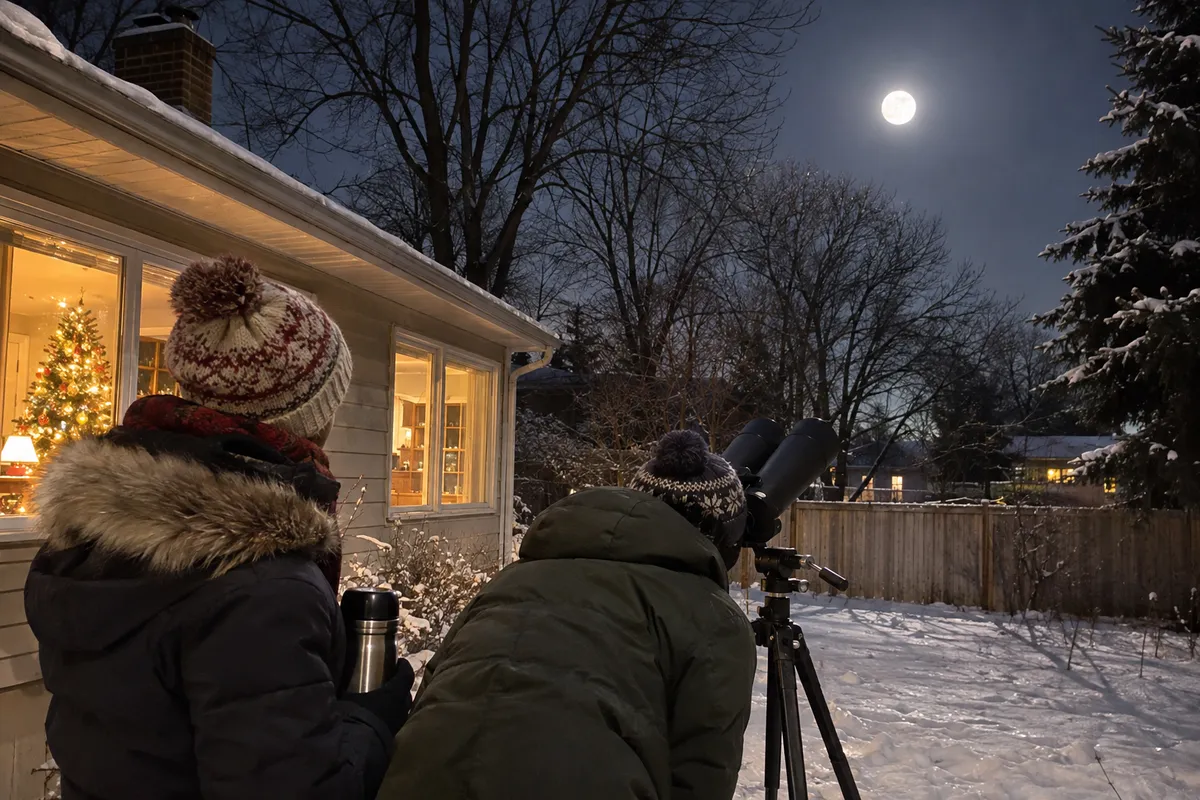
For someone who loves the sky but hasn’t bought equipment, start with binoculars or a telescope that does the finding for them. If you’re still deciding between telescope types, our telescope finder asks five questions and narrows the field.
Best first gift
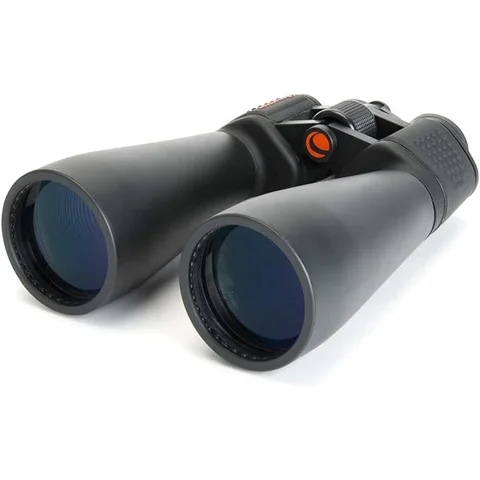
1. Celestron SkyMaster 15×70 binoculars
Big astronomy binoculars are the gift I recommend most to people who aren’t sure a telescope is right for them. The 70 mm lenses gather about twice the light of standard 50 mm binoculars, and 15x is enough to separate the Pleiades into dozens of stars, show the Orion Nebula as a glowing smudge and pick out Jupiter’s moons as a line of dots. Both eyes stay open, so the sky looks the way people expect it to.
At 15x and 3.3 pounds they shake in your hands, so they need a tripod. The built-in 1/4-20 socket takes a standard photo tripod with an L-adapter. Pair them with our list of nebulae you can see with binoculars for a ready-made first night.
- 15x magnification, 70 mm objectives, BaK-4 prisms
- Rubber armor, water-resistant body
- Tripod socket built in (tripod and adapter not included)
Good: wide, bright views with no setup, and they work for birds and ships in daytime. Not great: too heavy to hand-hold for long. For a lighter pair to hold without a tripod, the Celestron Cometron 7×50 shows a wider 6.6 degree field.
Best first telescope
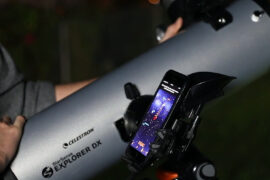
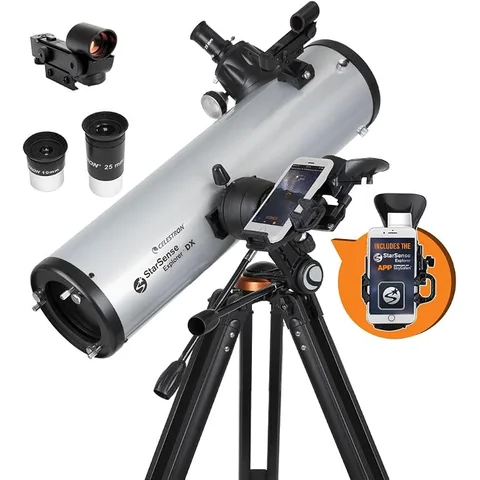
2. Celestron StarSense Explorer DX 130AZ
Most new telescope owners quit because they can’t find anything. The StarSense Explorer fixes that with a phone dock: the app photographs the sky through a small mirror, works out where the telescope is pointing and shows arrows to the target. When the bullseye turns green, the object is in the eyepiece. The mount is manual, so there are no motors to fail and no alignment routine to learn.
The 130 mm mirror is large enough for Saturn’s rings, the cloud belts of Jupiter, the Orion Nebula and the core of the Andromeda Galaxy. We cover its smaller sibling in our StarSense Explorer LT 114AZ review, and the same app runs both.
- 130 mm Newtonian reflector on a manual altazimuth mount with slow-motion controls
- StarSense app with a curated list of tonight’s best targets
- 18 pounds assembled, 2-year US warranty
Good: it removes the hardest part of the first month. Not great: it depends on the phone, so cold drains the battery fast; a small power bank in a pocket helps.
Best grab-and-go telescope
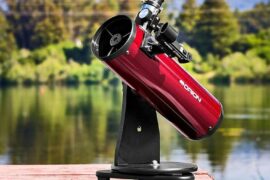
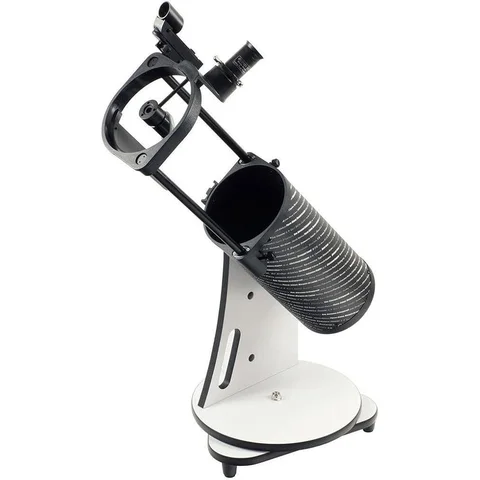
3. Sky-Watcher Heritage 130P tabletop Dobsonian
The Heritage 130 is the telescope I’d give someone who will only use it if it’s ready in two minutes. It arrives assembled, the tube collapses on a truss, and the whole thing sits on a sturdy table, a picnic bench or an overturned cooler. You push it toward a target and it stays there. The same 130 mm aperture as the StarSense means the same views of the planets and bright deep-sky objects, without the phone.
The trade-off is finding things. A tabletop Dobsonian expects you to learn the sky with a chart, which is why it pairs well with the planisphere and Turn Left at Orion further down. Our tabletop telescope guide compares it with the alternatives, and Dobsonian vs Newtonian explains the design.
- 130 mm parabolic mirror, collapsible truss tube
- 10 mm and 25 mm eyepieces and a red-dot finder included
- No assembly, 2-year warranty
Good: the fastest setup of any real telescope here. Not great: it needs something stable to sit on, and the open truss lets in stray light in a lit backyard.
Best for city skies
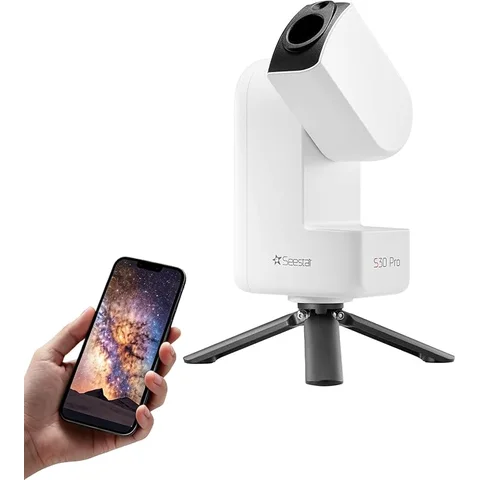
4. ZWO Seestar S30 Pro
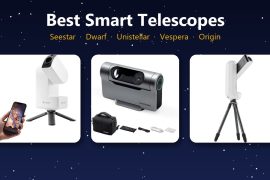
A smart telescope has no eyepiece. It points itself, tracks the sky and stacks dozens of short exposures into one image on a phone, so a faint galaxy builds up on the screen over a few minutes. Stacking also cuts through light pollution, and that makes a smart telescope the best gift for an astronomy lover in an apartment downtown. The S30 Pro adds apochromatic optics, a built-in light pollution filter and a second wide-angle camera for Milky Way and star trail shots.
ZWO says it’s designed for deep-sky objects and not intended for planets, and that matches what the small aperture can do. For Jupiter and Saturn, the reflectors above show more. Our smart telescope comparison covers the Dwarf, Vespera and Unistellar models too.
- Automatic GoTo and tracking, controlled by phone app
- Dual cameras, built-in light pollution filter
- 3.6 pounds, small enough for a carry-on bag
Good: real nebula and galaxy photos on the first clear night, even from a city. Not great: you look at a screen, not through glass, and it’s sold by the ZWO store rather than Amazon directly.
Gifts for someone who already owns a telescope
This is where most astronomy gift lists go wrong, with another telescope or a gadget that will never leave the box. An observer with a telescope needs light, warmth, better eyepieces and a way to share what they see.
Most useful small gift
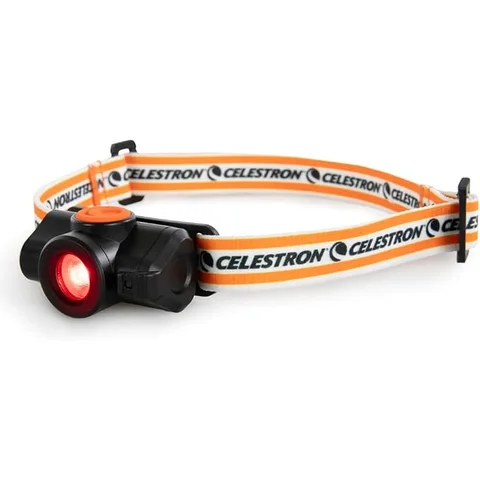
5. Celestron Night Vision red LED headlamp
Every observer needs a red light, and a headlamp beats a flashlight because both hands stay free for the chart and the focuser. This one is red only, so nobody can switch it to white by mistake and blind the group at a star party. At my first club observing night in Ontario, someone opened a car door with the dome light on and twenty people groaned at once. A red-only lamp avoids being that person.
- Red LED only, high and low brightness plus blink and SOS
- 45 degree tilt, adjustable strap
- Up to 100 hours on AAA batteries (not included)
Good: solves a real problem every single night out. Not great: even the low setting is bright for reading charts at a very dark site; tilt it down and away. Celestron also sells a red flashlight version.
Best upgrade for a beginner scope
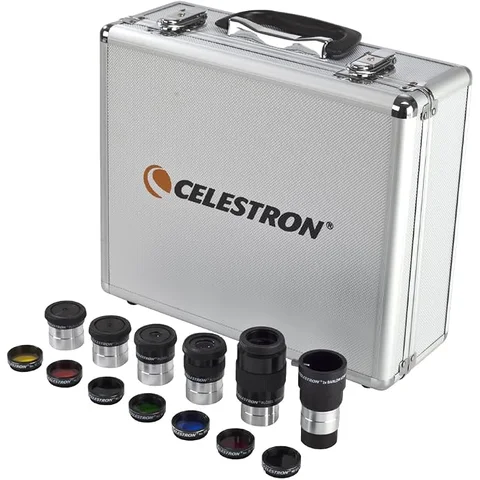
6. Celestron eyepiece, Barlow and filter kit
Beginner telescopes ship with two eyepieces, often of mediocre quality, which leaves big gaps in magnification. This kit fills them: five Plössl eyepieces from 32 mm (low power, wide views of star clusters) to 6 mm (high power for the planets), a 2x Barlow that doubles each of them, a Moon filter and a set of colored planetary filters, all in a foam-lined metal case. It fits any telescope that takes standard 1¼-inch eyepieces, which covers nearly every beginner scope.
The Moon filter alone earns its place this year: the full Moon falls on Christmas Eve 2026, and through a telescope it’s bright enough to make your eye water. See do you need a Moon filter and our eyepiece set guide for more options.
- 32, 17, 13, 8 and 6 mm Plössl eyepieces, 52 degree field
- 2x Barlow lens, Moon filter, colored planetary filters
- Hard case with room for more eyepieces
Good: the most practical upgrade for a new telescope. Not great: the 6 mm Plössl has a small eye lens and is tight for glasses wearers. If they only need the filter, the Celestron Moon filter is sold on its own.
Best for sharing the view
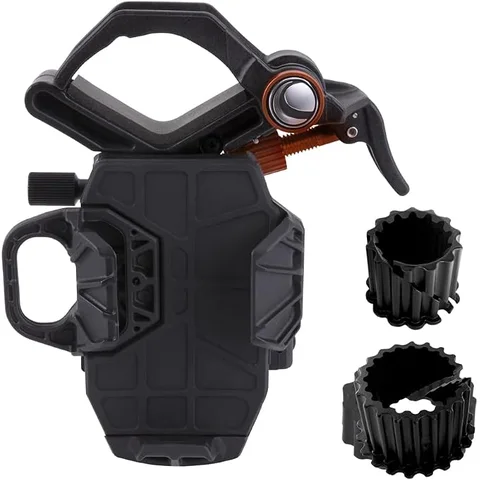
7. Celestron NexYZ phone adapter
The first thing new observers want after seeing Saturn is a photo of Saturn. Holding a phone up to an eyepiece by hand almost never works. The NexYZ clamps onto the eyepiece and uses three knobs to center the phone camera over it, and the spring-loaded holder takes the phone off and back on without losing that alignment. It’s the easiest way to get Moon photos that are worth sending to family.
For a fuller astrophotography kit, see our night sky photography accessories.
- Fits eyepieces from 35 to 60 mm outside diameter, 1¼ and 2 inch
- Holds phones up to 10 ounces, most cases on
- Also works on binoculars, spotting scopes and microscopes
Good: turns a visual telescope into a Moon and planet camera. Not great: the adapter is heavy enough to tip a small tabletop scope out of balance.
For the 2027 eclipse
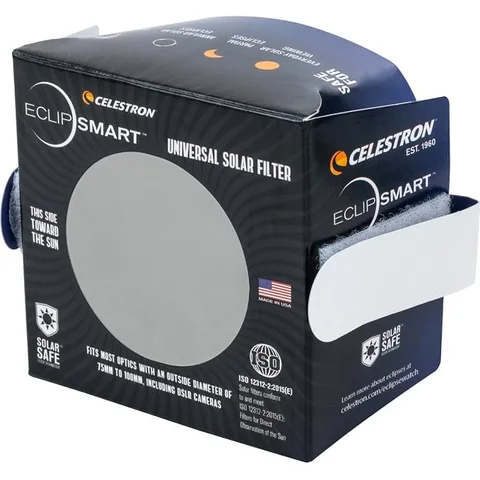
8. Celestron EclipSmart universal solar filter
A solar filter turns a night-only telescope into a daytime one. With safe solar film over the front of the tube, the Sun becomes an orange disc with sunspots, and the Sun is still near the active peak of its 11-year cycle. The bigger reason to give one this Christmas is the total solar eclipse of August 2, 2027, which crosses southern Spain, North Africa and Egypt with more than six minutes of totality near Luxor. Check every upcoming eclipse in our next eclipse finder.
The filter must cover the front of the telescope, never the eyepiece. This one fits objective lenses with an outside diameter of 75 to 100 mm, which means small refractors, spotting scopes and camera lenses. For a 130 mm reflector, measure the tube and buy the size that matches.
- Meets ISO 12312-2:2015 for direct solar viewing
- Film made in the USA by American Paper Optics
- Adjustable panels and an elastic band, folds flat for storage
Good: safe sunspot and eclipse views with the telescope they already own. Not great: it fits only a 75 to 100 mm range; measure first.
For GoTo telescope owners
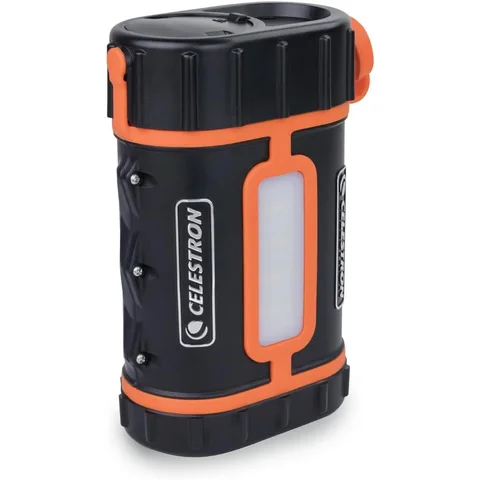
9. Celestron PowerTank Lithium Pro
Computerized telescopes eat AA batteries, and cold makes it worse: alkaline cells lose much of their capacity below freezing, so the mount slows down or loses its alignment halfway through the night. A 12 V lithium iron phosphate pack fixes both problems. This one powers any current Celestron computerized telescope, has a 12 V car-socket port, two USB ports for phones and a red and white flashlight built in.
- 12 V output, 12,400 mAh LiFePO4 battery rated for 2,000 cycles
- Up to 17 hours of telescope power (depends on the mount)
- Two USB ports, red and white LED light, 4.5 pounds
Good: a full night of power in winter and an emergency battery at home. Not great: only worth it for a motorized mount; a manual Dobsonian doesn’t need it.
For cold nights
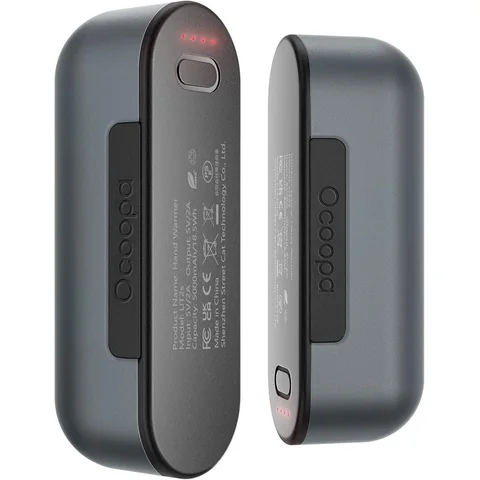
10. OCOOPA rechargeable hand warmers (2-pack)
Observing is standing still in the cold, and you can’t focus a telescope with mittens on. Rechargeable hand warmers go in a pocket between targets and bring your fingers back in a minute. These two halves snap together with magnets into one palm-sized warmer or split into two, one per pocket, and one half doubles as a power bank for a phone that the cold is draining.
- Four heat levels up to 137°F (58°C)
- 5,000 mAh battery, 8+ hours on low
- Aluminum body, magnetic split design
Good: the gift a winter observer actually uses every night. Not great: on the highest setting the run time drops sharply; charge both halves before every session.
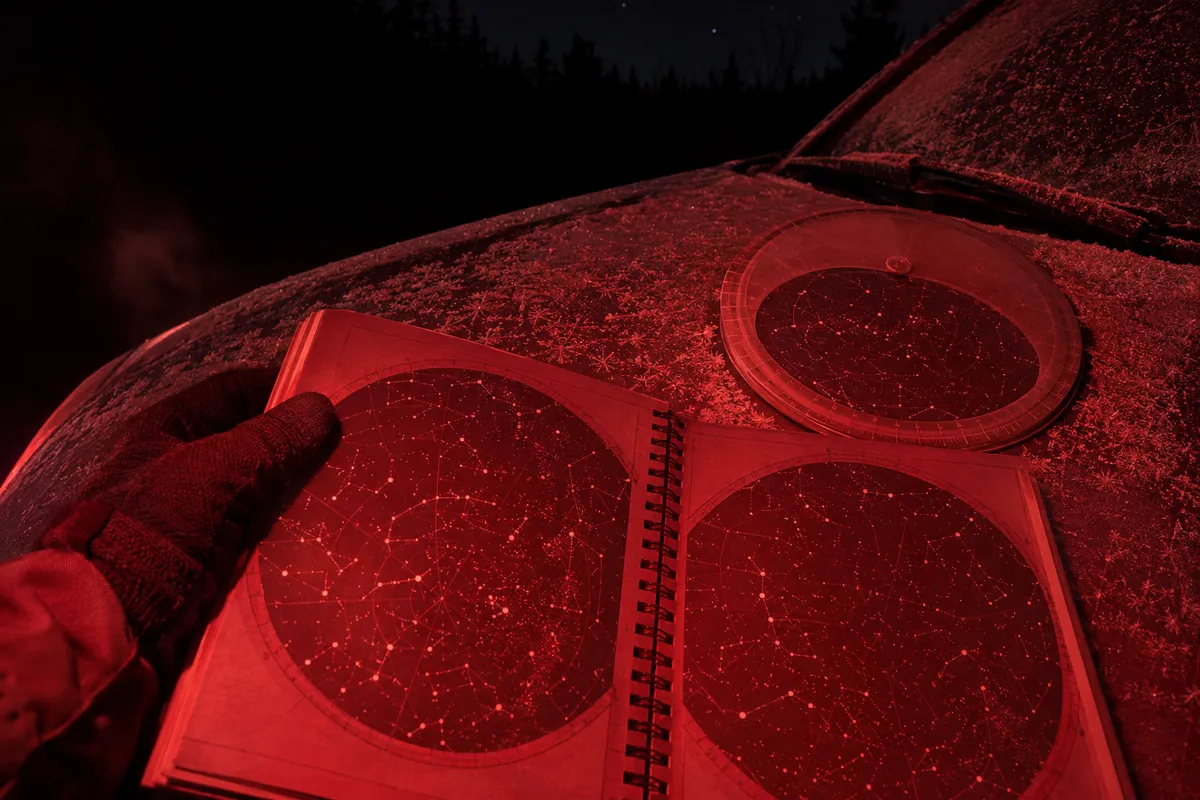
Astronomy books and star charts
Books are the most reliable astronomy gift. They don’t need batteries, they get used on cloudy nights and the best ones make the telescope more useful. If you’re shopping for a reader rather than an observer, our lists of space coffee table books and books about Mars have more ideas.
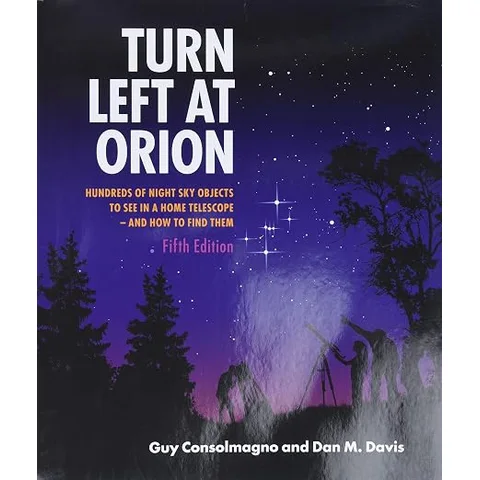
Best book for telescope owners
11. Turn Left at Orion (5th edition)
Guy Consolmagno and Dan M. Davis wrote the book on a simple idea: show each object the way it looks through a small telescope, not the way it looks in a Hubble photo. Each page has a finder chart, a sketch of the eyepiece view and directions in plain language, starting from a bright star you can already find. Consolmagno went on to direct the Vatican Observatory, and the book has been the standard gift for new telescope owners for more than thirty years.
The fifth edition covers hundreds of objects, adds views for different telescope types and is spiral-bound so it lies flat on a table in the dark.
- Cambridge University Press, 256 pages, spiral-bound
- Charts and eyepiece sketches for each object, sorted by season
Good: the fastest way to turn “what do I look at?” into a plan. Not great: it’s large and floppy; keep it in a dry bag because dew warps the pages.
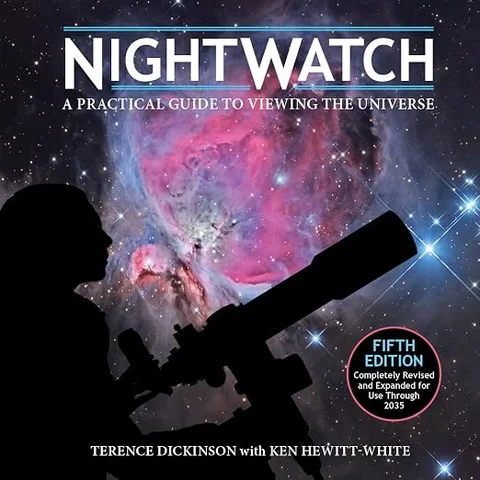
Best book for beginners
12. NightWatch: A Practical Guide to Viewing the Universe (5th edition)
Terence Dickinson was a Canadian astronomy writer, and NightWatch is the book I hand to anyone who says they want to “get into astronomy.” It starts with naked-eye stargazing, moves through binoculars and choosing a first telescope, and finishes with a set of seasonal star charts that are among the clearest in print. The fifth edition, revised with Ken Hewitt-White, has planet and eclipse tables for use through 2035.
- Firefly Books, 208 pages, spiral-bound
- Seasonal star charts, equipment advice, event tables to 2035
Good: the most complete beginner book that is also pleasant to read. Not great: for someone past the beginner stage, The Backyard Astronomer’s Guide by Dickinson and Alan Dyer (416 pages, 4th edition) goes much deeper into equipment and astrophotography.
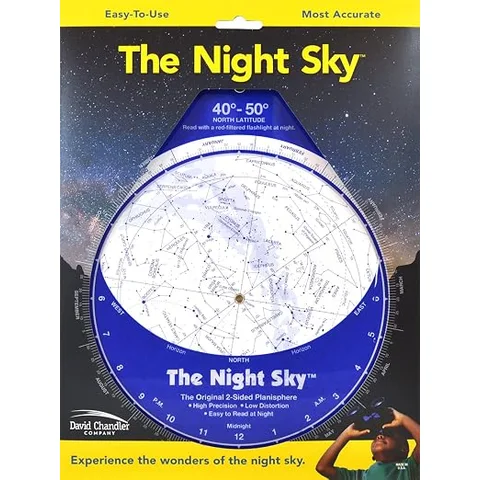
Best star finder
13. David Chandler The Night Sky planisphere
A planisphere is a star wheel: turn it to the date and time and it shows which constellations are above the horizon. It needs no batteries, no signal and no screen glow. Most planispheres squeeze the whole sky onto one side, which badly stretches the southern constellations. Chandler’s design prints the sky on both sides, one for looking north and one for looking south, so the shapes on the wheel match the shapes in the sky.
Buy the latitude band where they live. This is the 40 to 50 degree north version, which covers most of the northern US and southern Canada. Chandler also makes 30 to 40 degree and 20 to 30 degree versions for the southern states.
- Large size, durable plastic, two-sided design
- Shows constellations, bright stars and the Milky Way
Good: the most useful thing you can give a new stargazer for the least money. Not great: it doesn’t show planets, which move; check the Moon phase and a planet app for those.
Best star atlas
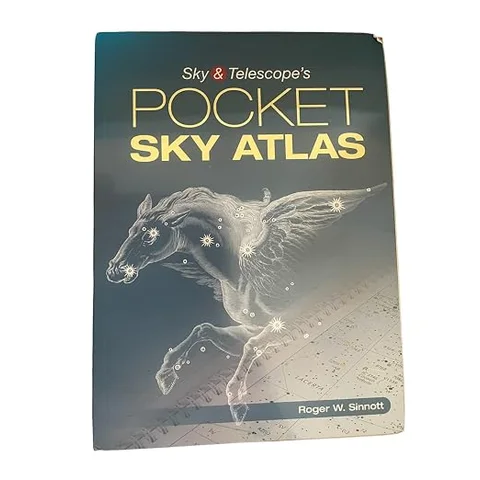
14. Sky & Telescope’s Pocket Sky Atlas (2nd edition)
Once someone outgrows a planisphere, they need a star atlas that shows stars fainter than the eye can see, so they can star-hop from a bright star to a faint galaxy. Roger Sinnott’s Pocket Sky Atlas is the one most observers carry: 30,000 stars and about 1,500 deep-sky objects on charts small enough to hold at the eyepiece. The second edition is published by the American Astronomical Society and is spiral-bound to lie flat.
- Spiral-bound, sized for the observing table
- Close-up charts of crowded areas like the Virgo galaxy cluster
Good: the right next step after Turn Left at Orion. Not great: the type is small; a red headlamp with a low setting is a must. When I checked, Amazon listed it through a third-party bookseller, so check the seller before you order.
Space gifts for the home and desk
Some astronomy lovers will never stand in a frozen field at 2 a.m. These are gifts for the space lover who wants the sky indoors: building sets, a Moon that turns on its own, a planetarium for the bedroom ceiling and a piece of an asteroid.
Best LEGO for astronomy lovers
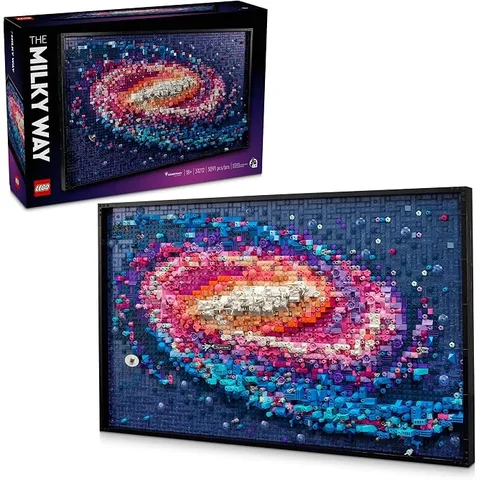
15. LEGO Art The Milky Way Galaxy (31212)
This is the LEGO set with the most real astronomy in it: a layered 3D picture of our galaxy built from 3,091 pieces, with real objects marked in their places, including the Pleiades, the Crab Nebula, the Pillars of Creation and the TRAPPIST-1 system. It hangs on a wall at about 26 by 16 inches. The picture is split into five panels with five instruction booklets, so a family can build it together over the Christmas break.
- 3,091 pieces, five panels, wall-mountable
- About 65 x 40 cm (25.5 x 15.5 inches) finished
Good: a group project and a piece of wall art that rewards anyone who knows the sky. Not great: it’s a view of the galaxy from outside, which no one has seen; enjoy it as art rather than a map.
Best for rocket fans
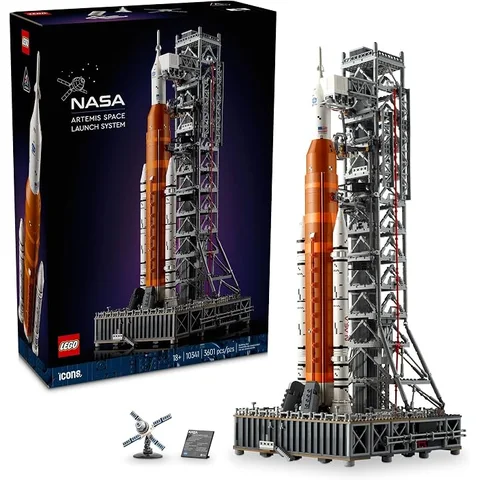
16. LEGO Icons NASA Artemis Space Launch System (10341)
The Space Launch System is the rocket NASA’s Artemis program uses to send astronauts toward the Moon, and this set builds it with the Orion capsule, both solid rocket boosters and the mobile launch tower. The stages separate and the boosters detach. At 3,601 pieces and over 27 inches tall it’s a long build and a large display piece. For space fans who follow launches, pair it with our rocket launch schedule.
- 3,601 pieces, 70 cm (27.5 inches) tall with tower
- Separating stages, detachable boosters, retractable tower arms
- Rated 18+
Good: a current NASA rocket rather than a historic one. Not great: the tower makes it deep; measure the shelf.
Best for kids 10 and up
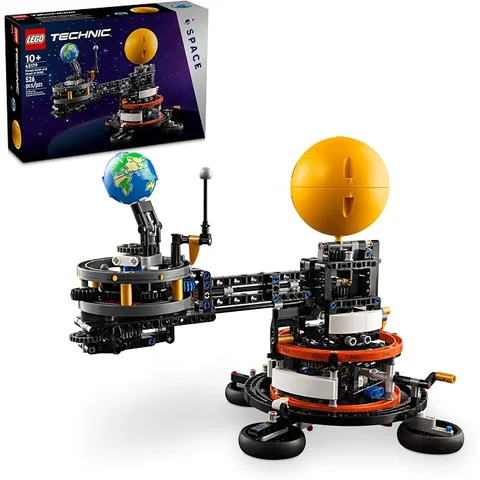
17. LEGO Technic Planet Earth and Moon in Orbit (42179)
A crank-driven orrery: turn the handle and the Earth circles the Sun while the Moon circles the Earth. The base is printed with the months and the Moon’s phases, so a child can see why the seasons change and why the Moon looks different each week. It’s the rare LEGO set that teaches something a parent might struggle to explain. Our telescopes for 10-year-olds guide has bigger gifts for the same age.
- 526 pieces, ages 10+
- Shows orbits, seasons and Moon phases
Good: a working model, not only a display. Not great: distances and sizes are nowhere near scale, which is worth pointing out.
Best desk gift
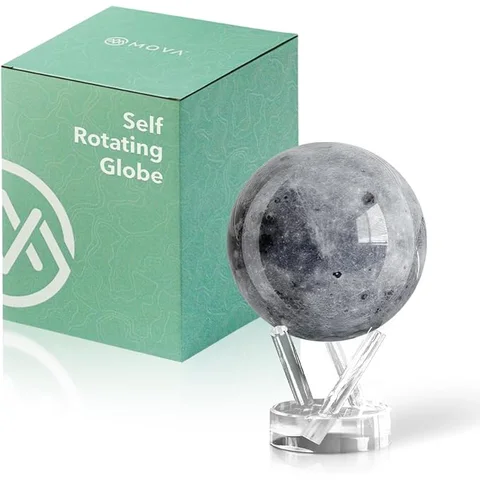
18. MOVA self-rotating Moon globe (4.5 inch)
A small Moon globe that turns on its own with no plug and no batteries. The inner sphere floats in liquid inside a clear acrylic shell, and small solar cells drive it with ambient light and the Earth’s magnetic field, so it keeps rotating slowly on a desk for years. The surface shows the maria and major craters as we see them from Earth. Anyone who has spent time at the eyepiece will find Tycho and Copernicus on it right away.
For the full Moon map with landing sites, try our free 3D Moon model.
- 4.5 inch globe with acrylic base
- Light-powered rotation, no wires or batteries
Good: quiet, unusual and it never needs charging. Not great: it needs a well-lit room to keep turning. For a child’s room, a BRIGHTWORLD Moon lamp is the glowing alternative.
Best home planetarium
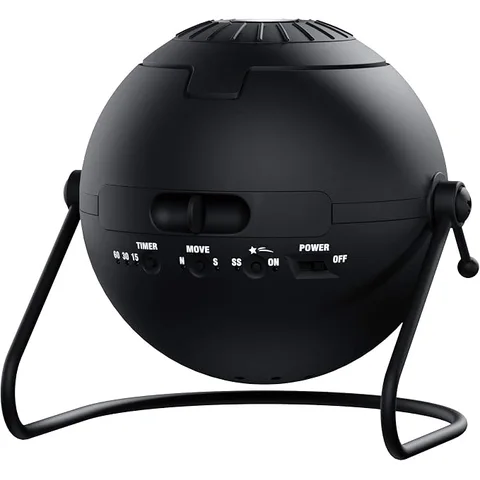
19. Sega Toys Homestar Flux
Most “star projectors” throw colored blobs and lasers onto the ceiling. The Homestar uses glass lenses and a printed disc to project 60,000 stars in their real positions, so the constellations on the ceiling are the ones outside. It was designed with Takayuki Ohira, who builds professional planetarium projectors. Extra discs show the southern sky, the Moon or the Earth from space.
We compare it with the galaxy lights in our star projector guide.
- 60,000 stars, 5 W warm white LED, glass lenses
- Two discs included, more than 30 optional discs
- Quiet rotation, USB powered
Good: the most accurate sky you can put on a ceiling. Not great: it needs a dark room and a fairly plain ceiling, and the extra discs add up.
Best coffee table book
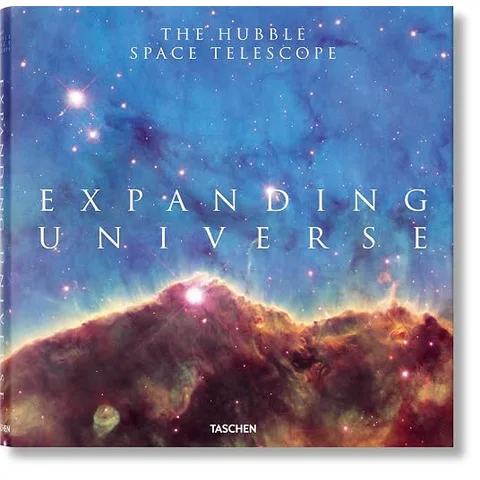
20. Expanding Universe: The Hubble Space Telescope (Taschen)
The Hubble book to own. Taschen printed the telescope’s best images large, on heavy paper, with essays by astronaut and former NASA administrator Charles Bolden, Hubble repair astronaut John Grunsfeld and Zoltan Levay, who processed many of the images. It’s the kind of book that gets opened on Christmas afternoon and passed around the room.
- Taschen, 260 pages, about 11.4 inches square, hardcover
- Multilingual edition
Good: the best printed Hubble images available. Not great: it weighs over five pounds. For Webb rather than Hubble, give Infinite Cosmos by Ethan Siegel from National Geographic.
Most unusual gift
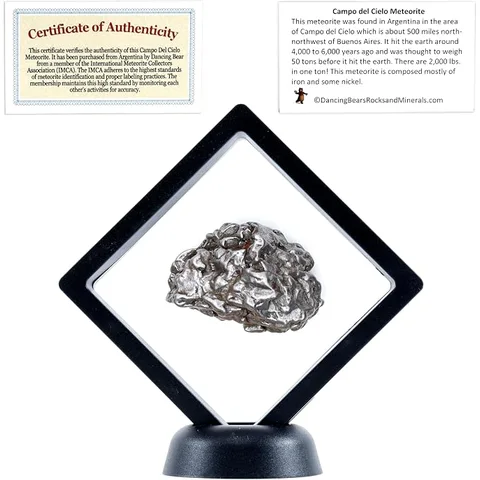
21. Campo del Cielo meteorite (20 to 32 grams)
A real piece of an asteroid, and the only gift on this list that came from space. Campo del Cielo is an iron meteorite shower that fell on northern Argentina about 4,000 years ago and left a field of craters. Because tons of fragments were recovered, genuine pieces are common and affordable, and they are heavy for their size because they are mostly iron and nickel. This one comes with an ID card and a certificate of authenticity.
Meteorites are legal to buy and own in the US; our guide on meteorite laws covers the exceptions in other countries. For the stories behind the big ones, see famous meteorites.
- Genuine Campo del Cielo iron, 20 to 32 grams
- Gift box, ID card and certificate
Good: it surprises everyone who picks it up. Not great: iron meteorites rust; keep it dry and away from salty hands.
For the new year
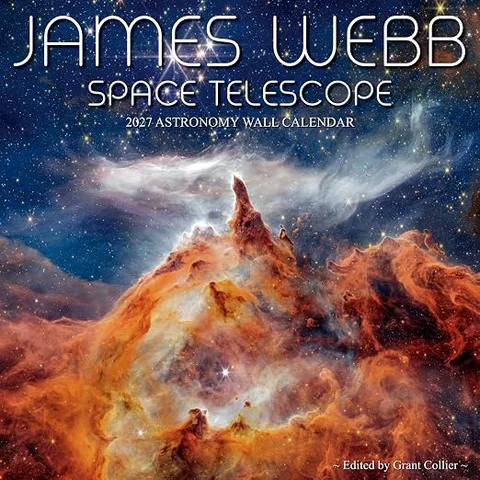
22. James Webb Space Telescope 2027 wall calendar
A practical gift with a December deadline. Collier Publishing’s calendar runs twelve months of Webb images at 12 by 12 inches, so 2027 opens with a new nebula or galaxy on the wall every month. It’s an easy add-on to a bigger gift, or a stand-alone present for a teacher or co-worker who likes space.
- 12 x 12 inches, 24 pages, January to December 2027
- Images from the James Webb Space Telescope
Good: a year of space images for very little shelf space. Not great: it’s done by next December.
Astronomy stocking stuffers
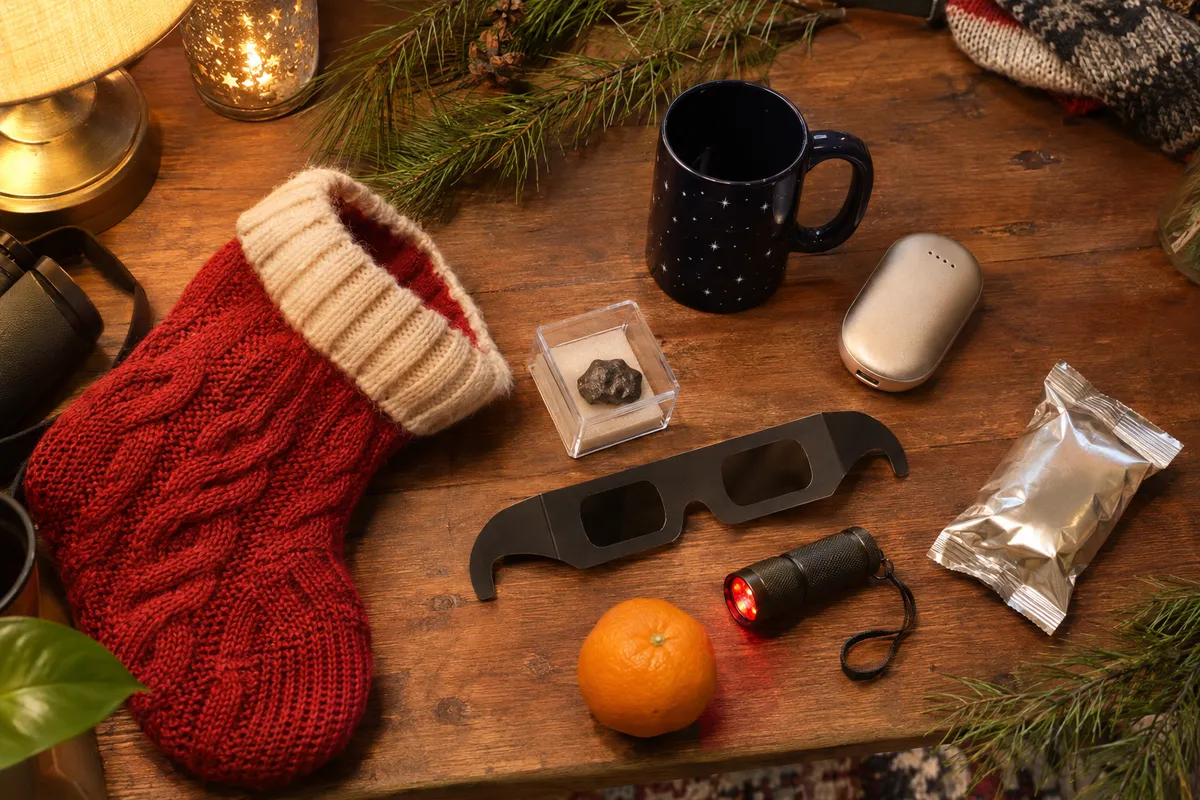
Small gifts that fit in a stocking and still get used. The red headlamp and the planisphere above also fit in most stockings.
Best stocking stuffer
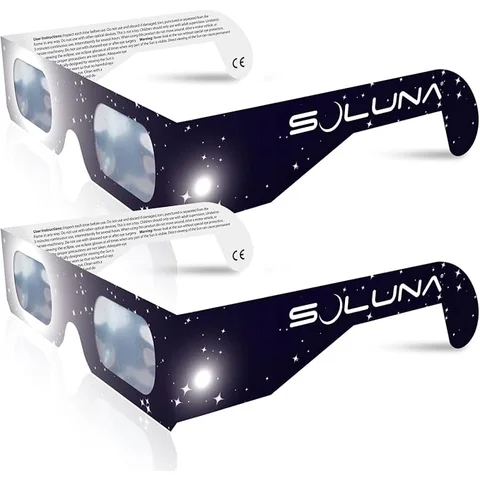
23. Soluna solar eclipse glasses
Eclipse glasses are made by American Paper Optics in the USA and meet the ISO 12312-2 standard for looking straight at the Sun. They’re the simplest way to see a large sunspot group with the naked eye, and everyone heading to Spain, Morocco or Egypt for the August 2, 2027 total eclipse will need a pair for the partial phases. Put one pair in each stocking and the family is ready.
Never look through binoculars or a telescope while wearing eclipse glasses. The optics concentrate sunlight and burn through the film; those need a front filter like the EclipSmart above. Read more in types of eclipses explained.
- ISO 12312-2:2015 compliant, tested by ICS Laboratories
- Made in the USA by American Paper Optics
Good: safe and useful for years if stored flat. Not great: throw them away if the film is scratched or creased.

Best mug
24. Unemployed Philosophers Guild constellation mug
Cold, the mug shows a field of stars. Pour in coffee and the lines appear, joining the stars into Orion, Ursa Major, Cassiopeia, Scorpius, Taurus, Perseus and more. It’s a small gift that rewards anyone who can name the patterns, and a good way to learn them for anyone who can’t.
- 12 oz ceramic, heat-reveal constellation lines
- Microwave safe, hand wash only
Good: fun every morning, and the constellations are accurate. Not great: the heat-sensitive coating doesn’t survive a dishwasher.
For the adult stargazer
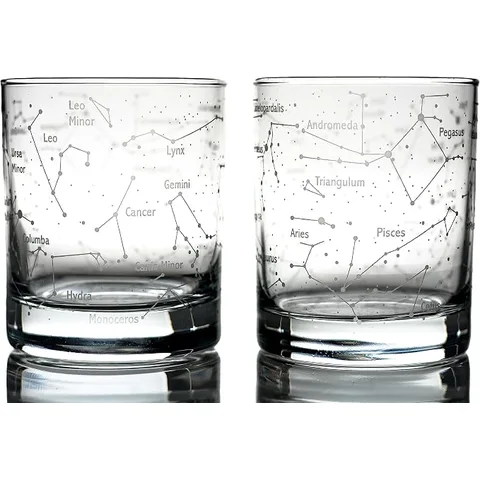
25. Greenline Goods constellation whiskey glasses
A pair of 10 oz rocks glasses with a star map sand-etched all the way around, constellation lines included. They’re a better adult gift than most of what comes up when you search for “space gifts,” and they work as well for a hot chocolate after a cold night out as for whisky.
- Set of two, 10 oz, heavy base, lead free
- Dishwasher safe etching
Good: looks good on any shelf, not only in a space fan’s house. Not great: glasses are the one item here you can’t wrap in a stocking without padding.
The fun one
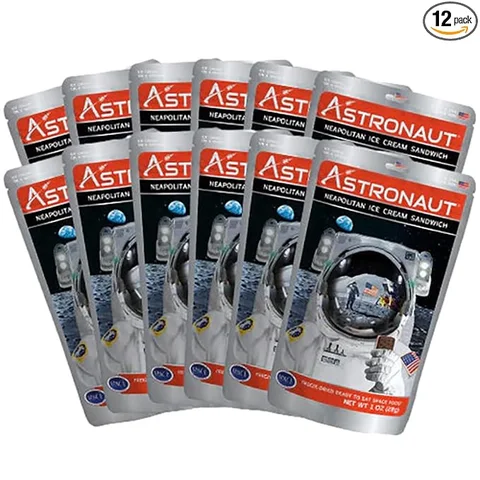
26. Astronaut freeze-dried ice cream sandwiches
Every science museum gift shop sells astronaut ice cream, and kids love it. The true story is better than the packaging: according to the Smithsonian’s National Air and Space Museum, freeze-dried ice cream flew in space only once, on Apollo 7 in 1968, and the crew didn’t care for it because it was too crumbly for weightlessness. Real ice cream reached the International Space Station in 2006, in a freezer carried up by the Space Shuttle. Tell that story when you hand it over.
- 12 individually wrapped Neapolitan sandwiches
- No refrigeration needed
Good: shareable and a conversation starter. Not great: it’s chalky and sweet, and nobody eats a second one.
Astronomy gifts you can’t wrap
Some of the best gifts for an astronomy lover are experiences.
- A night under a dark sky. Book a cabin near a certified dark sky park for a new Moon weekend. The Milky Way from a truly dark site is the thing most city astronomers have never seen. Start with our list of dark sky parks in the US.
- An astronomy club membership. Clubs run observing nights with telescopes members can try, which is the best way to learn before buying. NASA’s Night Sky Network lists clubs across the US, and the Royal Astronomical Society of Canada has centres from Victoria to St. John’s.
- Planetarium tickets or a membership. Many planetariums sell annual passes and run winter evening shows. Our state-by-state planetarium guides, starting with New York, list what’s open.
- A trip to the 2027 eclipse. The August 2, 2027 total solar eclipse is the big one for the next few years, and hotels along the path in Spain and Egypt are already filling.
Astronomy gifts to skip
- “Name a star” certificates. The International Astronomical Union does not recognize any paid star registry, and the name appears nowhere outside the company’s own database. We explain why in are star naming sites legit?
- Telescopes sold by magnification. A box that advertises “525x power” is a warning sign. Useful magnification is limited by the size of the lens or mirror, and these telescopes usually come with wobbly mounts and poor eyepieces. Look for the aperture in millimeters instead.
- White flashlights and bright gadgets. Anything with a white light and no red mode ends up ruining someone’s night vision.
- A surprise telescope for someone who has been researching one. They probably have a model in mind. Ask, or give a gift card with a printed copy of our telescope finder results.
For more ideas by budget and age, see our astronomy gift ideas for adults, our wider list of space themed gifts, space board games for family game night and space jewelry made from real space rocks. If you’re shopping for someone just starting out, astronomy for beginners is a good page to send with the gift.
FAQ
What is a good Christmas gift for an astronomy lover?
For someone without a telescope, astronomy binoculars such as the Celestron SkyMaster 15×70 and a planisphere make the best first gift. For someone who already owns a telescope, a red LED headlamp, an eyepiece and filter kit or the book Turn Left at Orion are the most useful. For space fans who don’t observe, LEGO’s Milky Way Galaxy art set or a Sega Homestar planetarium are good choices.
What do you buy an amateur astronomer who has everything?
Buy for comfort and convenience: rechargeable hand warmers, a 12 V lithium power pack for a GoTo mount, a solar filter for daytime observing or a trip to a dark sky site. A new star atlas such as the Pocket Sky Atlas or a club membership also suits experienced observers.
Is a telescope a good Christmas gift?
Yes, if the person wants one and you pick a telescope that is easy to use. The Celestron StarSense Explorer DX 130AZ uses a phone to find targets, and the Sky-Watcher Heritage 130P sets up in two minutes. Avoid telescopes advertised by magnification, and if the person has been researching models, ask before you buy.
What are good astronomy stocking stuffers?
Eclipse glasses, a red LED headlamp or flashlight, a planisphere, a heat-changing constellation mug, a small meteorite and astronaut ice cream all fit in a stocking. Eclipse glasses are especially timely before the August 2, 2027 total solar eclipse.
What can I see with astronomy binoculars?
Astronomy binoculars show craters on the Moon, the four largest moons of Jupiter, the Pleiades and other star clusters, the Orion Nebula and the Andromeda Galaxy as a soft glow. Large 15×70 binoculars should be mounted on a tripod to hold them steady.
Why do astronomers use red lights?
The eye takes 20 to 30 minutes to adapt to the dark, and white light undoes that adaptation in seconds. The eye’s night vision cells are much less sensitive to red light, so a dim red light lets you read charts and set up equipment without losing the ability to see faint stars.
Are star naming gifts real?
No. The International Astronomical Union, which assigns official star names, does not sell names and does not recognize the companies that do, so astronomers never use those names. A planisphere or a night under a dark sky is a better gift.
Can you look at the Sun with a telescope?
Only with a certified solar filter over the front of the telescope, such as the Celestron EclipSmart filter. Never use eclipse glasses behind a telescope or binoculars, and never use a filter that screws onto the eyepiece, because the focused sunlight can crack it and cause instant eye damage.
Sources
- American Astronomical Society, How to view a solar eclipse safely.
- NASA Science, Eclipses.
- International Astronomical Union, Frequently asked questions (buying star names).
- Smithsonian National Air and Space Museum, We all scream, even in space, for ice cream.
- Meteoritical Society, Meteoritical Bulletin: Campo del Cielo.
- DarkSky International, International Dark Sky Places program.
- Product details from each Amazon listing, checked November 10, 2026.