As an Amazon Associate, Little Astronomy earns from qualifying purchases. The links below go to Amazon.
More holiday ideas for kids are in our Christmas gifts for kids who love space.
Looking for more space gifts? See our Christmas gifts for astronomy lovers.
Our family plays board games at least twice a week, and space games make up a big part of the shelf. Some are serious strategy games that take a whole evening. Others are 10-minute card games that our kids pull out after dinner. This list covers the space board games we keep coming back to, sorted by who they suit best.
Every game here is in print and sold on Amazon US as of November 2026. Picks from the older version of this list that are now out of print or hard to find new, like Space Hulk and Tiny Epic Galaxies, have been replaced.
Quick picks
| Game | Best for | Players | Ages |
|---|---|---|---|
| Terraforming Mars | Best overall | 1 to 5 | 12+ |
| The Crew: The Quest for Planet Nine | Best card game | 2 to 5 | 10+ |
| The Search for Planet X | Best for astronomy fans | 1 to 4 | 13+ |
| Space Base | Best dice game | 2 to 5 | 14+ |
| Starry Night Sky | Best constellation game | 2 to 4 | 10+ |
| Astronomy Fluxx | Best for classrooms | 2 to 6 | 8+ |
| Space Escape | Best for young kids | 2 to 4 | 7+ |
| Cows in Space | Best silly game | 2 | 6+ |
| Spaceteam | Best party game | 3 to 6 | 12+ |
| Race for the Galaxy | Best quick strategy | 2 to 4 | 12+ |
| CATAN Starfarers | Best for CATAN fans | 3 to 4 | 14+ |
| Twilight Imperium 4th Edition | Best epic game | 3 to 6 | 14+ |
The 12 best space board games
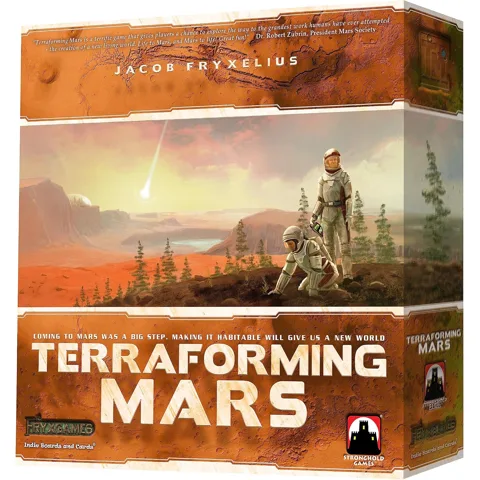
Best overall
1. Terraforming Mars
- Players: 1 to 5
- Ages: 12+
- Play time: about 2 hours
Each player runs a corporation that is turning Mars into a planet people can live on. You raise the temperature, add oxygen and place oceans, and the game ends when all three reach their targets. The cards are the heart of it: over 200 projects, from importing ammonia-rich asteroids to releasing lichen and building domed cities.
What we liked: No two games feel the same because the cards come out in a different order every time. My teenager learned more about the Martian atmosphere from this game than from any school unit, and the solo mode keeps it on the table when no one else wants to play. If your kids get hooked, our interactive 3D map of Mars shows the real places named on the board, like Tharsis and Hellas.
Drawbacks: The player boards are thin cardboard and the cubes slide around when someone bumps the table. A five-player game can run past three hours. It is a game for older kids and adults.
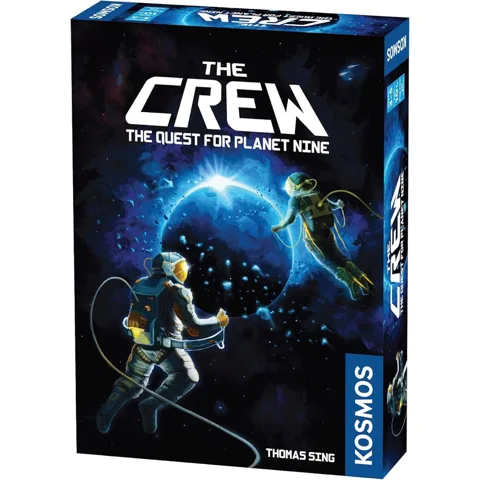
Best card game
2. The Crew: The Quest for Planet Nine
- Players: 2 to 5 (best with 3 to 5)
- Ages: 10+
- Play time: about 20 minutes
The Crew is a cooperative trick-taking game, so if you have played Hearts or Spades you already know half the rules. The twist is that you win or lose together. The logbook has 50 missions that send your crew across the solar system, and each one adds a new condition, like “win the pink 3” or “win the first trick.” Talking about your cards is limited, so you have to read each other’s plays.
What we liked: It fits in a coat pocket and is one of the cheapest games on this list. We play three or four missions after dinner and keep track in the logbook. It won the Kennerspiel des Jahres in 2020, and it deserved it.
Drawbacks: The space theme is light. You are playing cards with rocket art, not flying a ship. The two-player variant works but is weaker than the full game.
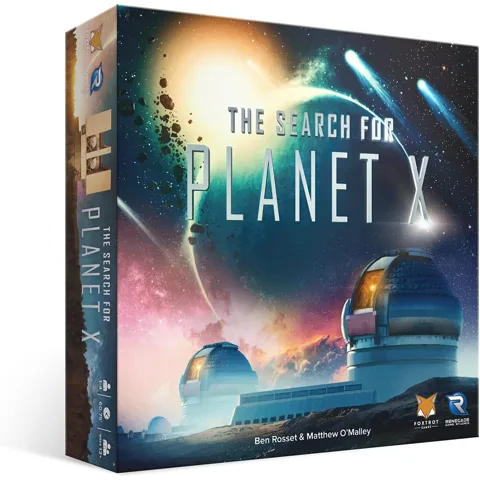
Best for astronomy fans
3. The Search for Planet X
- Players: 1 to 4
- Ages: 13+
- Play time: 60 to 75 minutes
- Needs: free companion app
This is the closest any board game gets to real astronomy. Each player is an astronomer surveying a ring of sectors for comets, asteroids, dwarf planets, gas clouds and the hidden Planet X. The free app sets up a new solar system every game and answers your survey questions. You use logic rules (comets only appear in certain sectors and every asteroid sits next to another asteroid, for example) to narrow down where Planet X has to be.
What we liked: It mirrors the real search for a ninth planet beyond Neptune, and the deduction is satisfying in the same way a good Sudoku is. Publishing your theories before the others gives it a race feel. It is the game I pick when guests ask what kind of science we do at home.
Drawbacks: You need a phone or tablet on the table. Players who dislike logic puzzles will find it dry, and younger kids need an adult partner.
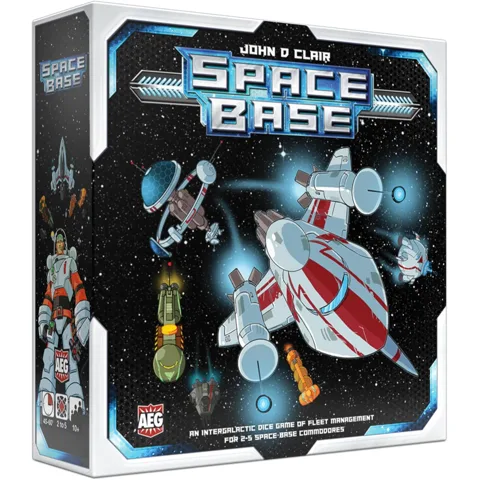
Best dice game
4. Space Base
- Players: 2 to 5
- Ages: 14+ on the box
- Play time: about 60 minutes
You roll two dice and every ship in your fleet that matches the numbers activates. Ships can also pay out on other players’ turns, so nobody sits around waiting. When you buy a new ship, the one it replaces moves to your deployed row and pays out when other players roll. The first player to 40 points wins.
What we liked: It plays like a supercharged Machi Koro. You can teach it in two rounds, and the end game gets loud because everyone is cheering for the right roll. Our 11-year-old plays it fine despite the 14+ rating.
Drawbacks: Luck decides some games. The card text is small and the iconography takes a game to learn. Stock on Amazon comes and goes, so check the seller before you buy.
Best constellation game
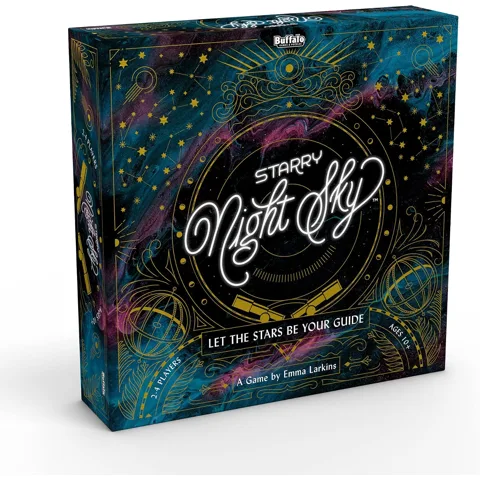
5. Starry Night Sky
- Players: 2 to 4
- Ages: 10+
- Play time: 30 to 45 minutes
Designed by Emma Larkins for Buffalo Games, Starry Night Sky has you move a shared telescope across the sky board and place stars to complete constellations before dawn. You score points for each star, bonus points for exploration goals and more points for the constellations on your secret myth cards.
What we liked: It is the best-looking game on our shelf, with a dark board and glowing star art. The telescope piece makes the theme feel real, and the myth cards gave my daughter an excuse to ask about the stories behind each constellation. It pairs well with our constellation quiz for the next morning.
Drawbacks: The constellations are stylized, so it does not teach the real sky in any detail. Experienced gamers will find it light.
Best for classrooms
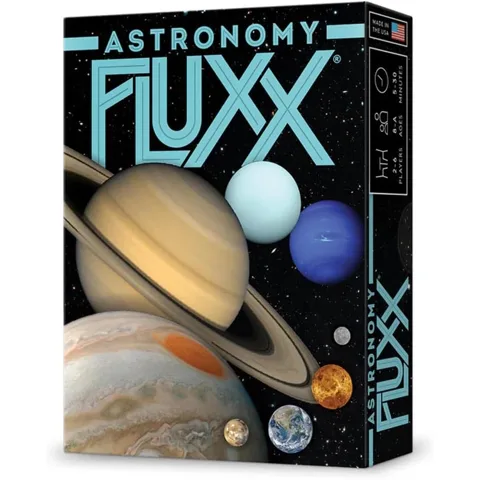
6. Astronomy Fluxx
- Players: 2 to 6
- Ages: 8+
- Play time: 5 to 30 minutes
Fluxx is the card game where the rules change as you play. You start with “draw one, play one,” and the cards you play change how many you draw, how many you hold and what you need to win. In Astronomy Fluxx the goal cards pair real objects, like the Sun and the Moon or a telescope and a planet, and the cards use NASA photographs.
What we liked: The NASA photos are the real draw. Kids pick up the names of the planets and missions without noticing. A game can last five minutes, which suits a classroom or a waiting room. Teachers should also look at our free space printables.
Drawbacks: The chaos frustrates kids who like planning. Some games end on a lucky draw before anyone feels they played.
Best for young kids
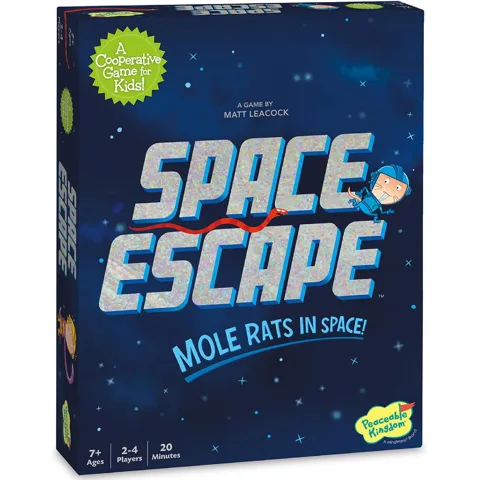
7. Space Escape
- Players: 2 to 4
- Ages: 7+
- Play time: about 20 minutes
Snakes have boarded the mole rats’ space station, and the players work together to collect equipment and get every mole rat to the escape pod. Each card has two actions: one for your mole rat and one for the snakes. The group decides which mole rats move and where the snakes go. It was designed by Matt Leacock, who also made Pandemic.
What we liked: It is a real strategy game scaled down for kids, not a roll-and-move. Because everyone wins or loses together, there are no tears when the game ends. Our seven-year-old started planning two turns ahead after a few plays.
Drawbacks: Adults will solve it quickly once they learn the patterns, though the included challenge rules help. Kids under seven will need help with the double-action cards.
Best silly game
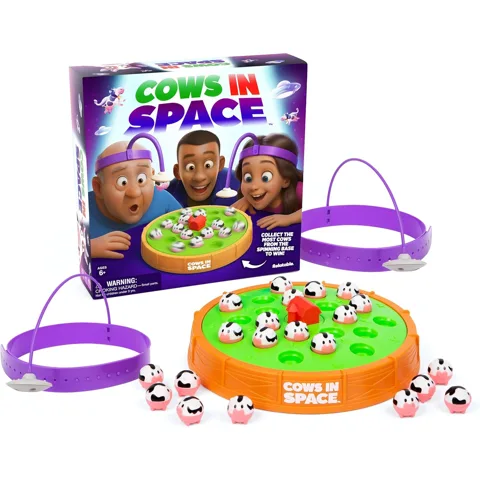
8. Cows in Space
- Players: 2
- Ages: 6+
- Play time: about 10 minutes
- Needs: 2 AA batteries (not included)
Each player wears a UFO headband with a magnet and tries to abduct the magnetic cows off a spinning farm base, no hands allowed. Whoever beams up the most cows wins.
What we liked: It is pure slapstick and the whole room watches. Grandparents took a turn at Thanksgiving and laughed harder than the kids. It is a good warm-up before a longer game.
Drawbacks: Only two can play at a time. There is no strategy, and the novelty fades faster than the other games here.
Best party game
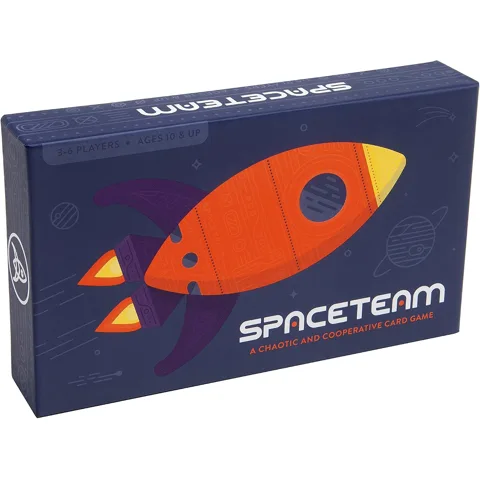
9. Spaceteam
- Players: 3 to 6
- Ages: 12+
- Play time: 5-minute rounds
Your spaceship is falling apart and you have five minutes to fix it. Everyone holds repair cards that need specific tools, and the tools are in other players’ hands. There are no turns. You shout, trade and pass cards as fast as you can until the timer runs out. It is based on the Spaceteam mobile game.
What we liked: It breaks the ice faster than anything else we own. The cards are plastic, so spilled drinks are not a problem. We use it to start game nights with a big group.
Drawbacks: It is loud. Quiet players get steamrolled, and it is not a game for a calm evening.
Best quick strategy
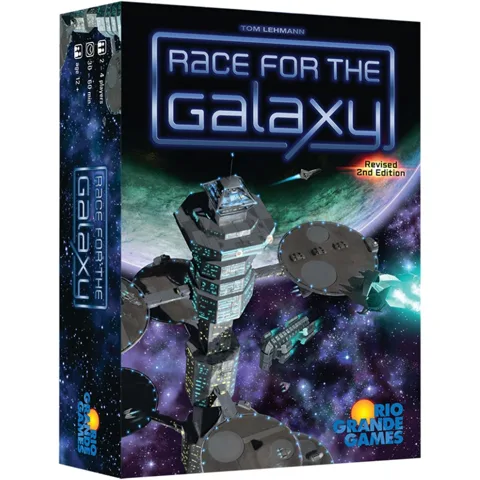
10. Race for the Galaxy
- Players: 2 to 4
- Ages: 12+
- Play time: 30 to 60 minutes
Each round, every player secretly picks an action card (explore, develop, settle, produce or consume) and everyone reveals at once. Only the chosen phases happen, so you try to pick actions that help you and not your rivals. You build a galactic empire out of worlds and technologies on cards.
What we liked: It packs a two-hour strategy game into 45 minutes. Once you know the cards, games go fast and every decision matters. My partner and I play it as a two-player game on weeknights.
Drawbacks: The icons are a wall at first, and the first game is rough. It is not one to bring out for casual players.
Best for CATAN fans
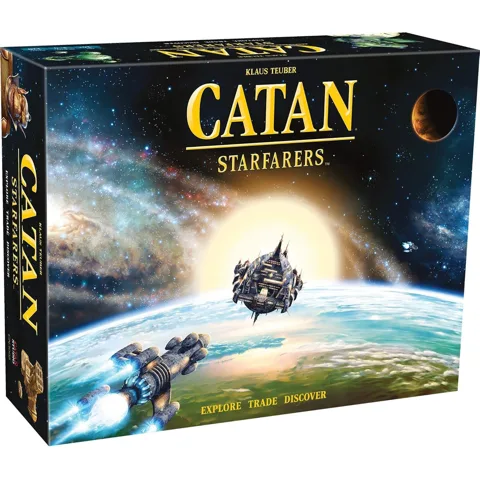
11. CATAN Starfarers
- Players: 3 to 4
- Ages: 14+
- Play time: about 2 hours
Starfarers takes the CATAN rules of rolling for resources, trading and building and moves them to space. You fly a snap-together mothership, found colonies and trading posts and meet alien races. Movement and encounters use a mothership you shake to drop colored balls, which works like a dice roll.
What we liked: Families who already play CATAN learn it in minutes. The motherships are great table pieces, and you can upgrade them with boosters, freight pods and cannons. The encounter cards add a story to every game.
Drawbacks: It is a standalone game, not a CATAN expansion, and the box is big. Three players is the sweet spot. The rules for encounters take a while to look up the first time.
Best epic game
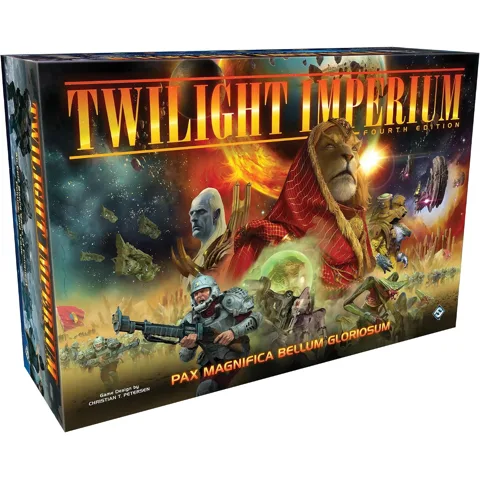
12. Twilight Imperium 4th Edition
- Players: 3 to 6
- Ages: 14+
- Play time: 4 to 8 hours
Twilight Imperium is the biggest space game you can buy. Each player leads one of 17 factions fighting for the throne of Mecatol Rex through war, trade and politics. The box holds over 1,000 pieces, and the galaxy board is built from hex tiles so no two games look alike.
What we liked: Nothing else matches the sense of running a space empire. The negotiation and voting rounds create stories that our group still retells years later. It is the game we plan a whole Saturday around.
Drawbacks: It takes a full day, and teaching it takes an hour. It sits at the top of the price range for board games. Buy it only if you already know you have five friends who will commit to it.
How to choose a space board game
Start with who will play
Player count rules out more games than anything else. Cows in Space is two players only, CATAN Starfarers needs three, and Twilight Imperium is not worth it under five. For a couple, The Crew, Race for the Galaxy and Terraforming Mars all work at two. For a big group, Spaceteam and Astronomy Fluxx handle six.
Match the ages on the box, then adjust
Age ratings measure rules and reading, not ability. A child who reads well and has played other strategy games can handle Space Base or Terraforming Mars a couple of years early. For kids under eight, stick with Space Escape or Cows in Space. For mixed ages, The Crew and Starry Night Sky are the safest bets.
Decide how long you want to play
Short games get played more often. The Crew, Astronomy Fluxx and Spaceteam fit a weeknight. Terraforming Mars and Starfarers need an evening. Twilight Imperium needs a day.
Pick cooperative or competitive
Cooperative games (The Crew, Space Escape, Spaceteam) are best for younger kids and for families where losing ends in tears. Competitive games suit groups that enjoy a rivalry.
Theme or real science
Most space games are science fiction with spaceships and aliens. If you want the game to teach something, look at The Search for Planet X (deduction like a real sky survey), Astronomy Fluxx (NASA photos) or Terraforming Mars (planetary science).
More space fun for kids and adults
A space board game makes a great gift. For more ideas, see our space-themed gifts list, our astronomy gift ideas for adults and the best space books for kids by age. If the games spark an interest in the real sky, our guide to the best telescopes for 10-year-olds is the next step. For a quick game on a phone, try Guess the Space Photo.
FAQ
What is the best space board game?
Terraforming Mars is the best space board game for most families with older kids and adults. It has deep strategy, a solo mode and a science theme about making Mars habitable. For a shorter and cheaper game, The Crew: The Quest for Planet Nine is the best pick.
What is a good space board game for kids?
Space Escape is the best space board game for kids aged 7 and up. It is cooperative, so everyone wins or loses together, and it was designed by the creator of Pandemic. For kids 8 and up, Astronomy Fluxx teaches real astronomy with NASA photos. For ages 10 and up, Starry Night Sky and The Crew work well.
Is there a board game about real astronomy?
Yes. The Search for Planet X has players act as astronomers surveying the sky for a hidden planet, based on the real search for a ninth planet. Starry Night Sky is about mapping constellations, and Astronomy Fluxx uses NASA photographs of planets and spacecraft.
What is the best two-player space game?
Race for the Galaxy is the best two-player space game for adults. Terraforming Mars also plays well with two. For a quick and silly game with a young child, Cows in Space is built for exactly two players.
What is the longest space board game?
Twilight Imperium 4th Edition is the longest popular space board game. A full game with six players takes four to eight hours, and first games often run longer.
Are cooperative space games good for families?
Yes. In cooperative games like The Crew, Space Escape and Spaceteam the players win or lose as a team. Younger kids learn strategy from older players, and nobody ends the night as the only loser.