As an Amazon Associate, Little Astronomy earns from qualifying purchases. The product links below go to Amazon.
A smart telescope is a small telescope, a camera and a computerized mount sealed in one body. You set it on a table or tripod, open an app on your phone and tap a target. The telescope works out where it is pointing from the stars it sees, slews to the object, focuses, tracks it and stacks exposures one on top of another. A minute later the Orion Nebula appears on your screen in color, and it keeps getting cleaner for as long as you leave it running.
That is something no eyepiece telescope can show you. Through a traditional telescope the Orion Nebula is a gray mist, because the human eye cannot build up light over time. A camera can. This is why smart telescopes have become the fastest growing part of amateur astronomy, and why they are now a common first telescope for adults who live under city lights.
This guide covers the six smart telescopes worth buying on Amazon US right now, from the 840 gram Dwarf mini to the 6 inch Celestron Origin Mark II. Each one is listed with what it does well, what it cannot do and who should buy it. The ZWO Seestar S50 is not on the list because it is not sold on Amazon US; its newer sibling, the Seestar S30 Pro, is.
Quick picks
| Telescope | Best for | Aperture | Price tier |
|---|---|---|---|
| ZWO Seestar S30 Pro | Best overall | 30 mm | Mid-range |
| Dwarf mini | Best budget pick | 30 mm | Budget |
| Dwarf 3 | Best for travel and wildlife | 35 mm | Mid-range |
| Vaonis Vespera 3 | Best for long sessions | 50 mm | Premium |
| Unistellar Odyssey Pro | Best with an eyepiece | 85 mm | Premium |
| Celestron Origin Mark II | Best image quality | 152 mm | Splurge |
What a smart telescope can and cannot show you
Smart telescopes are built for the deep sky: nebulae, galaxies and star clusters. These objects are large and faint, and a small lens with a short focal length frames them well. The Andromeda Galaxy is about three degrees long, six times the width of the full Moon. It fits whole in the frame of a Seestar or a Dwarf, and it does not fit in most large telescopes.
Planets are the weak spot. Jupiter and Saturn are tiny in the sky, and seeing their cloud bands or rings in detail takes a long focal length and high magnification. A Seestar S30 Pro shows Jupiter as a small bright disc with its moons as dots beside it. Every manufacturer on this list says the same thing in its own documentation. If the planets are what you want to see, a traditional telescope does that job better and costs less. Our guide to the best telescopes for viewing planets covers those.
The other trade is the eyepiece. With one exception on this list, you look at a phone or tablet, not through glass. Some people miss that. Many more find that sharing a live, colored image with the whole family on a tablet is the better night out.
The 6 best smart telescopes
Best overall
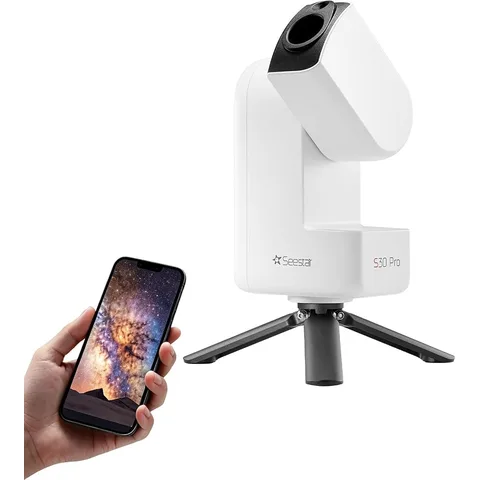
1. ZWO Seestar S30 Pro
- 30 mm, f/5.3 apochromatic
- Sony IMX585, 8.3 MP
- 1,650 g (3.6 lb)
- About 6 h battery
- 128 GB
ZWO’s Seestar S50 brought smart telescopes into a mainstream price range in 2023, and the S30 Pro, released at the end of 2025, is its current model. It pairs a 30 mm four-element apochromatic lens with Sony’s IMX585 sensor, the same 4K astronomy sensor that Vaonis uses in the Vespera 3, a telescope that sits in a much higher price tier. A second camera with a 63 degree wide-angle lens captures the Milky Way, star trails and landscapes, and it shows a wide view of the sky so you can see where the main camera is pointing.
The filters are built in. A dual-band filter that passes only the light of hydrogen and oxygen cuts through city light pollution on nebulae, and a magnetic solar filter comes in the box for the Sun. Active dew control keeps the lens clear on damp nights, which matters more than most buyers expect. A small tabletop tripod and a carrying case are included, so it works the night it arrives.
What I like: The S30 Pro gets the most out of a small aperture. The four-element lens keeps stars round and free of color fringes, the field of view of about 4.6 degrees frames the Andromeda Galaxy, the Pleiades and the whole North America Nebula, and the app is the most polished in this category. It also speaks ASCOM Alpaca, so it can grow with you into astronomy software on a computer.
Drawbacks: In its default alt-azimuth mode, single exposures are limited to 10 seconds because the field slowly rotates as the sky turns. Longer 60 second exposures need equatorial mode, which needs the separate TH10 tripod head (listed under accessories below). Wi-Fi range is about 10 meters, so the phone has to stay close. It is not a planet telescope.
Who should buy it: Anyone buying their first smart telescope. If you are not sure which one to get, get this one.
Best budget pick
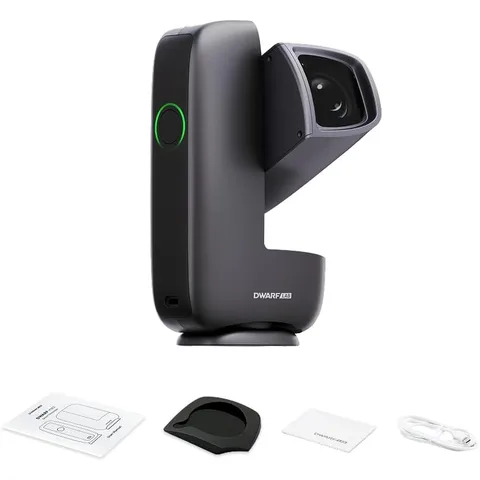
2. DWARFLAB Dwarf mini
- 30 mm, f/5 apochromatic
- Sony IMX662, 2 MP
- 840 g (1.9 lb)
- About 4 h battery
- 64 GB
The Dwarf mini is the least expensive smart telescope from an established brand on Amazon and the lightest one on this list. It weighs 840 grams and fits in a jacket pocket. Inside are a 30 mm apochromatic lens, a wide-angle camera, an astronomy filter, a dual-band nebula filter and a dark filter for calibration. A solar filter comes in the box.
The trick that sets it apart is its equatorial mode. Tilt the Dwarf mini toward the celestial pole on a ball head or wedge, and it takes single exposures up to 90 seconds, the longest of any telescope on this list. Its multi-night stacking keeps adding to the same image across several clear nights, so a faint galaxy can build up over a week.
What I like: It delivers the main promise of the category at the lowest price: you tap the Orion Nebula and watch it appear in color. Its sensor has large 2.9 micron pixels, which suits faint targets.
Drawbacks: The images are 2 megapixels, about Full HD. They look good on a phone and on a computer screen, but they do not crop well or print large. There is no tripod or case in the box. Battery life is about four hours and shorter in the cold. Like every small smart telescope, it shows planets as small dots.
Who should buy it: Families who want to try the hobby without spending much, and hikers or campers who want a smart telescope that weighs less than a water bottle.
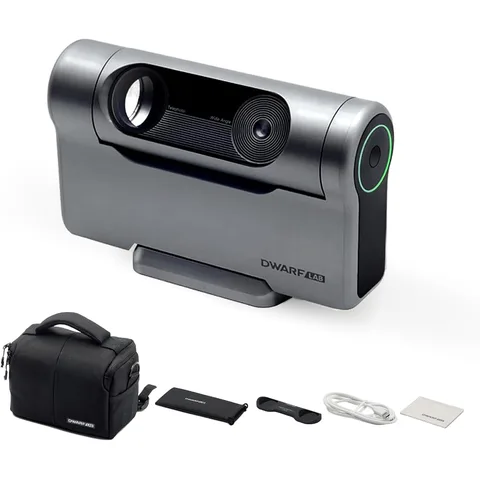
Best for travel and wildlife
3. DWARFLAB Dwarf 3
- 35 mm, f/4.3 apochromatic
- Sony IMX678, 8.3 MP
- About 1,350 g (3 lb)
- Up to 5.5 h battery
- 128 GB
The Dwarf 3 is shaped like a thick book with two lenses on its face: a 35 mm telephoto and a wide-angle. It has three switchable filters, an astro filter, a dual-band nebula filter and a visible-light filter for daytime, plus a magnetic solar filter in the box. It is rated IP54 against dust and splashes and works down to -20 °C, the widest temperature range here.
It is also the most useful smart telescope during the day. The telephoto lens with auto-tracking works as a long camera lens for birds and wildlife, and it shoots panoramas. At night it does 2×2 mosaics for large nebulae and stacks the same target over several nights.
What I like: One device covers a camping trip: a wildlife camera by day, a deep-sky camera at night and a solar camera for sunspots. The 8.3 MP sensor is a big step up from the Dwarf mini.
Drawbacks: No tripod is included, and you will want one (see the Dwarf tripod below). In alt-azimuth mode exposures stay around 10 to 15 seconds; 60 second exposures need equatorial mode. Battery drains faster in the cold, and the Sun and Moon look small in the frame.
Who should buy it: Travelers and nature photographers who want one small device for wildlife by day and nebulae by night.
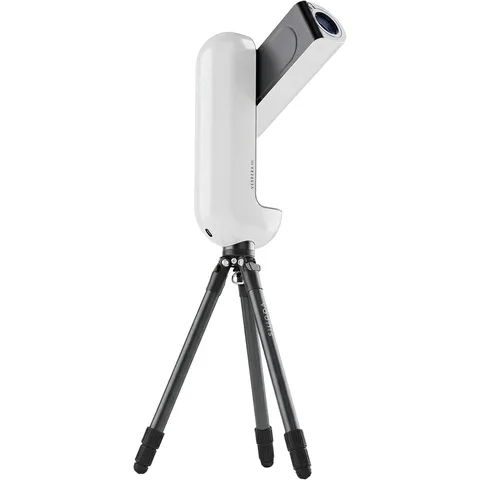
Best for long sessions
4. Vaonis Vespera 3
- 50 mm, f/4.9 apochromatic quadruplet
- Sony IMX585, 8.3 MP
- 5 kg (11 lb)
- Up to 11 h battery
- 115 GB
Vaonis is a French company that designs its telescopes to look like objects you would leave out in the living room, and the Vespera 3, released in April 2026, follows that pattern. It uses a 50 mm flat-field quadruplet lens, the largest refractor on this list, and the same IMX585 sensor as the Seestar S30 Pro. An aluminum tripod comes in the box, as does a five-year warranty.
Its best feature is automatic multi-night capture. You frame a target once, and on each clear night after that you press Resume; the telescope finds the target again and keeps adding to the same stack. Mosaic mode stitches several frames into images up to 24 MP that span 4.3 by 2.4 degrees. The battery lasts up to 11 hours, enough for a full winter night, and an anti-fog system switches on when its humidity sensor says the lens is about to dew up.
What I like: It runs a whole night without attention. The larger lens gathers almost three times the light of a 30 mm Seestar, so faint galaxies build up faster.
Drawbacks: No equatorial mode and no built-in filters; the light pollution filter, the dual-band filter and the solar filter are all separate purchases that you swap by hand. The first alignment of the night can take over five minutes. It costs several times as much as a Seestar.
Who should buy it: Buyers who want to set up a telescope, go to bed and wake up to a finished image, and who value design and build quality.
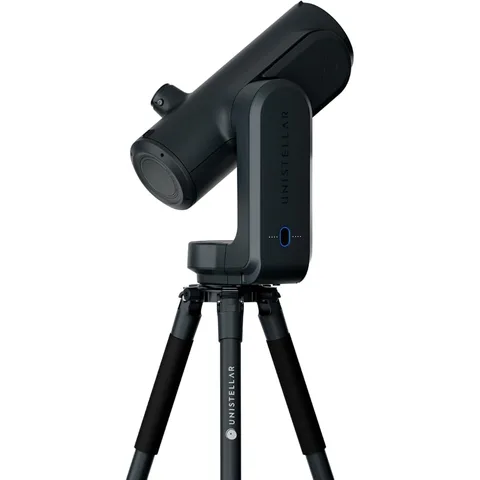
Best with an eyepiece
5. Unistellar Odyssey Pro
- 85 mm Newtonian, f/3.9
- 4.1 MP images
- 4 kg (8.8 lb) plus 2.5 kg tripod
- 5 h battery
- 64 GB
The Odyssey Pro is the only smart telescope on this list you can put your eye to. Unistellar built a digital eyepiece with Nikon: a small high-resolution screen behind real eyepiece optics that shows the live stacked image. It is still a camera view, not light coming straight from the sky, but it feels like using a telescope.
The 85 mm mirror is the second largest aperture here. Focus is automatic and the telescope never needs collimating, the mirror alignment that traditional reflectors need. A full-height tripod is included. Up to ten phones or tablets can connect to it at once, which makes it a strong pick for schools, clubs and outreach. Owners can also join Unistellar’s citizen science campaigns with the SETI Institute, recording exoplanet transits and asteroid occultations for real research.
What I like: The eyepiece. For anyone who feels a telescope should be looked through, this is the smart telescope to buy. Setup takes about two minutes.
Drawbacks: The images are 4.1 MP and the field of view is narrow, so large nebulae do not fit. There are no built-in filters; light pollution is handled in software, and the solar filter is extra. No equatorial mode. Planets look soft. Slewing between targets is slow. If you do not care about the eyepiece, the standard Odyssey has the same optics and app for considerably less.
Who should buy it: Teachers, astronomy clubs and families who want a group to share one telescope, and anyone who wants an eyepiece.
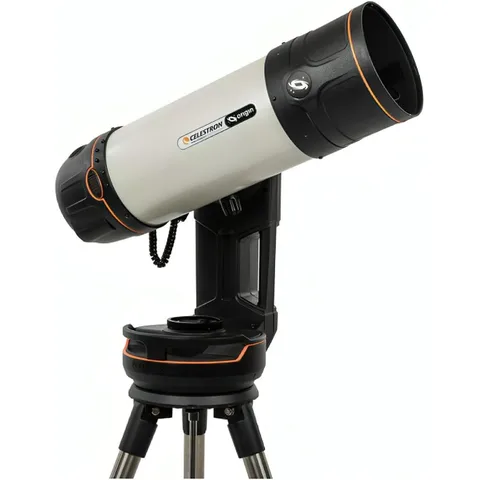
Best image quality
6. Celestron Origin Mark II
- 152 mm RASA, f/2.2
- Sony IMX678, 8.3 MP
- 18.9 kg (41.6 lb) system
- 6 to 7 h battery
- Dew heater
Celestron calls the Origin an “intelligent home observatory”, and the size fits the name. It is built around a 6 inch Rowe-Ackermann Schmidt Astrograph, the same RASA design astrophotographers use for fast deep-sky imaging. At f/2.2 it collects light about five times faster than the f/5 lenses in the small smart telescopes, and its 152 mm aperture gathers about 25 times the light of a 30 mm Seestar. The Mark II, released in late 2025, replaced the original 6.4 MP camera with an 8.3 MP Sony IMX678.
A dew heater, dew shield and environmental sensor are built in. A filter drawer takes standard 1¼ inch and 2 inch filters. Software updates in 2026 added dithering and a mosaic mode, and the app is built on SkySafari, one of the best planetarium apps.
What I like: No other smart telescope comes close on faint galaxies. Light that a 30 mm telescope needs an hour to collect, the Origin collects in a few minutes, and that shows in the dust lanes and spiral arms of galaxies.
Drawbacks: It is a home observatory, not a travel scope: the tube, mount and tripod together weigh 41.6 pounds, carried out in three pieces. The field of view is about 1.3 degrees by three-quarters of a degree, so large nebulae need mosaics. It needs occasional collimation. Below -5 °C the battery shuts down unless you run it from mains power. Planets are not its strength.
Who should buy it: Experienced observers and serious beginners with a backyard who want the best deep-sky images a smart telescope can make and do not need to move it far.
Accessories worth adding
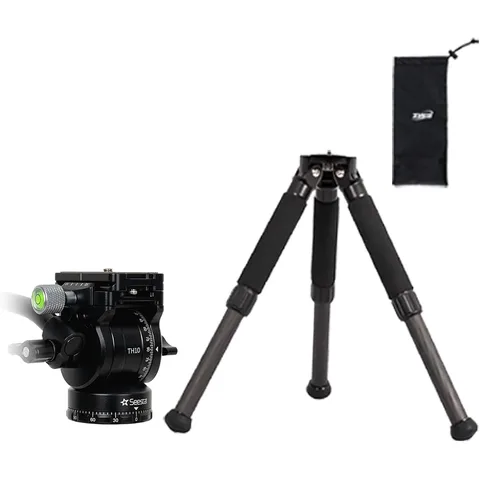
ZWO Seestar TH10 head and TC20 tripod
The S30 Pro’s included tripod sits on a table. This full-height carbon fiber tripod with the TH10 head lifts it above walls and fences, and the head is what unlocks equatorial mode: 60 second exposures and no field rotation. ZWO recommends this pair for S30 and S30 Pro owners. It is the first upgrade to buy for a Seestar.
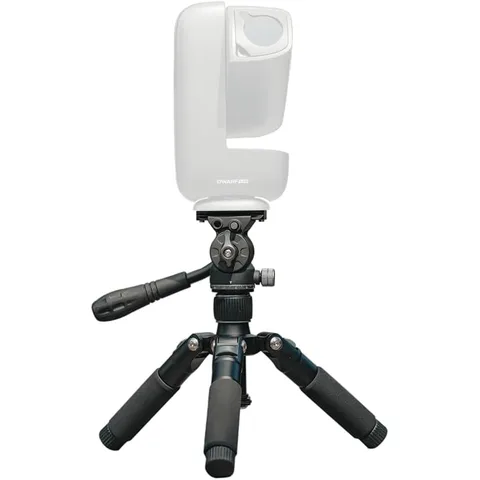
DWARFLAB mini tripod with hydraulic head
Neither Dwarf ships with a tripod. This one is made for them: aluminum, folds to about 7 inches and holds 3 kg. Its hydraulic head tilts far enough to point either Dwarf at the celestial pole for equatorial mode.
How to choose a smart telescope
Aperture decides how fast faint objects appear
Every smart telescope gets there in the end; a bigger lens or mirror gets there sooner. A 50 mm lens gathers almost three times the light of a 30 mm lens, and an 85 mm mirror about eight times. On bright targets like the Orion Nebula the difference is small. On a faint galaxy it decides whether you see it in five minutes or in an hour. Our telescope aperture comparison explains the math.
The sensor decides how much detail you can keep
Four telescopes here record 8.3 MP: the S30 Pro and Vespera 3 with Sony’s IMX585, and the Dwarf 3 and Origin Mark II with Sony’s IMX678. The Dwarf mini records 2 MP and the Odyssey Pro 4.1 MP. For phone screens and social media that gap is small. For prints, crops and computer wallpapers it matters.
Alt-azimuth or equatorial mode
All six telescopes track the sky on an alt-azimuth mount by default: up-down and left-right. Over a long session the image slowly rotates, so they keep each exposure short and correct for it. Equatorial mode tilts the telescope to match Earth’s axis, which removes the rotation and allows longer exposures. The Seestar, both Dwarfs and the Origin (with a wedge) support it. The Vespera 3 and the Odyssey do not. Beginners can ignore this for the first few months. Our guide to types of telescope mounts covers the difference.
Light pollution and filters
A dual-band filter is the best tool against city skies on emission nebulae such as the Orion, Lagoon and Rosette nebulae. The Seestar and both Dwarfs have one built in. On the Vespera 3 it is a separate purchase, and Unistellar handles light pollution in software. Galaxies and star clusters do not benefit from narrowband filters; for those, a darker sky is the only real fix. Our map of the best dark sky locations helps with that.
Weight and where you will use it
The telescope you take out more often shows you more. The Dwarf mini, Dwarf 3 and Seestar all weigh under 4 pounds and travel in a backpack. The Vespera 3 and the Odyssey weigh about 13 and 14 pounds with their tripods, fine for the car but heavy for a hike. The Origin lives at home.
Smart telescope or traditional telescope?
Buy a smart telescope if you live in a city or suburb, want to see nebulae and galaxies in color, want to share the view with others or want pictures to keep. Buy a traditional telescope if you want to look at planets, want to see light with your own eye or want the most aperture for the money. A 6 inch Dobsonian shows Saturn’s rings and Jupiter’s cloud bands better than any telescope on this page. Our best telescopes under 500 guide covers both kinds, and the telescope finder picks one from your answers to a few questions.
FAQ
What is the best smart telescope for beginners?
The ZWO Seestar S30 Pro. It works out of the box with an included tripod, has light pollution and solar filters built in, and its app is the easiest to learn. The Dwarf mini is the best choice for beginners on a tighter budget.
Can you see planets with a smart telescope?
Yes, but small. Small smart telescopes show Jupiter as a bright disc with its four large moons beside it and Saturn as a small ringed shape. Cloud bands and ring detail need a traditional telescope with a long focal length and high magnification.
Do smart telescopes work in cities?
Yes. Live stacking and dual-band filters let smart telescopes show bright nebulae from light-polluted suburbs and cities where an eyepiece telescope shows almost nothing. Faint galaxies still look better from a dark site.
Can you look through a smart telescope?
Most smart telescopes have no eyepiece, and you view the image on a phone or tablet. The Unistellar Odyssey Pro is the exception: it has a digital eyepiece developed with Nikon that shows the live image.
Do smart telescopes need the internet?
No. Each telescope creates its own Wi-Fi network and your phone connects to it directly. You need the internet only to download the app, update firmware and use cloud processing features.
Can a smart telescope photograph the Sun?
Yes, with a solar filter fitted over the lens. The Seestar S30 Pro, Dwarf 3 and Dwarf mini include one. For the Vespera 3, Odyssey and Origin it is a separate purchase. Never point any telescope at the Sun without a proper solar filter. Check our next eclipse finder for the next one you can photograph.
Is a smart telescope a good gift?
For teenagers and adults, yes. It shows results on the first clear night, which is where many first telescopes fail. Children under ten usually do better with a simple eyepiece telescope they can point themselves; see our telescopes for 10 year olds.