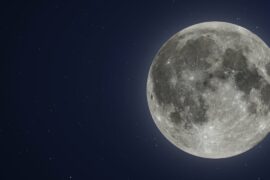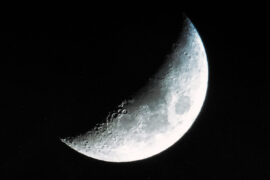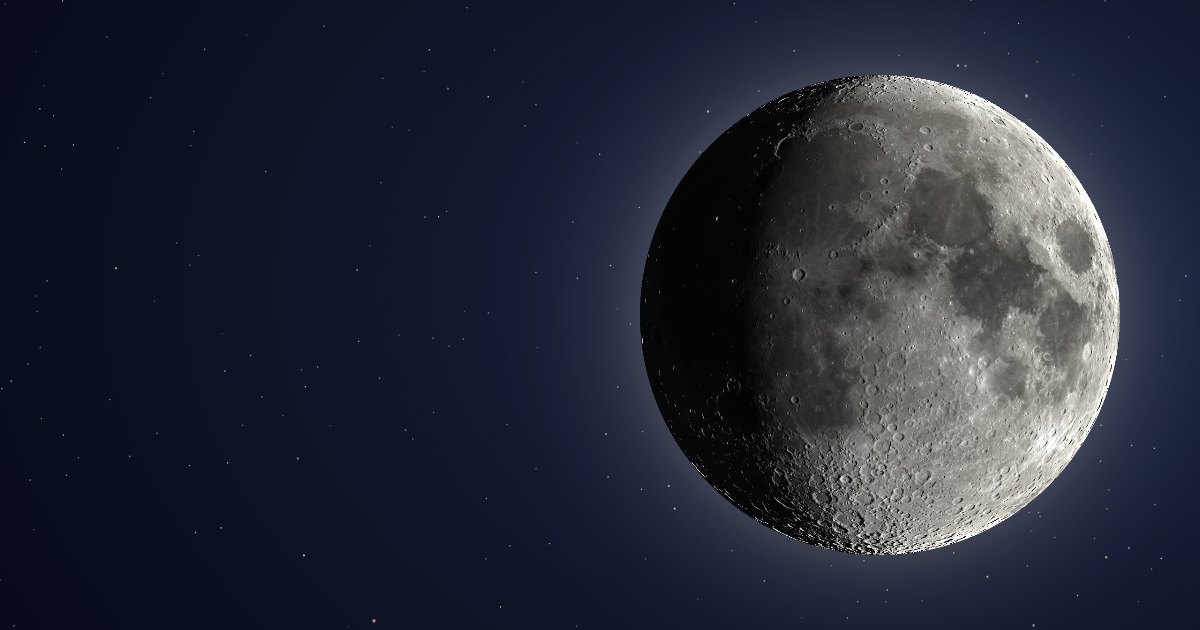
Today, Monday, October 12, 2026, the Moon is a Waxing Crescent, 6% illuminated. The next full moon is the Hunter's Moon on Monday, October 26, 2026 at 12:12 a.m. EDT.
The card below shows the Moon’s phase, its next full moon countdown and its next quarter phases, recalculated each time you open the page.
The Moon right now
Waxing Crescent
- Illuminated
- 6%
- Direction
- Waxing
- Moon age
- 2.4 days
- Distance
- 396,615 km
Is it a full moon tonight? No — 6% lit, full in 13 days.
In 13d 3h 26m
- Next new moon Mon, Nov 9, 2026
- Next first quarter Sun, Oct 18, 2026
- Next last quarter Sun, Nov 1, 2026
This month's full moon: Hunter's Moon, Oct 26, 2026
Times shown in US Eastern (EDT). Your browser will switch them to your own time zone.
When is the next full moon?
The countdown in the card above gives the next full moon to the minute. The table below lists the next 12 full moons with their traditional names and times in US Eastern Time. A full moon comes every 29.5 days on average, so most calendar months have one and a few have two.
| Date | Time (ET) | Name | Notes |
|---|---|---|---|
| 12:12 a.m. EDT | Hunter's Moon | ||
| 9:53 a.m. EST | Beaver Moon | Supermoon | |
| 8:28 p.m. EST | Cold Moon | Supermoon | |
| 7:17 a.m. EST | Wolf Moon | Supermoon | |
| 6:23 p.m. EST | Snow Moon | Penumbral lunar eclipse | |
| 6:44 a.m. EDT | Worm Moon | ||
| 6:27 p.m. EDT | Pink Moon | ||
| 6:59 a.m. EDT | Flower Moon | ||
| 8:44 p.m. EDT | Strawberry Moon | ||
| 11:45 a.m. EDT | Buck Moon | Micromoon Penumbral lunar eclipse | |
| 3:29 a.m. EDT | Sturgeon Moon | Micromoon Penumbral lunar eclipse | |
| 7:04 p.m. EDT | Harvest Moon | Nearest the autumn equinox |
The Moon is full at one exact instant, when it sits directly opposite the Sun in the sky. The names follow the Old Farmer’s Almanac. The Harvest Moon is the full moon closest to the September equinox, and when that one falls in October, September’s full moon is the Corn Moon. Months are assigned by Eastern date, and a second full moon in the same calendar month is a Blue Moon. On this site, a supermoon is a full moon closer to Earth than 361,885 km at the moment it turns full.
For a full year laid out month by month, see every 2027 full moon. For the Moon’s other special cases, including supermoons, blue moons and Blood Moons, see the types of moons.
Is it a full moon tonight?
The Moon looks full on the night of the exact full moon and on the nights just before and after it. It is more than 98% lit for about three nights in a row. The status line in the card above says “yes” when the exact full moon falls on your local date or the Moon is at least 98% lit, and otherwise tells you how many days remain.
The lit fraction falls off slowly from the peak. One day from full the Moon is about 99% lit, two days away about 96% and three days away about 90%. To most people a Moon one day either side of full looks full.
A full moon rises near sunset and sets near sunrise, so it is up all night. If the exact moment falls during your daytime, as it does for much of the US when it lands in the morning, the best view is the evening before or the evening after.
The 8 phases of the Moon
The Moon goes through eight phases in a cycle that averages 29.53 days: new moon, waxing crescent, first quarter, waxing gibbous, full moon, waning gibbous, last quarter and waning crescent. Waxing means the lit part is growing, waning means it is shrinking. The percentages below give the fraction of the visible disk that is lit.
The quarter phases are named for how far the Moon has traveled around its orbit, not for how much is lit. At first and last quarter the Moon is 50% lit, so you see a half disk.
New Moon
0 to 1% lit. The Moon is between Earth and the Sun with its lit side facing away from us. It rises and sets with the Sun and cannot be seen. These are the best nights of the month for faint galaxies and nebulae.
Waxing Crescent
1 to 49% lit. A thin crescent appears low in the western sky after sunset and sets within a few hours. From the Northern Hemisphere the lit edge is on the right. The unlit part often glows faintly with earthshine, sunlight reflected from Earth.
First Quarter
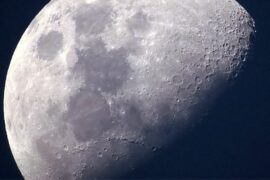
50% lit, about 7.4 days after new moon. The Moon rises around noon, stands highest in the south near sunset and sets around midnight. The line between light and dark is the terminator, and the long shadows along it make this one of the best nights for seeing craters.
Waxing Gibbous
51 to 99% lit. The Moon rises in the afternoon, is up through the evening and sets after midnight. It is visible in daylight on many afternoons.
Full Moon
About 100% lit at the exact moment, and more than 98% for roughly three nights. The Moon rises near sunset, crosses the sky at its highest around midnight and sets near sunrise.
Waning Gibbous
99 to 51% lit. The Moon rises after sunset, later each night, and is up late in the evening and through the early morning. It sets in the morning after sunrise, so it can be seen in the daytime sky.
Last Quarter
50% lit, also called third quarter. The Moon rises around midnight, stands highest in the south near sunrise and sets around noon. From the Northern Hemisphere the lit edge is on the left.
Waning Crescent
49 to 1% lit. A thinning crescent rises in the east shortly before dawn and is lost in the Sun’s glare by sunrise. It is the last chance to see the Moon before the next new moon.
This month’s moon calendar
The calendar below shows the Moon’s shape for each day of the month and marks the new moon, the quarters and the full moon. Use it to plan around the phases: the days around new moon for dark skies, the days around the quarters for crater detail and the days around full moon for the brightest night.
October 2026
| Sunday | Monday | Tuesday | Wednesday | Thursday | Friday | Saturday |
|---|---|---|---|---|---|---|
| 2799% | 2895% | 2989% | 3081% | 171% | 260% | 349%3rd Qtr |
| 438% | 527% | 618% | 710% | 85% | 91% | 100%New |
| 111% | 124% | 139% | 1416% | 1523% | 1632% | 1741% |
| 1850%1st Qtr | 1960% | 2069% | 2178% | 2286% | 2392% | 2497% |
| 25100% | 2699%Full | 2797% | 2891% | 2984% | 3074% | 3163% |
| 152%3rd Qtr | 241% | 330% | 421% | 513% | 67% | 73% |
- Oct 3 Last Quarter 9:25 a.m. EDT
- Oct 10 New Moon 11:50 a.m. EDT
- Oct 18 First Quarter 12:13 p.m. EDT
- Oct 26 Full Moon (Hunter's Moon) 12:12 a.m. EDT
The cycle runs new moon, first quarter, full moon, last quarter and back to new moon, with about 7.4 days between each step. The spacing is not fixed. In the US Naval Observatory tables for 2026 through 2028, the gap between successive new moons ranges from 29.3 to 29.8 days, because the Moon’s orbit is elliptical, it moves faster when it is closer to Earth, and the Sun’s pull speeds and slows it.
What to look at tonight
What you can see depends on the phase. The box below picks targets for the current Moon with links to the telescopes that suit them.
What to look at tonight
The Moon is only 6% lit tonight, so the sky is dark. Faint galaxies, nebulae and star clusters are within reach.
Around first and last quarter, aim any telescope or binoculars at the terminator, where craters and mountain ranges throw long shadows. Near full moon the surface is lit from straight above and looks flat, but the bright ray systems around the craters Tycho and Copernicus stand out best. A bright Moon is also uncomfortable at the eyepiece; a moon filter cuts the glare. Near new moon the sky is dark, which is the time for galaxies, nebulae and star clusters.
If you do not own a telescope yet, the Telescope Finder narrows the choice in a few questions. To see where the Apollo landings happened and how the lunar features line up, use the interactive Moon 3D model.
Frequently asked questions
What is the moon phase today?
The current moon phase is shown at the top of this page, calculated for today’s date in US Eastern Time and refreshed in your own time zone when the page loads. The Moon changes phase gradually, so a given phase lasts about three to four days.
Why does the Moon have phases?
The Sun always lights half of the Moon. As the Moon orbits Earth, we see a different share of that lit half, and the full cycle of phases repeats every 29.5 days. When the Moon is between us and the Sun we see almost none of it, and when Earth is between them we see all of it.
How many nights does the Moon look full?
About three. The Moon is more than 98% lit for roughly one day before and one day after the exact full moon, and most people cannot tell it from a perfect full disk.
When is the next new moon?
The new moon falls about 14.8 days after each full moon. The month calendar above marks it, and the dates for every 2027 new moon are in the table on the 2027 moon calendar.
What are the traditional full moon names?
From January to December: Wolf Moon, Snow Moon, Worm Moon, Pink Moon, Flower Moon, Strawberry Moon, Buck Moon, Sturgeon Moon, Harvest or Corn Moon, Hunter’s Moon, Beaver Moon and Cold Moon. The Harvest Moon is the full moon nearest the September equinox. Each name’s origin is on the full moon names by month list.
Why does the Moon look reversed in the Southern Hemisphere?
Observers south of the equator look at the Moon from the opposite side up, so the lit edge flips. A waxing crescent is lit on the right from the Northern Hemisphere and on the left from the Southern Hemisphere. The phase itself is the same worldwide. The hemisphere switch in the card above flips the picture.
Can you see the Moon during the day?
Yes. The Moon is above the horizon in daylight for several days each side of first and last quarter. A waxing Moon shows up in the afternoon and a waning Moon in the morning. The full moon is the exception: it sets near sunrise and stays in the night sky. The new moon is above the horizon all day but unlit on our side, so it cannot be seen.
What was the moon phase on my birthday?
Enter any date in the moon phase on my birthday calculator to see the phase and illumination for that day, along with the full moon name for that month.