No single equation explains the universe. Nine of them, working at different scales, explain almost everything we’ve measured. They also contradict each other at the edges, and that’s the interesting part.
Gravity, as Einstein described it, is smooth geometry. Everything else, as quantum theory describes it, is lumpy fields and probabilities. Nobody has merged the two into one formula, so there is no “theory of everything equation” on any physicist’s wall yet. What exists is a toolkit, and the nine equations below are the core of it, ordered from the everyday to the cosmic.
Each entry gives the equation, what the symbols mean, a plain-English explanation, and one thing it explained or predicted that nobody had seen yet.
Table of Contents
- 1. Newton’s second law: F = ma
- 2. Newton’s law of gravitation
- 3. Maxwell’s equations
- 4. Boltzmann’s entropy formula
- 5. Einstein’s mass-energy equation: E = mc²
- 6. The Schrödinger equation
- 7. The Standard Model Lagrangian
- 8. Einstein’s field equations
- 9. The Friedmann equation
- Which equations explain the universe at which scale
- What these equations still can’t explain
- Quick-reference table
- FAQ
1. Newton’s second law: F = ma
F = ma
- F: the net force acting on an object, in newtons
- m: the object’s mass, in kilograms
- a: its acceleration, the rate its velocity changes
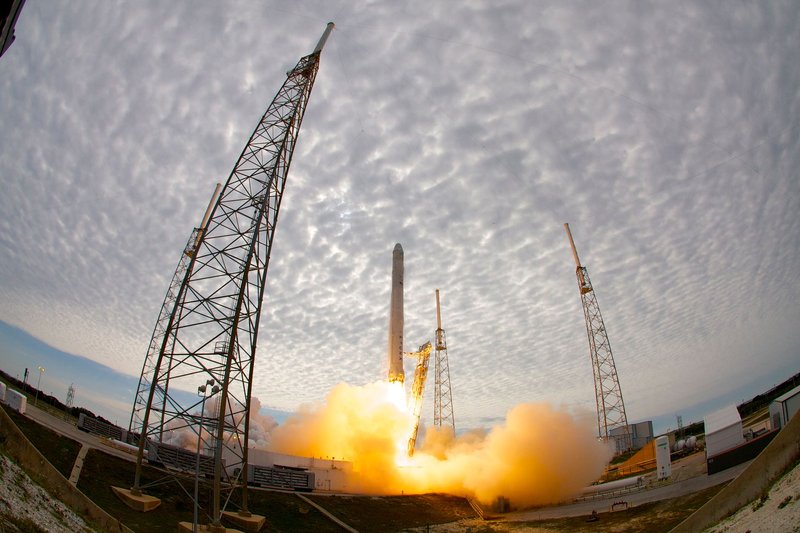
Push something harder and it speeds up faster. Make it heavier and it speeds up slower. That’s the whole equation, and it has been running every rocket launch since the 1950s.
It matters for astronomy because it turns any force into a motion you can calculate. Give it the force of a rocket engine and the mass of the spacecraft, and you get a trajectory. Give it gravity, and you get an orbit. Every mission planner at NASA still starts here.
2. Newton’s law of gravitation
F = G m₁ m₂ / r²
- F: the gravitational pull between two objects
- G: the gravitational constant, about 6.674 × 10⁻¹¹ N·m²/kg²
- m₁, m₂: the two masses
- r: the distance between their centers
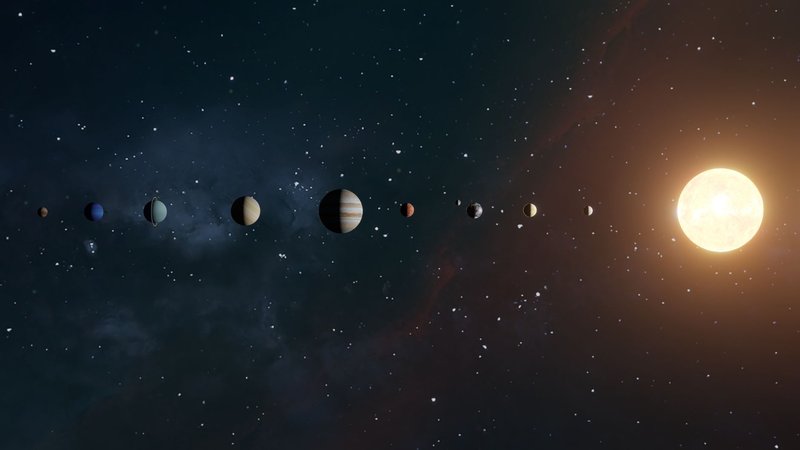
Double the distance and the pull drops to a quarter. Double either mass and the pull doubles. The same rule governs a dropped apple and the Moon, which is the leap Newton made in 1687: the sky isn’t running on different laws from the ground.
The proof of concept came in 1846. Uranus kept drifting off its predicted orbit, and Urbain Le Verrier and John Couch Adams each calculated that an unseen planet was tugging on it. Astronomers pointed a telescope where the numbers said to look and found Neptune. A planet discovered with pencil and paper.
The same equation also hit a wall. Mercury’s orbit swings around the Sun slightly faster than Newton predicts, off by 43 arcseconds per century. That discrepancy waited for item 8.
3. Maxwell’s equations
Four equations, usually written like this:
- ∇·E = ρ/ε₀
- ∇·B = 0
- ∇×E = −∂B/∂t
-
∇×B = μ₀J + μ₀ε₀ ∂E/∂t
-
E, B: the electric and magnetic fields
- ρ, J: electric charge density and electric current
- ε₀, μ₀: two constants that set how strongly electricity and magnetism act in empty space
- ∇·, ∇×: the divergence and curl, which measure how a field spreads out and how it swirls
In words: charges create electric fields, magnetic fields have no loose “magnetic charges,” a changing magnetic field makes an electric one, and a changing electric field (or a current) makes a magnetic one.
Here’s the result that matters. Combine the equations and you get a wave, an electric and magnetic field pushing each other along through empty space. Its speed comes out as 1/√(μ₀ε₀), which is about 299,792,458 meters per second. Maxwell noticed in the 1860s that this was the measured speed of light. Light, it turned out, is an electromagnetic wave.
That’s why astronomy works at all. Radio telescopes, X-ray observatories and the camera in your phone are all reading Maxwell’s waves. In a Physics World reader poll of the greatest equations, Maxwell’s set tied for first place.
4. Boltzmann’s entropy formula

S = k ln W
- S: entropy, a measure of disorder
- k: the Boltzmann constant, about 1.38 × 10⁻²³ J/K
- ln: the natural logarithm
- W: the number of microscopic arrangements that look identical from the outside
Take a cup of hot coffee. There are vastly more ways for its energy to be spread through the room than concentrated in the cup, so the energy spreads. Nothing forces it. It’s just overwhelmingly more probable.
This is the only equation on the list that gives time a direction. Newton’s, Maxwell’s and Einstein’s laws all work the same run forward or backward. Entropy is why eggs break but don’t un-break, and why stars burn their fuel and don’t regain it. The formula is carved on Boltzmann’s tombstone in Vienna.
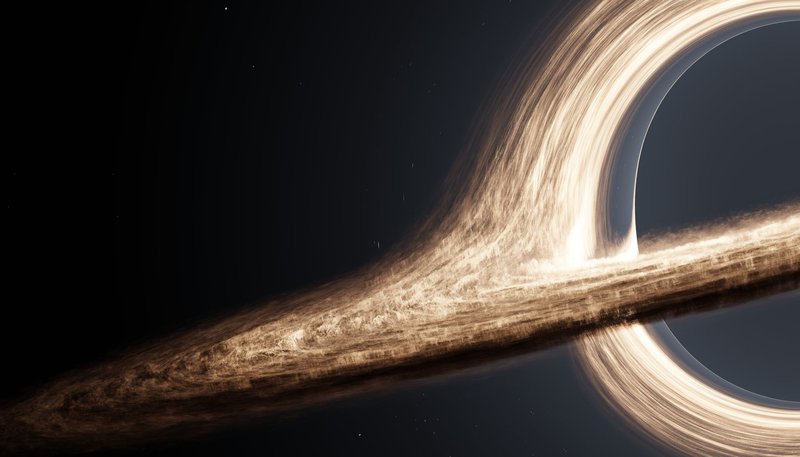
It scales all the way up. Jacob Bekenstein and Stephen Hawking showed in the 1970s that black holes have entropy too, proportional to the area of their event horizon. That result is one of the few clues about where gravity and quantum theory might meet.
5. Einstein’s mass-energy equation: E = mc²
E = mc²
- E: energy
- m: mass
- c: the speed of light, 299,792,458 m/s
Mass is a very compact form of energy. The factor c² is enormous, so a tiny amount of mass corresponds to a huge amount of energy.
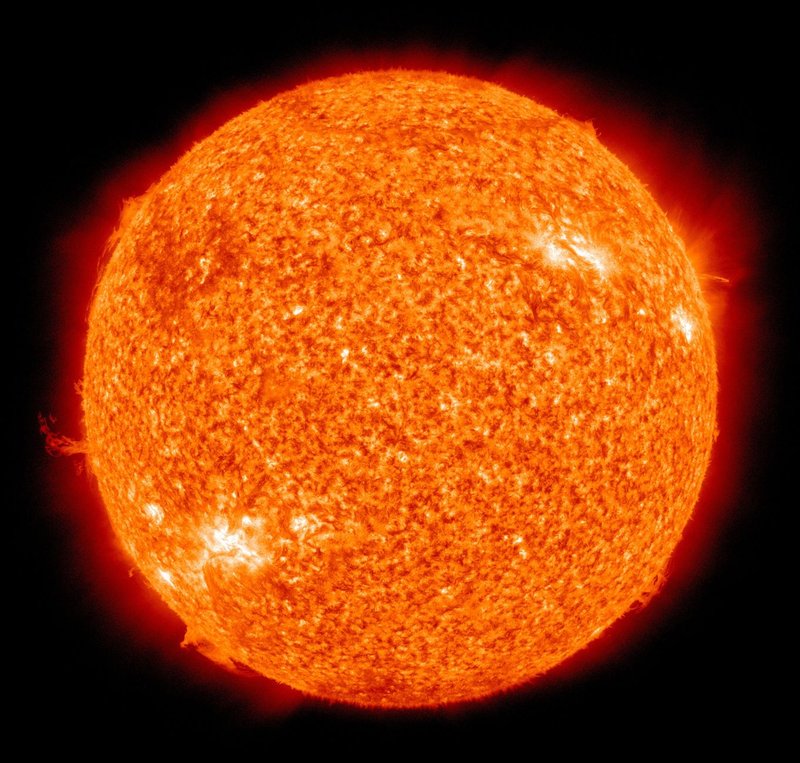
Look at the Sun. Its core fuses hydrogen into helium, and the helium weighs slightly less than the hydrogen that went in. The missing mass becomes sunlight. By this equation the Sun converts roughly 4 million tonnes of mass into energy every second, and has been doing it for about 4.6 billion years.
There’s a counterintuitive detail too. Most of the mass of a proton, about 99 percent, isn’t the mass of the three quarks inside it. It’s the energy of the quarks and gluons bouncing around in there, counted through E = mc². Most of your weight is stored motion.
6. The Schrödinger equation
iħ ∂ψ/∂t = Ĥψ
- ψ (psi): the wave function, which encodes everything knowable about a quantum system
- i: the imaginary unit, the square root of −1
- ħ: the reduced Planck constant, about 1.055 × 10⁻³⁴ J·s
- ∂ψ/∂t: how the wave function changes over time
- Ĥ: the Hamiltonian, which represents the total energy of the system
At small scales, particles don’t have a single position until they’re measured. They have a spread of possibilities, and the Schrödinger equation tells you how that spread evolves. Square the wave function and you get the probability of finding the particle at each spot.
Schrödinger published it in 1926, and it immediately explained why hydrogen only emits light at specific colors: the electron can only sit in certain energy levels. Spectroscopy relies on this. When astronomers identify hydrogen, helium or iron in a star 1,000 light-years away, they’re matching its spectral lines to quantum energy levels this equation predicts.
It also keeps the Sun lit. The Sun’s core, at about 15 million kelvin, is too cool for protons to overcome their mutual electric repulsion by brute force. Quantum tunneling lets a fraction of them slip through the barrier anyway, and fusion runs.
7. The Standard Model Lagrangian
𝓛 = −¼ F_μν F^μν + i ψ̄ D̸ ψ + ψ̄ᵢ yᵢⱼ ψⱼ φ + h.c. + |D_μ φ|² − V(φ)
- F_μν: the strength of the force fields (photon, gluons, W and Z bosons)
- ψ: the matter particles, quarks and leptons
- D̸: the term that couples matter particles to the force fields
- y: coupling strengths that give particles their masses through the Higgs field
- φ: the Higgs field
- V(φ): the Higgs potential, shaped like the bottom of a wine bottle
- h.c.: “plus the Hermitian conjugate,” a bookkeeping term that completes the mirror-image counterpart
Read left to right, the five terms say: how the force fields move, how matter moves and feels those forces, how matter picks up mass from the Higgs field, how the Higgs field itself moves, and the shape of its energy landscape.
This is the one most lists skip, or bury in jargon. It’s a single line (physicists often write it expanded across several lines) that describes every known particle and three of the four fundamental forces: electromagnetism, the weak force and the strong force. CERN’s overview of the Standard Model counts 17 fundamental particles: 12 matter particles, 4 force carriers and the Higgs boson.
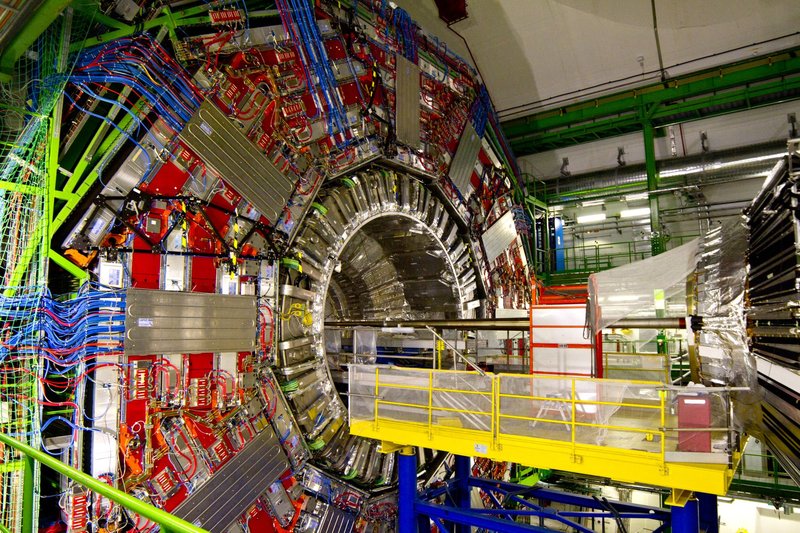
Its sharpest prediction was the Higgs boson. The mechanism was proposed in 1964 and the particle was found at CERN’s Large Hadron Collider in 2012, after almost half a century of waiting.
Notice what it leaves out. Gravity isn’t in it. Neither is dark matter. Neutrino masses had to be added by hand.
8. Einstein’s field equations
G_μν + Λ g_μν = (8πG/c⁴) T_μν
- G_μν: the Einstein tensor, which describes how spacetime is curved
- Λ (lambda): the cosmological constant, an energy built into empty space
- g_μν: the metric, which defines distances and times in spacetime
- T_μν: the stress-energy tensor, which describes where matter and energy are and how they move
- G, c: Newton’s gravitational constant and the speed of light
The shortest version: matter tells spacetime how to curve, and curved spacetime tells matter how to move. The left side is geometry. The right side is stuff.
Einstein finished the equations in 1915, and they fixed Newton’s problem right away. Plug in the Sun’s mass and you get Mercury’s extra 43 arcseconds per century. In 1919, expeditions photographed stars near the Sun during a solar eclipse, and the apparent shift in their positions matched Einstein’s prediction for bent starlight. In 2015, LIGO detected gravitational waves from two merging black holes, a ripple in spacetime that the equations predicted a century earlier.
You use them daily. GPS satellite clocks run about 45 microseconds per day faster than clocks on the ground because they sit higher in Earth’s gravity well, and about 7 microseconds slower because of their speed. The net is roughly 38 microseconds per day. Without correcting for it, GPS positions would drift by around 10 kilometers per day. Clock corrections like this are one of several effects of relativity visible in space.
9. The Friedmann equation
H² = (8πG/3)ρ − kc²/a² + Λc²/3
- H: the Hubble parameter, the universe’s expansion rate (H = ȧ/a)
- a: the scale factor, a number describing how big the universe is relative to today
- ρ: the average density of matter and radiation
- k: the curvature of space (positive, zero or negative)
- Λ: the cosmological constant from item 8
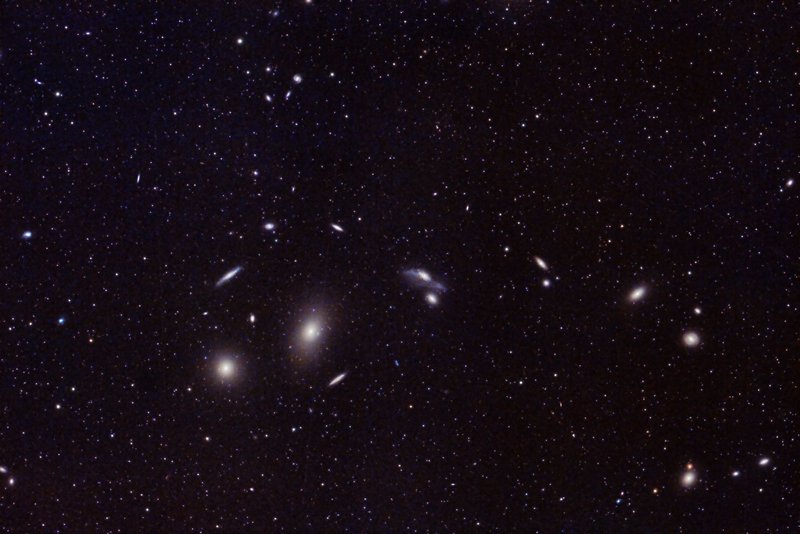
Apply Einstein’s equations to a universe that’s roughly the same everywhere on large scales and you get this one. Alexander Friedmann derived it in 1922. His result said the universe can’t sit still: it must expand or contract. Einstein didn’t like that and added the cosmological constant to hold it steady. Then Georges Lemaître (1927) and Edwin Hubble (1929) showed that distant galaxies are receding, and the expanding universe was real. The relationship they found, v = H₀d, is Hubble’s law: the farther away a galaxy, the faster it recedes.
This is the equation behind the Big Bang model. It tells cosmologists how the universe’s contents, whether matter, radiation or dark energy, control its expansion history. David Tong’s Cambridge cosmology notes derive it in full if you want the math.
It also sits at the center of an open argument. Measure H₀ using the cosmic microwave background and you get about 67 km/s per megaparsec. Measure it using nearby supernovae and you get about 73. The mismatch, known as the Hubble tension, has survived years of checking.
Which equations explain the universe at which scale
Each equation has a territory. Step outside it and the answers stop being reliable.
- Quantum scale (atoms and smaller): Schrödinger’s equation and the Standard Model Lagrangian. Gravity is too weak here to matter.
- Human scale (meters to planets): F = ma, Newton’s gravitation, Maxwell’s equations and Boltzmann’s entropy. These handle bridges, circuits, engines and orbits with high precision.
- Cosmic scale (stars, galaxies, the universe): Einstein’s field equations and the Friedmann equation, with E = mc² powering the stars.
The overlaps are where the useful physics happens. A star needs E = mc², quantum tunneling and Newtonian-style gravity, all at once. The trouble starts where two territories claim the same spot: the center of a black hole and the first instant of the Big Bang, where something is both extremely massive and extremely small. Einstein’s equations and the Standard Model each give a different answer there, or stop giving answers at all.
What these equations still can’t explain
The nine equations describe the universe’s visible ingredients very well, and visible is the problem. By the standard accounting, ordinary matter makes up only about 5 percent of the universe’s contents. Roughly 27 percent is dark matter, and about 68 percent is dark energy.
- Dark matter: Galaxies rotate too fast to be held together by the matter we can see. Something with mass is there. The Standard Model has no particle that fits. The two dark components are often confused, and how dark matter differs from dark energy explains why they need separate explanations.
- Dark energy: The Friedmann equation can include it as Λ, and the expansion has been speeding up for the last several billion years. But nobody knows what Λ is. NASA’s dark energy overview covers the evidence. A naive quantum calculation of empty space’s energy overshoots the measured value by something like 120 orders of magnitude.
- Quantum gravity: Einstein’s field equations and quantum field theory don’t fit together. That mismatch is why there’s still no theory of everything equation.
- Why matter beat antimatter: The Standard Model treats them almost identically, yet the universe is made of matter.
Each of these is a place where one of the nine equations is incomplete, or where a tenth is missing.
Quick-reference table
| Equation | Scale | Year | What it explains | Where it breaks |
|---|---|---|---|---|
| F = ma | Human | 1687 | How forces change motion | Near light speed, at atomic scale |
| F = G m₁m₂/r² | Human to solar system | 1687 | Orbits, tides, Neptune’s discovery | Mercury’s orbit, strong gravity |
| Maxwell’s equations | Human to cosmic | 1860s | Light, radio, electricity, magnetism | Quantum-scale light-matter detail |
| S = k ln W | Human to cosmic | 1877 | Why time has a direction | Needs quantum gravity for black hole interiors |
| E = mc² | Quantum to cosmic | 1905 | Why stars shine, where mass comes from | Doesn’t say why particles have the masses they do |
| Schrödinger equation | Quantum | 1926 | Atomic spectra, chemistry, fusion in the Sun | Doesn’t handle speeds near light on its own |
| Standard Model Lagrangian | Quantum | 1960s-70s | Particles and three forces, the Higgs | No gravity, no dark matter |
| Einstein’s field equations | Cosmic | 1915 | Gravity, black holes, gravitational waves, GPS | Singularities, quantum scales |
| Friedmann equation | Cosmic | 1922 | The expanding universe, Big Bang model | What dark energy is, the Hubble tension |
FAQ
Is there one equation that explains the universe?
No. Gravity is described by Einstein’s field equations and everything else by quantum field theory, and the two haven’t been unified. Physicists are working on candidates such as string theory and loop quantum gravity, but none has been confirmed by experiment.
What is the most important equation in physics?
There’s no official answer. Maxwell’s equations and Einstein’s field equations are the usual finalists, and cosmologists tend to pick the Friedmann equation because it describes the whole universe’s history. In a Physics World reader poll, Maxwell’s equations tied for first.
What is the Standard Model Lagrangian in simple terms?
It’s a compact formula that lists every known particle and how they interact through electromagnetism, the weak force and the strong force. It gives particles mass through the Higgs field. It doesn’t include gravity.
Which equation predicted the expanding universe?
The Friedmann equation, derived by Alexander Friedmann in 1922 from Einstein’s field equations. Lemaître and Hubble then supported it with observations of receding galaxies.
Why can’t general relativity and quantum mechanics be combined?
They work in incompatible ways. General relativity treats spacetime as a smooth, continuous fabric, while quantum mechanics treats everything as discrete and probabilistic. Naive attempts to combine them produce infinities that can’t be removed. The conflict matters only in extreme places like black hole centers and the early universe.