Updated November 2026 by Elena Stone
Jupiter’s Great Red Spot is visible for about 50 minutes on either side of its transit, the moment it crosses the central meridian (the line down the middle of Jupiter’s disk). Transits come every 9 hours 55 minutes 40 seconds. In late 2026 the spot sits near System II longitude 100° and drifts about 1.75° per month, so its transit times shift a few minutes later each month.
The calculator below lists every Great Red Spot transit for the coming days in your local time. It marks the ones you can actually observe: Jupiter above the horizon and the sky dark. It also draws Jupiter as it looks right now, with the spot in its current position on the disk.
Next Great Red Spot transit
Tue, Nov 10, 14:47 UTC
Times in UTC until your location loads
Set your location below: Jupiter is not well placed for the reference cities at this moment.
Times in UTC.
Advanced
Model value for today. Type a newer JUPOS measurement to override it.
Jupiter right now
The spot's position loads with the page.
Transit times
| Spot at center (UTC) | Good view from |
|---|---|
| Tue, Nov 10, 14:47 UTC | none of the reference cities |
| Wed, Nov 11, 00:43 UTC | Cairo, Mumbai; low or twilight: London |
| Wed, Nov 11, 10:39 UTC | New York, Los Angeles |
| Wed, Nov 11, 20:34 UTC | Mumbai, Singapore, Tokyo |
Method: the spot's System II longitude (about 100.3° today, from the 2026-11-10 model: JUPOS via Sky & Telescope (91° on 2026 June 1, +1.75°/month)) is compared with Jupiter's central meridian (Meeus, Astronomical Algorithms, chapter 43). Jupiter and Sun altitudes use JPL approximate planet positions. Times are when the spot crosses the center line of the disk; it is visible about 50 minutes either side. Accuracy is about 5 to 10 minutes, mostly from the spot's own wobble of a few degrees. Good: Jupiter at least 15 degrees up in a dark sky. Low: 5 to 15 degrees up. Twilight: Sun between 6 degrees below the horizon and the horizon.
How to use the Jupiter Red Spot calculator
- Check the location. The calculator guesses your city from your device’s time zone. Tap Change to pick another city, use your device’s location or type a latitude and longitude. Your location never leaves your browser.
- Pick a start date and range. It starts from now and covers 7 days. Choose 3, 14 or 30 days to plan ahead.
- Read the status of each transit. Good means Jupiter is at least 15° high in a dark sky. Low means it is between 5° and 15°, where the air blurs detail. Twilight means the Sun is just below the horizon; Jupiter is bright enough to see anyway. Not visible transits happen in daylight or with Jupiter below the horizon.
- Go out during the viewing window. The window runs from 50 minutes before to 50 minutes after the transit. Tap Add to calendar to save the next one.
The Advanced panel lets you enter your own Great Red Spot longitude. Use it if you have a fresh measurement from JUPOS or a recent observing report. Every time in the list updates instantly.
Great Red Spot transit times this week (UTC)
These are the transits for the next seven days in Universal Time (UTC), whether or not Jupiter is up where you are. Subtract 5 hours for US Eastern Standard Time, 8 hours for Pacific Standard Time; add 1 hour for Central European Time. The calculator above does the conversion and the visibility check for you.
| Date (UTC) | Spot at center (UTC) | Good view from |
|---|---|---|
| Tue, Nov 10 | 14:47 | none of the reference cities |
| Wed, Nov 11 | 00:43 | Cairo, Mumbai; low or twilight: London |
| Wed, Nov 11 | 10:39 | New York, Los Angeles |
| Wed, Nov 11 | 20:34 | Mumbai, Singapore, Tokyo |
| Thu, Nov 12 | 06:30 | New York, Sao Paulo, London |
| Thu, Nov 12 | 16:26 | Tokyo, Sydney |
| Fri, Nov 13 | 02:22 | London, Cairo |
| Fri, Nov 13 | 12:17 | Los Angeles |
| Fri, Nov 13 | 22:13 | Mumbai, Singapore; low or twilight: Cairo |
| Sat, Nov 14 | 08:09 | New York; low or twilight: Los Angeles, Sao Paulo |
| Sat, Nov 14 | 18:04 | Tokyo, Sydney; low or twilight: Singapore |
| Sun, Nov 15 | 04:00 | London; low or twilight: Cairo |
| Sun, Nov 15 | 13:56 | Los Angeles |
| Sun, Nov 15 | 23:52 | Cairo, Mumbai; low or twilight: London |
| Mon, Nov 16 | 09:47 | New York, Los Angeles |
| Mon, Nov 16 | 19:43 | Singapore, Tokyo; low or twilight: Mumbai |
| Tue, Nov 17 | 05:39 | New York, Sao Paulo, London |
Convert with the calculator above for your time zone. “Good view from” lists reference cities where Jupiter is at least 15° up in a dark sky at that moment; cities with Jupiter low or the sky in twilight follow in the same cell.
How Great Red Spot transit times are calculated
Jupiter has no solid surface, and its clouds do not all rotate at the same speed. Clouds near the equator go around in about 9 hours 50 minutes. Clouds at higher latitudes take about 5 minutes longer. Astronomers track them with two longitude systems:
- System I covers the equatorial zone, roughly 10° north to 10° south. It turns 877.90° per day.
- System II covers the rest of the planet. It turns 870.27° per day, one rotation every 9 h 55 m 40.6 s. The Great Red Spot, at about 22° south, is measured in System II.
The central meridian (CM) is the System II longitude facing Earth at a given moment. It increases by about 36.3° per hour. A transit happens when the central meridian equals the spot’s longitude. The calculation has four steps:
- Find the spot’s current System II longitude. The calculator uses a straight-line model from the JUPOS amateur measurement database: 91.0° on June 1, 2026, increasing 1.75° per month.
- Compute Jupiter’s System II central meridian for the starting time. The calculator uses Jean Meeus’s method from Astronomical Algorithms (chapter 43). It corrects for the light travel time from Jupiter (33 to 53 minutes) and for the angle between the Sun, Earth and Jupiter.
- Divide the difference between the two longitudes by 870.19° per day. That gives the time until the next transit. Repeat the step twice to absorb the spot’s own drift.
- Check Jupiter’s altitude and the Sun’s altitude at your location for each transit.
A worked example: on November 10, 2026 at 00:00 UTC the central meridian is 283.9° and the spot is at 100.3°. The spot is 176.4° ahead of the meridian (100.3 + 360 − 283.9). At 870.19° per day that is 0.2027 days, or 4 hours 52 minutes. The transit falls at 04:52 UTC.
We checked the calculator’s central meridian against NASA JPL’s DE421 planetary ephemeris for dates from 2026 to 2027. Transit times agree within 2 seconds. The real limit on accuracy is the spot itself. It wobbles about 1° back and forth over a 90-day cycle and its drift rate changes from year to year, so treat any prediction as good to within 5 to 10 minutes.
Where is the Great Red Spot now? Its longitude since 2010
The Great Red Spot does not stay at a fixed longitude. In recent decades it has drifted toward higher System II longitudes, and the drift sped up after 2010. Transit predictions made with an old longitude can be off by an hour or more. JUPOS measurements, as compiled by Project Pluto and Sky & Telescope:
| Date | GRS longitude (System II) |
|---|---|
| October 2010 | 156° |
| February 2014 | 209° |
| June 2018 | 288° |
| December 2020 | 347° |
| November 2022 | 26° |
| January 2024 | 50° |
| October 2024 | 61° |
| December 2025 | 79° |
| June 2026 | 91° |
| November 2026 (model) | 100° |
From 2010 to 2026 the spot moved about 295° of longitude, an average of roughly 18° per year. One degree of longitude shifts a transit by 1.65 minutes, so a year of drift moves the transit time by about half an hour compared with a fixed longitude.
When is Jupiter visible in 2026 and 2027?
A transit only helps if Jupiter is above the horizon in a dark sky. Jupiter’s 2026-27 season in Leo runs like this:
| Period | Where to find Jupiter | Disk size |
|---|---|---|
| November 2026 | Rises around midnight, high in the southeast before dawn | 37″ |
| December 2026 to January 2027 | Rises in the late evening, then early evening; best after midnight | 40″ to 44″ |
| February 11, 2027 (opposition) | Rises at sunset, up all night, highest around midnight | 45″ |
| March to May 2027 | High in the evening sky after dark | 44″ to 37″ |
| June to July 2027 | Low in the west after sunset | 35″ to 33″ |
| Late August 2027 | Conjunction with the Sun (about August 31); not observable | — |
Jupiter rises about 4 minutes earlier each night, or 2 hours earlier each month. Opposition in February 2027 is the best time to watch the Great Red Spot: Jupiter is at its largest and brightest and up all night, so nearly every night has one usable transit and many have two. The Jupiter 3D model shows the planet, its cloud bands and the four Galilean moons at their real positions for any date.
What you need to see the Great Red Spot
The Great Red Spot is about 1.3 times as wide as Earth. Seen from here it spans about 4 to 5 arcseconds, inside a planet that is 35 to 45 arcseconds across. That is well within reach of a small telescope. The hard part is contrast, not size: the spot has been a pale salmon or orange color in recent years rather than deep red.
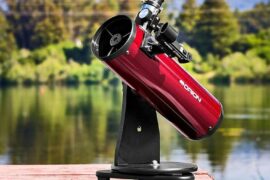
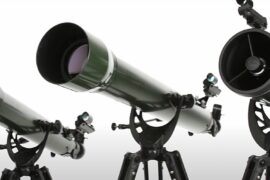
- Telescope. A 70 to 80 mm refractor shows the spot on steady nights when it is near the central meridian. A 4-inch (100 mm) or larger telescope shows it on most nights, with its color. A 6- to 8-inch Dobsonian shows the spot’s outline, the dark belt around it and the white oval clouds nearby. Our guide to the best telescopes for viewing planets covers models at every price.
- Magnification. Use 100× to 200×. Higher power only helps on nights when the air is steady; the telescope resolution calculator shows what your aperture can resolve and how much the air limits it. See the best eyepieces for planets for focal lengths that give these powers.
- Filter (optional). A light blue filter (Wratten 80A or 82A) darkens the reddish spot and the belts against the cream-colored zones. It makes the spot easier to pick out with a small telescope.
- Binoculars will not show it. At 10× or 15× Jupiter is a small disk with its moons beside it. The spot needs at least 50× to 60×.
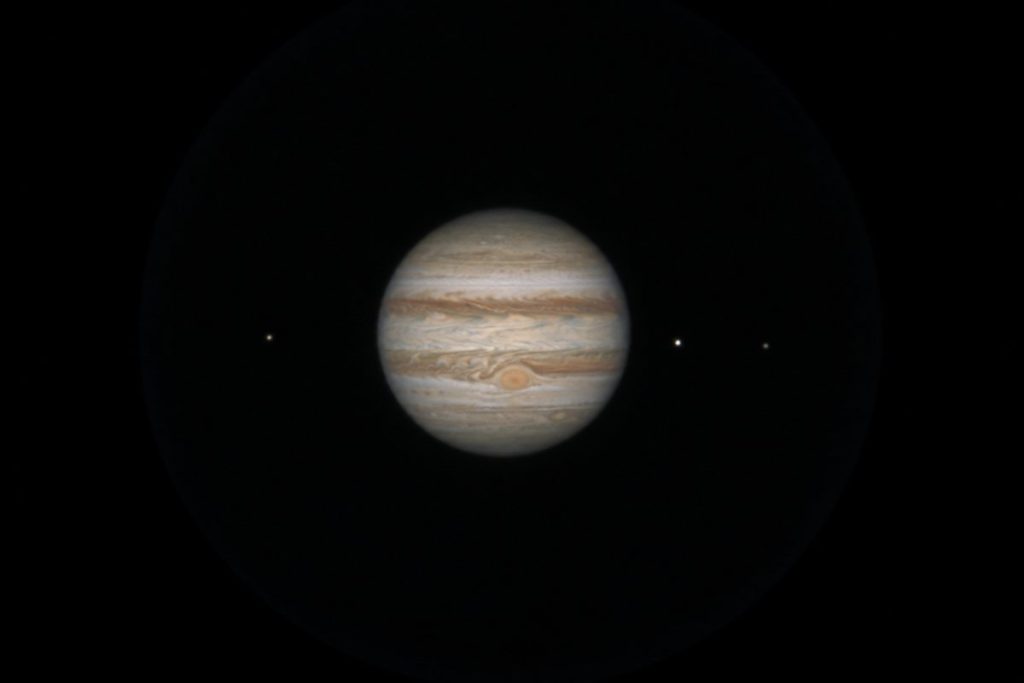
Tips for observing a Great Red Spot transit
- Look for the Red Spot Hollow first. The spot sits in a scooped-out bay on the south edge of the South Equatorial Belt, the dark belt just south of Jupiter’s equator. The bay is often easier to see than the spot inside it. If you find the hollow, the spot is there.
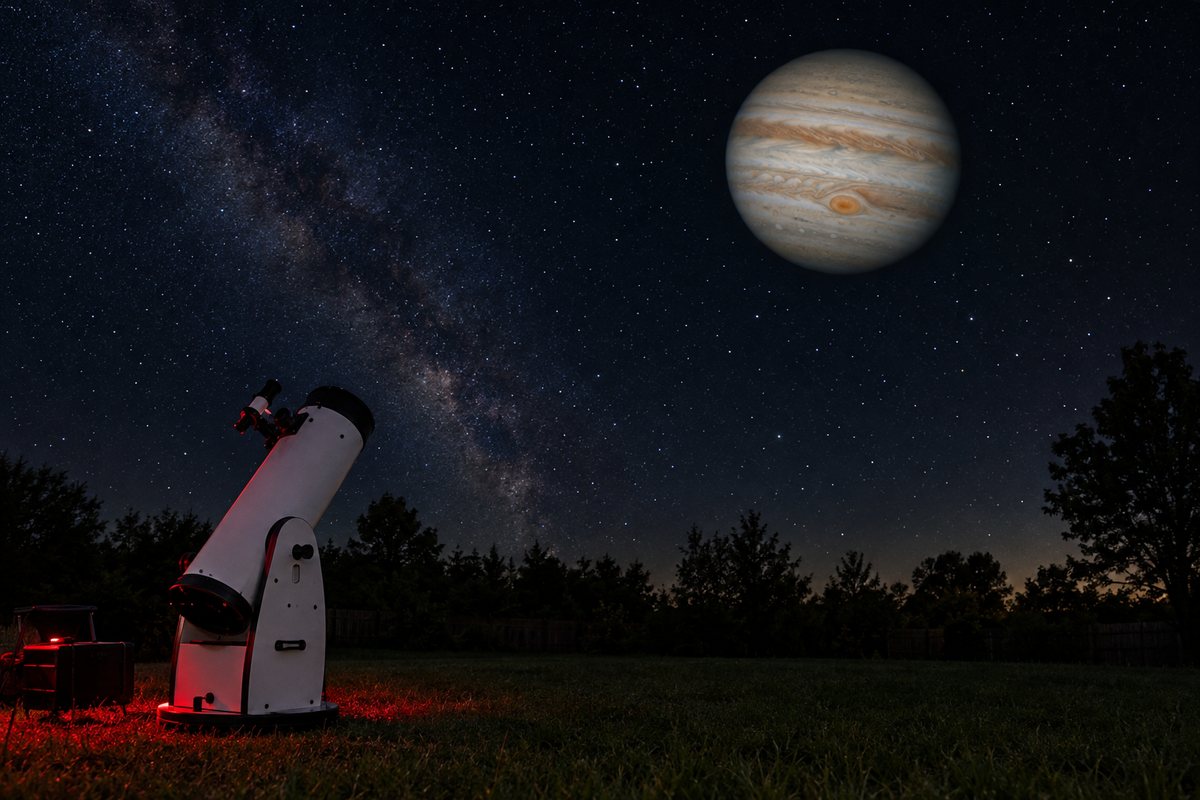
- Know which way your view is turned. With north up, as in binoculars and most photos, the spot appears in the southern half of the disk and moves from left to right. A Newtonian reflector turns the view upside down, so the spot appears in the upper half moving right to left. A star diagonal on a refractor or Schmidt-Cassegrain mirrors the image left to right. The calculator’s Jupiter drawing has a Flip setting for each case.
- Let the telescope cool. Put it outside 30 to 60 minutes before the transit. A warm mirror or lens blurs planetary detail more than a smaller aperture does.
- Wait for steady moments. The air above you moves. Keep looking for a few minutes and the detail appears in short sharp moments between blurry ones.
- Prefer transits with Jupiter high. Jupiter at 40° or higher is seen through less air than at 15°. When two transits fall in the same night, pick the one with Jupiter higher.
- Watch for a moon shadow. Io, Europa, Ganymede and Callisto cast black shadows on Jupiter’s clouds. When a shadow crosses near the spot, the two make an easy, high-contrast pair.
The spot transits about 2.4 times a day. If a transit falls at 10:00 PM tonight, the next ones come at 7:56 AM and 5:51 PM tomorrow, then 3:47 AM the morning after. Five rotations take 2 days, 1 hour and 38 minutes, so the 10:00 PM transit returns as an 11:38 PM transit two nights later. The good evening transits shift through the night from week to week, which is why a list for your location beats any rule of thumb.
About the Great Red Spot
The Great Red Spot is an anticyclone, a high-pressure storm that turns counterclockwise once every 4.5 to 6 days. Winds on its outer edge reach about 430 km/h (270 mph). NASA’s Juno spacecraft measured its roots extending 300 to 500 km below the visible cloud tops. Observers have tracked it continuously since 1831, and it may be the “permanent spot” Giovanni Cassini recorded between 1665 and 1713. It was about 40,000 km long in the late 1800s and has been shrinking since; today it is about 1.3 Earth diameters wide and rounder than it used to be. More on the planet in unique features of Jupiter and things we still don’t understand about Jupiter.
Frequently asked questions
When can I see Jupiter's Great Red Spot tonight?
You can see it for about 50 minutes before and after each transit, when it crosses the center of Jupiter's disk, as long as Jupiter is above the horizon in a dark sky. Transits repeat every 9 hours 55 minutes 40 seconds. Enter your location in the calculator above to get tonight's times in your time zone.
How do you calculate when the Great Red Spot is visible?
Take the spot's current System II longitude (about 100° in November 2026), compute Jupiter's System II central meridian for a starting time, and divide the difference by 870.19° per day. The result is the time until the spot crosses the central meridian. Then check that Jupiter is above the horizon after dark at your location.
What is the current longitude of the Great Red Spot?
The Great Red Spot was at System II longitude 91° on June 1, 2026, according to JUPOS measurements, and it is drifting to higher longitudes at about 1.75° per month. That puts it near 100° in November 2026 and about 105° at Jupiter's opposition in February 2027.
How often does the Great Red Spot face Earth?
Once every Jupiter rotation in System II: 9 hours 55 minutes 40.6 seconds. That gives about 2.4 transits per day, so most nights when Jupiter is up all night have one or two observable transits.
Why do Great Red Spot transit times change?
The spot is a cloud feature, not a fixed mark on a surface, and it drifts in longitude. Since 2010 it has moved about 18° per year on average. Each degree changes the transit time by 1.65 minutes, so tables made with an old longitude can be off by an hour or more.
What size telescope do you need to see the Great Red Spot?
A 70 to 80 mm refractor can show it on steady nights near transit. A 4-inch (100 mm) or larger telescope shows it on most nights. Use 100x to 200x and consider a light blue 80A or 82A filter, which darkens the pale orange spot against the bright zones around it.
Can you see the Great Red Spot with binoculars?
No. Binoculars at 10x to 15x show Jupiter as a small disk with its moons. The Great Red Spot is about 4 to 5 arcseconds across and needs a telescope at 50x or more.
Why can't I see the Great Red Spot in my telescope?
The most common reasons are timing, contrast and air. The spot is only on the visible side half of the time, and it is easiest within 50 minutes of transit. It has been pale salmon in recent years, so look first for the Red Spot Hollow, the bay it makes in the South Equatorial Belt. Unsteady air, a warm telescope and Jupiter low in the sky all wash out the detail.
Which direction does the Great Red Spot move across Jupiter?
With north up, as in binoculars and photos, the spot enters on the left (east) limb, crosses the southern half of the disk and leaves on the right (west) limb. A Newtonian reflector shows the view upside down, and a star diagonal mirrors it left to right.
How accurate are Great Red Spot transit predictions?
The central meridian calculation is accurate to a few seconds. The spot's position is the limit: it wobbles about 1° over a 90-day cycle and its drift rate changes, so predictions are good to about 5 to 10 minutes. With a fresh longitude from JUPOS entered in the Advanced panel, they are good to a few minutes.
When is the best time to see the Great Red Spot in 2026 and 2027?
Around Jupiter's opposition on February 11, 2027. Jupiter is then 45 arcseconds across and up all night, so nearly every night has an observable transit. From November 2026 Jupiter rises around midnight; by March 2027 it is high in the evening sky. It is lost in the Sun's glare around its conjunction on August 31, 2027.
Sources
- Meeus, J. (1998). Astronomical Algorithms, 2nd ed., chapter 43, “Ephemeris for Physical Observations of Jupiter.” Willmann-Bell.
- JUPOS, database of Jupiter object positions: jupos.privat.t-online.de
- Gray, B. Great Red Spot longitudes since 1831: projectpluto.com
- Sky & Telescope, “Transit Times of Jupiter’s Great Red Spot” (2026 longitude and drift rate).
- British Astronomical Association Jupiter Section, Guide to Jupiter’s Atmospheric Phenomena (2026 edition).
- Simon, A. A. et al. (2018). “Historical and Contemporary Trends in the Size, Drift, and Color of Jupiter’s Great Red Spot.” The Astronomical Journal 155:151.
- NASA JPL, DE421 planetary ephemeris (used to verify the calculator).