Updated November 2026 by Elena Stone
A telescope’s resolution is the smallest angle between two points it can show as separate. The Dawes limit gives it in arcseconds: 116 divided by the aperture in millimeters (or 4.56 divided by the aperture in inches). An 8-inch (203 mm) telescope resolves 0.57 arcseconds, a 4-inch (102 mm) telescope 1.14 arcseconds.
Pick your telescope below or type its aperture. The calculator gives the Dawes, Rayleigh and Sparrow limits, then shows two stars at that separation as your telescope would render them, with the air above you shimmering on top. It also lists the double stars you can split, the smallest crater you can see on the Moon, the magnification you need and the pixel scale for your camera.
Rayleigh 0.68″ · Sparrow 0.53″ · Airy disk 1.36″
Your 8-inch (203 mm) telescope can split double stars about 0.57 arcseconds apart, but on an average night (2.5″ seeing) the air limits you to about 2.5″.
Both curves are scaled to their own peak. The dip is measured against the fainter star.
Your sky vs your scope
The air is the bottleneck tonight. A bigger telescope would not split anything closer than about 2.5″; steadier air would.
Shorter bar means finer detail. The bar for the larger of the two is your limit.
What can you split?
Double stars from widest to tightest. Tap one to load it into the simulator.
| Double star | Sep. | Perfect night | Tonight |
|---|---|---|---|
| 34.3″ | Yes | Yes | |
| 18.4″ | Yes | Yes | |
| 14.4″ | Yes | Yes | |
| 9.5″ | Yes | Yes | |
| 9.4″ | Yes | Yes | |
| 5.5″ | Yes | Yes | |
| 4.8″ | Yes | Yes | |
| 2.9″ | Yes | Yes | |
| 2.8″ | Yes | Yes | |
| 2.6″ | Yes | Yes | |
| 2.4″ | Yes | Marginal | |
| 2.4″ | Yes | Marginal | |
| 2.1″ | Yes | No | |
| 1.8″ | Yes | No | |
| 1.6″ | Yes | No | |
| 0.9″ | Yes | No | |
| 0.5″ | Marginal | No | |
| 0.35″ | No | No |
What detail can you see?
| On the Moon | Perfect night | Tonight |
|---|---|---|
| Smallest detail | 1.06 km | 4.66 km |
| Smallest craterabout twice the detail size | 2.13 km | 9.32 km |
Tonight your smallest crater is about as big as Messier (9 km).
The Apollo landers are about 4 m wide. Seeing one from Earth takes a telescope about 54 m across, roughly 23 times the width of the Hubble mirror.
| Planet detail | Size | Perfect night | Tonight |
|---|---|---|---|
| Cassini DivisionSaturn | 0.7″ | Yes | No |
| About 4,800 km wide, a high-contrast dark line. Usually seen in 60–80 mm scopes when the rings are well open, even though it is near their Dawes limit. | |||
| Encke GapSaturn | 0.05″ | No | No |
| A thin, low-contrast gap in the outer A ring. Rarely seen visually; needs a large scope and very steady air. Easier in processed images. | |||
| Great Red SpotJupiter | 5.3″ | Yes | Yes |
| About 1.3 Earth diameters wide and slowly shrinking. Large but pale: visibility depends on its colour and contrast more than on aperture. It faces Earth only part of each 10-hour rotation. | |||
| North Equatorial Belt widthJupiter | 4.1″ | Yes | Yes |
| About 10° of Jupiter latitude; the width varies over the years. Easy in a 60 mm telescope. | |||
| Ganymede diskJupiter | 1.7″ | Yes | No |
| The largest moon. Looks like a tiny disk, not a point, in a 6–8 inch scope on a steady night. | |||
| Io diskJupiter | 1.2″ | Yes | No |
| Slightly smaller than Ganymede. Shows as a disk only in good seeing and a larger scope; no surface detail visually. | |||
| Syrtis Major (Feb 2027 opposition)Mars | 2″ | Yes | No |
| Mars is only about 13.8″ across at the 19 Feb 2027 opposition, a small, distant one. The dark Syrtis Major is about 1,000 km wide and 1,500 km long. Needs 4 inches or more and steady air. | |||
| Uranus diskUranus | 3.7″ | Yes | Yes |
| A tiny blue-green disk at about 19 AU. Needs 100× or more to tell it from a star. | |||
| Neptune diskNeptune | 2.3″ | Yes | Marginal |
| A tiny blue disk at about 29 AU. Needs 150× or more and steady air. No surface detail visually. | |||
| Plato's craterletsMoon | 1.1″ | Yes | No |
| The 2 km craterlets on Plato's dark floor. Observers report borderline results in 4–6 inch scopes and reliable views from about 8 inches in good seeing and low sun angle. | |||
| Hyginus Rille widthMoon | 1.3″ | Yes | No |
| A rille about 2–3 km wide and about 220 km long. Long, thin lines stay visible near the Dawes limit, so small telescopes show it. | |||
| Apollo lunar moduleMoon | 0.002″ | No | No |
| A 4 m object. Resolving it would take an aperture of about 54 m (Dawes). Hubble's limit is about 0.05″, so lunar orbiters photographed the sites instead. | |||
Magnification you need
Beyond the highest useful magnification the image only gets bigger and fainter. On most nights seeing caps you near 250 to 350×.
Astrophotography: pixel scale and sampling
Choose a camera or type a pixel size. Pixel scale, the planetary f-ratio and deep-sky sampling appear here.
Compare telescopes
Each bar is the finest detail that scope shows tonight. Gold is the diffraction limit, blue is what the air takes away. Pin up to three.
Loading chart…
How to use the telescope resolution calculator
- Choose your telescope from the list, or enter the aperture in millimeters or inches. Aperture is the width of the main lens or mirror, not the focal length. It is printed on the tube or in the model name (a “130EQ” has a 130 mm mirror).
- Check the central obstruction. Reflectors and Schmidt-Cassegrains have a secondary mirror in the light path. The preset fills in a typical value. Refractors have none.
- Set your seeing. Seeing is how steady the air is. Most backyards get 2 to 3 arcseconds on an average night. If stars twinkle hard to the naked eye, pick Poor.
- Pick a target from “What can you split?” to load it into the simulator, or drag the separation slider.
- Add a focal length and camera pixel size if you want eyepiece suggestions and astrophotography sampling.
Tap Share to copy a link that reopens the calculator with your settings. Add to compare pins up to three telescopes on one chart, which is the fastest way to see what an upgrade buys you.
Telescope resolution formula
Three formulas are in common use. All three say the same thing: resolution improves in direct proportion to aperture. Double the aperture and you split stars half as far apart.
| Limit | Formula (aperture D in mm) | Formula (D in inches) | What it means |
|---|---|---|---|
| Dawes limit | 116 / D | 4.56 / D | Two equal stars look like a figure 8 with a faint notch. The working limit for visual observers. |
| Rayleigh criterion | 138 / D (at 550 nm) | 5.45 / D | The peak of one star falls on the first dark ring of the other. A clear dip of about 26% between them. |
| Sparrow limit | 107 / D (at 550 nm) | 4.23 / D | The dip disappears. The pair looks like one stretched star. Image processing can still separate it. |
The Rayleigh criterion comes from the physics of light: θ = 1.22 λ / D, where λ is the wavelength and θ is in radians. Multiply by 206,265 to get arcseconds. At 550 nm, the green light the eye is most sensitive to, that gives 138/D. Blue light resolves finer detail than red light, which is why the calculator has a wavelength setting.
The Dawes limit is not derived from theory. William Rutter Dawes, an English clergyman and double star observer, measured it in the 1860s by testing which pairs of equal 6th-magnitude stars he could split with telescopes of different sizes. It matches what trained observers see at the eyepiece, so it is the number most telescope makers quote.
Worked example: a 130 mm reflector. Dawes limit = 116 / 130 = 0.89 arcseconds. Rayleigh = 138 / 130 = 1.06 arcseconds. On a night with 2.5 arcsecond seeing, the air sets the limit, not the mirror.
Resolution by telescope size
The table lists common apertures with their theoretical limits, the smallest detail each can show on the Moon and the highest magnification worth using.
| Aperture | Dawes | Rayleigh | Lunar detail | Max. useful | Faintest star |
|---|---|---|---|---|---|
| 50 mm2 in | 2.32″ | 2.77″ | 4.32 km | 100× | 11.2 |
| 60 mm2.4 in | 1.93″ | 2.31″ | 3.6 km | 120× | 11.6 |
| 70 mm2.8 in | 1.66″ | 1.98″ | 3.09 km | 140× | 11.9 |
| 80 mm3.1 in | 1.45″ | 1.73″ | 2.7 km | 160× | 12.2 |
| 90 mm3.5 in | 1.29″ | 1.54″ | 2.4 km | 180× | 12.5 |
| 102 mm4 in | 1.14″ | 1.36″ | 2.12 km | 204× | 12.7 |
| 114 mm4.5 in | 1.02″ | 1.21″ | 1.9 km | 228× | 13 |
| 127 mm5 in | 0.91″ | 1.09″ | 1.7 km | 254× | 13.2 |
| 130 mm5.1 in | 0.89″ | 1.06″ | 1.66 km | 260× | 13.3 |
| 150 mm5.9 in | 0.77″ | 0.92″ | 1.44 km | 300× | 13.6 |
| 203 mm8 in | 0.57″ | 0.68″ | 1.06 km | 406× | 14.2 |
| 254 mm10 in | 0.46″ | 0.54″ | 0.85 km | 508× | 14.7 |
| 305 mm12 in | 0.38″ | 0.45″ | 0.71 km | 610× | 15.1 |
| 356 mm14 in | 0.33″ | 0.39″ | 0.61 km | 712× | 15.5 |
| 406 mm16 in | 0.29″ | 0.34″ | 0.53 km | 812× | 15.7 |
Why stars look like disks with rings
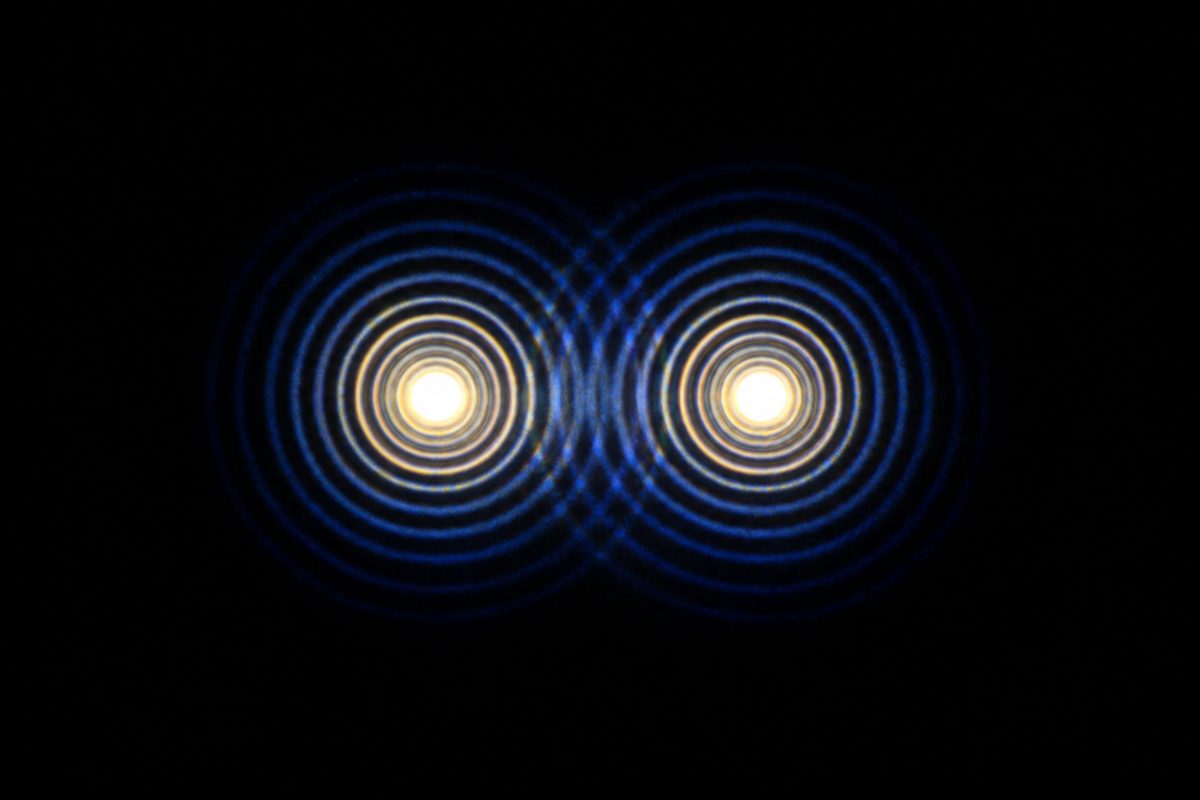
A star is so far away that it is a true point of light. A telescope cannot show it as a point. Light passing through a circular opening spreads into a small bright disk surrounded by faint rings, called the Airy pattern after George Airy, who described it in 1835. About 84% of the light lands in the central disk.
The size of that disk is fixed by the aperture. A bigger lens or mirror makes a smaller disk, and smaller disks can sit closer together before they merge. That is all resolution is. Magnification makes the disks look bigger but does not make them smaller relative to each other, so it cannot split a pair the aperture cannot.
Switch the simulator to an SCT or a Newtonian and watch the rings. A secondary mirror blocks the center of the light path and pushes light out of the disk into the first ring. The Dawes number barely changes, but fine low-contrast detail on Jupiter and Mars softens. This is why a 120 mm refractor and a 150 mm Newtonian show planets with similar sharpness, even though the Newtonian splits closer double stars.
Seeing: why your telescope rarely reaches its limit
Every resolution formula assumes perfect optics in a vacuum. On the ground, starlight passes through turbulent layers of air of different temperatures. The star image dances and swells. Astronomers call this seeing and measure it as the width of the blurred star in arcseconds.
| Seeing | Star size | Aperture at which the air becomes the limit |
|---|---|---|
| Excellent | 0.8″ | about 145 mm (5.7 in) |
| Good | 1.5″ | about 77 mm (3 in) |
| Average | 2.5″ | about 46 mm (1.8 in) |
| Poor | 4″ | about 29 mm (1.1 in) |
On an average night even a small telescope is limited by the air. Large telescopes still win for three reasons. Seeing is not constant: the air steadies for a fraction of a second at a time, and a large aperture shows its full resolution in those moments. A large aperture gathers more light, so faint companions and low-contrast planet features become visible. And experienced observers wait for good nights, which come a few times a month at most sites.
Seeing is usually best when the jet stream is not overhead, late at night once the ground has cooled, and with the target high in the sky. Let the telescope cool to outside temperature for 30 to 60 minutes first. A warm mirror creates its own turbulence inside the tube.
Double stars you can split, and the aperture each needs
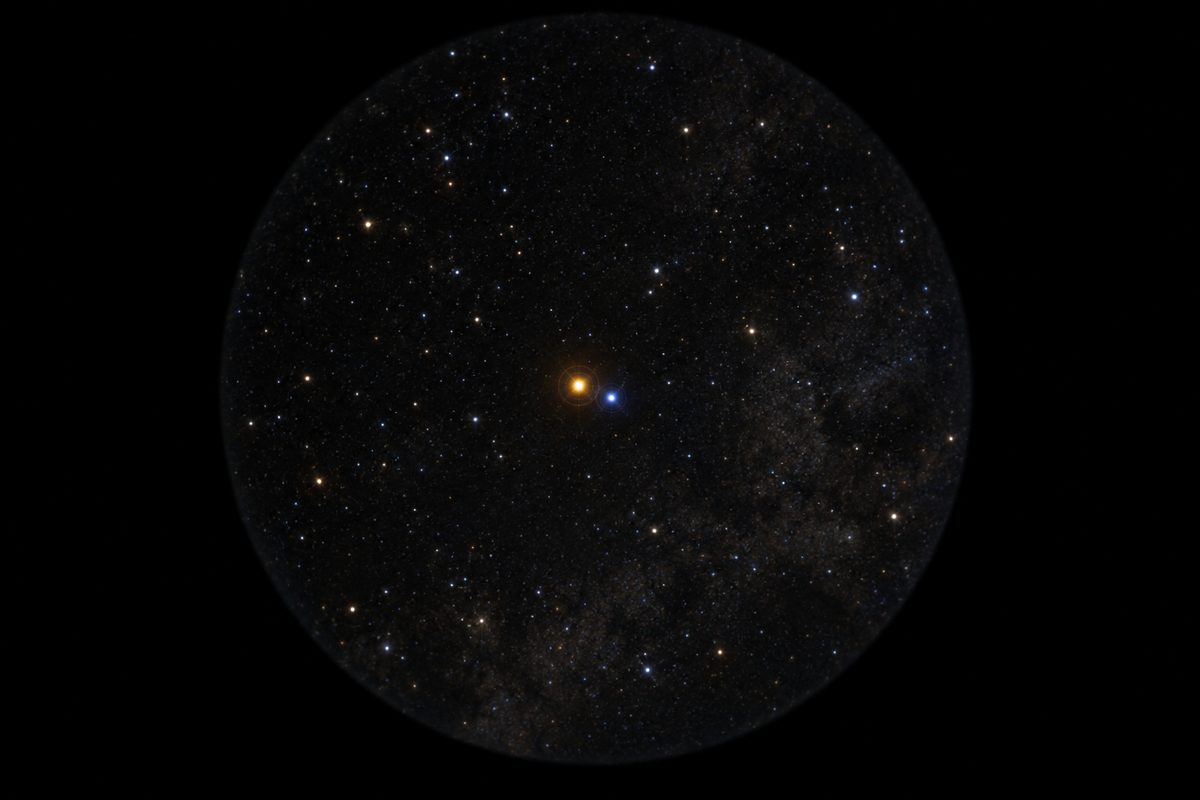
Double stars are the standard test of resolution. The table gives each pair’s current separation and the minimum aperture the Dawes limit predicts. Treat that minimum as a perfect-night figure and add 50% for comfort. Pairs with very unequal brightness, such as Antares and Rigel, need more aperture than the table suggests because the bright star’s rings hide the faint companion. For tips on finding and observing them, read our double star guide.
| Double star | Separation | Magnitudes | Smallest aperture (Dawes) |
|---|---|---|---|
| AlbireoCygnus | 34.3″ | 3.2 + 5.1 | 3.4 mm0.13 in |
| PolarisUrsa Minor | 18.4″ | 2 + 9.1 | 6.3 mm0.25 in |
| Mizar A–BUrsa Major | 14.4″ | 2.2 + 3.9 | 8.1 mm0.32 in |
| AlmachAndromeda | 9.5″ | 2.3 + 5 | 12 mm0.48 in |
| RigelOrion | 9.4″ | 0.1 + 6.8 | 12 mm0.49 in |
| Castor A–BGemini | 5.5″ | 1.9 + 3 | 21 mm0.83 in |
| AlgiebaLeo | 4.8″ | 2.4 + 3.6 | 24 mm0.95 in |
| IzarBoötes | 2.9″ | 2.6 + 4.8 | 40 mm1.6 in |
| Delta CygniCygnus | 2.8″ | 2.9 + 6.3 | 41 mm1.6 in |
| AntaresScorpius | 2.6″ | 1 + 5.4 | 45 mm1.8 in |
| AlnitakOrion | 2.4″ | 1.9 + 3.7 | 48 mm1.9 in |
| Epsilon Lyrae ε2Lyra | 2.4″ | 5.2 + 5.4 | 48 mm1.9 in |
| Epsilon Lyrae ε1Lyra | 2.1″ | 5.1 + 6.1 | 55 mm2.2 in |
| Eta OrionisOrion | 1.8″ | 3.6 + 4.9 | 64 mm2.5 in |
| Zeta HerculisHercules | 1.6″ | 2.9 + 5.4 | 73 mm2.9 in |
| Lambda CygniCygnus | 0.9″ | 4.7 + 6.3 | 129 mm5.1 in |
| Beta DelphiniDelphinus | 0.5″ | 4.1 + 5 | 232 mm9.1 in |
| Almach B–CAndromeda | 0.35″ | 5.3 + 6.5 | 331 mm13 in |
Epsilon Lyrae, the “Double Double” near Vega, is the classic benchmark. Binoculars show two stars. A 60 to 80 mm telescope at 100× or more splits each of those into two again. If you can see all four stars on a given night, your telescope and the air are both in good shape.
Resolution on the Moon and planets
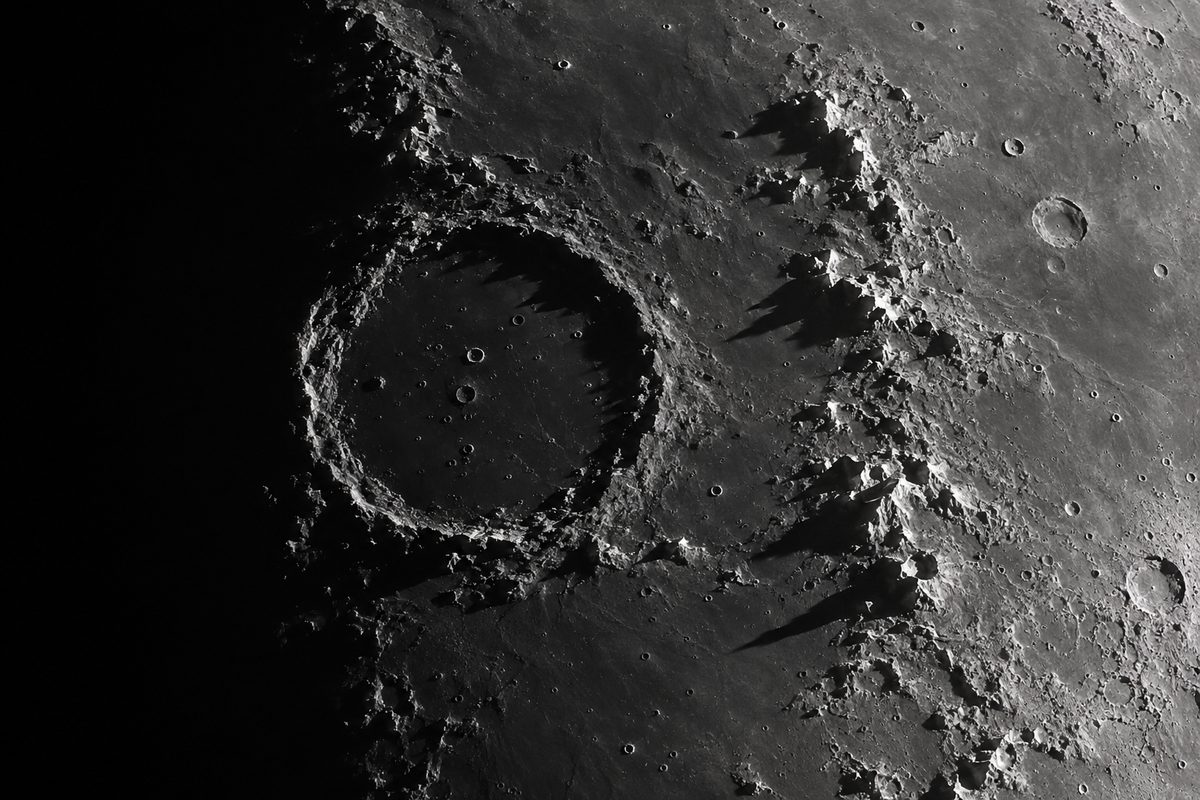
At the Moon’s average distance of 384,400 km, one arcsecond spans 1.86 km of lunar surface. Multiply your telescope’s resolution by 1.86 to get the smallest detail it can show. A crater needs about twice that to look like a crater, with a rim and a shadow. An 8-inch telescope on a steady night shows craters about 2 km across. The craterlets on the floor of Plato, between 1.5 and 3 km wide, are a well-known test for 6 to 10-inch telescopes.
No amateur telescope can see the Apollo landers. The lunar module’s descent stage is about 9.4 m across with its legs out, which is 0.005 arcseconds from Earth. Showing it as more than a point would take a telescope about 23 meters wide, larger than any optical telescope working today, and it would have to sit above the atmosphere. We cover this in detail in can a telescope see the flag on the Moon.
Planets follow the same rule with one exception. Lines and edges with strong contrast show up below the formal limit. Saturn’s Cassini Division is about 0.7 arcseconds wide, yet 80 mm telescopes show it, because the eye detects a dark gap between two bright rings without resolving its width. Low-contrast features like the festoons in Jupiter’s belts need more aperture and steadier air than the numbers suggest. Our best telescopes for viewing planets guide covers which designs handle this best.
Magnification and resolution
Your eye resolves about 1 to 2 arcminutes. To see a 0.57 arcsecond gap, a telescope has to enlarge it past that size. The rule of thumb is 1× per millimeter of aperture to start seeing the full resolution, and up to 2× per millimeter (50× per inch) before the image turns dim and soft with no new detail. Past that is empty magnification.
For an 8-inch telescope that means 200× to see its resolution and about 400× as the ceiling. On most nights seeing caps useful magnification at 250× to 350× whatever the aperture. Enter your focal length in the calculator and it gives the eyepiece focal lengths for both figures. To work out magnification for a specific eyepiece, use the telescope magnification calculator. To see how much sky an eyepiece shows, use the field of view calculator.
Resolution for astrophotography: pixel scale and sampling
A camera records detail only if its pixels are small enough to sample it. Pixel scale is how much sky one pixel covers:
Pixel scale (arcseconds per pixel) = 206.265 × pixel size (µm) / focal length (mm)
- Planets (lucky imaging): short video frames freeze the seeing, so you sample the telescope’s own resolution. The working rule is a focal ratio of about 5 times the pixel size in microns. A 2.9 µm camera wants about f/15. On an f/5 Newtonian that means a 3× Barlow.
- Deep sky: long exposures blur to the size of the seeing. Aim for a pixel scale between one half and one third of your seeing. With 2.5 arcsecond seeing that is about 0.8 to 1.25 arcseconds per pixel. Much finer wastes signal. Much coarser makes stars blocky.
Open the camera panel in the calculator, enter your sensor’s pixel size and focal length, and it reports the pixel scale, the verdict for planets and deep sky and the Barlow you would need.
Using resolution to choose a telescope
Resolution is one reason to buy aperture, but not the only one. Light grasp grows with the square of the aperture, so a 200 mm telescope collects about 2.4 times the light of a 130 mm one while resolving 1.5 times finer. For galaxies and nebulae, light grasp matters more. For double stars, the Moon and planets, resolution and contrast matter more.
- Below 80 mm: splits most showpiece doubles, shows Saturn’s rings and Jupiter’s two main belts.
- 100 to 150 mm: splits the Double Double with ease and shows Cassini’s Division, the Great Red Spot and lunar craters 3 to 4.5 km across.
- 200 mm and up: reaches pairs under 0.7 arcseconds on good nights and lunar craterlets about 2 km across. Seeing becomes the main limit.
If you are still deciding, the telescope finder matches a telescope to what you want to see and your budget, and the telescope view simulator shows what the Moon and planets look like through each size. Our guide to telescope specs explains focal ratio, focal length and the other numbers on the box.
Frequently asked questions
How do you calculate the resolution of a telescope?
Divide 116 by the aperture in millimeters to get the Dawes limit in arcseconds, or divide 4.56 by the aperture in inches. A 150 mm telescope resolves 116 / 150 = 0.77 arcseconds. The Rayleigh criterion, 138 / D at 550 nm, gives a slightly larger and more conservative figure.
What is the Dawes limit?
The Dawes limit is the closest separation at which two equal stars of about 6th magnitude can be seen as two through a telescope: 116 / D arcseconds with D in millimeters. William Rutter Dawes found it by observation in the 1860s, so it describes what an observer sees at the eyepiece rather than a theoretical boundary.
What is the difference between the Dawes limit and the Rayleigh criterion?
The Rayleigh criterion (1.22 λ / D, or 138 / D mm at 550 nm) puts one star's peak on the other's first dark ring and leaves a dip of about 26% between them. The Dawes limit (116 / D) is about 16% tighter and leaves a dip of only a few percent, which a trained eye still sees as a notch. Visual observers use Dawes. Optical engineers use Rayleigh.
What is the resolution of an 8-inch telescope?
An 8-inch (203 mm) telescope has a Dawes limit of 0.57 arcseconds and a Rayleigh limit of 0.68 arcseconds. On the Moon that is about 1.1 km of surface, so on a steady night it shows craters about 2 km across. Average backyard seeing of 2 to 3 arcseconds usually keeps it from reaching that limit except in moments of steady air.
Does more magnification increase resolution?
No. Resolution is set by the aperture. Magnification only enlarges the image so your eye can see the detail the aperture already delivers. You need about 1x per millimeter of aperture to see the full resolution. Beyond about 2x per millimeter the image gets bigger, dimmer and softer with no new detail.
Why can't my telescope reach its theoretical resolution?
Usually the atmosphere. Turbulent air blurs stars to 2 or 3 arcseconds on an average night, which is coarser than the diffraction limit of any telescope over about 50 mm. Other causes are a telescope that has not cooled to outside temperature, poor collimation in reflectors and low target altitude.
Does a central obstruction reduce resolution?
Barely. A secondary mirror slightly shrinks the central disk of a star image, so the Dawes limit stays the same or improves a little. What it does is move light from the disk into the rings, which lowers contrast on planets and the Moon. A rough rule for planetary contrast is to subtract the secondary mirror's diameter from the aperture: an 8-inch Schmidt-Cassegrain with a 34% obstruction shows planets about as well as a 135 mm refractor.
What is the resolution of the Hubble Space Telescope?
Hubble's 2.4 m mirror gives a Dawes limit of about 0.05 arcseconds in visible light. It reaches that limit because it sits above the atmosphere. At the Moon's distance 0.05 arcseconds is about 90 meters, so even Hubble cannot see the Apollo landers.
How small a crater can I see on the Moon with my telescope?
Multiply your telescope's Dawes limit in arcseconds by 1.86 to get the smallest detail in kilometers, then double it for a crater with a visible rim and shadow. A 70 mm refractor shows craters about 6 km wide, a 130 mm reflector about 3.3 km and a 10-inch telescope about 1.7 km on a steady night.
What size telescope do I need to split Epsilon Lyrae?
Epsilon Lyrae's two pairs are about 2.1 and 2.4 arcseconds apart. The Dawes limit says 55 mm is enough in theory. In practice a 60 to 80 mm telescope at 100x or more splits both pairs cleanly on a steady night.
Sources
- Dawes, W. R. (1867). Catalogue of micrometrical measurements of double stars. Memoirs of the Royal Astronomical Society, 35, 137.
- Rayleigh, Lord (1879). Investigations in optics, with special reference to the spectroscope. Philosophical Magazine, 8(49), 261.
- Sparrow, C. M. (1916). On spectroscopic resolving power. Astrophysical Journal, 44, 76.
- Born, M. and Wolf, E. Principles of Optics, 7th ed., section 8.5 (Airy pattern and annular apertures).
- Double star separations: Washington Double Star Catalog (U.S. Naval Observatory), latest measures.