
Yes, plenty of things are heavier than the Sun. The Sun holds 99.86% of the mass in the solar system, so it feels like the biggest thing around. Zoom out and it’s an ordinary star: heavier than most, nowhere near the top.
This post builds one ladder, starting at the Sun and climbing to objects that weigh billions of Suns and more. Every rung has a number in solar masses (1 solar mass is the Sun’s mass, about 2 × 10^30 kg) and a comparison you can hold in your head.
TLDR
- The Sun is more massive than most stars, but stars like Rigel (about 21 Suns) and R136a1 (roughly 200 Suns) outweigh it many times over.
- Neutron stars hold 1.1 to 2.3 Suns in a ball about 20 km wide.
- Black holes run from a few Suns to tens of billions. TON 618 is around 40 billion.
- Galaxy clusters reach a quadrillion Suns. Nothing in the universe is heavier than that kind of structure.
Table of contents
- Things heavier than the Sun at a glance
- First, how heavy is the Sun?
- Heavier stars
- Neutron stars
- Stellar-mass black holes
- Intermediate-mass black holes
- Supermassive black holes
- Galaxies, clusters and the cosmic web
- Heavier is not the same as bigger
Things heavier than the Sun at a glance
Masses are in solar masses (M☉). Most of these are estimates with real error bars, so treat the numbers as the current best values, not exact ones. Figures reflect published estimates as of 2025.
| Object | Type | Mass (solar masses) | How many Suns |
|---|---|---|---|
| Sirius B | White dwarf | ~1.02 | about the same as 1 |
| Typical neutron star | Neutron star | ~1.4 | 1.4 |
| Sirius A | Star | ~2.06 | 2 |
| Betelgeuse | Red supergiant | ~16–19 | 16 to 19 |
| Rigel | Blue supergiant | ~21 | 21 |
| Cygnus X-1 | Stellar-mass black hole | ~21 | 21 |
| GW190521 merger remnant | Intermediate-mass black hole | ~142 | 142 |
| R136a1 | Star | ~200 | 200 |
| Omega Centauri (candidate) | Intermediate-mass black hole | at least 8,200 | 8 thousand |
| Sagittarius A* | Supermassive black hole | ~4.3 million | 4.3 million |
| M87* | Supermassive black hole | ~6.5 billion | 6.5 billion |
| TON 618 | Supermassive black hole | ~40 billion | 40 billion |
| Milky Way (with dark matter) | Galaxy | ~1 trillion | 1 trillion |
| Virgo Cluster | Galaxy cluster | ~1 quadrillion | 1 quadrillion |
First, how heavy is the Sun?
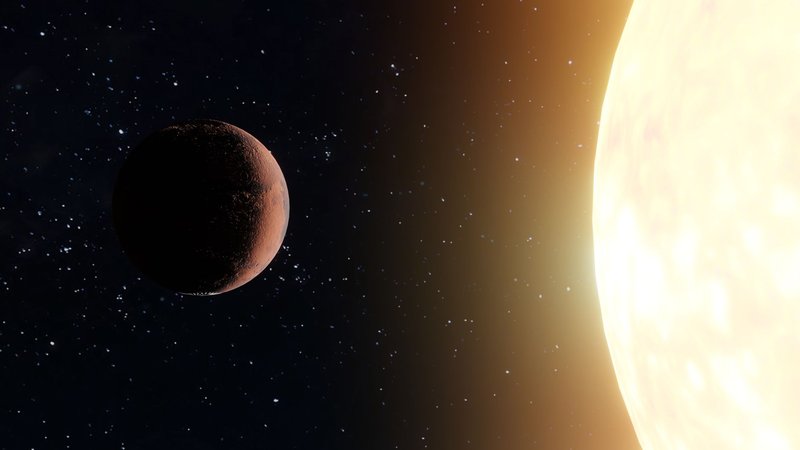
The Sun weighs about 333,000 Earths. Jupiter, the heavyweight of the planets, weighs about 318 Earths, and the Sun still outweighs it by a factor of roughly 1,050. Put every planet, moon, asteroid and comet together and you get about 0.14% of the Sun.
That’s the starting line. Everything below is a step up from it.
Heavier stars
The nearest bright star that beats the Sun is Sirius, 8.6 light-years away. Sirius A has about 2.06 solar masses, so it’s twice as heavy and about 25 times as luminous. It has a companion, Sirius B, that most people never hear about. It’s a white dwarf with roughly 1.02 solar masses packed into a body about the size of Earth. We’ll come back to that.
Beyond the neighborhood, the numbers climb fast.
- Betelgeuse is a red supergiant in Orion with an estimated 16 to 19 solar masses.
- Rigel, the blue-white supergiant in Orion’s foot, comes in around 21 solar masses.
- R136a1 sits in the Tarantula Nebula in the Large Magellanic Cloud, about 160,000 light-years away. It’s the heaviest star known. Estimates have moved around. A 2010 study put its current mass above 250 Suns, and a 2022 Hubble analysis revised it down to about 200. Even the lower figure means R136a1 is two hundred Suns in one object, shining millions of times brighter than ours. A good explainer on the most massive star in the universe covers why the exact number keeps changing.
The Sun is a G-type star at 1 solar mass. Red dwarfs, which are lighter than it, make up roughly three out of every four stars in our galaxy. So the Sun beats most stars and still barely registers against the heaviest ones.
Neutron stars
A neutron star is what’s left when a star of roughly 8 to 20 solar masses runs out of fuel, blows off its outer layers and collapses. The core crushes down until protons and electrons merge into neutrons.
A typical neutron star holds about 1.4 solar masses. The range runs from about 1.1 to about 2.3, and the heaviest confirmed one, the pulsar PSR J0740+6620, measures about 2.08. That’s the answer to “how many solar masses is a neutron star”: more than one, rarely more than two.
It isn’t a step up from R136a1 in raw mass. It belongs on the ladder because of what it weighs for its size. The whole thing is about 20 km across, roughly the width of a city. A teaspoon of its material would weigh a few billion tonnes. All eight billion humans together come to about half a billion tonnes, so one teaspoon outweighs everyone alive several times over.
Stellar-mass black holes
If the collapsing core is heavier than about 2.3 solar masses, nothing stops it. It becomes a black hole. Black holes formed from single stars are called stellar-mass black holes, and they run from a few solar masses up to a few tens, with merger products going past 100.
- Cygnus X-1, about 6,000 light-years away, has about 21 solar masses. It was the first strong black hole candidate ever found.
- Gaia BH3, found in 2024 in the constellation Aquila, has about 33 solar masses and sits only about 1,900 light-years away. That makes it the heaviest stellar-mass black hole known in the Milky Way.
A 10-solar-mass black hole has an event horizon, the point of no return, only about 30 km in radius. Ten Suns, in a space you could drive across in an afternoon.
You can browse NASA’s mass chart for dead stars and black holes to see how neutron stars and stellar-mass black holes line up. The chart also shows the gap where neither one seems to form often.
Intermediate-mass black holes
Intermediate-mass black holes weigh between 100 and 100,000 solar masses. They were the missing rung for decades: plenty of small black holes, plenty of giant ones, and almost nothing in between.
Two kinds of evidence have started to fill it in.
- Gravitational waves. In 2019 the LIGO and Virgo detectors recorded a collision that produced a black hole of about 142 solar masses, called GW190521. It was the first clear detection in this range. A merger reported in 2025, GW231123, produced a black hole of roughly 225 solar masses, the heaviest ever caught in gravitational waves.
- Star clusters. In 2024, Hubble measurements of stars moving at the center of the globular cluster Omega Centauri pointed to a black hole of at least 8,200 solar masses. It’s still called a strong candidate rather than a confirmed discovery.
Supermassive black holes
Almost every large galaxy has a black hole at its center that weighs millions to billions of Suns.
Sagittarius A* sits at the center of the Milky Way, about 26,000 light-years from Earth, and holds about 4.3 million solar masses. Its event horizon would fit inside Mercury’s orbit. The Event Horizon Telescope team imaged it in 2022, and ESO’s announcement of the first image of Sagittarius A* has the details.
M87* is the black hole in the 2019 “orange donut” image. It weighs about 6.5 billion Suns.
TON 618 is the heavyweight of the group most often quoted. It’s a quasar roughly 10 billion light-years away, powered by a black hole of about 40 billion solar masses, with estimates running as high as 66 billion. Its event horizon is about 800 times the Earth-Sun distance in radius, more than 25 times farther out than Neptune orbits. A few other candidates, such as the black hole at the center of the Phoenix cluster, have estimates reaching toward 100 billion. Those numbers are less settled, so treat the top of this list as a moving target.
That’s the answer to “largest black hole mass”: tens of billions of Suns, with the exact winner depending on who’s measuring.
Galaxies, clusters and the cosmic web
Black holes are the densest heavy things. The heaviest things overall are the structures built from everything else.
- The Milky Way has roughly 1 trillion solar masses in total. Its visible stars account for only about 50 to 60 billion of those. The rest is mostly dark matter.
- The Virgo Cluster, the galaxy cluster nearest to us, holds on the order of a quadrillion solar masses across more than a thousand galaxies.
- Laniakea, the supercluster that contains the Milky Way, is estimated at around 100 quadrillion solar masses.
- The observable universe holds about 50 sextillion solar masses of ordinary matter, with dark matter adding roughly five times more.
The cosmic web, the filament pattern that links clusters across space, doesn’t have a single mass. It’s the scaffolding, not an object. That’s where the ladder ends.
Heavier is not the same as bigger
Mass and size don’t track each other, and the ladder is full of examples.
- Betelgeuse is huge. If it replaced the Sun, its surface would reach past Mars into the asteroid belt. It only has about 16 to 19 Suns of mass, spread so thin that its outer layers are less dense than the air around you.
- Sirius B is more massive than the Sun, yet it’s the size of Earth.
- A neutron star holds up to two Suns in a body 20 km across.
- Jupiter has about a tenth of the Sun’s diameter and about a thousandth of its mass.
- A black hole doesn’t have a surface to measure. Its “size” is the event horizon, and that grows in direct proportion to its mass.
The first thing to remember is that mass tells you how much stuff there is and how hard it pulls on its surroundings. Size only tells you how widely it’s spread. The Sun sits in the middle of the range, with plenty of stars, remnants and black holes above it, and a very long ladder past that.