Headlines swap “asteroid” and “comet” like they’re synonyms. They aren’t.
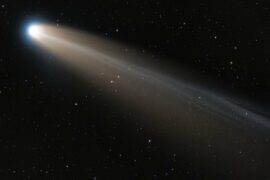
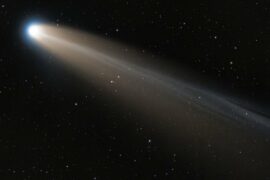
The difference between asteroids and comets comes down to composition and origin. Asteroids are rock and metal that formed in the warm inner solar system. Comets are ice, dust and organic compounds that formed in the cold outer solar system, and they sprout a glowing coma and tails when the Sun heats them.
Contents
- TLDR
- The Difference Between Asteroids and Comets at a Glance
- Where the Difference Comes From
- What Asteroids Are
- What Comets Are
- Where the Line Blurs
- Meteoroid, Meteor, Meteorite: The Glossary
- Missions That Visited Both
- FAQ
TLDR
- Asteroids: rocky or metallic, mostly in the belt between Mars and Jupiter, on fairly round orbits, no tail.
- Comets: icy and dusty, from the Kuiper Belt and Oort Cloud, on stretched orbits, with a coma and tails near the Sun.
- Shared history: both are leftovers from planet formation about 4.6 billion years ago, and a handful of objects behave like both.
The Difference Between Asteroids and Comets at a Glance
| Asteroids | Comets | |
|---|---|---|
| Composition | Rock, metal, some clays and carbon compounds | Water ice, frozen CO2 and CO, dust, organic molecules |
| Formed | Inside the frost line, where it was warm | Beyond the frost line, where it was cold |
| Home region | Main belt between Mars and Jupiter, plus near-Earth and Jupiter-Trojan groups | Kuiper Belt and Oort Cloud |
| Orbit | Mostly near-circular, close to the plane of the planets | Elongated ellipses, often steeply tilted |
| Tail | None (rare exceptions) | Dust tail and ion tail when near the Sun |
| Typical size | A few meters to about 940 km (Ceres) | Most nuclei under 20 km; Hale-Bopp’s was about 60 km |
| Known objects | More than 1.4 million | Roughly 4,000 |
| Examples | Vesta, Bennu, Eros | Halley, 67P/Churyumov-Gerasimenko, NEOWISE |
The counts matter. Asteroids are common and easy to find because they sit in reflected sunlight year-round. Comets are mostly invisible until a nucleus falls inward and switches on. NASA’s Center for Near-Earth Object Studies alone tracks well over 38,000 near-Earth asteroids, and that’s only the ones that wander close to us.
Where the Difference Comes From
Location at birth explains almost everything else.
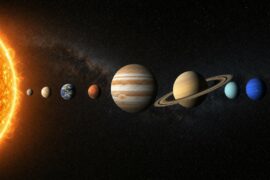
When the solar system was young, the Sun heated the disk of gas and dust around it. Close in, water stayed vapor and only rock and metal could clump together. Past a boundary called the frost line, roughly 2.7 times the Earth-Sun distance, water froze and became building material. Objects that formed inside that line became asteroids. Objects that formed far outside it became comets.
Then the giant planets shuffled things around. Jupiter’s gravity kept the asteroid belt from ever assembling into a planet, and the migration of the outer planets flung icy bodies into distant, stretched orbits. That’s why the two groups also differ in how they move.
The split isn’t perfectly clean. Many dark asteroids, the carbon-rich C-types, contain water locked inside clay minerals. Ceres has more water than all of Earth’s fresh water by some estimates. “Asteroids are dry” is a good first approximation and a bad final answer.
What Asteroids Are
The word comes from the Greek for “star-like,” because through a telescope an asteroid is a pinpoint, not a disk. Giuseppe Piazzi found the first one, Ceres, on New Year’s Day 1801.
Most asteroids sit in the main belt, between about 2.1 and 3.3 times the Earth-Sun distance. Despite the movie version, the belt is mostly empty space. Its total mass is only a few percent of the Moon’s, and Ceres alone holds about a third of it.
Astronomers sort asteroids by what they’re made of:
- C-type (carbonaceous): about three quarters of all asteroids. Dark, rich in carbon and hydrated minerals. Bennu is one.
- S-type (silicate): stony and brighter. Eros is one.
- M-type (metallic): iron and nickel. Psyche is the big example.
Vesta, at about 525 km across, is the second most massive object in the belt and the source of a large family of meteorites. It’s also the one asteroid that can be spotted with the naked eye under dark skies when it’s well placed.
Asteroids don’t stay in the belt. Collisions and Jupiter’s gravity push some onto paths that cross Earth’s orbit, and those near-Earth asteroids are the ones planetary defense teams watch.
What Comets Are
“Comet” comes from the Greek for “long-haired,” which is how ancient observers described the tail.
The solid core is the nucleus, and it’s smaller and darker than most people expect. Halley’s nucleus is about 15 km long and reflects roughly 4 percent of the light that hits it, darker than coal. Comet 67P, which the Rosetta spacecraft studied up close, is about 4 km across and has a density around half that of water. It’s closer to a frozen sponge than a snowball.
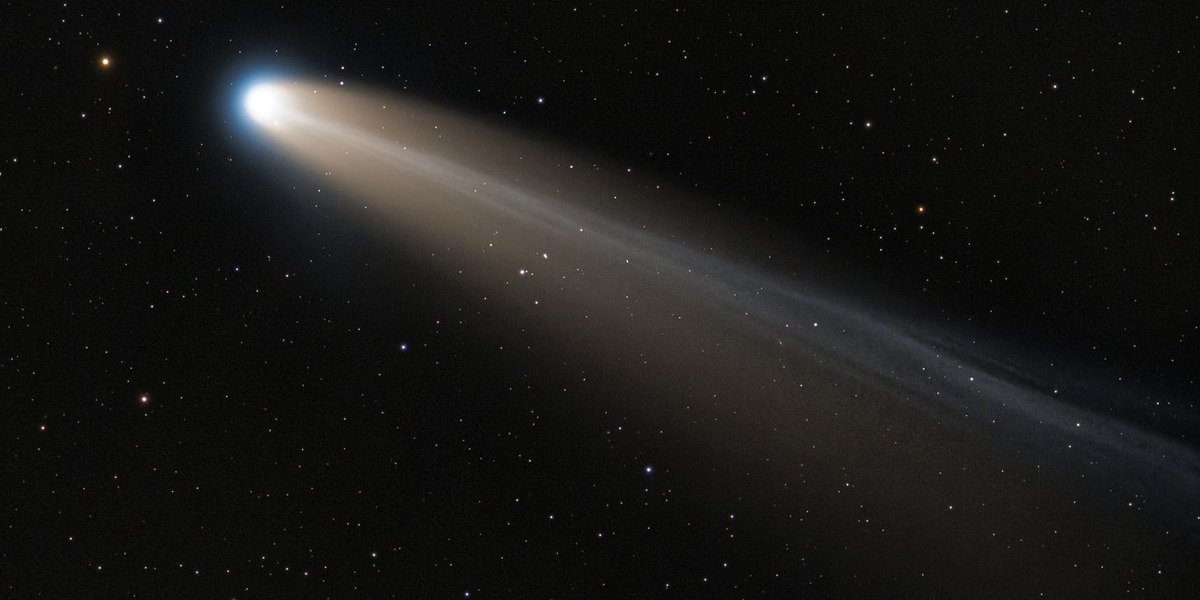
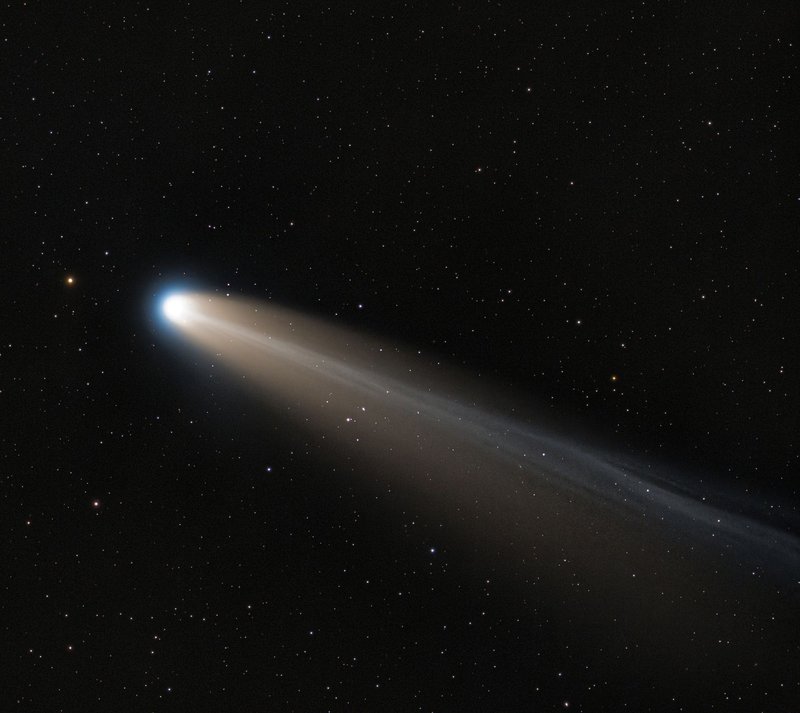
When a comet gets within roughly 3 times the Earth-Sun distance, sunlight turns surface ice straight into gas. The gas drags dust along and forms the coma, a fuzzy atmosphere that can swell larger than Jupiter around a nucleus only a few kilometers wide. Then come two tails:
- Dust tail: curved, yellowish-white, made of grains pushed back by sunlight.
- Ion tail: straight, bluish, made of gas electrically charged by the solar wind.
Both point away from the Sun, not behind the comet’s path. On the way out of the inner solar system, a comet flies tail-first.
Comets also split by orbit. Short-period comets take under 200 years to circle the Sun. Many are Jupiter-family comets from the Kuiper Belt, and Halley, back in 2061, is the best-known example. Long-period comets take more than 200 years, sometimes millions, and arrive from the Oort Cloud from any direction. The Oort Cloud is still a prediction based on orbits, since no telescope has imaged it. And in 2025, the interstellar object 3I/ATLAS showed that comets from other star systems pass through ours too.
Where the Line Blurs
Here’s the part most explainers skip. Nature didn’t read the textbook.
Active asteroids look like asteroids but shed dust like comets. A few dozen are known. Some, such as 133P/Elst-Pizarro in the main belt, appear to have buried ice. Others lose material because of impacts or because they spin fast enough to fling off debris.
311P/PANSTARRS is the weird one. Hubble photographed it in 2013 with six comet-like tails, which astronomers traced to a fast-spinning asteroid ejecting dust in bursts. No ice required.
3200 Phaethon has an asteroid’s name and number, an orbit that swings closer to the Sun than Mercury’s, and the Geminid meteor shower, a trail normally associated with comet debris. It brightens and grows a short tail near the Sun. Recent work suggests the tail comes from sodium vaporized by the heat, not from ice.
Dead and dormant comets are comets whose ice is sealed under a crust. They look like asteroids, and some near-Earth asteroids are probably extinct comets.
So the working rule is simple. If it has ice-driven activity, call it a comet. If it’s inert rock, call it an asteroid. The borderline cases get both labels.
Meteoroid, Meteor, Meteorite: The Glossary
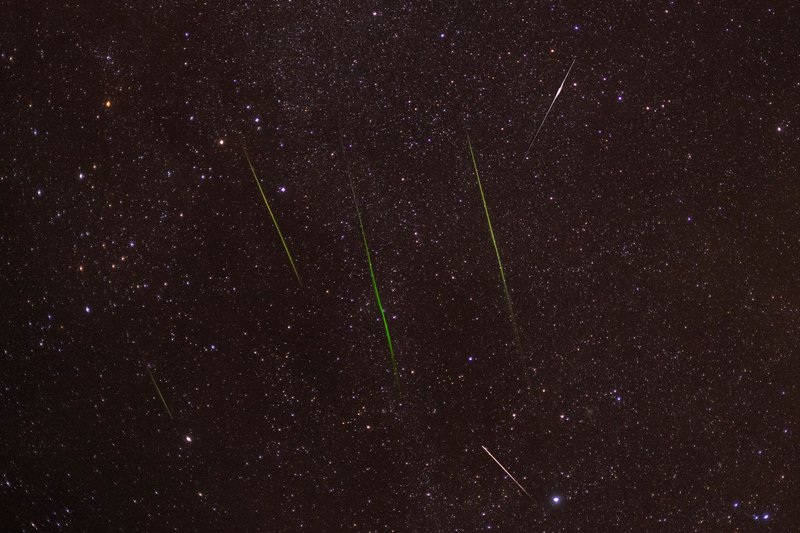
Three words, one object at three stages.
- Meteoroid: a chunk of rock or metal in space, from a grain of dust to about a meter across. Anything bigger is an asteroid.
- Meteor: the streak of light when a meteoroid burns up in the atmosphere. A shooting star.
- Meteorite: the piece that survives and lands on the ground.
Comets and asteroids both feed this system. When a comet passes, it leaves a stream of grit along its orbit. Earth crosses these streams every year, which produces meteor showers: the Perseids come from Comet Swift-Tuttle, and the Eta Aquariids and Orionids from Halley. Most meteorites that people hold come from asteroids, because a dense rocky fragment is far more likely to survive the fall than fluffy comet dust.
Missions That Visited Both
Spacecraft have settled most of the arguments.
- Rosetta (ESA): orbited comet 67P for two years from 2014 and dropped the Philae lander, the first soft landing on a comet. Its measurements showed 67P’s water carries a heavier form of hydrogen than Earth’s oceans do, which weakened the idea that comets alone filled our seas.
- OSIRIS-REx (NASA): collected a sample from asteroid Bennu and returned about 120 grams to Earth in September 2023. Analysis found amino acids and salt minerals left behind by evaporated water, evidence that Bennu’s parent body once held liquid water.
- Hayabusa2 (JAXA): brought back about 5 grams from asteroid Ryugu in 2020. It’s now on an extended mission to another asteroid, 1998 KY26.
- DART (NASA): slammed into Dimorphos on September 26, 2022 and shortened its orbit around the asteroid Didymos by 32 minutes, the first time humans measurably changed a celestial body’s motion. ESA’s Hera spacecraft is due at the pair around the end of 2026 to inspect the crater.
FAQ
Which is more dangerous, an asteroid or a comet?
Asteroids, by probability. They’re far more numerous, and many orbit near Earth’s path. Comets are rarer, but a long-period comet arrives with little warning and moves faster, so a hit would carry more energy per kilogram. Surveys have found about 95 percent of near-Earth asteroids larger than 1 km, and none of them threatens Earth in the next century, according to NASA’s comet and asteroid pages. The gap is in smaller objects. Asteroid 2024 YR4, spotted in December 2024, briefly carried a few percent chance of hitting Earth in 2032 before further observations ruled it out. NASA’s NEO Surveyor telescope, planned for launch in 2027, is built to find more of those mid-size rocks.
Is Ceres an asteroid?
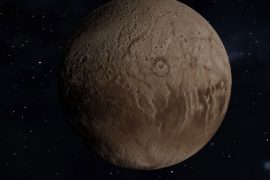
Yes and no. Ceres is the largest object in the asteroid belt, and it’s numbered “1 Ceres” in the asteroid catalog. Since 2006, it’s also officially a dwarf planet because it’s massive enough to be round. Both labels apply. The Dawn spacecraft found bright salt deposits in its Occator Crater, left by briny water that reached the surface.
Can an asteroid become a comet?
In effect, yes, in both directions. A comet that exhausts its surface ice goes dormant and looks like an asteroid. And an asteroid with buried ice can switch on if an impact exposes it.
Do comets burn up?
They erode. Each trip near the Sun strips off material, and a comet can break apart or fade out after enough passes. Comet ISON broke up in 2013 after passing close to the Sun.
Can I see them without a telescope?
Sometimes. A naked-eye comet appears only a few times a decade, and the brightest ones, like NEOWISE in 2020, are memorable. Among asteroids, Vesta is the one realistic naked-eye target, and you’ll need a dark sky and a finder chart.
Is Pluto a comet or an asteroid?
Neither. Pluto is a dwarf planet in the Kuiper Belt. It formed in the same region as many comets, but it’s far larger and has a planet-style structure of rock, ice and a thin atmosphere.