Picture an asteroid that never catches up to Jupiter and never falls behind. It just hangs there, locked 60 degrees ahead of the planet, riding the same orbit for billions of years. That’s a trojan asteroid. There’s a matching swarm 60 degrees behind, too, and between the two camps Jupiter drags along more than 15,300 known companions like a planet with an entourage.
These aren’t loose rocks that happened to drift nearby. They’re held in place by a quirk of gravity that turns two specific points in any planet’s orbit into parking spots, and the rocks parked there have been sitting undisturbed since the solar system was forming. That makes them some of the best-preserved fossils we have. It’s also why NASA built an entire mission, named after a fossil, to go look at them.
Table of Contents
- What a Trojan Asteroid Actually Is
- The L4 and L5 Physics, Without the Headache
- Tadpoles and Horseshoes: How They Wobble
- The Greek and Trojan Camps
- How We Found Them
- Trojans of Every Planet, Not Just Jupiter
- Why They’re Time Capsules
- The Lucy Mission: Going to See Them
- Quick Answers
What a Trojan Asteroid Actually Is
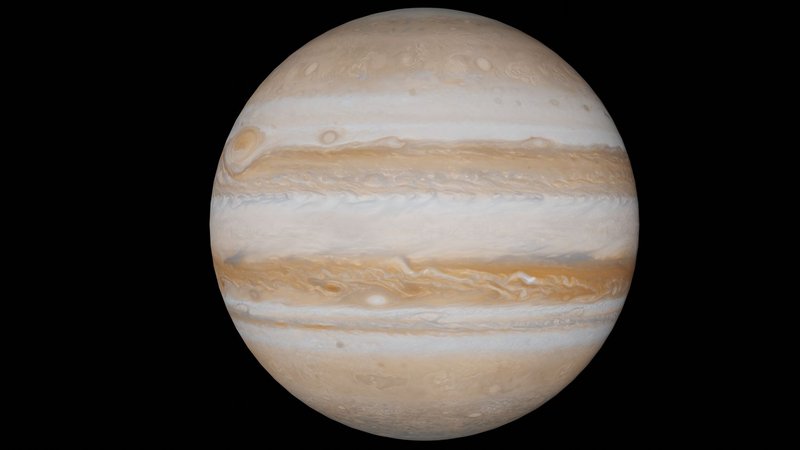
A trojan is an asteroid that shares a planet’s orbit around the Sun, but stays clustered around one of two stable points: one 60 degrees ahead of the planet, one 60 degrees behind. It loops the Sun in the same amount of time the planet does, so it never collides with it and never gets left behind.
The geometry is the key part. Draw a line from the Sun to the planet, then swing 60 degrees off to either side and draw another line the same length. The two new endpoints are where trojans gather. The Sun, the planet, and the trojan form an equilateral triangle that rotates as a rigid shape over the course of a year. Same triangle, every orbit.
This is different from a regular asteroid that crosses a planet’s path, and different from a moon that orbits the planet itself. A trojan orbits the Sun, keeping pace with the planet from a polite, permanent distance. The arrangement is stable enough that some of these rocks have likely held their position for over four billion years.
The L4 and L5 Physics, Without the Headache
Those two parking spots have names: L4 (the one leading the planet) and L5 (the one trailing it). They’re two of the five Lagrange points, the special locations in a two-body system where a small object can sit in gravitational balance.
Here’s the intuitive version. Anywhere else in the planet’s orbit, an asteroid that drifts off-station keeps drifting, because nothing pushes it back. At L4 and L5, the combined pull of the Sun and the planet, plus the centrifugal effect of the whole system rotating, adds up to a gentle net force that always nudges a stray rock back toward the point. It’s a gravitational valley. Roll a marble into a bowl and it settles at the bottom; roll an asteroid toward L4 and it settles into a loose orbit around the point.
The other three Lagrange points (L1, L2, L3) sit on the line connecting the Sun and the planet, and those are unstable: a marble balanced on a saddle, ready to slide off at the first nudge. That’s why we don’t find permanent asteroid swarms there. L4 and L5 are the only two that genuinely trap material, and they only do it well when the bigger body vastly outweighs the smaller one. The math works out cleanly when the mass ratio is above roughly 25 to 1, which is comfortably true for the Sun and any planet.
One more detail that surprises people: a trojan doesn’t sit exactly at L4 or L5. It orbits around the point in a slow loop, sometimes a wide one, the way a satellite orbits a planet even though there’s nothing physically at the center.
Tadpoles and Horseshoes: How They Wobble
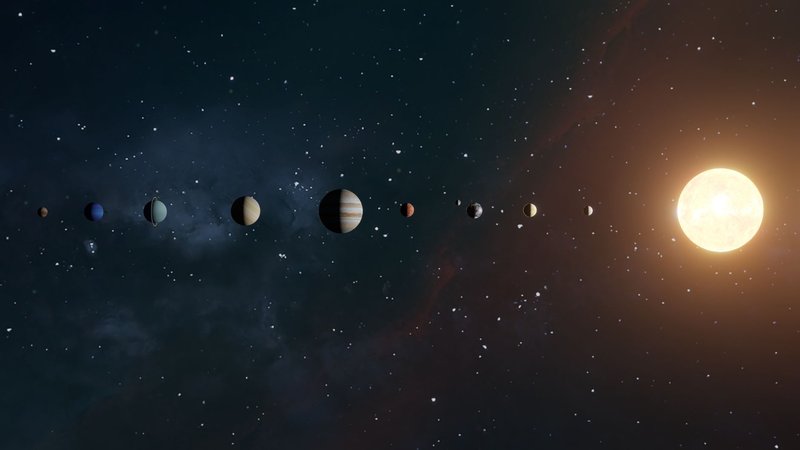
Trace the path a trojan takes relative to the planet over thousands of years and you get one of two shapes.
The common one is a tadpole orbit. The asteroid circles loosely around L4 or L5, tracing an elongated loop that, from the planet’s rotating point of view, looks like a tadpole: a fat body near the Lagrange point with a tail curving back toward the planet. Most Jupiter trojans live in tadpole orbits, swinging tens of degrees back and forth but never escaping their camp.
The dramatic one is a horseshoe orbit. Here the asteroid doesn’t stay loyal to a single point. It drifts all the way along the orbit, passes near L4, sweeps across the far side of the orbit through L3, and comes around to L5, then reverses before it ever reaches the planet. The path traces a giant horseshoe wrapped almost all the way around the Sun, open only at the gap where the planet sits. The asteroid creeps toward the planet, gets gently turned away by its gravity, and retreats the other direction. Some Earth co-orbital asteroids do exactly this, taking hundreds of years to complete a single lap of the horseshoe.
The difference comes down to energy. A rock with just enough nudge stays in a tadpole near one point; a rock with a bit more roams the full horseshoe.
The Greek and Trojan Camps
Jupiter’s two swarms have a naming tradition that’s half astronomy, half Homer. Asteroids at the leading L4 point are named after Greek heroes from the Iliad. Asteroids at the trailing L5 point get Trojan heroes. So there’s a “Greek camp” out front and a “Trojan camp” behind.
The convention got set up before the rule was firm, which is why each camp has one spy. Hektor, a Trojan name, sits in the Greek camp. Patroclus, a Greek name, sits in the Trojan camp. Astronomers basically planted a mole in each side before deciding to keep the camps pure, and now those two misfits are stuck behind enemy lines forever.
The whole class of objects, by the way, takes its name from this Jupiter population. “Trojan” started as the label for Jupiter’s companions and later became the general term for any asteroid sharing a planet’s orbit at L4 or L5.
How We Found Them
The first one turned up in 1906, when German astronomer Max Wolf spotted 588 Achilles near Jupiter’s leading Lagrange point. It was the first hard proof that the stable points Joseph-Louis Lagrange had worked out mathematically in 1772 actually held real objects. Theory met telescope.
More followed quickly: Patroclus in 1906, Hektor in 1907. For decades the known count grew slowly, a handful at a time, limited by how faint these distant rocks are. Then wide-field digital surveys arrived and the numbers exploded. By the 2000s the catalog ran into the thousands.
As of October 2025, astronomers have logged more than 15,300 Jupiter trojans, and estimates suggest the true population of objects larger than a kilometer rivals the entire main asteroid belt, that sprawling reservoir of many different kinds of space rock. We’ve cataloged a fraction of what’s actually out there.
Trojans of Every Planet, Not Just Jupiter
Jupiter hogs the spotlight because it has the most, but it isn’t the only planet with companions parked at L4 and L5. This is the part most explainers skip, and it’s the most interesting.
Neptune is the runner-up, with around 30 confirmed trojans and likely many more hidden in the dark outer system. Some models suggest Neptune’s trojan population could rival Jupiter’s in total numbers, just much harder to spot at that distance.
Mars has a small, confirmed family. The standout is 5261 Eureka, found in 1990, anchoring a cluster at the planet’s L5 point. Mars trojans are notable because they appear to be genuinely ancient, possibly original to the planet’s formation.
Earth has exactly two known trojans, and finding them was a slog. The first, 2010 TK7, was identified in 2011 from data taken by NASA’s WISE space telescope. It sits at Earth’s L4 point and traces a wide, looping orbit. The second, 2020 XL5, was confirmed in 2021 and is the larger of the pair, roughly a kilometer across. Earth trojans are brutally hard to observe because they sit in the daytime sky from our point of view, lost in the Sun’s glare.
Uranus has at least one confirmed trojan, 2011 QF99, though the planet’s chaotic gravitational neighborhood makes long-term stability there iffy. Venus has co-orbital companions too, though these tend to be temporary horseshoe-riders rather than permanently locked trojans.
The pattern: nearly every major planet collects companions at its stable points. The size of the collection depends on the planet’s mass, its formation history, and how cluttered its orbital neighborhood is.
Why They’re Time Capsules
The reason scientists care so much isn’t the gravitational trick. It’s what the trick preserves.
Trojan asteroids have been locked in place since the planets were still forming, around 4.5 billion years ago. They haven’t been ground down in the collisional chaos of the main belt, and they haven’t been baked and reshaped the way planets were. They’re leftovers from the original cloud of material that built the outer solar system, kept on ice and out of the way.
The Jupiter trojans in particular are dark and reddish, hinting at surfaces rich in carbon, complex organic molecules, and likely ice beneath. Their compositions suggest some of them may have formed much farther out and migrated inward when the giant planets shuffled their orbits early on. If that’s right, the trojan swarms are a mixed archive: samples from different regions of the early solar system, all swept into the same two gravitational corners. Reading them is like reading the solar system’s birth records.
The Lucy Mission: Going to See Them
You can only learn so much about a dark rock a billion kilometers away through a telescope. So NASA launched a spacecraft to fly out and look.
Lucy lifted off in October 2021 on a 12-year tour, and it’s the first mission ever sent to the Jupiter trojans. The name is a nod to the famous fossilized hominin skeleton, because the asteroids are fossils of planet formation, and the spacecraft even carries a plaque with the Beatles lyric the original Lucy was named after.
Its flight path is genuinely wild. Lucy loops back past Earth for gravity assists, dips into the main asteroid belt, then swings out to the leading Greek camp before eventually crossing the entire solar system to visit the trailing Trojan camp. By the time it’s done, it will have flown past more asteroids than any single mission in history.
Lucy has already started delivering. In November 2023 it flew past a small main-belt asteroid called Dinkinesh and discovered it has a tiny moon, which itself turned out to be a contact binary, two lumps stuck together. In April 2025 it cruised past Donaldjohanson, another main-belt rock, returning detailed images of an oddly elongated, fractured body. Those were both rehearsals. The main event begins in August 2027, when Lucy reaches its first Jupiter trojan, Eurybates, and works through a list that includes Polymele, Leucus, Orus, and the binary Patroclus-Menoetius out at the L5 camp.
If everything holds, Lucy will give us our first close looks at the objects we’ve only ever seen as dots, and finally tell us what the solar system’s oldest leftovers are actually made of.
Quick Answers
Are trojan asteroids dangerous to Earth? No. The whole point of a trojan is that it stays locked at a stable point in a planet’s orbit. Earth’s two trojans keep their distance and pose no impact risk. The L4 and L5 arrangement is what keeps them safely out of the way.
Why are they called “trojans”? The first ones found, near Jupiter, were named after heroes of the Trojan War from Homer’s Iliad. The name stuck and became the general term for any asteroid sharing a planet’s orbit at L4 or L5.
How many trojan asteroids are there? More than 15,300 are confirmed around Jupiter as of October 2025, split between the leading Greek camp and the trailing Trojan camp. The real total of kilometer-plus objects may match the entire main asteroid belt. Other planets, including Earth, Mars, Neptune, Uranus, and Venus, host their own, much smaller, sets.
What’s the difference between a tadpole and a horseshoe orbit? A tadpole orbit stays looped around a single Lagrange point. A horseshoe orbit drifts almost all the way around the Sun, passing near both stable points before reversing. Most Jupiter trojans are tadpoles; some of Earth’s co-orbital companions ride horseshoes.