The Geminid meteor shower peaks on the night of December 13 to 14, 2026. The International Meteor Organization (IMO) puts the maximum at 14:00 UTC on December 14 with a zenithal hourly rate (ZHR) of 150, the highest of any annual shower. The Moon is a thin waxing crescent that sets by about 9 pm, so the rest of the night is dark. 2026 is the best Geminid year until 2028: the 2027 peak falls two days before a full Moon.
Geminids 2026 at a glance
| Peak night | December 13 to 14, 2026 (Americas and Europe); evening of December 14 (Asia) |
| Exact peak | December 14, 14:00 UTC (9:00 am EST, 6:00 am PST) |
| Active | December 4 to 20 |
| Peak rate | ZHR 150; up to 100 or more per hour from a dark site, 15 to 20 from the suburbs |
| Best time | From moonset until dawn; the radiant is highest around 2 am local time |
| Where to look | Anywhere overhead; meteors trace back to the star Castor in Gemini |
| Moon | 25% lit waxing crescent, sets about 8:40 pm on December 13 (New York) |
| Parent body | Asteroid 3200 Phaethon |
| Speed | 35 km/s (about 78,000 mph) |
For a live answer on any night of the year, use the Meteor Shower Tonight tool. It shows which showers are active, where to look from your city and how much the Moon washes them out.
When is the Geminid meteor shower in 2026?
The Geminids are active from December 4 to December 20. Rates stay low for the first week, climb sharply from December 12 and peak on December 14. After the peak they drop faster than they rose, so the nights before the maximum are better than the nights after it.
The IMO 2026 calendar puts the maximum at solar longitude 262.2 degrees, which is December 14 at 14:00 UTC. Every well-observed Geminid peak of the past two decades fell between 21:00 UTC on December 13 and 18:00 UTC on December 14 (2026 dates). The maximum is also broad: the ZHR stays at 100 or more for 10 to 12 hours. Anyone with a dark sky on the night of December 13 to 14 will see the shower close to its best.
Peak time in your time zone
| Location | Peak (local time) | Best night to watch |
|---|---|---|
| Hawaii (HST) | 4:00 am, Dec 14 | Dec 13 to 14, peak falls in darkness |
| Alaska (AKST) | 5:00 am, Dec 14 | Dec 13 to 14, peak falls in darkness |
| US Pacific (PST) | 6:00 am, Dec 14 | Dec 13 to 14, best in the hours before dawn |
| US Mountain (MST) | 7:00 am, Dec 14 | Dec 13 to 14 |
| US Central (CST) | 8:00 am, Dec 14 | Dec 13 to 14 |
| US Eastern (EST) | 9:00 am, Dec 14 | Dec 13 to 14 |
| UK (GMT) | 2:00 pm, Dec 14 | Dec 13 to 14; Dec 14 to 15 is also good |
| Central Europe (CET) | 3:00 pm, Dec 14 | Dec 13 to 14; Dec 14 to 15 is also good |
| India (IST) | 7:30 pm, Dec 14 | Dec 14 to 15 |
| China, Philippines (UTC+8) | 10:00 pm, Dec 14 | Dec 14 to 15, peak falls in darkness |
| Japan, Korea (UTC+9) | 11:00 pm, Dec 14 | Dec 14 to 15, peak falls in darkness |
| Sydney (AEDT) | 1:00 am, Dec 15 | Dec 14 to 15, radiant stays low |
East Asia is the best-placed region in 2026. The peak arrives there in the late evening with the radiant already high and the Moon gone. Western North America and Hawaii come next: the peak lands in the last dark hours before sunrise. In the eastern US and Europe the maximum falls in daylight, but the broad peak means the night of December 13 to 14 still delivers rates close to the maximum.
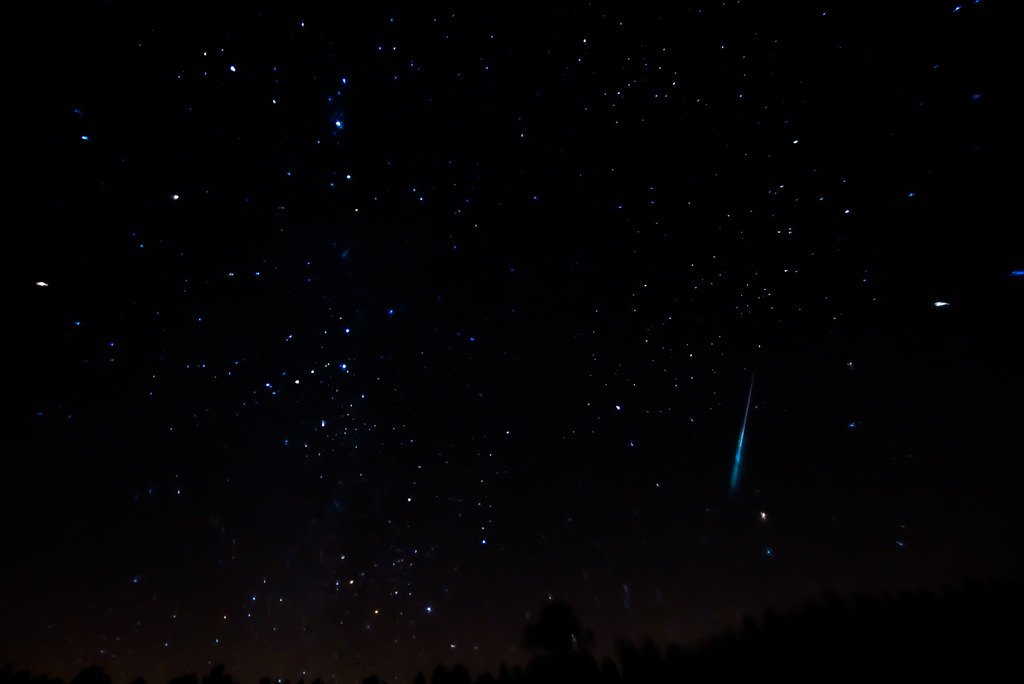
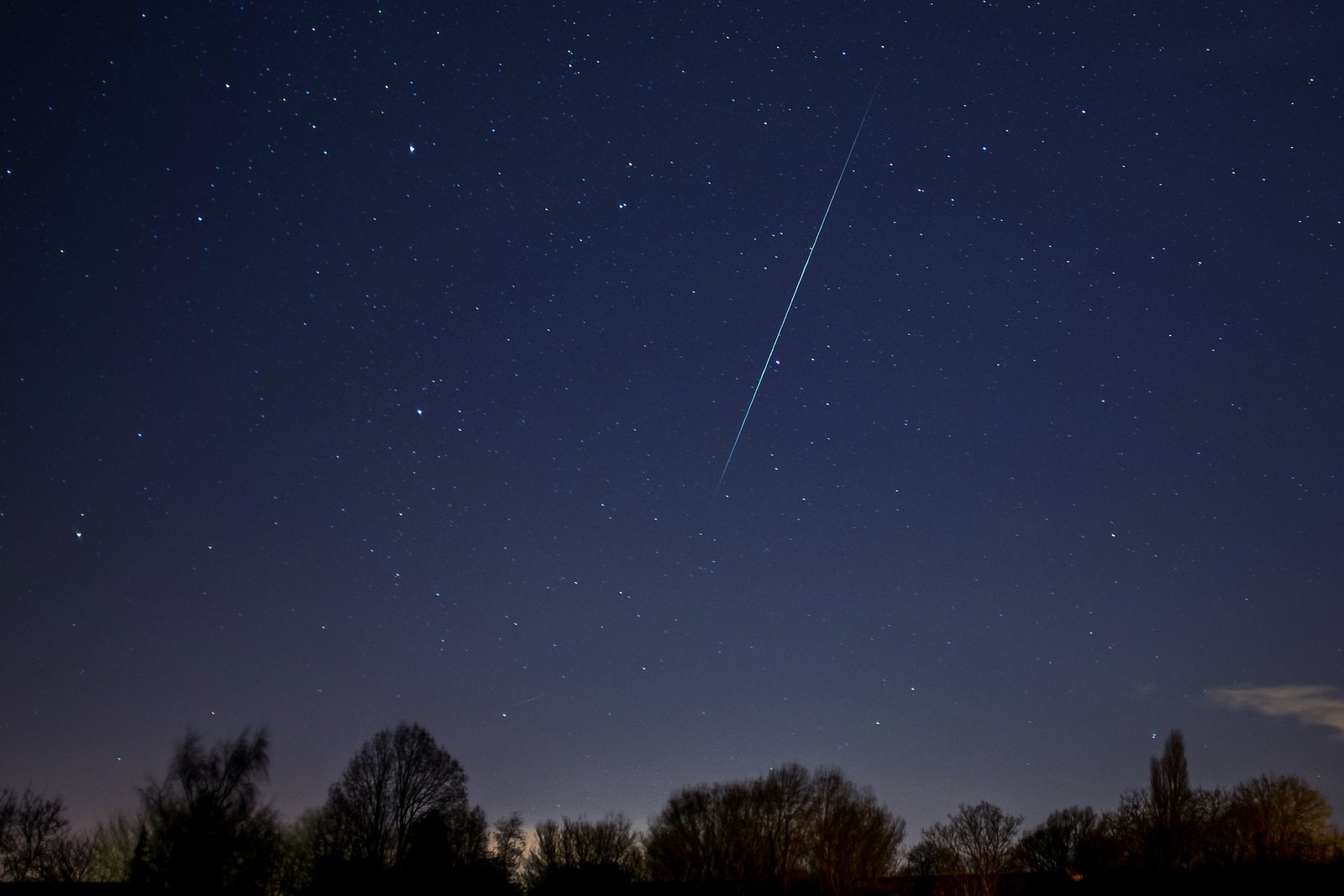
A Geminid meteor beside Orion. Photo: StephenGA, CC0.
How many meteors will you see?
The ZHR of 150 is a standard figure, not a promise. It is the number one observer would count with the radiant directly overhead under a perfectly dark sky where stars of magnitude 6.5 are visible. Real counts depend mostly on how dark your sky is. For the Geminids, every step of one magnitude in sky brightness cuts the count by a factor of 2.6.
| Where you watch | Faintest stars visible | Geminids per hour near the peak |
|---|---|---|
| Remote dark site | Magnitude 6.5 | Up to 100 to 150 |
| Rural area | Magnitude 5.5 | About 40 to 60 |
| Suburbs | Magnitude 4.5 | About 15 to 20 |
| City | Magnitude 3.5 | About 5 to 8 |
The figures assume the radiant is high in the sky, which it is from about 11 pm to 4 am at mid-northern latitudes. Earlier in the evening the radiant is lower and you see fewer meteors, though the ones you do see are often long, slow “earthgrazers” that skim the upper atmosphere almost horizontally. Driving 30 to 60 minutes away from city lights does more for your count than anything else. Our best dark sky locations guide and the dark sky parks in the US list help you find a site.
Where to look
Geminid meteors appear to come from a point called the radiant, near the bright star Castor in the constellation Gemini. The radiant rises in the northeast around sunset (5:35 pm in New York on December 13), climbs through the evening and reaches its highest point near 2 am local time, almost straight overhead from the northern United States and Europe.
You do not need to look at the radiant itself. Meteors near it have short trails because they are coming almost straight at you. The longest trails show up 40 to 60 degrees away from it. Lie back, face whichever part of the sky is darkest and take in as much of the sky as you can. If a meteor’s path traces back to Gemini, it is a Geminid; other showers active in mid-December, such as the December Monocerotids and the sigma Hydrids, produce only a few meteors per hour.
To find Gemini, locate Orion first. Draw a line from Rigel, at Orion’s lower right, through Betelgeuse at his upper left and keep going about the same distance again. You reach the twin stars Castor and Pollux. The how to find Gemini guide walks through it with a chart, and the stars of Gemini lists each named star.
The Moon in 2026
New Moon falls on December 9, 2026, so at the peak the Moon is a 25% lit waxing crescent in the evening sky. It sets early and leaves the late-night hours, when the radiant is highest, completely dark.
| Night | Moonset, New York | Moonset, Los Angeles | Moonset, London |
|---|---|---|---|
| Dec 12 to 13 | 7:40 pm | 8:01 pm | 6:50 pm |
| Dec 13 to 14 (peak) | 8:42 pm | 9:00 pm | 8:02 pm |
| Dec 14 to 15 | 9:44 pm | 9:57 pm | 9:15 pm |
| Dec 15 to 16 | 10:47 pm | 10:55 pm | 10:27 pm |
After moonset the sky stays dark until morning twilight begins around 5:30 am. That gives roughly eight moon-free hours on the peak night. The Moon Phase Today page has the exact phase and moonset for any date.
Compare that with the next few years. In 2027 the Moon is 98% full at the Geminid peak and drowns out all but the brightest meteors. 2028 is excellent again, with a 5% crescent. The full moon calendar lists the dates.
What causes the Geminids?
Most meteor showers come from comets. The Geminids come from an asteroid: 3200 Phaethon, a rocky body about 5 to 6 kilometers across. Every December, Earth passes through the trail of dust and grit that Phaethon has left along its orbit. The particles hit the atmosphere at 35 kilometers per second and burn up 70 to 100 kilometers overhead. Each streak of light is a grain usually smaller than a pea. The what causes a meteor shower article explains the process in detail.
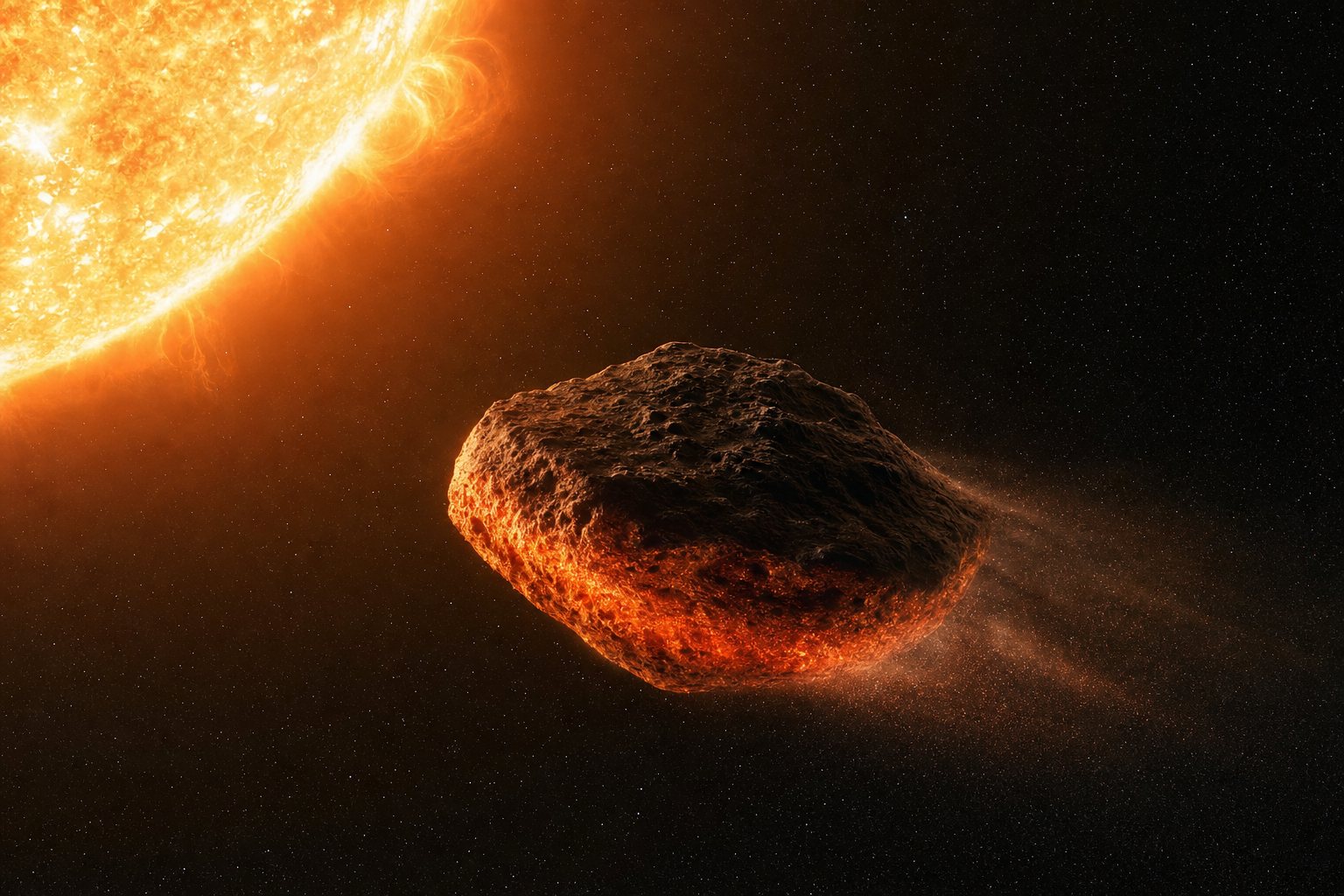
Illustration of 3200 Phaethon near perihelion, where sunlight heats its surface to roughly 750 degrees Celsius.
Astronomers Simon Green and John Davies found Phaethon in October 1983 in data from the Infrared Astronomical Satellite (IRAS). It was the first asteroid discovered by a spacecraft, and its orbit matched the Geminid stream almost at once. At its closest, Phaethon passes 0.14 astronomical units from the Sun, less than half of Mercury’s closest distance. It completes one orbit every 1.4 years. The name comes from the son of the Greek sun god Helios, who drove his father’s chariot too close to the Earth.
The intense heat near the Sun cracks Phaethon’s surface and releases small amounts of material, which is why it is sometimes called a “rock comet.” That activity is far too weak to supply a stream as massive as the Geminids, so most of the material came off in an earlier, more violent episode. Japan’s space agency JAXA is building the DESTINY+ spacecraft to fly past Phaethon and study it up close. For more on how these bodies differ, see 6 differences between comets and asteroids or explore real shapes in the Asteroid 3D Model.
Why the Geminids look different
Geminid particles are denser than the fluffy comet dust behind most showers. They hold together longer, penetrate deeper into the atmosphere and burn for longer, so Geminid meteors look slower and brighter than Perseids or Leonids. At 35 km/s they are medium-speed meteors, about half the speed of the Leonids. Many leave yellowish or white trails and some flash green or blue. The shower also produces more fireballs (meteors brighter than Venus) than most.
Observers have also found that the brightest Geminids tend to arrive late in the maximum, after the bulk of the fainter meteors. Watching in the hours after the peak can therefore pay off with fewer but brighter meteors.
The Geminids are also a young shower. Records go back only to 1862, when observers in England and the United States first noted them, and early returns produced 10 to 20 meteors per hour. Rates climbed through the 20th century and today the Geminids beat the August Perseids. Read more in meteors vs shooting stars and how big are meteors.
How to watch the Geminids
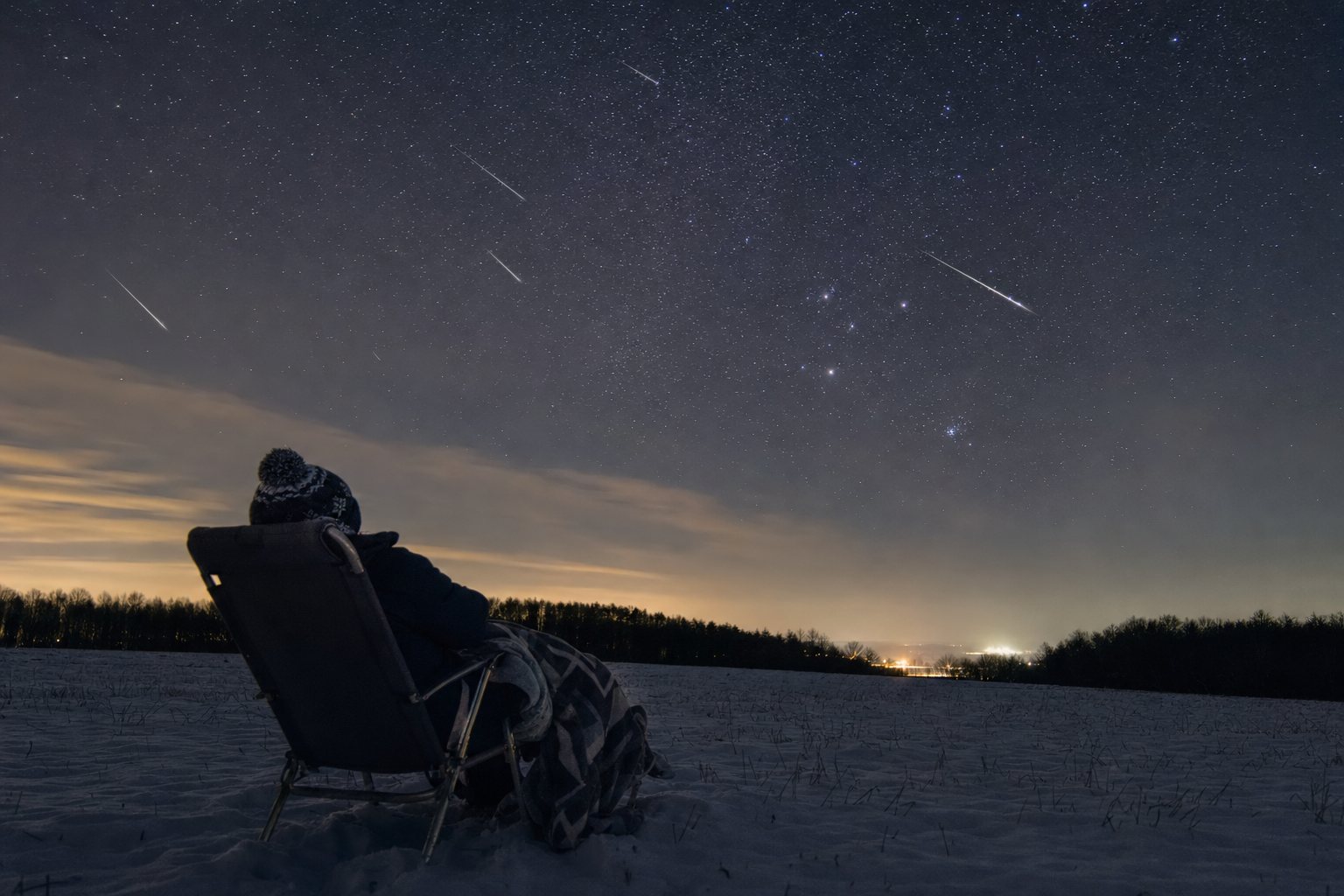
A reclining chair and a blanket are the most useful meteor-watching gear.
- Pick the night. December 13 to 14 in the Americas and Europe, December 14 to 15 in Asia and Australia. Check the cloud forecast a day ahead; if the peak night is cloudy, December 12 to 13 is the next best.
- Get away from lights. Even a few kilometers out of town doubles the count. A spot with an open view of the whole sky beats a mountaintop hemmed in by trees.
- Go after moonset. The best window runs from about 10 pm to 5 am, with the highest rates after midnight.
- Lie back. A reclining camp chair or a sleeping pad lets you watch the whole sky for an hour without neck strain.
- Give your eyes 20 to 30 minutes. Dark adaptation takes that long and one look at a white phone screen resets it. Use a red light such as the Celestron red LED headlamp and turn your phone to night mode or keep it in your pocket.
- Dress for the cold. December nights are cold almost everywhere in the Northern Hemisphere and you will be sitting still for hours. Wear more layers than you think you need, plus a hat, gloves, warm boots and a blanket. Hand warmers and a thermos of something hot help.
- Watch for at least an hour. Meteors come in clusters with lulls in between. Ten minutes with nothing does not mean the shower is over.
No telescope or binoculars are needed. Both show only a tiny piece of sky, and meteors are too fast to follow. Your eyes are the best instrument. If you want to put names to the stars while you wait, a planisphere such as The Night Sky star finder (40 to 50 degrees north, or the 30 to 40 degrees version for the southern US) shows the sky for any date and hour.
Watching from the Southern Hemisphere
The Geminids are visible from the Southern Hemisphere, but the radiant rises late and stays low. In Sydney it rises around 10:30 pm and climbs only about 23 degrees above the northern horizon before dawn, which cuts the count to roughly a third of what northern observers see. Watch on the night of December 14 to 15, after 1 am, from a site with a clear northern horizon.
Photographing the Geminids
Meteor photography is a numbers game. Put a camera on a tripod with the widest lens you have (14 to 24 mm on a full-frame camera), open the aperture to f/2.8 or as wide as the lens allows, set ISO 1600 to 3200 and take back-to-back exposures of 15 to 25 seconds with an intervalometer. Focus manually on a bright star, turn off image stabilization and aim the camera 40 to 60 degrees away from Gemini, toward the darkest part of the sky. Over a few hours you will catch a handful of bright meteors among hundreds of frames. Cold drains batteries fast, so bring spares and keep them in an inside pocket. Our guide to night sky photography accessories covers intervalometers, dew heaters and tripods.
Other meteor showers in December 2026
The Ursids peak on December 22, 2026, at about 22:00 UTC, with a ZHR of about 10, visible only from the Northern Hemisphere. This year a 96% lit Moon sits in the sky that night, so expect very few. The radiant is near Kochab in the Little Dipper and stays up all night from mid-northern latitudes. The December meteor showers page covers the minor streams, and the annual meteor showers list covers the whole year.
Geminid peak dates and moon phase, 2026 to 2030
| Year | Peak (UTC) | Moon at peak | Conditions |
|---|---|---|---|
| 2026 | Dec 14, 14:00 | 25%, waxing crescent | Excellent |
| 2027 | Dec 14, 20:00 | 98%, nearly full | Poor |
| 2028 | Dec 14, around 02:00 | 5%, crescent | Excellent |
| 2029 | Dec 14, around 08:00 | 65%, gibbous | Fair |
| 2030 | Dec 14, around 14:00 | 82%, gibbous | Poor |
Peak times for 2028 to 2030 are calculated from the solar longitude of recent maxima; the IMO publishes refined times in each year’s calendar.
FAQ
When is the Geminid meteor shower in 2026?
In 2026 the Geminids are active from December 4 to 20 and peak on the night of December 13 to 14. The exact maximum is December 14 at 14:00 UTC, which is 9:00 am Eastern and 6:00 am Pacific time.
What time should I watch the Geminids?
Watch from moonset (about 8:40 pm on December 13 in New York) until morning twilight, around 5:30 am. Rates are highest between midnight and 4 am, when the radiant near Castor is high overhead.
How many Geminids per hour can I see?
The peak ZHR is 150. From a dark rural site with the radiant high you can see 100 or more per hour; from the suburbs about 15 to 20; from a city center only a handful.
Which direction should I look for the Geminids?
Look up at the darkest, widest part of the sky. Meteors appear in every direction but trace back to the constellation Gemini, which rises in the northeast in the evening and is nearly overhead around 2 am.
Will the Moon affect the Geminids in 2026?
Very little. The Moon is a 25% lit crescent that sets in the mid-evening, so the hours after 10 pm are dark. Conditions are far better than in 2027, when the Moon is nearly full at the peak.
Do I need a telescope to see the Geminids?
No. Meteors are best seen with the naked eye because they can appear anywhere in the sky. Telescopes and binoculars show too small an area.
Can you see the Geminids from the Southern Hemisphere?
Yes, but at lower rates. The radiant rises around 10:30 pm in Sydney and stays low in the north, so southern observers see roughly a third as many meteors. The best time is after 1 am on December 15.
What causes the Geminid meteor shower?
The Geminids are debris from asteroid 3200 Phaethon, a rocky body about 5 to 6 km wide that passes closer to the Sun than Mercury. Earth crosses its debris stream every December and the grains burn up in the atmosphere at 35 km per second.
Why are they called the Geminids?
Meteor showers are named after the constellation that holds their radiant. Geminid meteors appear to come from a point near the star Castor in Gemini, the Twins.
Is the Geminid shower better than the Perseids?
In most years, yes. The Geminids reach a ZHR of 150 against 100 for the Perseids, and they can be seen from early evening. The Perseids have warm August nights in their favor.
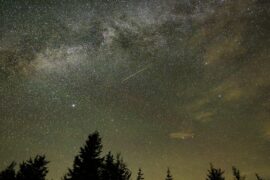
Featured image: a Geminid meteor in 2017 by Brian Tomlinson, CC BY 2.0, resized. Phaethon and observer images are illustrations.