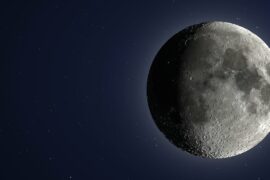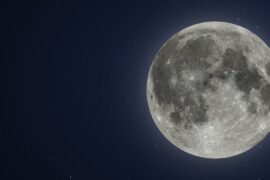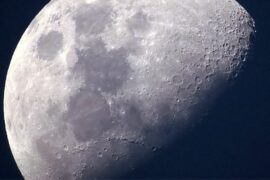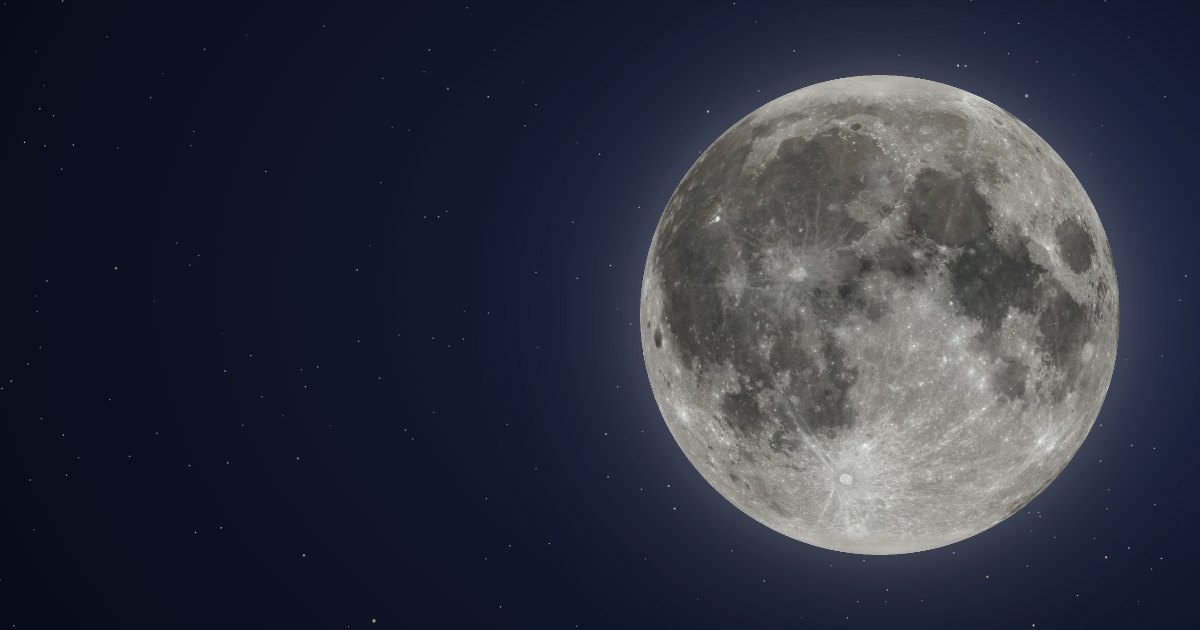
There are 12 full moons in 2027, from the Wolf Moon on Friday, January 22 to the Cold Moon on Monday, December 13. The January 22 full moon is the only supermoon of the year. No month has two full moons, so 2027 has no monthly Blue Moon (May 20 is a seasonal Blue Moon by the older definition), and all three lunar eclipses are penumbral, the faint kind that darkens the Moon only slightly.
Times in the table are Eastern Time (ET). The month-by-month section also gives Pacific Time (PT). For the phase of the Moon right now, use the live Moon phase tool.
Full moon schedule 2027
The table lists every full moon in 2027 with its date, time and traditional name. Dates and times come from the US Naval Observatory and are converted to Eastern Time, with daylight saving time from March 14 to November 7.
| Date | Time (ET) | Name | Notes |
|---|---|---|---|
| 7:17 a.m. EST | Wolf Moon | Supermoon | |
| 6:23 p.m. EST | Snow Moon | Penumbral lunar eclipse | |
| 6:44 a.m. EDT | Worm Moon | ||
| 6:27 p.m. EDT | Pink Moon | ||
| 6:59 a.m. EDT | Flower Moon | ||
| 8:44 p.m. EDT | Strawberry Moon | ||
| 11:45 a.m. EDT | Buck Moon | Micromoon Penumbral lunar eclipse | |
| 3:29 a.m. EDT | Sturgeon Moon | Micromoon Penumbral lunar eclipse | |
| 7:04 p.m. EDT | Harvest Moon | Nearest the autumn equinox | |
| 9:47 a.m. EDT | Hunter's Moon | ||
| 10:26 p.m. EST | Beaver Moon | ||
| 11:09 a.m. EST | Cold Moon |
Two full moons fall on a different date in Universal Time (UT) than in the United States. The June full moon is on June 19 in UT and June 18 in the US, and the November full moon is on November 14 in UT and November 13 in the US.
Full moon names by month (2027 dates)
Each full moon has a traditional name tied to the season, and the names below follow the Old Farmer’s Almanac list. A full moon looks full on the evening before and the evening after its exact time, so a morning full moon is best seen the night before.
Wolf Moon: Friday, January 22
7:17 a.m. EST (4:17 a.m. PST). The Almanac says wolves were often heard howling at this time of year, and the name is thought to be of English origin rather than a traditional Native American name. View it on the evenings of January 21 and 22. Winter full moons ride high, passing above 60 degrees from the horizon at 40 degrees north, because the Moon sits opposite the low winter Sun. This is also the year’s supermoon.
Snow Moon: Saturday, February 20
6:23 p.m. EST (3:23 p.m. PST). In the 1760s the explorer Jonathan Carver recorded the name among the Dakota; it fits because more snow commonly falls in February than in any other winter month. The Moon rises around sunset in the eastern US, close to the time of a faint penumbral lunar eclipse that peaks at 6:13 p.m. EST.
Worm Moon: Monday, March 22
6:44 a.m. EDT (3:44 a.m. PDT). The name usually refers to the earthworms that appear as the soil warms, though Carver tied it to larvae emerging from tree bark. This is the first full moon after the March 20 equinox. Look on the evenings of March 21 and 22.
Pink Moon: Tuesday, April 20
6:27 p.m. EDT (3:27 p.m. PDT). The name comes from moss pink, an early spring wildflower, and the Moon does not turn pink. It rises at dusk, and a Moon near the horizon looks orange because its light travels through more air.
Flower Moon: Thursday, May 20
6:59 a.m. EDT (3:59 a.m. PDT). Flowers appear in abundance in May, which gave the Moon its name. Look on the evenings of May 19 and 20. By an older definition this is a seasonal Blue Moon (see below).
Strawberry Moon: Friday, June 18
8:44 p.m. EDT (5:44 p.m. PDT). Ripe strawberries were ready to be gathered at this time. It is full about two and a half days before the June solstice, when the full moon takes its lowest path of the year, staying under 35 degrees above the horizon at 40 degrees north.
Buck Moon: Sunday, July 18
11:45 a.m. EDT (8:45 a.m. PDT). Bucks, the male deer, have antlers in full growth in July. Look on the evenings of July 17 and 18. This is the most distant full moon of 2027, at about 406,000 km, and it coincides with the faintest penumbral eclipse of the century (magnitude 0.0014).
Sturgeon Moon: Tuesday, August 17
3:29 a.m. EDT (12:29 a.m. PDT). Sturgeon in the Great Lakes and Lake Champlain were said to be most readily caught in August. The exact moment falls in the middle of the night across North America, during a penumbral lunar eclipse that peaks at 3:14 a.m. EDT.
Harvest Moon: Wednesday, September 15
7:03 p.m. EDT (4:03 p.m. PDT). The Harvest Moon is the full moon closest to the September equinox, which falls on September 23 at 06:02 UT. September 15 is a week before the equinox, while the October full moon is three weeks after it, so September holds the Harvest Moon and there is no Corn Moon in 2027. Near the equinox the Moon rises roughly 20 to 30 minutes later each night in mid-northern latitudes, against an average of 50, so several evenings in a row have a bright Moon at dusk.
Hunter’s Moon: Friday, October 15
9:47 a.m. EDT (6:47 a.m. PDT). October is the month when game was fattening up for winter, and the Hunter’s Moon is the first full moon after the Harvest Moon. Look on the evenings of October 14 and 15.
Beaver Moon: Saturday, November 13
10:26 p.m. EST (7:26 p.m. PST). Beavers finish their winter preparations and retreat into their lodges in November, and the season was also when they were trapped for pelts. The exact moment is November 14 in UT. For a close look at this name and its alternatives, see the Beaver Moon 2026 guide.
Cold Moon: Monday, December 13
11:09 a.m. EST (8:09 a.m. PST). The Almanac credits the name to the Mohawk people, for the time when winter cold fastens its grip. A Mohican name for the same Moon is the Long Night Moon. Look on the evenings of December 12 and 13, when it rides high in the sky.
2027 supermoons
One 2027 full moon is a supermoon: January 22, at 357,600 km from Earth. This site counts a full moon as a supermoon when the Moon is closer than 361,885 km at the moment it turns full. Other sites use different cutoffs, so lists of supermoons vary.
The distances below are the Earth-to-Moon center distance at the exact full moon instant from NASA’s JPL Horizons system.
| Full moon (ET date) | Distance | Supermoon? |
|---|---|---|
| January 22 | 357,600 km | Yes |
| February 20 | 363,300 km | No |
| March 22 | 372,500 km | No |
| April 20 | 383,400 km | No |
| May 20 | 393,900 km | No |
| June 18 | 402,000 km | No |
| July 18 | 406,000 km | No |
| August 17 | 405,100 km | No |
| September 15 | 399,400 km | No |
| October 15 | 389,900 km | No |
| November 13 | 378,800 km | No |
| December 13 | 368,100 km | No |
The January 22 Moon is 12% closer than the July 18 Moon, which makes it appear 13.5% wider and, by the inverse-square law, about 29% brighter. Perigee, the Moon’s closest point of the month, comes about 14 hours before full, at roughly 5 p.m. EST on January 21 at 357,300 km. The February 20 full moon misses the cutoff by about 1,400 km.
The January supermoon is the last of a run of three. The November 24 and December 23 (ET) full moons of 2026 are also supermoons, at about 360,800 km and 356,700 km. The December 2026 Moon is the closest full moon of 2026 and 2027 combined.
Is there a Blue Moon in 2027?
No. Every calendar month in 2027 has exactly one full moon by Eastern date, so there is no monthly Blue Moon, which is the second full moon in a calendar month. The most recent one was May 31, 2026, and the next is December 31, 2028.
An older definition, the seasonal Blue Moon, counts the third full moon in a season that has four. Spring 2027 qualifies: the full moons of March 22, April 20, May 20 and June 18 all fall between the March equinox and the June solstice, which makes May 20 a seasonal Blue Moon. The December 31, 2028 Blue Moon coincides with a total lunar eclipse.
2027 eclipses
All three lunar eclipses in 2027 are penumbral, in which the Moon passes through Earth’s faint outer shadow and does not enter the dark inner shadow. There is no partial or total lunar eclipse in 2027. The last total lunar eclipse was March 3, 2026, and the next is December 31, 2028.
| Date | Greatest eclipse (ET) | Greatest eclipse (PT) | Penumbral magnitude |
|---|---|---|---|
| February 20 | 6:13 p.m. EST | 3:13 p.m. PST | 0.93 |
| July 18 | 12:03 p.m. EDT | 9:03 a.m. PDT | 0.001 |
| August 17 | 3:14 a.m. EDT | 12:14 a.m. PDT | 0.55 |
Magnitude is the fraction of the Moon’s diameter inside the penumbra, so 0.93 means a sliver of the Moon stays outside it. The February event is deep enough that a faint shading on one edge of the Moon may be visible around maximum. The August event is shallower and hard to notice. The July 18 event, at magnitude 0.0014, is the smallest penumbral eclipse of the 21st century.
Solar eclipses happen at new moon. In 2027 there is an annular eclipse on February 6 and a total solar eclipse on August 2, with up to 6 minutes 23 seconds of totality along a path across Spain, Morocco, Algeria, Tunisia, Libya, Egypt, Saudi Arabia, Yemen and Somalia.
New moons in 2027
There are 13 new moons in 2027, from January 7 to December 27, and August has two of them. The new moon is the best phase for deep-sky observing, and the week around each date gives the darkest skies of the month.
| Date | Time (ET) | Notes |
|---|---|---|
| 3:24 p.m. EST | ||
| 10:56 a.m. EST | Annular solar eclipse | |
| 4:29 a.m. EST | ||
| 7:51 p.m. EDT | ||
| 6:58 a.m. EDT | ||
| 3:40 p.m. EDT | ||
| 11:02 p.m. EDT | ||
| 6:05 a.m. EDT | Total solar eclipse | |
| 1:41 p.m. EDT | ||
| 10:36 p.m. EDT | ||
| 9:36 a.m. EDT | ||
| 10:24 p.m. EST | ||
| 3:12 p.m. EST |
The new moons on August 2 and August 31 both fall in August by Eastern date. A second new moon in a calendar month is most commonly, and informally, called a Black Moon. The August 2 new moon is the date of the total solar eclipse.
Remaining full moons of 2026
As of mid-October 2026, three full moons remain this year: the Hunter’s Moon on October 26, the Beaver Moon on November 24 and the Cold Moon on December 23. The Beaver and Cold Moons are supermoons.
| Name | Date and time (ET) | Time (PT) | Distance |
|---|---|---|---|
| Hunter’s Moon | Monday, October 26, 12:12 a.m. EDT | Sunday, October 25, 9:12 p.m. PDT | 368,900 km |
| Beaver Moon | Tuesday, November 24, 9:53 a.m. EST | 6:53 a.m. PST | 360,800 km |
| Cold Moon | Wednesday, December 23, 8:28 p.m. EST | 5:28 p.m. PST | 356,700 km |
The Hunter’s Moon is the first full moon after the Harvest Moon, which fell on September 26, about four days after the equinox. The exact moment is just after midnight on the East Coast, so look on the evenings of Sunday, October 25 and Monday, October 26. The Cold Moon is December 24 in UT. Details on the next one are in the Beaver Moon 2026 guide.
Frequently asked questions
How many full moons are there in 2027?
There are 12, one in each calendar month. The first is the Wolf Moon on January 22 and the last is the Cold Moon on December 13. The next year, 2028, opens with a full moon on January 11 in US time.
What are the full moon names by month?
January Wolf Moon, February Snow Moon, March Worm Moon, April Pink Moon, May Flower Moon, June Strawberry Moon, July Buck Moon, August Sturgeon Moon, September Harvest Moon (or Corn Moon in years when the Harvest Moon falls in October), October Hunter’s Moon, November Beaver Moon and December Cold Moon.
What is the September 2027 full moon called?
The Harvest Moon, on September 15 at 7:03 p.m. EDT. It is the full moon closest to the September 23 equinox.
Is there a supermoon in 2027?
Yes, one: January 22, at 357,600 km. It follows supermoons on November 24 and December 23, 2026.
Is there a lunar eclipse in 2027?
There are three, all penumbral, on February 20, July 18 and August 17. None is a partial or total lunar eclipse. A total solar eclipse occurs on August 2.
Why do sites list different dates for the same full moon?
The Moon is full at one instant worldwide, but the date depends on the time zone. The full moons of June and November 2027 fall one day earlier in the US than in Universal Time, which is the basis of many international calendars.
Which full moon is the best to watch?
The January 22 supermoon is the closest and brightest of the year. For a bright Moon rising at dusk on several evenings in a row, the Harvest Moon on September 15 is the best, because the nightly rise delay is shortest near the equinox.