TLDR
Astronomers sort comets mainly by orbital period, and the period tells you where the comet came from. Short-period comets (under 200 years) come from the Kuiper Belt region. Long-period comets (over 200 years) come from the Oort Cloud. Everything else, from sungrazers to interstellar visitors, is a special case layered on top.
Contents
- The main types of comets at a glance
- Short-period comets
- Long-period comets
- Non-periodic and hyperbolic comets
- Special categories
- Great comets are a brightness label, not a type
- What the letters in a comet’s name mean
- Which types of comets can you actually see?
- FAQ
The main types of comets at a glance
The only question that sorts comets cleanly is how long one trip around the Sun takes. Period reflects orbit shape, and orbit shape reflects where the comet formed and how the planets have pushed it around since. Here is the whole system in one table.
| Type | Orbital period | Usual source | Orbit tilt | Famous example |
|---|---|---|---|---|
| Jupiter-family | Under 20 years | Kuiper Belt / scattered disc | Low, near the planets’ plane | 67P/Churyumov-Gerasimenko |
| Halley-type | 20 to 200 years | Likely Oort Cloud, debated | Any, including retrograde | 1P/Halley |
| Long-period | Over 200 years, up to millions | Oort Cloud | Any | Hale-Bopp |
| Non-periodic (hyperbolic) | None, one pass only | Oort Cloud or interstellar space | Any | 2I/Borisov |
Jupiter-family and Halley-type comets together make up the short-period group. The 200-year cutoff is a convention, not a law of physics, but it stuck because it separates comets with recorded return histories from those without.
Short-period comets
Short-period comets have been around the Sun many times, and it shows. Each pass boils off ice and dust, so these comets are worn down and usually fainter than first-time visitors.
Jupiter-family comets
These complete an orbit in under 20 years, and they’re the comets most people never notice. Their paths sit close to the plane of the planets, and Jupiter’s gravity has reshaped them so that their far point sits near Jupiter’s orbit. They likely started in the Kuiper Belt, the icy region past Neptune, and drifted inward over millions of years.
Comet Encke has the shortest known period of any comet, about 3.3 years. Comet 67P/Churyumov-Gerasimenko, with a period near 6.4 years, is the one ESA’s Rosetta mission orbited for two years and landed a probe on in 2014.
Halley-type comets
Halley-type comets take between 20 and 200 years per orbit. Unlike the Jupiter family, they arrive from any direction. Halley itself orbits backward, against the direction the planets travel, and swings about 75 to 76 years between visits. Its next perihelion is in 2061.
Where they come from is still argued. The leading idea is that they began in the Oort Cloud and got captured onto shorter orbits by the giant planets. The comet 12P/Pons-Brooks, which put on a show in spring 2024 with a period near 71 years, is another member of this class.
Long-period comets
A long-period comet takes more than 200 years to circle the Sun. Some take thousands. Some take millions.
Their orbits are long, stretched ellipses that carry them far out into the Oort Cloud, a huge, mostly theoretical shell of icy bodies that may stretch tens of thousands of astronomical units from the Sun. No telescope has imaged it directly. Its existence is inferred from the orbits of these comets, which come in from every angle, not just along the planetary plane.
Hale-Bopp, which was visible to the naked eye for about 18 months in 1996 to 1997, has a period of roughly 2,500 years. Comet NEOWISE, the 2020 evening-sky favorite, won’t return for about 6,800 years.
Long-period comets are the unpredictable ones. Many are making their first trip through the inner solar system, so nobody had seen them coming until a survey telescope caught a faint dot years or months ahead.
Non-periodic and hyperbolic comets
A non-periodic comet follows an open path, a parabola or a hyperbola, instead of a closed ellipse. It passes the Sun once and doesn’t come back. Astronomers describe this with eccentricity: below 1 is a closed ellipse, 1 or above is a one-way trip.
Most of these aren’t mysterious. A long-period comet on a very long ellipse can be nudged by Jupiter or Saturn into an escape orbit, and that turns it from “returns in 50,000 years” into “never returns.” Others are true outsiders, which brings us to the first special case.
Special categories
These categories cut across the orbital types above. A comet can be a Jupiter-family member and also something else.
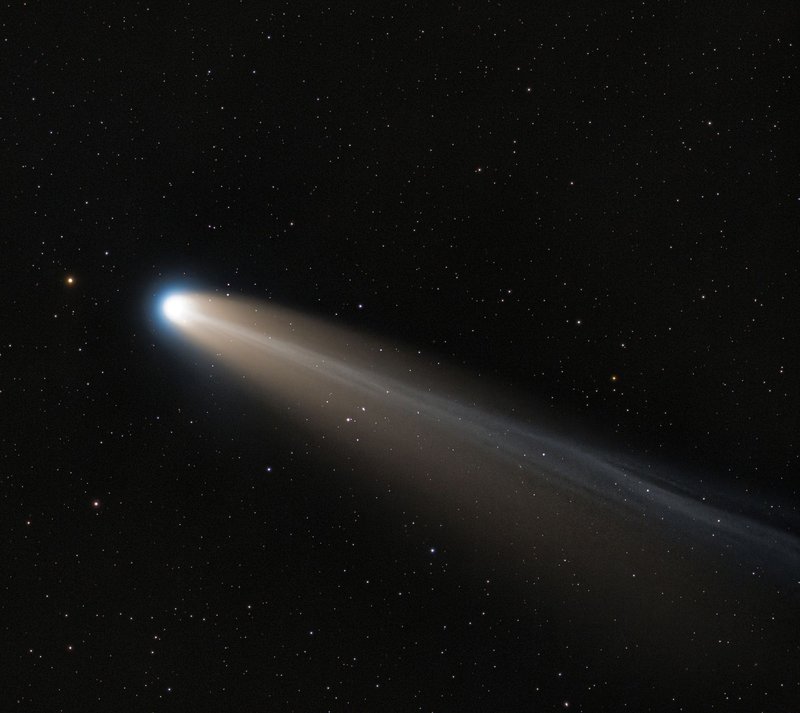
Interstellar comets
Interstellar comets formed around other stars and were thrown out into space. They pass through our solar system on hyperbolic orbits at high speed and then leave for good. Three have been found so far.
- 1I/ʻOumuamua (2017): the first confirmed interstellar object. It had no visible coma but showed a small push that gravity alone couldn’t explain, so astronomers still debate whether to call it a comet.
- 2I/Borisov (2019): the first clearly active interstellar comet, with a coma and a tail like any local comet.
- 3I/ATLAS (2025): discovered in July 2025 and tracked by NASA and observatories worldwide as it crossed the inner solar system, then headed back out.
Sungrazers
Sungrazers pass within a few solar radii of the Sun’s surface. The best-known family is the Kreutz group, which astronomers think are fragments of one giant comet that broke apart centuries ago. The Great Comet of 1882 and Comet Ikeya-Seki in 1965 belong to it. So do most of the thousands of small comets found in images from the SOHO solar observatory. Many don’t survive perihelion, and they vaporize in the Sun’s glare.
Active asteroids and main-belt comets
Some objects look like asteroids by orbit but grow tails like comets. A main-belt comet sits in the asteroid belt on a near-circular path, yet sheds gas and dust when sunlight warms buried ice. 133P/Elst-Pizarro, noticed to be active in 1996, was the first.
“Active asteroid” is the wider label. It also covers objects whose tails come from impacts or from spinning fast enough to shed material, with no ice involved. Those carry an A/ designation instead of a P/ or C/.
Extinct and dormant comets
A comet that has run out of surface ice, or sealed it under a crust of dust, stops making a coma. If it might wake up again, it’s dormant. If it won’t, it’s extinct. Many near-Earth asteroids may be dead comets that look like rock now, and telling them apart from the real thing is hard.
Dark comets
Dark comets are small near-Earth objects that look like asteroids, with no visible coma or tail, but accelerate in ways gravity doesn’t explain. The first group of seven was reported in 2023, and more candidates have since been added. The best explanation is a tiny amount of outgassing, too faint to see, that nudges them along. The category is new, and astronomers are still drawing its edges.
Great comets are a brightness label, not a type
“Great comet” shows up in lists of comet types, and it doesn’t belong there. It’s a name for any comet that gets unusually bright and puts on a good show for ordinary observers, with no orbital meaning at all. Hale-Bopp was a long-period great comet. The Great Comet of 1882 was a sungrazer. Both earned the title the same way, by being very easy to see.
If a page lists “great comets” next to Jupiter-family comets as if they were sibling categories, it has mixed two different systems.
What the letters in a comet’s name mean
The prefix in a name like 1P/Halley or C/2020 F3 comes from the standard designation system. Here are the ones you’ll see.
- P/: periodic, with an orbit under 200 years or confirmed at more than one perihelion. A number in front, as in 1P/Halley, means its orbit is well established.
- C/: non-periodic or long-period, over 200 years.
- D/: defunct. The comet has broken up or vanished. D/1993 F2 is Shoemaker-Levy 9, which hit Jupiter in 1994.
- X/: no reliable orbit could be calculated, which usually applies to historical comets.
- I/: interstellar, as in 2I/Borisov.
- A/: an object first mistaken for an asteroid, found to be on a comet-like orbit.
The number and letters after the slash give the discovery year and the half-month of discovery. C/2020 F3 was found in the second half of March 2020.
Which types of comets can you actually see?
Most comets are too faint to notice without a telescope. The ones you can find depend heavily on type.
Jupiter-family comets return on predictable schedules, but they rarely get bright. A few, like 46P/Wirtanen in late 2018, reach binocular range when they pass close to Earth.
Halley-type comets are rarer in the sky, and they’re the ones that make headlines. If you’re young, you may see Halley in 2061.
Long-period comets provide nearly every naked-eye spectacle, such as Hale-Bopp, NEOWISE, and Tsuchinshan-ATLAS in 2024. They also arrive with the least warning. If you want to catch one, follow a current comet tracker and plan a dark-sky trip once a bright one is confirmed. Binoculars show many more than your eyes will.
For a broader overview of how comets work, NASA’s comet pages are a good next step.
FAQ
How many types of comets are there?
There are two main groups by orbital period, short-period and long-period. Short-period splits into Jupiter-family and Halley-type, which gives three working classes. Non-periodic comets, sungrazers, interstellar comets, and a handful of others are special cases.
Is Halley’s Comet short-period or long-period?
Short-period. It orbits the Sun in about 75 to 76 years, which makes it the namesake of the Halley-type class.
Where do comets come from?
Short-period comets mostly come from the Kuiper Belt and scattered disc beyond Neptune. Long-period comets come from the Oort Cloud, much farther out. Interstellar comets come from other star systems.
Are all comets periodic?
No. Non-periodic comets are on open orbits and pass the Sun once. Some were thrown onto those paths by planetary encounters. Interstellar comets arrive that way.
What is the difference between a comet and an asteroid?
A comet is rich in ice and sheds gas and dust when heated. An asteroid is mostly rock and metal. The gap blurs for main-belt comets, active asteroids, and dark comets, which is why those categories exist. For a side-by-side look at composition, orbits, and appearance, see 6 differences between comets and asteroids.