TLDR
A red giant is a star with roughly 0.5 to 8 times the Sun’s mass that has run out of hydrogen in its core. The core shrinks, the outer layers swell to 10 to several hundred times the Sun’s radius, and the surface cools to about 3,000 to 5,000 K, which turns it orange or red. The Sun will do this in about 5 billion years. Mercury and Venus will be swallowed, Earth probably will be too, and Mars will survive. The star then sheds its outer layers as a planetary nebula and leaves behind a white dwarf.
Contents
- What is a red giant?
- Key facts at a glance
- How a star becomes a red giant
- The life sequence, stage by stage
- Where red giants sit on the H-R diagram
- Red giant vs red supergiant
- Famous red giants
- What happens when the Sun becomes a red giant
- How to see a red giant yourself
- Quick answers
What is a red giant?
A red giant is a star in the late part of its life that has exhausted the hydrogen in its core and swollen far past its original size. The name is a bit loose. Many of the stars astronomers call red giants look orange to the eye, and the cooler, redder ones are mostly the later, larger stages.
The core of the star gets smaller and hotter. The outer layers do the opposite: they puff outward until the star is tens or hundreds of times wider than it was on the main sequence. Spread the same energy over a vastly bigger surface and each patch of that surface is cooler, which is why a star that is hundreds of times brighter than the Sun can still glow a duller color.
Red giants are not rare. They are what most stars become, and they are a large share of the bright stars you can see without a telescope. NASA’s overview of stellar evolution is a good starting point if you want the full life cycle of stars.
Key facts at a glance
| Property | Typical red giant |
|---|---|
| Starting mass | About 0.5 to 8 times the Sun |
| Radius | About 10 to 100 times the Sun on the red giant branch; up to a few hundred times in the final giant stage |
| Surface temperature | About 3,000 to 5,000 K (the Sun is about 5,800 K) |
| Luminosity | Tens to a few thousand times the Sun |
| Color | Orange to red |
| Core | Inert helium at first; later helium-burning, then carbon and oxygen |
| Time spent as a giant | Roughly 1 to 2 billion years for a Sun-like star; far less for heavier stars |
Those are ranges, not fixed values. A star’s radius and brightness change a lot from one stage to the next, and figures quoted for individual stars vary between studies.
How a star becomes a red giant
A star spends most of its life on the main sequence, fusing hydrogen into helium in its core. For the Sun that lasts about 10 billion years, and it is about 4.6 billion years in, according to NASA. Smaller, dimmer stars last far longer. Heavier stars burn through their hydrogen in millions to hundreds of millions of years.
When the core runs out of hydrogen, fusion there stops. With no energy pushing outward, the helium core contracts under gravity and heats up. That heat ignites hydrogen in a thin shell around the core, and the shell burns faster than the old core ever did. The extra energy pushes the outer layers outward. The star expands, cools at the surface, and brightens overall. It is now a red giant.
One boundary matters here. Stars below about half the Sun’s mass, the red dwarfs, will not become red giants in the usual sense because they never get hot enough to ignite helium. They are so long-lived that none has had time to leave the main sequence since the universe began.
The life sequence, stage by stage
For a Sun-like star the sequence runs like this. Durations are approximate and depend on the star’s mass.
1. Main sequence
Hydrogen fuses to helium in the core. The star is stable and slowly brightens. For the Sun this lasts about 10 billion years.
2. Subgiant and hydrogen shell burning
The core is out of hydrogen and contracts. Hydrogen fusion moves to a shell around it. The star swells and begins its climb toward the giant stage.
3. Red giant branch
This is the classic red giant. The star grows steadily larger and brighter over roughly a billion years while its helium core keeps gathering mass. In a Sun-like star that core is squeezed so tightly that electrons resist further compression, a state called degeneracy. The core is dense, hot, and cannot expand to cool itself.
Strong winds blow off a good share of the star’s mass during this climb. A Sun-like star can lose a third of its mass on the red giant branch alone.
4. Helium flash
When the core reaches about 100 million K, helium fusion ignites. In stars up to about twice the Sun’s mass the core is degenerate, so it cannot respond by expanding. Fusion runs away in a helium flash that lasts only minutes. The core briefly produces an enormous amount of power, but the star’s envelope absorbs it, and an observer outside would see almost nothing. The flash lifts the degeneracy and the core expands. Heavier stars ignite helium more gently without a flash.
5. Red clump
After the flash the star shrinks and dims. It now fuses helium to carbon and oxygen in its core while hydrogen burns in a shell around it. In a Sun-like star this phase lasts around 100 million years, and the star is much smaller than at the tip of the giant branch, about 10 times the Sun’s radius. Stars in this phase bunch up on the H-R diagram in a dense patch called the red clump. Because their brightness is fairly consistent, astronomers use them as distance markers.
6. Asymptotic giant branch
When the helium in the core is gone, the star is left with an inert carbon-oxygen core, with a helium shell and a hydrogen shell burning above it. It swells again, becoming larger and cooler than before. This is the asymptotic giant branch, or AGB. The star becomes unstable, pulsing in size and brightness, and loses mass at a high rate in strong winds. For the Sun this lasts only about 20 million years, a short stretch compared with everything before it.
7. Planetary nebula
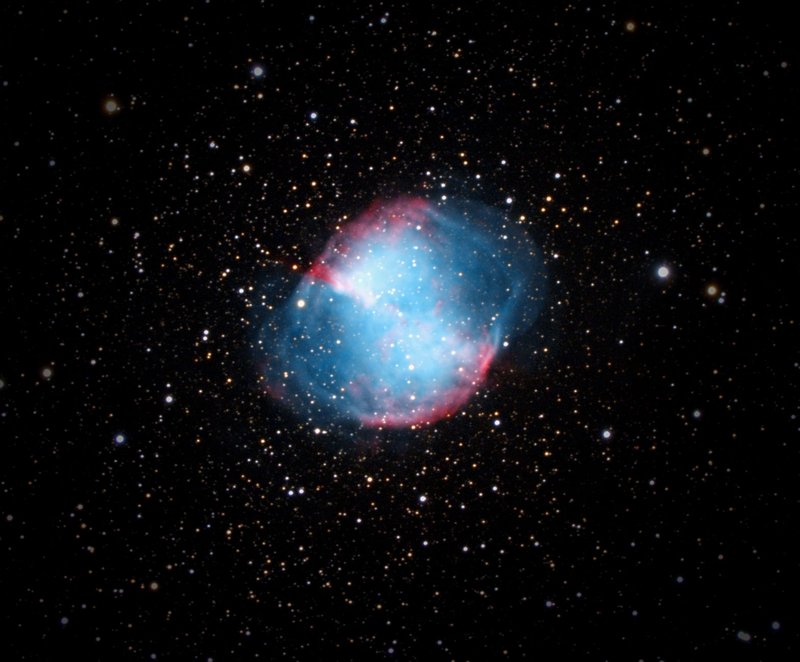
The star ejects its outer layers. The exposed core is hot enough to ionize the expelled gas, which glows for roughly 10,000 to 20,000 years before dispersing. The name is a historical accident: through early telescopes these shells looked like planets, and they have nothing to do with them.
8. White dwarf
What remains is a dense core, about Earth-sized and about half the Sun’s mass for a Sun-like star. It no longer fuses anything. It cools for a very long time, slowly fading.
Where red giants sit on the H-R diagram
The Hertzsprung-Russell (H-R) diagram plots stars by surface temperature and luminosity. Temperature runs backwards, with hot stars on the left and cool stars on the right. Brightness increases going up.
Most stars fall along a diagonal band called the main sequence, from hot and bright at the upper left to cool and dim at the lower right. Red giants sit in the upper right: cool, so they plot toward the right, and very bright, so they plot high. White dwarfs sit at the bottom left, hot but tiny and faint.
As a Sun-like star ages, its dot on the diagram moves off the main sequence, up and to the right along the red giant branch, drops to the red clump after the helium flash, climbs again along the AGB, and then swings left as it becomes a white dwarf. That trail is the life sequence above.
Red giant vs red supergiant
The two get confused constantly, including on some of the top-ranking pages for this topic. They are different kinds of stars with different fates.
| Red giant | Red supergiant | |
|---|---|---|
| Starting mass | About 0.5 to 8 times the Sun | More than about 8 times the Sun |
| Typical radius | 10 to a few hundred times the Sun | Hundreds to over 1,000 times the Sun |
| Luminosity | Tens to thousands of times the Sun | Tens of thousands to hundreds of thousands of times the Sun |
| Spectral luminosity class | III | I |
| End | Planetary nebula, then white dwarf | Core-collapse supernova, leaving a neutron star or black hole |
| Example | Arcturus, Aldebaran | Betelgeuse, Antares |
Betelgeuse is the standard example. Put it in the Sun’s place and its surface would sit out in the asteroid belt, well beyond Mars. The European Southern Observatory has imaged its surface in detail, including the dimming that drew attention to the star in 2019 and 2020. It will end in a supernova that leaves behind a neutron star or a black hole. A red giant like Arcturus never will.
Famous red giants
| Star | Constellation | Distance | Radius (Sun = 1) | Surface temperature | Notes |
|---|---|---|---|---|---|
| Pollux | Gemini | About 34 light-years | About 9 | About 4,600 K | Orange giant with a confirmed planet |
| Arcturus | Boötes | About 37 light-years | About 25 | About 4,300 K | Fourth-brightest star in the night sky |
| Aldebaran | Taurus | About 65 light-years | About 44 | About 3,900 K | The “eye” of the bull |
| Gacrux | Crux | About 88 light-years | About 84 | About 3,600 K | Top star of the Southern Cross |
| Mira | Cetus | About 300 light-years | About 300 to 400 | About 3,000 K | AGB star that pulsates |
Mira is the odd one. It is a pulsating AGB star, and over a cycle of about 332 days it swings from around magnitude 3 at its brightest to about 9, which is far too faint to see without optical aid. It was one of the first variable stars identified, and it shows what the unstable end of the giant stage looks like from the outside.
Arcturus and Aldebaran are the easy ones to introduce to a first-time observer. Both are bright and visibly orange against their neighbors.
What happens when the Sun becomes a red giant
The Sun will not become a red giant for a very long time. The sequence below follows the models of Schröder and Smith (2008), which are the most cited calculation of the Sun’s distant future. Dates are approximate, counted from today.
| When | What happens |
|---|---|
| About 1 to 1.5 billion years | The Sun has brightened by about 10 percent. Earth’s oceans begin to evaporate and the planet becomes uninhabitable, well before the Sun becomes a giant. |
| About 5 billion years | Core hydrogen runs out. The Sun leaves the main sequence and swells into a subgiant. |
| About 7.6 billion years | The Sun reaches the tip of the red giant branch: about 256 times its present radius (roughly 1.2 AU) and about 2,700 times its present brightness. Then the helium flash. |
| About 100 million years later | Red clump phase. The Sun shrinks to roughly 10 solar radii while fusing helium. |
| Next 20 million years or so | Asymptotic giant branch. Pulsations and heavy mass loss. |
| Afterward | Planetary nebula, then a white dwarf of about half the Sun’s present mass. |
Which planets are engulfed
The two innermost of the eight planets, Mercury and Venus, will be swallowed. Earth is the close call. As the Sun loses mass its gravity weakens and the planets drift outward, which helps, but the Sun’s expanding envelope also drags on anything inside it. Schröder and Smith’s calculation concluded that Earth is likely to be engulfed as well. Mars, Jupiter, and the outer planets survive, though their orbits widen and their surfaces are scorched.
The star’s average density helps explain why anything inside the envelope eventually spirals in. Averaged over its whole volume, the Sun at its peak giant size would be tens of thousands of times thinner than sea-level air, so the drag is gentle, but it acts over a very long time.
What about habitability
Earth’s loss of liquid water comes long before any of this. But the Sun’s habitable zone moves outward as it brightens. During the red giant phase it sweeps out past the asteroid belt, so in principle icy moons in the outer solar system could be warmed for a while. The window is short compared with geological time, and the strong winds and flares of an expanding giant make the idea unpromising.
How to see a red giant yourself
You do not need a telescope. Several of the brightest stars in the sky are red or orange giants. Each sits in a constellation you can find with a star chart.
- Arcturus. Follow the curve of the Big Dipper’s handle away from the bowl, the old “arc to Arcturus” trick. It is the brightest star in the northern sky in spring and summer evenings and has a distinct orange tint.
- Aldebaran. Extend the line of Orion’s belt toward the upper right (to the west in the northern hemisphere) and you reach it in Taurus. It is brightest in northern winter.
- Gacrux. The top star of the Southern Cross. Visible from the Southern Hemisphere and tropical latitudes in the north. It is a deeper orange-red than the other two.
- Mira. Check an observing calendar for its next maximum. At peak it is naked-eye visible for a few weeks, otherwise it is not.
- Betelgeuse. Not a red giant, but a red supergiant, and a good side-by-side comparison. It is the upper-left star of Orion.
Binoculars bring out color. Defocus slightly and the tint of a star like Aldebaran gets easier to see against a white star nearby.
Quick answers
Is the Sun a red giant?
No. It is a main-sequence star, about halfway through its roughly 10-billion-year hydrogen-burning life.
How big is a red giant?
Most are between 10 and 100 times the Sun’s radius, and the largest red giants, in the AGB stage, reach a few hundred. Red supergiants like Betelgeuse are bigger still.
Why are red giants red?
They are cooler on the surface, about 3,000 to 5,000 K compared with the Sun’s 5,800 K. Cooler stars emit more of their light at red wavelengths.
How long does the red giant stage last?
For a Sun-like star, about 1 to 2 billion years across the red giant branch, red clump, and AGB combined, most of it on the red giant branch. More massive stars go through the same stages much faster.
Will red giants explode?
No. Red giants shed their outer layers gently and become white dwarfs. Only the much more massive red supergiants end in supernovae.
Can a red giant have planets?
Yes. Pollux has a confirmed planet, and astronomers have found planets around other giants. Planets close to the star when it expands are the ones at risk of being swallowed.