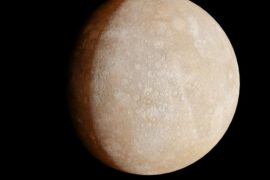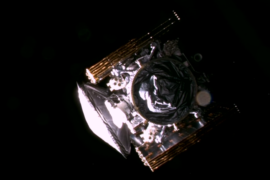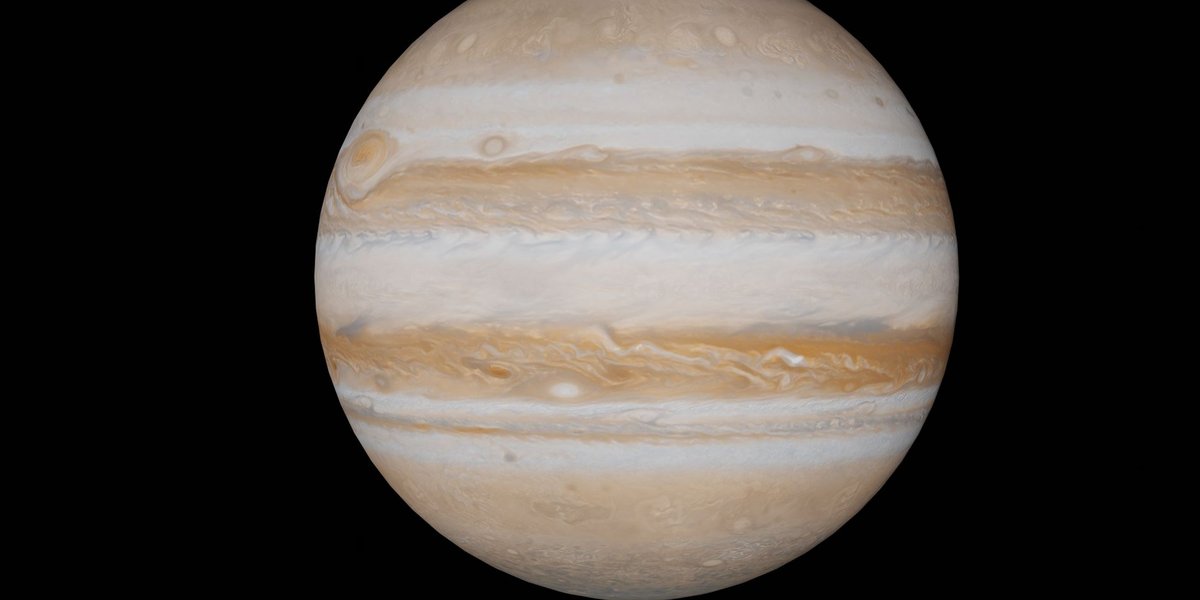
NASA has sent nine spacecraft past or around Jupiter, and a tenth is on its way right now. Some only got a few hours with the planet as they slingshotted toward somewhere else. Others spent years circling it, dodging radiation that would fry an unshielded human in minutes.
Here’s every NASA mission to Jupiter in the order it arrived, what each one actually found, and why the next one might be the most important of all.
Table of Contents
- The quick rundown
- Pioneer 10 (1973)
- Pioneer 11 (1974)
- Voyager 1 (1979)
- Voyager 2 (1979)
- Ulysses (1992)
- Galileo (1995-2003)
- Cassini (2000)
- New Horizons (2007)
- Juno (2016-present)
- Europa Clipper (arriving 2030)
- What all these missions taught us
- FAQ
The quick rundown {#the-quick-rundown}
If you just want the map before the deep dive, here’s every NASA Jupiter mission at a glance.
| Mission | Launched | Arrived | Type | Key result |
|---|---|---|---|---|
| Pioneer 10 | 1972 | 1973 | Flyby | First spacecraft ever to reach Jupiter |
| Pioneer 11 | 1973 | 1974 | Flyby | Mapped a path through the radiation belts |
| Voyager 1 | 1977 | 1979 | Flyby | Discovered active volcanoes on Io |
| Voyager 2 | 1977 | 1979 | Flyby | Found Jupiter’s faint ring and new moons |
| Ulysses | 1990 | 1992 | Gravity assist | Studied Jupiter’s magnetosphere en route to the Sun’s poles |
| Galileo | 1989 | 1995 | Orbiter + probe | Dropped a probe into the atmosphere, found evidence of Europa’s ocean |
| Cassini | 1997 | 2000 | Flyby | Highest-resolution global portrait at the time, en route to Saturn |
| New Horizons | 2006 | 2007 | Flyby | Filmed an erupting Io plume, en route to Pluto |
| Juno | 2011 | 2016 | Orbiter | Measured the deep interior and mapped the poles |
| Europa Clipper | 2024 | 2030 | Orbiter (of Jupiter) | Will assess whether Europa could support life |
Notice the pattern. The early missions were drive-bys. Only two spacecraft, Galileo and Juno, have ever orbited Jupiter itself. A third, Europa Clipper, is about to make it three.
Pioneer 10 (1973) {#pioneer-10}
Before Pioneer 10, nobody knew if a spacecraft could even survive the trip. The asteroid belt sat between Earth and Jupiter, and engineers genuinely worried that flying debris would shred anything that tried to cross it. Pioneer 10 crossed it fine, which was its own quiet discovery: the belt is mostly empty space.
On December 3, 1973, it passed within about 81,000 miles of Jupiter’s cloud tops and sent back the first close-up images of the planet. It also took the first hit of Jupiter’s radiation, which turned out to be roughly 10,000 times stronger than Earth’s Van Allen belts. That single data point reshaped how every later mission was designed. According to NASA’s mission record, Pioneer 10 kept transmitting until 2003, when its signal finally faded somewhere past the orbit of Neptune.
Pioneer 11 (1974) {#pioneer-11}
Pioneer 11 launched a year after its twin and did something its sibling couldn’t risk: it dove far closer, skimming about 26,000 miles above the cloud tops. The close approach was a deliberate gamble. By threading through a narrow gap and using Jupiter’s gravity, the spacecraft bent its trajectory hard enough to become the first probe aimed at Saturn.
That gravity-assist maneuver is the real legacy here. Pioneer 11 proved you could use Jupiter as a free engine, a trick every outer-planet mission since has depended on. It also got the first decent look at Jupiter’s polar regions, which earlier flybys had missed entirely.
Voyager 1 (1979) {#voyager-1}
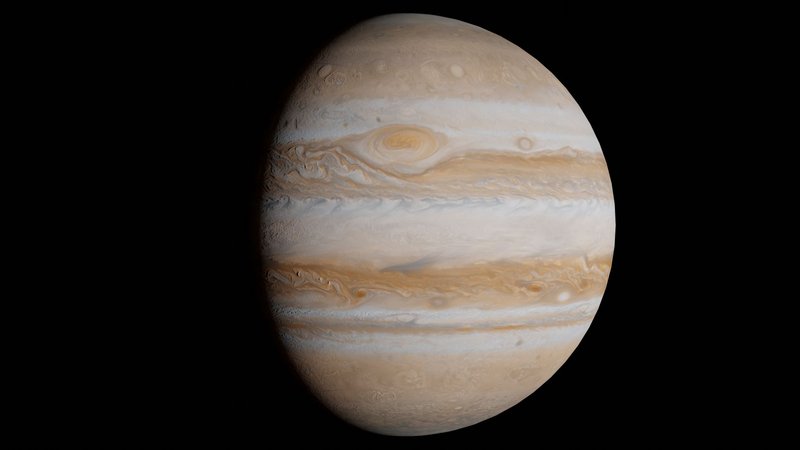
The Voyagers changed Jupiter from a fuzzy disk into a world. When Voyager 1 reached the planet in March 1979, its cameras were sharp enough to catch something nobody expected: a plume rising 190 miles above the surface of the moon Io. It was a volcano, caught mid-eruption.
That was the first time anyone had seen active volcanism anywhere other than Earth. Io turned out to be the most volcanically active body in the solar system, its surface constantly repaved by lava driven by Jupiter’s tidal squeezing. Voyager 1 also revealed that the Great Red Spot was a hurricane-like storm with structure and motion, not just a smudge.
Voyager 2 (1979) {#voyager-2}
Voyager 2 arrived four months later and filled in what its twin had rushed past. It confirmed Io’s volcanoes were still erupting, watched the Great Red Spot’s clouds churn over time, and got better looks at the icy moons Europa and Ganymede.
Its standout find was Jupiter’s ring. Voyager 1 had caught a hint of it; Voyager 2 confirmed the planet has a faint, dusty ring system, making Jupiter the second ringed planet known after Saturn. Voyager 2 then continued on to become the only spacecraft to visit all four giant planets, a record it still holds.
Ulysses (1992) {#ulysses}
Ulysses is the odd one out, and it’s easy to forget it counts. A joint NASA and European Space Agency probe, it wasn’t built to study Jupiter at all. Its real target was the Sun’s poles, which no spacecraft had ever flown over, putting it among the rare missions sent to study the Sun rather than the planets.
The problem is that everything in the solar system orbits in roughly the same flat plane, so to get above the Sun you need to throw yourself out of that plane entirely. Ulysses used Jupiter’s enormous gravity to do exactly that in February 1992, swinging up and over toward the Sun. Along the way it took fresh measurements of Jupiter’s magnetosphere, the vast bubble of magnetic field around the planet.
Galileo (1995-2003) {#galileo}
Galileo was the first spacecraft to orbit Jupiter, and it spent nearly eight years doing it. It arrived in December 1995 carrying a passenger: a descent probe that it released into the atmosphere. The probe survived for 58 minutes, falling about 100 miles deep while transmitting before the crushing pressure and heat ended it. It found far less water than expected and winds that got stronger with depth, hinting the weather was powered from inside, not from the Sun.
The orbiter’s biggest contribution was Europa. Galileo’s magnetic readings showed the moon’s field behaving exactly as it would if a salty, electrically conductive liquid sat beneath the ice. The most natural explanation, laid out in NASA’s Galileo overview, was a global ocean of liquid water under Europa’s frozen shell. That single inference is the reason NASA keeps sending missions back to Europa, with another one heading there right now. Galileo was deliberately crashed into Jupiter in 2003 to make sure it never contaminated Europa.
Cassini (2000) {#cassini}
Cassini is famous for Saturn, but it got to Jupiter first. On its way to the ringed planet, it flew past Jupiter in late 2000 and early 2001, partly to borrow a gravity assist and partly to test its instruments on a planet whose behavior was already well understood.
For a few weeks Cassini and the orbiting Galileo studied Jupiter at the same time, a rare two-spacecraft view. Cassini produced what was then the most detailed global color portrait of the planet ever made, stitched from thousands of images, capturing the bands and storms in sharp relief.
New Horizons (2007) {#new-horizons}
New Horizons was racing to Pluto, but it used Jupiter for a speed boost in 2007 and grabbed a working vacation’s worth of science on the way. The flyby shaved about three years off its trip to the outer solar system.
Its best catch was Io, again. New Horizons filmed a 200-mile-high eruption from the volcano Tvashtar in enough detail to watch the plume’s structure, the clearest view of an extraterrestrial eruption ever recorded. It also studied lightning in Jupiter’s polar atmosphere and the planet’s faint ring, then carried on toward its 2015 Pluto encounter.
Juno (2016-present) {#juno}
Juno is the spacecraft working Jupiter right now, and it’s built to answer a question the others couldn’t reach: what’s the planet actually made of, all the way down? Earlier missions studied the clouds. Juno studies the interior.
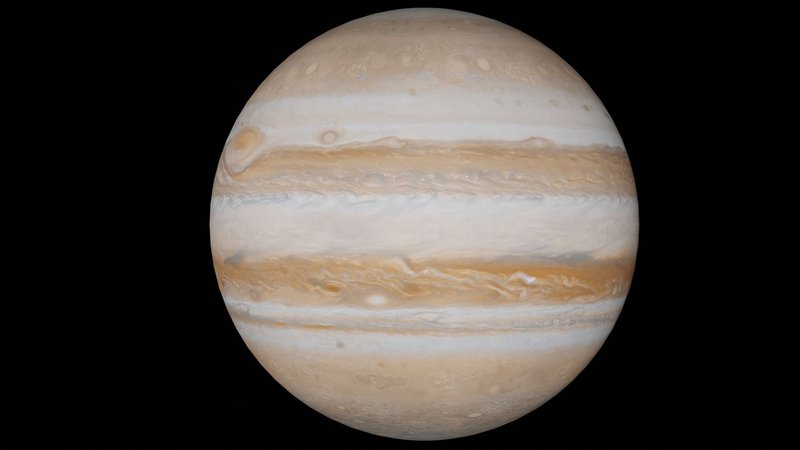
To do that it flies a wild looping orbit that dives between the planet and its most intense radiation belts, then swings far out to recover before plunging back in. Its instruments live inside a titanium vault to survive the punishment. The findings have been genuinely strange, adding fresh entries to the long list of open questions about Jupiter. Jupiter’s core appears to be “fuzzy,” a diluted region of heavy elements blended into the hydrogen rather than a neat solid ball, which suggests a giant impact may have scrambled it long ago. Juno’s JunoCam images of the poles revealed clusters of cyclones arranged in geometric patterns, eight ringing the north pole, five the south, that have held their formation for years. It also measured the Great Red Spot’s roots reaching at least 200 miles down into the atmosphere.
Europa Clipper (arriving 2030) {#europa-clipper}
This is the one to watch. Europa Clipper launched in October 2024 and is the largest spacecraft NASA has ever built for a planetary mission, big enough that its solar arrays span over 100 feet, because sunlight at Jupiter is only a twenty-fifth as strong as at Earth. It will reach Jupiter in 2030.
It won’t orbit Europa directly, which sounds backward until you remember the radiation. Instead it orbits Jupiter and makes around 50 close flybys of the moon, ducking in for data and retreating to limit its radiation dose. The goal, per NASA’s Europa Clipper page, isn’t to find life but to answer whether Europa is even habitable: how thick is the ice, how deep is the ocean, and does the seafloor have the chemistry life would need.
It won’t be alone out there. Europe’s JUICE spacecraft, launched in 2023, is heading to the Jupiter system to study the icy moons Ganymede and Callisto. The two missions overlap in time and will trade data, giving the 2030s the most coordinated look at Jupiter’s moons in history.
What all these missions taught us {#what-we-learned}
Step back from the individual spacecraft and a story emerges. Five decades of NASA missions turned Jupiter from a bright dot into one of the most scientifically loaded places we know.
- Io is alive with fire. Voyager and New Horizons showed the most volcanically active world in the solar system, resurfacing itself constantly.
- Europa hides an ocean. Galileo’s magnetic data points to a global sea of salt water under the ice, possibly holding more water than all of Earth’s oceans combined.
- The Great Red Spot has depth. Juno found the storm extends hundreds of miles down, not just across.
- Jupiter’s insides are messier than expected. That fuzzy, diluted core rewrote the textbook picture of how gas giants form.
- The radiation is the real boss. Every mission’s design, from Galileo’s vault to Clipper’s flyby strategy, is shaped by surviving Jupiter’s lethal magnetic environment.
The throughline is that each mission was built on the last one’s surprise. Pioneer measured the radiation so Voyager could plan for it. Voyager found Io’s volcanoes and Europa’s smooth ice, which sent Galileo. Galileo found the ocean, which sends Clipper.
FAQ {#faq}
How many missions has NASA sent to Jupiter? Nine spacecraft have reached Jupiter so far: Pioneer 10 and 11, Voyager 1 and 2, Ulysses, Galileo, Cassini, New Horizons, and Juno. A tenth, Europa Clipper, launched in 2024 and arrives in 2030. Most were flybys; only Galileo, Juno, and the upcoming Clipper orbit the planet.
Which spacecraft is at Jupiter right now? Juno, which has been orbiting since July 2016. Its mission has been extended multiple times and it continues to study the planet’s interior, poles, and moons.
Has any spacecraft landed on Jupiter? No, and none ever will. Jupiter has no solid surface to land on, just deepening layers of gas that eventually crush anything descending into them. Galileo’s atmospheric probe came closest, falling about 100 miles before the pressure destroyed it.
Why does NASA keep going back to Europa instead of Jupiter itself? Because the ocean beneath Europa’s ice is one of the best places in the solar system to look for conditions that could support life. Jupiter the planet is fascinating, but liquid water plus the right chemistry is what makes Europa a target worth a dedicated mission.
What’s the difference between Europa Clipper and ESA’s JUICE? Both study Jupiter’s icy moons in the 2030s. NASA’s Europa Clipper focuses on Europa and whether it’s habitable. ESA’s JUICE focuses mainly on Ganymede and Callisto and will eventually orbit Ganymede directly. They complement each other rather than compete.