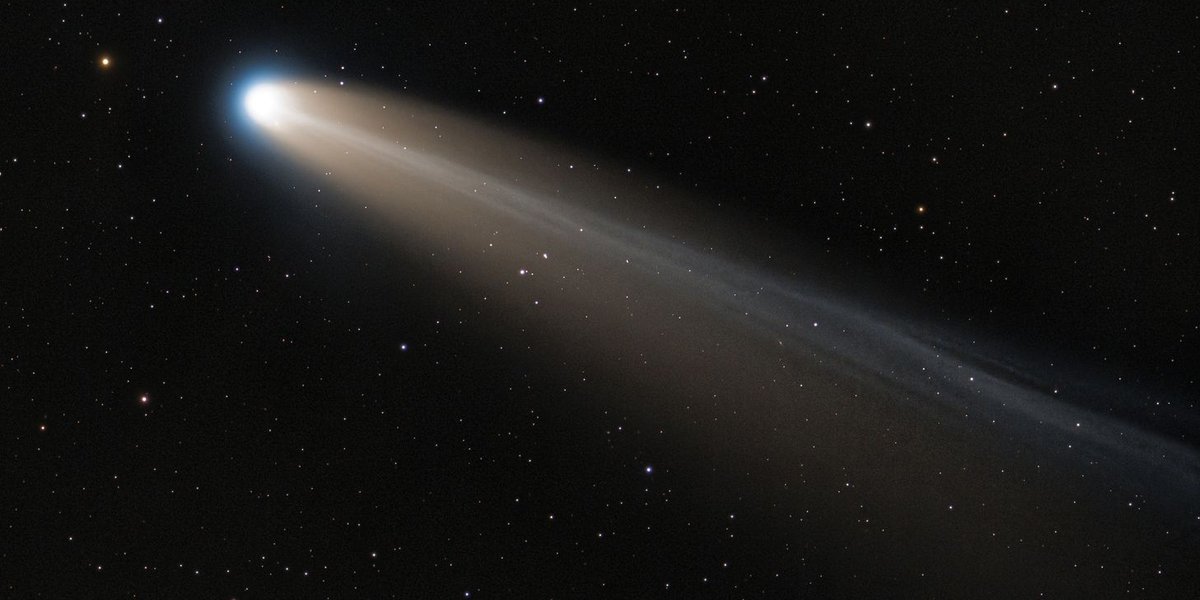
In April 2026, a comet called C/2026 A1 (MAPS) skimmed within 161,000 kilometers of the Sun’s surface — closer than some satellites orbit Earth, relatively speaking — and came apart on camera. Skywatchers had been tracking it for weeks, hoping it would survive to put on a daylight show. It didn’t. That’s the sungrazing comet story in miniature: a spectacular approach, a violent ending, and usually nothing left to show for it but a smear of debris in a spacecraft’s coronagraph.
Quick answer: a sungrazing comet is one whose orbit brings it within a few solar radii of the Sun — close enough that solar heat and gravity routinely rip it apart. Most belong to the Kreutz Group, a family of fragments descended from one giant comet that broke up centuries ago. Thousands have been spotted since the 1990s, almost all by two Sun-watching spacecraft, and most never survive their trip.
Table of Contents
- What Is a Sungrazing Comet?
- The Kreutz Group’s Origin Story
- Why the Sun Tears Them Apart
- Famous Sungrazers, Side by Side
- How We Find Thousands of These Comets
- Frequently Asked Questions
What Is a Sungrazing Comet?
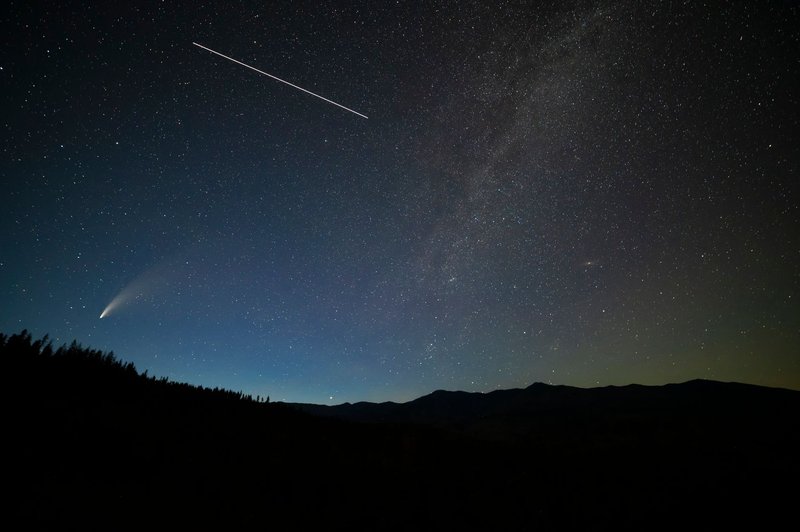
A sungrazing comet is any comet whose orbit carries it to within roughly a solar diameter or two of the Sun’s surface at perihelion — its closest point. For context, Earth never gets closer to the Sun than about 147 million kilometers. A true sungrazer can pass within a few hundred thousand kilometers, sometimes less, which puts it inside the Sun’s outer atmosphere, the corona, for a few dangerous hours.
NASA’s sungrazer overview draws a useful line between “sunskirters,” which pass close but survive fairly comfortably, and true sungrazers, which are gambling with total destruction every time. Most sungrazers are small — house-sized or smaller nuclei — which is exactly why they rarely make it out the other side.
Roughly 85% of the sungrazing comets on record aren’t independent objects at all. They’re siblings. They belong to a single family with a shared, violent history: the Kreutz Group.
The Kreutz Group’s Origin Story
German astronomer Heinrich Kreutz spent the late 1800s tracing the orbits of several unusually bright comets — including the Great Comet of 1843 and the Great September Comet of 1882 — and noticed something odd. Their paths through the inner solar system were nearly identical. Not similar. Nearly identical, the kind of overlap that doesn’t happen by coincidence.
Kreutz’s conclusion, confirmed and refined by later researchers, was that these weren’t separate comets at all. They were fragments of one enormous parent comet that broke apart on a previous close pass by the Sun, probably corresponding to the Great Comet of 1106, itself likely the product of an even earlier split. Research published in Monthly Notices of the Royal Astronomical Society describes this as a cascading fragmentation — one big comet splitting, its pieces splitting again on later passes, over and over across centuries. Ikeya-Seki in 1965 and Lovejoy in 2011 both trace back to that same lineage.
That’s the Kreutz Group: not a coincidence of orbits, but a genealogy written in celestial mechanics.
Why the Sun Tears Them Apart
Two forces do the damage, and they work together.
The first is tidal stress — the same mechanism that raises ocean tides on Earth, except turned up to a lethal setting. The side of a comet’s nucleus facing the Sun feels noticeably stronger gravity than the far side. Stretch that difference across a fragile, loosely bound ball of ice and dust, and the nucleus gets pulled apart along its axis. Ikeya-Seki’s nucleus fractured into two or three pieces during its 1965 perihelion for exactly this reason.
The second is heat. At a few hundred thousand kilometers from the photosphere, surface temperatures on the nucleus spike into the thousands of degrees. Ice doesn’t melt so much as flash into gas, venting in violent jets that can spin, tumble, or further crack an already-stressed nucleus. Radiation pressure and the solar wind strip away whatever comes loose.
Survival mostly comes down to size. A comet needs enough mass, and enough structural cohesion, to hold together against both stresses for the few hours it takes to round the Sun. Lovejoy, at an estimated few hundred meters across, made it — reaching perihelion at about 1.2 solar radii from the Sun’s center and surviving another 1.6 days before its nucleus finally gave out. Comet ISON, of comparable size but apparently looser structure, disintegrated on Thanksgiving Day 2013 as it passed roughly 1.17 million kilometers above the surface. Same neighborhood, different outcome.
Famous Sungrazers, Side by Side
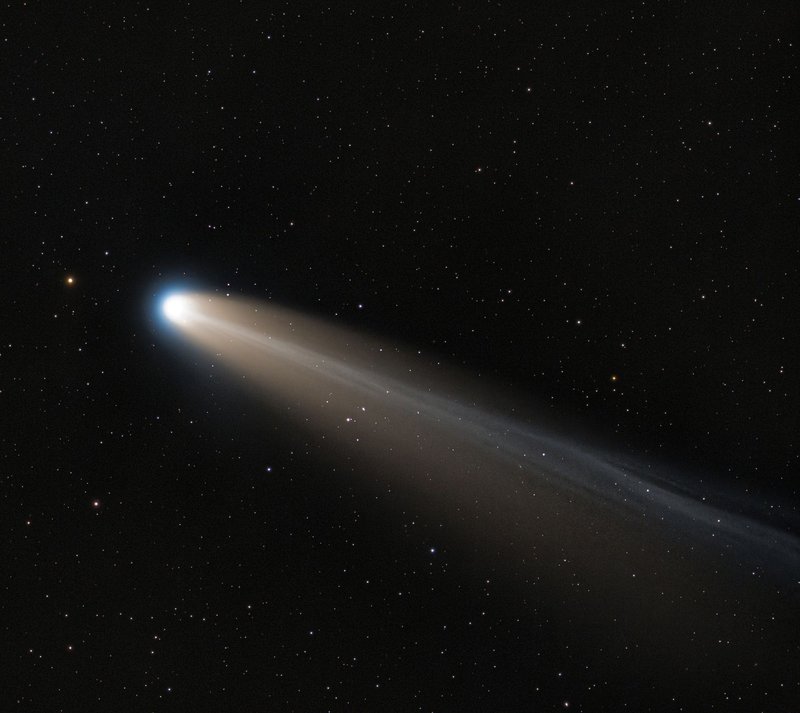
Four sungrazers define the modern story of this phenomenon — one historic, two cautionary tales, and one still fresh in the news.
| Comet | Year | Kreutz Group? | Closest approach | Outcome |
|---|---|---|---|---|
| Ikeya-Seki | 1965 | Yes | 0.008 AU (~1.2 million km from center) | Nucleus split into 2–3 pieces; survived, visible in daylight at magnitude -10 |
| Lovejoy (C/2011 W3) | 2011 | Yes | ~1.2 solar radii | Survived perihelion by 1.6 days before nucleus disintegrated |
| ISON (C/2012 S1) | 2013 | No (independent orbit) | ~1.17 million km above the surface | Disintegrated at perihelion, on Thanksgiving Day |
| MAPS (C/2026 A1) | 2026 | Yes | 161,000 km above the surface | Broke apart before reaching perihelion |
Ikeya-Seki remains the benchmark: discovered independently within 15 minutes of each other by two Japanese amateur astronomers, it peaked at magnitude -7 to -10 depending on the observer’s location, briefly outshining every object in the sky except the Sun itself. It’s still ranked among the brightest comets of the last thousand years.
ISON is the odd one out on this list — a genuine sungrazer, but not a Kreutz Group member. Its orbit resembled the Great Comet of 1680 rather than the Kreutz lineage, a reminder that “sungrazer” is a behavior, not a bloodline.
How We Find Thousands of These Comets
Before the 1990s, astronomers knew of roughly thirty Kreutz sungrazers total, pieced together from historical sightings going back centuries. Then the Solar and Heliospheric Observatory (SOHO) launched in 1995, and the count exploded.
SOHO’s LASCO coronagraphs block out the Sun’s overwhelming glare with a solid occulting disk, the same trick used during a total eclipse, which lets faint objects near the Sun show up in the surrounding field. Researchers tracking SOHO’s coronagraph data reported that the observatory had logged over 4,500 comets by late 2022, at an average discovery rate of roughly one every two days. The vast majority never get a formal name — they’re catalogued, watched for a few hours as they streak toward the Sun, and gone.
Most of that work isn’t done by professional astronomers sitting at institutions. The Sungrazer Project, run out of the Naval Research Laboratory, crowdsources comet-hunting to volunteers scanning public SOHO and STEREO imagery from home. The 1,000th Kreutz comet discovered through this pipeline was credited to a Polish amateur astronomer, not a paid researcher — a genuinely unusual case of citizen science driving a real discovery count in professional literature.
Frequently Asked Questions
Can you see a sungrazing comet from Earth without a telescope?
Occasionally, and only the exceptional ones. Ikeya-Seki was bright enough to spot in broad daylight next to the Sun in 1965. Most SOHO-discovered sungrazers, though, are faint, small, and gone within hours — visible only in spacecraft imagery, never to the naked eye.
Has a comet ever actually hit the Sun?
Not that anyone has confirmed. Sungrazers get remarkably close — within tens of thousands of kilometers of the photosphere in extreme cases — but that still means passing through the outer corona rather than striking the visible surface. The heat and tidal forces usually finish the job first: the comet vaporizes or fragments before it would ever reach the Sun itself.
Why are so many famous sungrazers related to each other?
Because they share a parent. The Kreutz Group’s cascading breakups mean that a large share of the biggest, brightest sungrazing comets in recorded history — Ikeya-Seki, Lovejoy, and now MAPS among them — are pieces of the same original object, fragmenting further with every close solar pass their descendants make.
What’s next after Comet MAPS?
Nothing scheduled, and that’s normal. SOHO and STEREO turn up new Kreutz fragments on a roughly two-day average, most too faint for headlines. The next Ikeya-Seki-caliber event is a matter of when, not if — the Kreutz Group hasn’t run out of pieces.
Enjoyed this article?
Get daily 10-minute PDFs about astronomy to read before bed!
Sign up for our upcoming micro-learning service where you will learn something new about space and beyond every day while winding down.