Table of Contents
- TLDR: Pluto’s five moons
- The moons at a glance
- Charon: the moon that is half the size of its planet
- The four small moons
- The 1:3:4:5:6 orbital pattern
- Where did the moons of Pluto come from?
- What New Horizons saw in 2015
- Why the names all point to the underworld
- FAQ
TLDR: Pluto’s five moons
Pluto has five known moons. In order outward from the dwarf planet, they are Charon, Styx, Nix, Kerberos and Hydra.
- Charon is huge: about 1,212 km across, roughly half of Pluto’s 2,377 km diameter. It’s the reason Pluto is often called a double system.
- Styx, Nix, Kerberos and Hydra are small, irregular and between about 16 and 51 km long. They were all found with the Hubble Space Telescope between 2005 and 2012.
- Their orbits sit in a near-resonant pattern, with periods close to 3, 4, 5 and 6 times Charon’s.
- New Horizons flew past in July 2015 and showed the small moons up close for the first time.
The moons at a glance
Sizes for the four small moons are the longest dimension, since none of them is round. Distances are measured from the center of Pluto.
| Moon | Longest dimension | Discovered | Discoverer | Distance from Pluto | Orbital period |
|---|---|---|---|---|---|
| Charon | 1,212 km (round) | 1978 | James Christy | about 19,600 km | 6.39 days |
| Styx | about 16 km | 2012 | Mark Showalter and team (Hubble) | about 42,700 km | 20.2 days |
| Nix | about 50 km | 2005 | Hal Weaver, Alan Stern and team (Hubble) | about 48,700 km | 24.9 days |
| Kerberos | about 19 km | 2011 | Mark Showalter and team (Hubble) | about 57,800 km | 32.2 days |
| Hydra | about 51 km | 2005 | Hal Weaver, Alan Stern and team (Hubble) | about 64,700 km | 38.2 days |
For comparison, the Moon orbits Earth at about 384,000 km. The whole Pluto system fits inside a much smaller space: Hydra, the outermost moon, orbits at less than a fifth of that distance.
Charon: the moon that is half the size of its planet
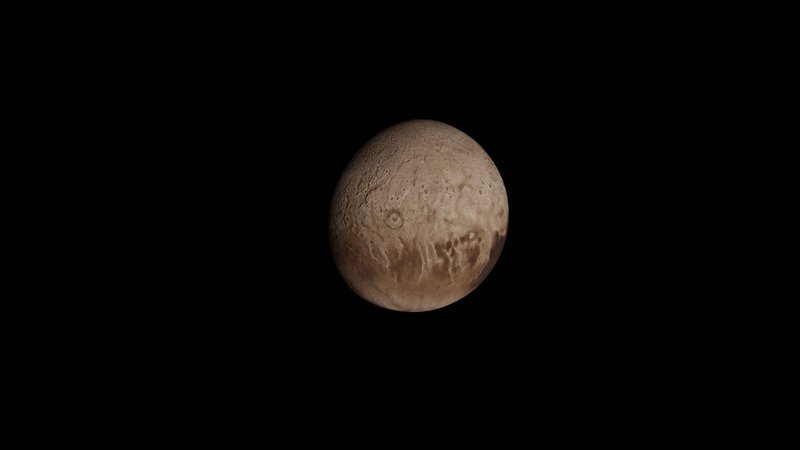
Christy found Charon in 1978 while checking old photographic plates of Pluto at the U.S. Naval Observatory. The planet’s image had a bump on one side that came and went on a 6.4-day cycle. The bump was a moon, and until then astronomers had assumed Pluto was a much larger object than it is.
Charon’s diameter is about 51% of Pluto’s. No other moon in the solar system is that large relative to its planet, except for Earth’s, which is about 27%. Charon holds roughly 12% of Pluto’s mass.
That ratio changes the geometry. Two bodies orbit their shared center of mass, called the barycenter. For Earth and the Moon it sits inside Earth. For Pluto and Charon it sits about 2,130 km from Pluto’s center, and Pluto’s radius is only about 1,190 km. The point they orbit is in empty space above Pluto’s surface. That’s why astronomers call Pluto and Charon a binary system, and why Pluto visibly wobbles around a spot that isn’t inside it.
The two are also tidally locked to each other. Pluto rotates once every 6.39 days, the same time Charon takes to orbit, so each always shows the same face to the other. From the Charon-facing hemisphere of Pluto, Charon hangs fixed in the sky and never rises or sets. From the far side, you’d never see it at all.
New Horizons showed that Charon isn’t a dead gray ball. It has a reddish-brown polar cap, informally named Mordor Macula, which is likely made of material that escaped Pluto’s atmosphere and froze on Charon’s pole. Canyons run along its equator, including Serenity Chasma, which is deeper than the Grand Canyon.
The four small moons
Styx, Nix, Kerberos and Hydra are a different kind of object. None is massive enough to pull itself into a sphere, so they’re elongated, closer in shape to potatoes than moons. Nix and Hydra are the largest at roughly 50 km long. Kerberos and Styx are only 16 to 19 km, about the size of a small city.
All four orbit in the same plane as Charon, on nearly circular paths. That tidy alignment matters for the origin story below.
Their rotation is the strange part. Charon is locked to Pluto, so you’d expect the small moons to be locked too, always facing Pluto the way our Moon faces Earth. They aren’t. Pluto and Charon’s combined gravity is lumpy, since the pair is a spinning double system, and that pulls on the small moons’ elongated shapes in ways that prevent them from settling. Before the flyby, researchers predicted the small moons would tumble chaotically. New Horizons confirmed that they spin far faster than their orbits and with their axes tipped sideways. Hydra, for instance, rotates in roughly 10 hours while taking 38 days to circle Pluto.
The 1:3:4:5:6 orbital pattern
Divide each small moon’s orbital period by Charon’s 6.39 days and you get numbers close to whole numbers:
- Styx: about 3.2
- Nix: about 3.9
- Kerberos: about 5.0
- Hydra: about 6.0
Those are near 3, 4, 5 and 6, with Charon as 1. Orbital resonances like this usually happen when a body’s gravity regularly tugs a neighbor at the same point in each orbit, and the repeated nudges keep the pattern stable.
Be precise about it, though. Kerberos and Hydra land almost exactly on their numbers, while Styx and Nix drift off. Only Styx, Nix and Hydra are in a true three-body resonance with each other. The pattern is a strong hint that the small moons formed close to Charon and migrated outward as it did, rather than being captured later from elsewhere.
Where did the moons of Pluto come from?
The leading explanation is a giant impact. Roughly 4.5 billion years ago, a large object collided with proto-Pluto and flung debris into orbit. Some of it coalesced into Charon, and the same debris disk fed the smaller moons. This is the same kind of event that formed Earth’s Moon, scaled down for the Kuiper Belt.
Simulations suggest one version in which Charon and Pluto briefly stuck together before separating, in a gentle encounter researchers have called “kiss and capture.” Both survive intact, and leftover debris sits in the same plane as the orbit, which matches the small moons’ flat, circular paths. A captured moon would likely orbit at a tilt, with a stretched path. Four nearly circular orbits in the same plane point to formation in place.
What New Horizons saw in 2015
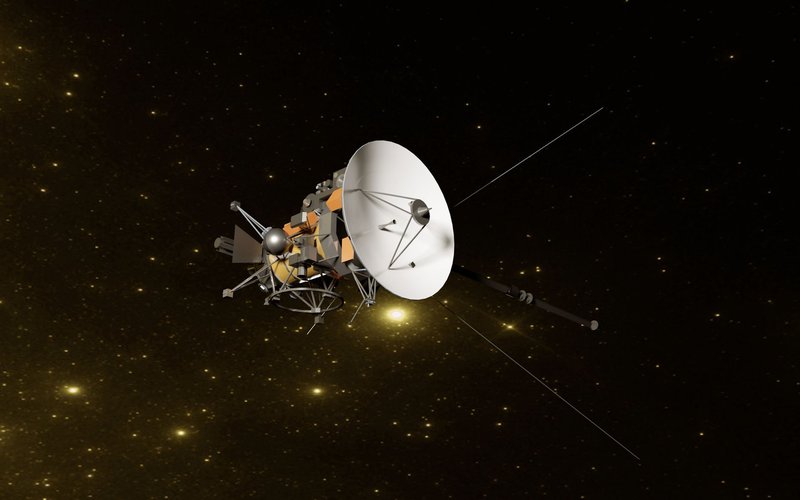
NASA’s New Horizons spacecraft passed Pluto on July 14, 2015, after nine years of travel. Most of the attention went to Pluto’s heart-shaped plain, but the probe also photographed the moons.
Several results stood out:
- Charon’s surface turned out to be water ice with a rift system suggesting that Charon’s interior once froze and expanded, cracking the crust.
- Nix and Hydra were imaged in enough detail to show craters and elongated shapes. Hydra is covered with water ice and reflects about 80% of the light that hits it. Nix has a reddish patch near a crater, probably material exposed from beneath the surface.
- Kerberos was a surprise. Because Hubble found it faint, researchers expected it to be dark. It’s about as bright as its neighbors and looks like two lobes joined together, around 19 km by 10 km, likely two smaller bodies that merged.
- Styx got the least coverage, with only a few pixels’ worth of detail.
The probe also searched for extra moons and rings and found none, so the count of five appears to be complete for anything of significant size. You can read the full small-moons analysis in Science.
Why the names all point to the underworld
The naming habit started with Pluto itself. In 1930, an 11-year-old girl from Oxford named Venetia Burney suggested the name over breakfast, after the Roman god of the underworld. Her grandfather passed it on, and the observatory’s astronomers voted to accept it.
Everything since follows that theme:
- Charon is the ferryman who carries souls across the river to the land of the dead. Christy also liked that it echoed the name of his wife, Charlene, which he pronounced like “Sharon.”
- Nix is the Greek goddess of night, Nyx. The N and H of Nix and Hydra also match the initials of the New Horizons mission.
- Hydra is the many-headed serpent of Greek myth.
- Kerberos is the Greek form of Cerberus, the three-headed dog that guards the underworld gate.
- Styx is the river that divides the living world from the dead.
Kerberos and Styx were chosen through a public poll in 2013. “Vulcan” won the poll after a campaign by William Shatner, but the International Astronomical Union passed on it because Vulcan is the Roman god of fire, not of the dead, and doesn’t fit the underworld theme.
FAQ
How many moons does Pluto have?
Five: Charon, Styx, Nix, Kerberos and Hydra.
What is Pluto’s biggest moon?
Charon, at about 1,212 km across. It’s roughly half the diameter of Pluto itself.
Is Pluto a binary system with Charon?
Many astronomers describe it that way. The barycenter, the point where the two bodies balance, sits outside Pluto, so Pluto and Charon orbit a point in space rather than Charon orbiting Pluto’s center. Officially, Charon is still classified as a moon of Pluto.
Do Pluto’s moons have atmospheres?
No. Pluto has a thin atmosphere of nitrogen, but Charon and the small moons are too light to hold one. Their gravity is far too weak.
Could Pluto have more moons we haven’t found?
Unlikely, at least large ones. New Horizons searched the system on approach and found no additional moons or rings down to very small sizes. A few-kilometer moon would be hard to spot at that distance.
Which moon is closest to Pluto?
Charon, at about 19,600 km from Pluto’s center. It’s also the only moon close enough to be tidally locked in the usual sense.
For the full discovery table and naming notes, see NASA’s Pluto moons page.