The nearest star to Earth is the Sun, 93 million miles away. The nearest star after that is Proxima Centauri, about 4.25 light-years out, and it belongs to the three-star Alpha Centauri system, whose two bright members sit at 4.37 light-years. Every other star is farther than 5.9 light-years. That’s the answer. The rest of this post is the ranked list, the rules behind it, and the details most “closest stars” pages skip.
TLDR
- Closest star: the Sun. Closest star beyond it: Proxima Centauri, about 4.25 light-years (roughly 25 trillion miles).
- Closest star system: Alpha Centauri (Proxima Centauri plus Alpha Centauri A and B).
- Second closest: Barnard’s Star, 5.96 light-years.
- Naked-eye stars among the ten nearest systems: only three: Alpha Centauri, Sirius and Epsilon Eridani.
- Most common type: red dwarfs. Seven of the ten systems below are built around them.
- Travel time to Proxima: about 75,000 years at Voyager 1’s speed.
Table of contents
- The 10 nearest stars at a glance
- How this list counts
- The 10 nearest stars to Earth, one by one
- The brown dwarfs that sit between them
- Nearest stars vs brightest stars
- How astronomers measure the distance
- Which nearby stars you can actually see
- How long it would take to get there
The 10 nearest stars at a glance
Distances are in light-years, rounded from Gaia-era measurements. Planet status reflects published results through 2025 and changes as new data arrives.
| Rank | System | Distance (ly) | Star type | Naked eye? | Known planets |
|---|---|---|---|---|---|
| 1 | Alpha Centauri (incl. Proxima) | 4.25 (Proxima), 4.37 (A and B) | G2 + K1 sun-like pair, M5.5 red dwarf | Yes (A and B), southern sky | Proxima b and d confirmed; Proxima c disputed; candidate giant at Alpha Cen A |
| 2 | Barnard’s Star | 5.96 | M4 red dwarf | No | Four sub-Earth planets reported |
| 3 | Wolf 359 | 7.86 | M6 red dwarf | No | None confirmed |
| 4 | Lalande 21185 | 8.29 | M2 red dwarf | No (just below the limit) | At least one confirmed |
| 5 | Sirius | 8.61 | A1 star + white dwarf | Yes, brightest star in the night sky | None known |
| 6 | Luyten 726-8 (UV Ceti and BL Ceti) | 8.73 | Two M5.5-M6 red dwarfs | No | None known |
| 7 | Ross 154 | 9.69 | M3.5 red dwarf | No | None known |
| 8 | Ross 248 | 10.3 | M5.5 red dwarf | No | None confirmed |
| 9 | Epsilon Eridani | 10.47 | K2 orange dwarf | Yes, dark sky needed | One giant planet confirmed |
| 10 | Lacaille 9352 | 10.7 | M0.5 red dwarf | No (magnitude 7.3) | Two super-Earths confirmed, a third disputed |
How this list counts
Most disagreement between “closest stars” pages comes down to three choices, so here are ours.
Systems, not individual stars. Alpha Centauri is one entry even though it holds three stars. Sirius is one entry even though one of its two stars is a white dwarf. If you count individual stars instead, the first three slots all go to the Alpha Centauri trio, and the rest of the ranking shifts down.
The Sun is excluded. It’s the nearest star by a margin of 4.25 light-years, so it doesn’t need a row.
Brown dwarfs are separate. They’re objects too small to sustain hydrogen fusion like a true star, and two of them sit closer than most of the entries above. We cover them in their own section so the “10” in the title stays honest. Counting them would push Epsilon Eridani and Lacaille 9352 off the list.
The 10 nearest stars to Earth, one by one
1. Alpha Centauri (4.25 to 4.37 light-years)
Three stars, one neighborhood. Alpha Centauri A is a near twin of the Sun, B is a slightly smaller orange star, and the two form a binary pair that orbit each other every 80 years. Proxima Centauri is a dim red dwarf circling the pair from far out, and it holds the “closest star to Earth after the Sun” title at 4.25 light-years.
Proxima is invisible to the naked eye at magnitude 11, even though A and B together shine as the third-brightest star in the night sky. Its planets are the headline. Proxima b, announced in 2016 by the European Southern Observatory, has about Earth’s mass and sits in the star’s habitable zone. A smaller planet, Proxima d, followed in 2022. A third, Proxima c, remains disputed. Proxima is also a flare star, so “habitable zone” doesn’t mean “pleasant.”
In 2025, JWST imaged a candidate gas giant around Alpha Centauri A. It still needs confirmation.
2. Barnard’s Star (5.96 light-years)
A red dwarf in Ophiuchus with the fastest apparent motion of any star: it drifts about 10.4 arcseconds a year across our sky, roughly the width of the Moon every 180 years. That’s why it carries a person’s name and not a catalog number. Edward Barnard noticed the motion in 1916.
Planet claims here have a messy history. A 2018 super-Earth announcement fell apart under later scrutiny. The newer story holds up better: astronomers have reported four sub-Earth planets, each under half of Earth’s mass, on orbits of just a few days. Treat the full set as recent and still being checked.
3. Wolf 359 (7.86 light-years)
A faint red dwarf in Leo that radiates a tiny fraction of the Sun’s light. It’s a flare star and has appeared in science fiction from Star Trek onward. Planet candidates have been proposed from radial-velocity data, but none is firmly established.
4. Lalande 21185 (8.29 light-years)
An M2 red dwarf in Ursa Major at magnitude 7.5, just past what dark-sky observers can see unaided. Binoculars show it easily. It hosts Lalande 21185 b, a planet around 2.7 times Earth’s mass on a 13-day orbit, and astronomers have reported additional candidate signals.
5. Sirius (8.61 light-years)
The brightest star in the night sky at magnitude -1.46, and the only one on this list that outshines everything else you can see. Sirius A is a blue-white star about twice the Sun’s mass and 25 times as luminous. Sirius B, its companion, is a white dwarf with roughly the Sun’s mass packed into an Earth-sized body.
Sirius ranks fifth among nearby systems but looks like first place because it’s intrinsically luminous. That mismatch is the whole reason the “nearest vs brightest” section below exists.
6. Luyten 726-8: UV Ceti and BL Ceti (8.73 light-years)
Two red dwarfs orbiting each other, both prone to violent flares. UV Ceti gave its name to the entire class of flare stars after a 1952 outburst made it dozens of times brighter within minutes. Neither star is visible without a telescope, and no planets are known.
7. Ross 154 (9.69 light-years)
A flare-prone red dwarf in Sagittarius at magnitude 10.4. It’s a small-telescope target, and no planets have been found around it.
8. Ross 248 (10.3 light-years)
An M5.5 red dwarf in Andromeda. It’s heading toward us: around the year 38,000 it will pass within about 3 light-years, briefly becoming the closest star to the Sun. No planets are confirmed.
9. Epsilon Eridani (10.47 light-years)
The best naked-eye star on this list after Sirius and Alpha Centauri. It’s an orange K-type dwarf at magnitude 3.7, visible from most of the planet on a dark autumn or winter evening. It’s also young, probably under a billion years old, which makes it a useful model for what our own solar system looked like early on.
A Jupiter-class planet orbits it at about 3.5 times Earth’s distance from the Sun, confirmed in 2019 using astrometry, and dust belts around the star hint at more.
10. Lacaille 9352 (10.7 light-years)
An M0.5 red dwarf in Piscis Austrinus at magnitude 7.3, just beyond naked-eye range. Two super-Earths have been confirmed. A third candidate is disputed.
The brown dwarfs that sit between them
If you count brown dwarfs, two of them slot into the ranking:
- Luhman 16 (6.5 light-years): a pair of brown dwarfs about 3 AU apart, found in 2013 in data from NASA’s WISE telescope. It’s the third-closest system to the Sun, after Alpha Centauri and Barnard’s Star. Astronomers have mapped cloud bands on the larger one.
- WISE 0855-0714 (7.4 light-years): one of the coldest known objects outside our solar system, at a temperature roughly like a household freezer. It’s so faint in visible light that it only showed up in infrared surveys.
Neither changes our top ten, because we’ve defined that list as stars. But if a source calls Luhman 16 the “third nearest star,” it’s counting brown dwarfs.
Nearest stars vs brightest stars
These are different lists, and mixing them up is the most common mistake on this topic.
“Nearest” is a distance ranking. “Brightest” is what your eye sees, and it depends on both distance and how much light a star produces. Sirius leads both because it’s close and powerful. Rigel and Betelgeuse look bright in Orion but are hundreds of light-years away, so they never come near a nearest-stars list. Going the other way, Proxima Centauri is the closest star yet is far too faint to see.
The reason is demographics. Roughly three in four stars near the Sun are red dwarfs, which shine at a sliver of our Sun’s output. The nearest neighborhood is mostly a crowd of dim, cool stars, and the bright ones are the exception.
How astronomers measure the distance
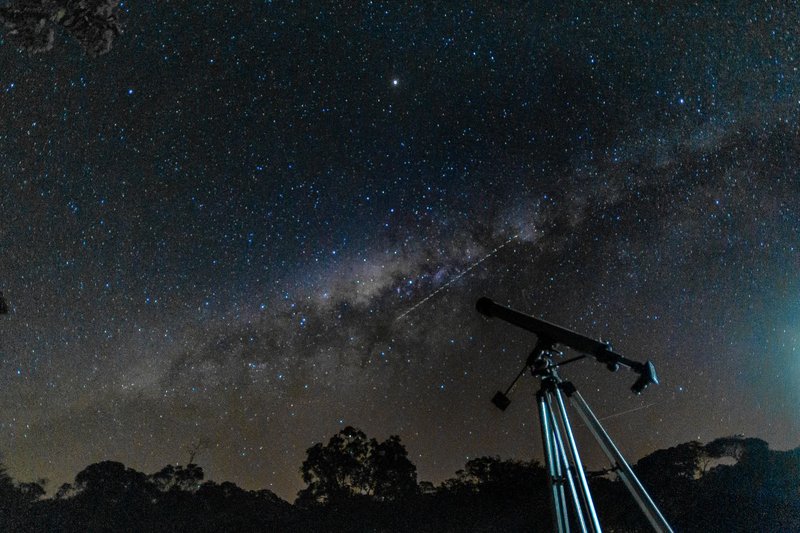
The method is parallax, the same trick you use when you hold up a finger and blink one eye at a time. As Earth moves around the Sun, a nearby star appears to shift slightly against distant background stars over six months. Measure that angle and you get the distance directly, with no assumptions about brightness.
For Proxima Centauri the shift is about 0.77 arcseconds, the width of a coin seen from several miles away. The ESA mission Gaia measured these shifts for nearly two billion stars, precisely enough to pin nearby distances to a few thousandths of a light-year. Gaia stopped collecting science data in 2025, so its catalog is the benchmark for the numbers above.
Very bright stars like Sirius are harder to measure because they overwhelm Gaia’s detectors, so their distances lean on earlier work.
Which nearby stars you can actually see
Only three of the ten are naked-eye stars, and where you live decides which.
- Alpha Centauri: visible from the Southern Hemisphere and from the tropics and subtropics, roughly south of 29 degrees north. In the US, that means southern Florida and Hawaii. It’s not visible from Europe or most of North America.
- Sirius: visible from nearly everywhere. It rises in the southeast on northern winter evenings, below and to the left of Orion’s belt.
- Epsilon Eridani: visible from most populated latitudes, but at magnitude 3.7 you need a dark sky. It sits in the constellation Eridanus, near Orion.
Lalande 21185 and Lacaille 9352 are the near misses, and binoculars bring both in easily. Barnard’s Star at magnitude 9.5 needs a small telescope and a dark sky.
How long it would take to get there
Distance in light-years is abstract. Travel time makes it concrete.
Voyager 1 travels at about 17 kilometers per second, or 61,000 km/h. It launched in 1977 and is only about one light-day from Earth. Proxima is roughly 1,550 light-days away, so at that pace the trip takes about 75,000 years.
Parker Solar Probe is the fastest object humans have built, hitting about 690,000 km/h at its closest approach to the Sun. A craft holding that speed the whole way would still need around 6,600 years. And that speed is a gravity-fed solar dive, not something a probe can sustain in deep space.
The one serious proposal that cuts the trip to a human timescale is Breakthrough Starshot, announced in 2016. The idea is to push gram-scale sails with a ground-based laser array to about 20% of light speed, which would reach Alpha Centauri in around 20 years, plus about four more for a signal to come back. No such craft has been built, and the sail and laser technology hasn’t been demonstrated at scale.
For now, the nearest stars are close enough to study with telescopes and far enough that every visit is a thought experiment.