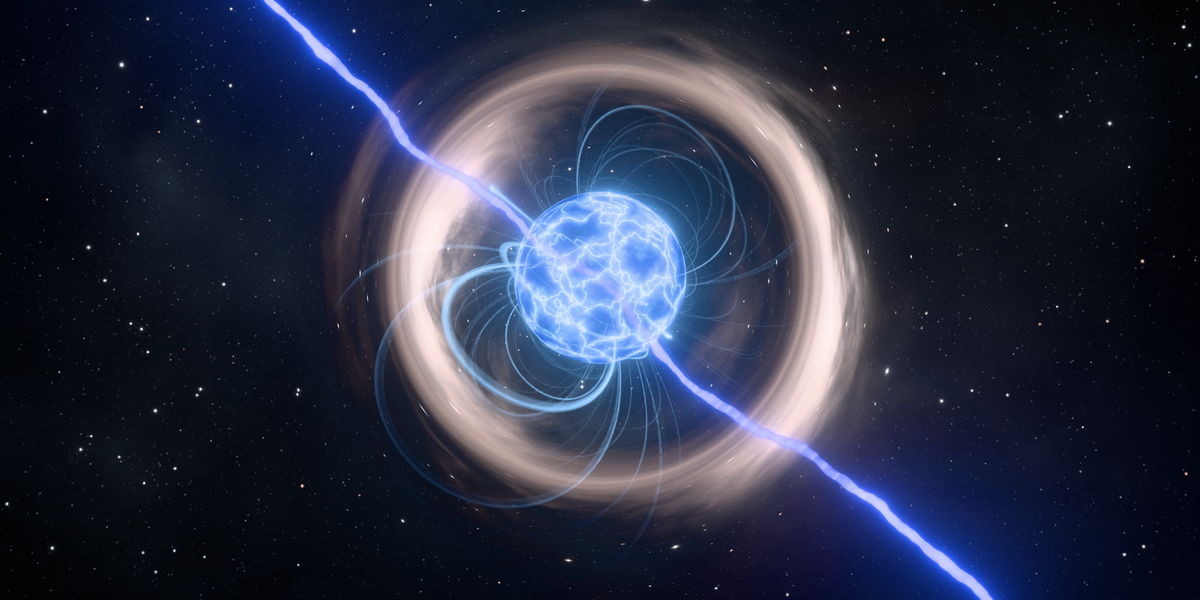
A neutron star is the collapsed core of a massive star that blew up as a supernova: about 1.4 times the Sun’s mass crushed into a ball roughly 20 kilometers across. A teaspoon of it would weigh around a billion tons.
Astronomers know of more than 3,000 of them, and they don’t all behave alike. Some flash like lighthouses, some spin hundreds of times a second, some carry the strongest magnetic fields known, and some are slowly eating their own companions. These 12 examples cover every major type, with the distance, spin, and one fact you can repeat at a party.
Contents
- The Short Version: Closest, Fastest, Strongest
- Neutron Star Types in a Minute
- Young Pulsars: Crab, Vela, Geminga
- Millisecond and Binary Pulsars: PSR B1937+21, PSR J0348+0432, PSR B1957+20
- Magnetars: SGR 1806-20, SGR 1935+2154
- Odd Ones Out: the double pulsar, RX J1856.5-3754, PSR B1257+12, GW170817
- Which Ones Can You Observe?
- Comparison Table
The Short Version: Closest, Fastest, Strongest
- Closest: RX J1856.5-3754, about 400 light-years away and usually cited as the nearest known isolated neutron star.
- Fastest in this list: PSR B1937+21, spinning 642 times per second. The record holder overall is PSR J1748-2446ad at 716 times per second.
- Strongest magnet: SGR 1806-20, with a field of about 2 × 10^15 gauss. Earth’s field is about 0.5 gauss, and a fridge magnet is around 50.
- Heaviest in this list: PSR J0348+0432 at 2.01 solar masses. A black widow pulsar, PSR J0952-0607, has a measured mass near 2.35 and holds the overall record.
Neutron Star Types in a Minute
- Pulsar: a neutron star whose radio (or X-ray, or gamma-ray) beam sweeps past Earth once per rotation, like a cosmic lighthouse.
- Millisecond pulsar: an old pulsar spun back up by a companion’s gas until it rotates in under about 30 milliseconds.
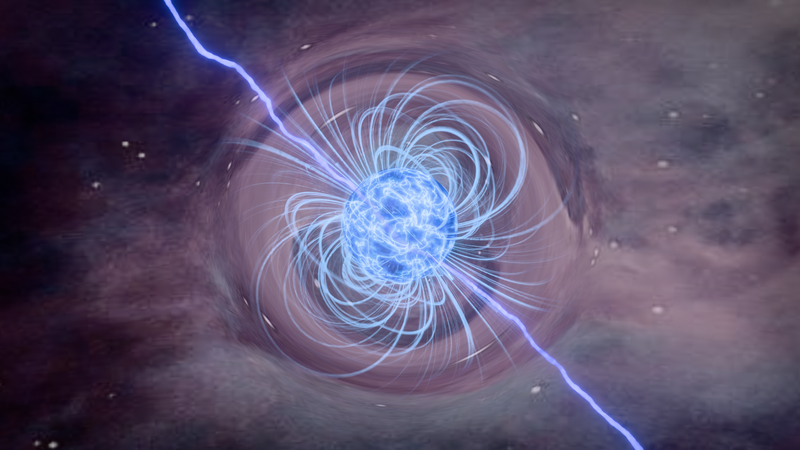
- Magnetar: a neutron star with a field of roughly 10^14 to 10^15 gauss, powering bursts and giant flares.
- Binary and black widow pulsars: pulsars in orbit around another star. In a black widow, the pulsar’s wind is vaporizing the companion.
- Isolated thermal neutron star: a quiet, cooling one with no strong radio beam. The Magnificent Seven are the nearby examples.
- Merger: two neutron stars spiraling together and colliding.
Young Pulsars
1. Crab Pulsar (PSR B0531+21)
- Distance: about 6,500 light-years
- Constellation: Taurus
- Spin period: 33 milliseconds (30 turns per second)
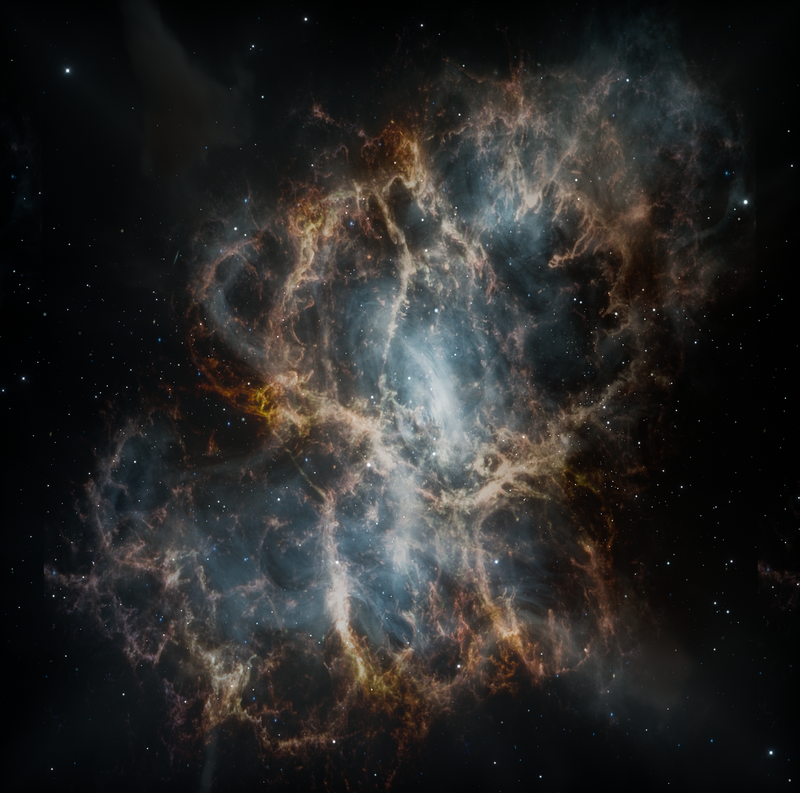
- Fact: Chinese astronomers recorded the supernova that made it in 1054, and the Crab Nebula is the debris.
The Crab is the pulsar that textbooks lead with, partly because it’s bright at nearly every wavelength from radio to gamma rays. Its pulses were first spotted in optical light in 1969, and the star itself is blinking on and off 30 times a second in the middle of the nebula. It’s also slowing down, losing about 38 nanoseconds of rotation per day, which is enough to power the whole glowing nebula.
2. Vela Pulsar (PSR B0833-45)
- Distance: about 1,000 light-years
- Constellation: Vela
- Spin period: 89 milliseconds
- Fact: It glitches, suddenly speeding up its spin, about every two to three years.
Vela is the pulsar astronomers use to study what’s inside a neutron star. When it glitches, the crust seems to lock onto a superfluid interior that spins slightly faster, then transfers its momentum in a jolt. Each glitch is a free look at matter you can’t build in any lab. Its supernova went off roughly 11,000 years ago, and in gamma rays it’s the brightest steady source in the sky.
3. Geminga (PSR J0633+1746)
- Distance: about 800 light-years
- Constellation: Gemini
- Spin period: 237 milliseconds
- Fact: For 20 years it was a gamma-ray source with no visible counterpart, and its name is a pun.
Geminga is a Milanese phrase, gh’è minga, meaning “it’s not there.” Satellites saw its gamma rays in 1972, and nobody could find the object behind them until X-ray telescopes caught its 237-millisecond pulse in 1992. It sends out almost no radio waves, which is why radio surveys missed it entirely. Its charged particles stream behind it in a long tail, which is partly why it’s a suspect for extra positrons detected near Earth.
Millisecond and Binary Pulsars
4. PSR B1937+21
- Distance: about 12,000 light-years
- Constellation: Vulpecula
- Spin period: 1.558 milliseconds (642 turns per second)
- Fact: Its equator moves at over 10 percent of the speed of light.
Found in 1982, this was the first millisecond pulsar ever discovered, and astronomers initially struggled to believe a star could spin that fast without tearing apart. A neutron star’s gravity is that strong, and this pulsar ranks among the fastest spinning objects in space. It held the spin record for 24 years, until PSR J1748-2446ad (716 Hz) was found in 2006. Millisecond pulsars are also nearly perfect clocks, which is why teams use arrays of them to listen for gravitational waves.
5. PSR J0348+0432
- Distance: about 7,000 light-years
- Constellation: Taurus
- Mass: 2.01 solar masses; spin period: 39 milliseconds
- Fact: It sets how heavy a neutron star can get before gravity wins.
This pulsar orbits a white dwarf every 2.5 hours. By timing the pulses precisely, astronomers measured both stars’ masses and confirmed a neutron star at twice the Sun’s mass, as reported in a 2013 Science paper. That ruled out many proposed models for neutron-star matter that go soft under pressure and collapse earlier. The same system also tested Einstein’s general relativity in a strong-gravity setting.
6. PSR B1957+20 (the first black widow)
- Distance: about 8,000 light-years
- Constellation: Sagitta
- Spin period: 1.607 milliseconds
- Fact: Its companion is shrinking, down to about 0.02 solar masses and still losing material.
Discovered in 1988, this pulsar is slowly cooking its partner. The companion’s near side is heated to thousands of degrees, and the pulsar’s wind strips gas off it, which also eclipses the radio signal for about 10 percent of each 9.2-hour orbit. The name comes from the spider that eats its mate. Astronomers think this process is how millisecond pulsars get spun up in the first place, then lose their donors entirely.
Magnetars
7. SGR 1806-20
- Distance: roughly 30,000 light-years (estimates reach 50,000)
- Constellation: Sagittarius
- Spin period: 7.5 seconds
- Fact: Its 2004 flare was the brightest burst of gamma rays ever recorded from outside our solar system.
SGR 1806-20 holds one of the strongest magnetic fields known, around 2 × 10^15 gauss. On December 27, 2004, its crust cracked under that field and released, in about a tenth of a second, as much energy as the Sun produces in roughly 100,000 years. The flash lit up detectors across the solar system and briefly disturbed Earth’s upper atmosphere, from 30,000 light-years away.
8. SGR 1935+2154
- Distance: about 30,000 light-years
- Constellation: Vulpecula
- Spin period: 3.2 seconds
- Fact: In April 2020 it produced the first fast radio burst traced to a source inside our own galaxy.
Fast radio bursts are millisecond flashes of radio energy, among the strangest radio signals from space, that until 2020 came only from other galaxies, with no way to tell what caused them. This magnetar fired off a burst that radio telescopes in Canada and the US picked up, and X-ray satellites saw a matching flash at the same moment. At least some fast radio bursts, then, come from magnetars.
Odd Ones Out
9. The Double Pulsar (PSR J0737-3039A/B)
- Distance: roughly 2,000 to 3,000 light-years
- Constellation: Puppis
- Spin periods: 22.7 milliseconds and 2.77 seconds
- Mass: 1.34 and 1.25 solar masses
- Fact: It’s the only system known where both neutron stars are visible as pulsars.
The two stars orbit each other every 2.4 hours at a separation of about twice the Earth-Moon distance. Because both stars pulse, astronomers can time them independently and test general relativity from both sides. The result, published in a 2006 Science paper, matched Einstein’s predictions to better than 0.05 percent. In billions of years, they’ll merge.
10. RX J1856.5-3754
- Distance: about 400 light-years
- Constellation: Corona Australis
- Spin period: about 7 seconds (faint pulses detected in 2007)
- Fact: It’s the nearest member of the “Magnificent Seven,” seven isolated neutron stars found by the ROSAT X-ray satellite.
This one has no radio beam and no companion. It’s a neutron star that exploded about a million years ago and is now slowly cooling, with a surface around 700,000 kelvin, glowing only because it’s hot. Hubble measured its distance in 2001, and the answer made it the closest neutron star known at the time, which is still the usual claim.
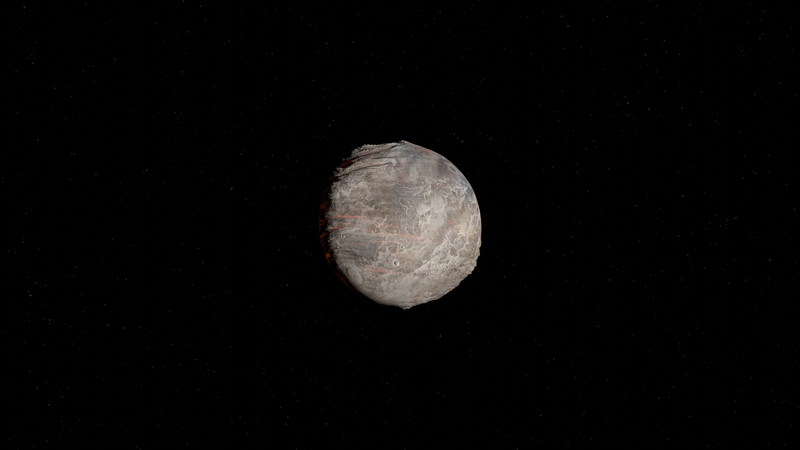
11. PSR B1257+12
- Distance: about 2,300 light-years
- Constellation: Virgo
- Spin period: 6.2 milliseconds
- Fact: In 1992 it became the first star ever confirmed to host planets.
Alex Wolszczan and Dale Frail found the pulse timing wobbling in ways that only orbiting planets could explain, and reported it in Nature before the first planet around a Sun-like star was found. There are three: Draugr, Poltergeist, and Phobetor. Draugr, at about 0.02 Earth masses, is still the lowest-mass exoplanet known. Nobody expected planets around a dead star, and the best guess is they formed from debris after the supernova.
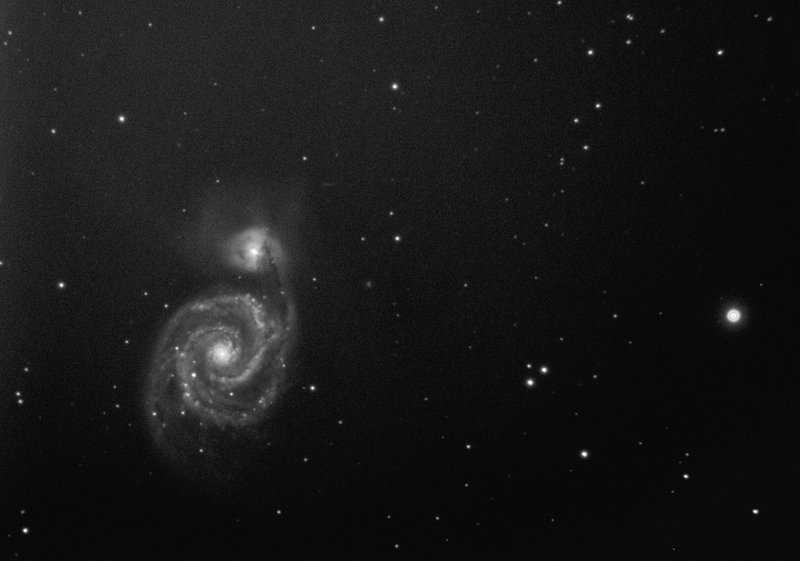
12. GW170817 (a neutron star merger)
- Distance: about 130 million light-years
- Constellation: Hydra (in the galaxy NGC 4993)
- Mass: about 1.4 solar masses each, combined 2.7
- Fact: It’s the first collision of two neutron stars detected through gravitational waves and light.
On August 17, 2017, LIGO and Virgo picked up a signal that rose in pitch for about 100 seconds, which the team described in a 2017 Physical Review Letters paper. Less than two seconds later, a gamma-ray burst arrived, and telescopes then found the afterglow, called a kilonova, in NGC 4993. Its light showed freshly made heavy elements such as gold and platinum. What remained afterward, a heavy neutron star or a black hole, is still unresolved.
Which Ones Can You Observe?
Short answer: not as stars, and not by eye.
- Crab: Its nebula (M1) shows in a small telescope under dark skies. The pulsar itself is around magnitude 16.5 and flashes too fast to see, so it takes a large telescope and a high-speed camera.
- Vela, Geminga, RX J1856.5-3754: All are far too faint in visible light for amateur gear. Professionals use X-ray satellites.
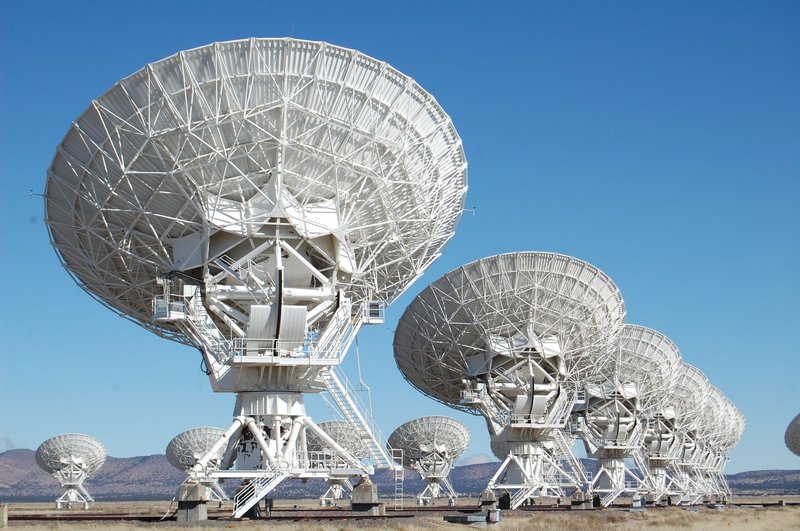
- Radio: A few dedicated amateurs with large dishes have detected the strongest pulsars. It’s a real project, not a casual one.
- GW170817: The host galaxy, NGC 4993, is within reach of mid-sized telescopes, but the kilonova faded within weeks.
The practical option is the Crab Nebula. You’re looking at the remains of a supernova, with the neutron star it left behind sitting in the middle.
Comparison Table
Values are approximate. Distances are in light-years, magnetic fields in gauss.
| Star | Type | Spin period | Magnetic field | Distance |
|---|---|---|---|---|
| Crab Pulsar | Young pulsar | 33 ms | ~4 × 10^12 | ~6,500 |
| Vela Pulsar | Young pulsar | 89 ms | ~3 × 10^12 | ~1,000 |
| Geminga | Radio-quiet pulsar | 237 ms | ~2 × 10^12 | ~800 |
| PSR B1937+21 | Millisecond pulsar | 1.56 ms | ~4 × 10^8 | ~12,000 |
| PSR J0348+0432 | Millisecond pulsar, white dwarf binary | 39 ms | ~2 × 10^9 | ~7,000 |
| PSR B1957+20 | Black widow | 1.61 ms | ~2 × 10^8 | ~8,000 |
| SGR 1806-20 | Magnetar | 7.5 s | ~2 × 10^15 | ~30,000 |
| SGR 1935+2154 | Magnetar | 3.2 s | ~2 × 10^14 | ~30,000 |
| PSR J0737-3039A/B | Double pulsar | 22.7 ms / 2.77 s | ~6 × 10^9 / ~2 × 10^12 | ~2,000 to 3,000 |
| RX J1856.5-3754 | Isolated thermal | ~7 s | ~1 × 10^13 | ~400 |
| PSR B1257+12 | Millisecond pulsar with planets | 6.2 ms | ~9 × 10^8 | ~2,300 |
| GW170817 | Merger | n/a | n/a | ~130 million |
The pattern holds across the list: young pulsars sit near 10^12 gauss, old recycled ones have fields 1,000 times weaker and spin far faster, and magnetars are the extreme at the other end.