Contents
- What is a binary star?
- How common are binary stars?
- The four ways astronomers find binary stars
- Detached, semidetached and contact binaries
- How binary stars form
- When binary stars interact: novae, supernovae and X-rays
- Planets in binary star systems
- FAQ
- Summary
What is a binary star?
A binary star is a pair of stars held together by gravity, each orbiting a point between them called the barycenter, the system’s center of mass. Neither star circles the other. Both circle that shared point, and the heavier star sits closer to it, so it traces the smaller loop.
If one star is ten times the mass of the other, the barycenter lies ten times closer to the heavy one. In a few systems it sits inside the larger star. In others it floats in empty space between the two.
Two terms get confused here. A double star is any pair of stars that look close together in the sky. Some are true binaries. Others are an optical double, two unrelated stars that happen to line up from our viewpoint, one maybe 100 light-years behind the other. A binary star system is the real thing: a physically bound pair. Systems with three or more stars are called multiple star systems.
How common are binary stars?
Very. A survey of 454 Sun-like stars in the solar neighborhood found that about 44 percent have at least one stellar companion. Dimmer red dwarfs, the most numerous stars in the galaxy, are more often single. Massive stars go the other way: most O-type and B-type stars have a companion, and many are close enough to affect each other’s lives.
So the Sun, a lone star, is the minority case for its type. Estimates run from about half of Sun-like stars to nearly all of the most massive ones, and the exact number depends on how many faint companions a survey can detect.
The four ways astronomers find binary stars
Most binaries are too far away, or too tight, to see as two points of light. Astronomers sort them by how they are detected, and each method catches a different kind of pair.
Visual binaries
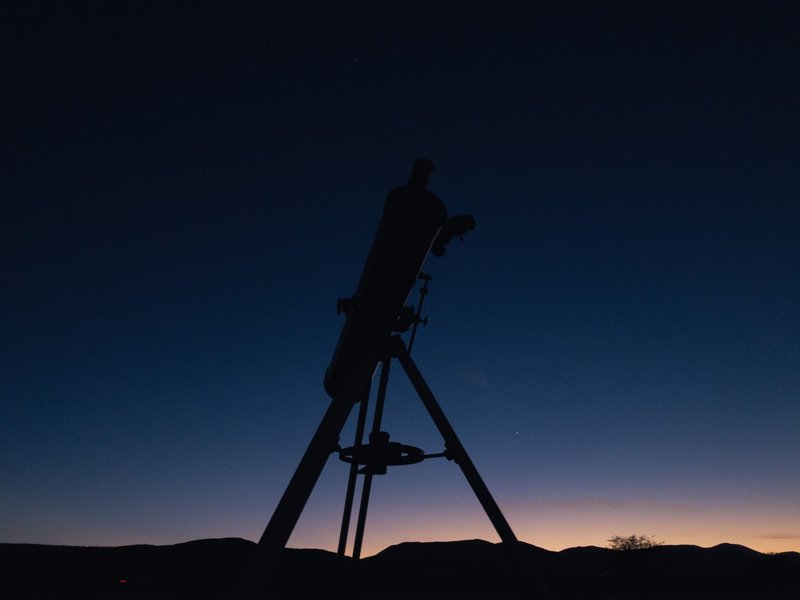
These are the ones you can split with a telescope. Many of the best examples are listed in this guide to observing double stars. The pair is wide enough, and close enough to us, that the two stars appear separately and you can watch them move around each other over years or centuries.
Albireo is the classic target. Beta Cygni, the star marking the head of Cygnus the Swan, resolves in a small telescope into a gold star and a blue one, one of the best color contrasts in the sky. Whether the two are truly bound has been debated, but it remains the standard example of a visual double. Mizar, in the bend of the Big Dipper’s handle, was the first binary discovered with a telescope, in the 1600s. With the naked eye you can see its companion Alcor next to it, which was once a traditional test of eyesight.
Spectroscopic binaries
When two stars are too close to separate, their light still gives them away. As the stars orbit, one moves toward us while the other moves away, and the Doppler shift moves their spectral lines. Lines from the approaching star slide toward blue and lines from the receding star slide toward red. Half an orbit later they swap.
In the spectrum, a single set of lines appears to split in two, merge, and split again on a regular cycle. The cycle length is the orbital period. Mizar A, one of the pair’s two bright stars, was the first spectroscopic binary ever identified, in 1889. Each of Mizar’s two main stars turned out to be a binary of its own, and Alcor has a companion too. The Mizar-Alcor group totals six stars.
Eclipsing binaries
If a binary’s orbit is edge-on from our view, the stars pass in front of each other, and the combined light dips. The brightness history of the system, its light curve, shows a deep dip when the dimmer star’s partner is covered and a shallower dip half an orbit later when the order flips. Eclipsing binaries are one kind of variable star, a star whose brightness changes over time.
Algol, Beta Persei, is the textbook case. It fades from magnitude 2.1 to about 3.4 every 2.87 days, a drop a patient observer can notice over a few hours with no equipment. Astronomers have recorded the pattern for centuries, and in 1783 John Goodricke proposed that a dark companion was eclipsing the bright star. The dimming was explained as a pair, not a pulse. Algol is also a semidetached system, which comes up below.
Eclipsing binaries are valuable because the shape and timing of the dips reveal each star’s size, and combined with spectroscopy, their masses. They are some of the most precise scales we have for weighing stars.
Astrometric binaries
Sometimes only one star is visible. The giveaway is the way it moves: instead of traveling in a straight line across the sky, it wobbles as an unseen partner tugs it around the barycenter.
Sirius, the brightest star in the night sky, is the famous case. In 1844 the astronomer Friedrich Bessel saw that Sirius was wandering in a wave pattern and concluded that an invisible companion was pulling on it. Telescope makers spotted that companion, Sirius B, in 1862. It turned out to be a white dwarf, the core of a dead star, about as massive as the Sun but only roughly Earth-sized. The two orbit each other every 50 years. Because Sirius B is so faint beside its brilliant partner, it remains a difficult target for amateur telescopes.
Which method finds what
| Type | How it’s found | Best for | Example |
|---|---|---|---|
| Visual | Resolved as two stars in a telescope | Wide, nearby pairs | Albireo, Mizar |
| Spectroscopic | Doppler shifts in the spectrum | Tight, fast pairs | Mizar A |
| Eclipsing | Periodic dips in brightness | Edge-on orbits | Algol |
| Astrometric | Wobble of a visible star | One bright star, one faint companion | Sirius |
The categories overlap. A system can fit several at once: Algol is eclipsing and spectroscopic, and Mizar is both visual and spectroscopic.
Alpha Centauri, the nearest star system to the Sun at about 4.3 light-years, is the neighbor worth knowing. Alpha Centauri A and B are a visual binary of Sun-like stars orbiting each other every 80 years or so. A third star, the red dwarf Proxima Centauri, circles them at a far greater distance and is the closest individual star to us.
Detached, semidetached and contact binaries
A second way to sort binaries ignores how we find them and asks how close the stars are. The answer depends on the Roche lobe, the teardrop-shaped region around each star within which its own gravity dominates. If material crosses the boundary, the other star can pull it away.
- Detached binaries: each star sits well inside its Roche lobe. They don’t exchange material, and each evolves almost as if it were alone. Most binaries, including Alpha Centauri A and B, fall here.
- Semidetached binaries: one star has swollen to fill its Roche lobe and is losing gas to its partner. Algol is the standard example.
- Contact binaries: both stars fill their lobes and share a common envelope of gas, like two beads in one thin shell. W Ursae Majoris stars are the usual example, with orbital periods under a day, in some cases around 8 hours.
Mass transfer produces a strange result in Algol. The less massive star in the pair is the more evolved one, even though more massive stars should age faster. The reason: the star that is now the lighter one used to be the heavier one. It swelled up first, then handed most of its mass to its partner. Astronomers call this the Algol paradox.
How binary stars form
Stars are born in clouds of gas and dust. When a dense clump of that cloud collapses, it doesn’t always make a single star. Fragmentation can split a collapsing core or its spinning disk into two or more pieces, each growing into a star. This is why binaries are so common: it is a normal outcome of star formation, not an exception.
The separation between the two stars is set early. Some pairs form close and tight, with orbits of a few days. Others form far apart, taking thousands of years to complete one orbit. Close encounters in crowded star clusters can also pair up stars that formed separately, though this is rarer than a pair forming together.
When binary stars interact: novae, supernovae and X-rays
Isolated stars live out their lives alone. Close binaries have a more eventful ending, because mass moves between them.

- Novae. A white dwarf pulls hydrogen from a companion star. The gas piles up on the dwarf’s surface until it ignites in a runaway burst of fusion. The star brightens by thousands of times and then fades. The dwarf survives and the cycle can repeat.
- Type Ia supernovae. If a white dwarf keeps accreting, or merges with another white dwarf, it can reach roughly 1.4 times the Sun’s mass. Past that limit, it can no longer support itself and detonates. These explosions have nearly uniform peak brightness, which is why astronomers use them to measure distances across the universe.
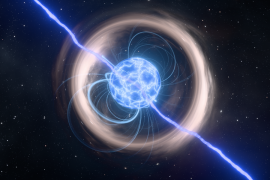
- X-ray binaries. Here, one star is a neutron star or black hole drawing gas from a normal companion. The gas forms a hot disk and glows in X-rays before it falls in. Cygnus X-1 is the best-known example, a black hole paired with a blue supergiant.
- Merging compact objects. Two black holes or neutron stars in orbit lose energy by emitting gravitational waves and spiral together. In 2015, the LIGO detectors recorded the first such merger, a pair of black holes about 1.3 billion light-years away. The discovery earned the 2017 Nobel Prize in Physics.
Without binaries, we would have far fewer of the tools that astronomers use to map the cosmos and none of these gravitational-wave events.
Planets in binary star systems
Tatooine from Star Wars, with its two suns, is less fictional than it looks. In 2011, NASA’s Kepler telescope found Kepler-16b, a Saturn-sized planet that circles two stars every 229 days. Planets in orbit around both stars are called circumbinary planets, or P-type orbits. Planets orbiting just one star of a wide binary are in S-type orbits.
The gravitational tug of two stars makes orbits tricky. A planet needs to be far enough from a close pair to avoid being flung out, so circumbinary planets tend to sit well beyond the stars’ own orbit. Planets around one member of a wide pair, such as Alpha Centauri, can be stable if the second star stays distant. Astronomers have found a planet candidate, Proxima b, around Proxima Centauri, the third member of the Alpha Centauri family.
FAQ
Is the Sun a binary star?
No. The Sun has no stellar companion. A hypothetical dim companion called Nemesis was proposed in the 1980s to explain a possible pattern of mass extinctions every 26 million years or so, but searches have not found it, and the extinction pattern itself is disputed. Infrared surveys that would have caught a brown dwarf or other faint object nearby have turned up nothing.
Can planets orbit two stars?
Yes. Kepler-16b was the first confirmed circumbinary planet, and Kepler has found several since. Stable orbits are possible both around both stars and around one star in a wide pair.
What’s the difference between a binary star and a double star?
A double star is anything that looks like two stars close together in the sky, including chance alignments. A binary star is a bound pair. Albireo and Mizar are famous doubles that are also binaries, or at least widely treated as such.
Can you see a binary star without a telescope?
A few, yes. Mizar and Alcor can be split by the naked eye in a dark sky, though the real pair, Mizar A and B, needs a small telescope. Algol’s dimming is visible to the eye over a few hours. Sirius, the brightest star in the sky, is a binary, but you need a large telescope to see its companion.
Summary
Binary stars are pairs of stars bound by gravity and orbiting a common barycenter, and they are the rule more than the exception: about 44 percent of Sun-like stars have a companion, and massive stars even more. Astronomers find them by sight (Albireo), by Doppler shifts (Mizar A), by eclipses (Algol), or by a visible star’s wobble (Sirius). Detached, semidetached and contact configurations describe how close the stars sit, and the closest ones trade mass, which drives novae, Type Ia supernovae, X-ray binaries and gravitational-wave mergers. Binary star systems can host planets too, as Kepler-16b showed.