
Table of Contents
- What Makes Double Stars Worth Your Time
- Optical Doubles vs. True Binaries
- What Equipment Do You Need?
- The Best Double Stars to Observe
- Starting Your Double Star Observing Program
Double stars are one of the most underrated targets in amateur astronomy. Not as flashy as nebulae, not as dramatic as planets, but in a small telescope they do something nothing else does: they put two suns in your eyepiece at the same time — sometimes gold and blue, sometimes orange and white — colors that exist nowhere else in the night sky.
They’re also practical. You don’t need dark skies. You don’t need a tracking mount. You just point and look.
What Makes Double Stars Worth Your Time
The color contrast is the headline. A few double stars are so visually striking that experienced observers who have seen them hundreds of times still stop and look again. Albireo in Cygnus — a gold and sapphire-blue pair — is the most famous example. The colors come from each star’s surface temperature: cooler stars burn orange and red, hotter ones glow white and blue. When you put two stars with wildly different temperatures in the same field, the result looks almost too vivid to be real.
Beyond the aesthetics, double stars are legitimate astrophysics targets. True binary systems — where both stars are gravitationally bound and orbit each other — have been used to calculate stellar masses, track orbital periods, and test gravitational theory. Some binaries have orbital periods of a few years; others take tens of thousands of years to complete a single orbit. You can spend decades tracking the same pair and watch it rotate.
Optical Doubles vs. True Binaries
The distinction matters once you start looking more closely.
A true binary (or multiple star system) is a pair of stars that are physically connected — they formed from the same gas cloud and orbit a shared center of mass. According to NASA, more than half of all sun-like stars in the Milky Way are part of multiple-star systems. Our own single star is the exception, not the rule.
An optical double just appears close together from Earth’s perspective. The two stars have nothing to do with each other; one might be a few hundred light-years away, the other thousands. From any other angle in the galaxy, they wouldn’t look paired at all.
For observing purposes, both are beautiful. For astrophysics, true binaries are the ones doing something interesting.
What Equipment Do You Need?
This depends on the pair. Double stars span a wide range of difficulty:
Naked eye: A few famous doubles are wide enough to split without any optics. Mizar and Alcor in Ursa Major’s handle is the classic test — ancient astronomers reportedly used it as a vision check.
Binoculars: Most bright, wide doubles resolve cleanly in 7×50 or 10×50 binoculars. This is also a good way to pick up the subtle color differences before magnification blows the stars into Airy disks.
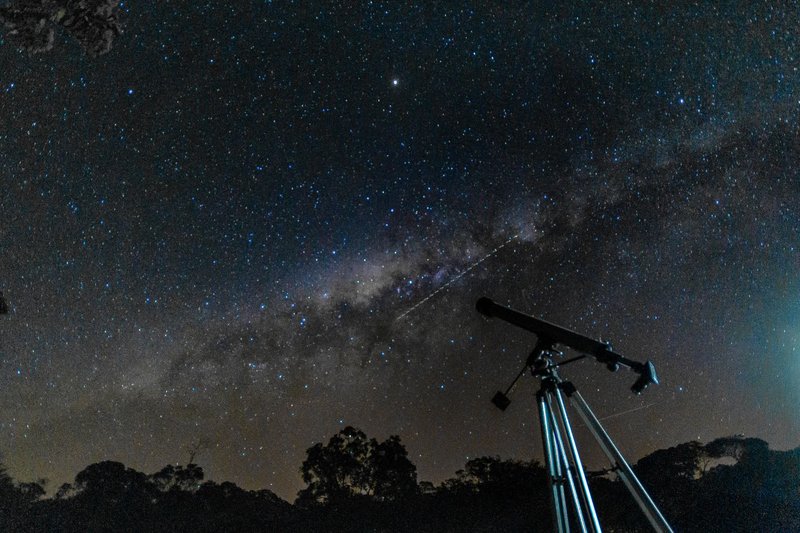
Small telescope (60–80mm): Opens up the majority of showpiece doubles. You don’t need aperture — you need a clean optical path and a steady atmosphere. Most of the targets below split at 50–100x magnification.
Larger telescope (100mm+): Required for close doubles separated by less than 2 arcseconds, or for dimmer companions that are overwhelmed by a bright primary at low aperture.
Seeing conditions matter more for tight doubles than aperture does. A night of poor atmospheric turbulence (the stars are twinkling hard) will smear a tight pair into a blob even in a large scope. Wait for steady nights — when the stars hold still — for the most challenging targets.
The Best Double Stars to Observe
Albireo (Beta Cygni) — The Gold and Blue Standard
Constellation: Cygnus
Separation: ~34 arcseconds
Colors: Gold (K-type) and sapphire blue (B-type)
Equipment: Any telescope, even small binoculars on a steady night
Albireo marks the beak of the swan in Cygnus and sits near the top of the Summer Triangle asterism — easy to find from late spring through autumn. The color contrast is as good as astronomy gets. At 100x in a 70mm refractor, the gold component glows like an ember and the blue looks almost electric. Whether the two stars are a true gravitational binary or just an optical pair is actually still debated; their distance from each other is large enough that measuring orbital motion is difficult.
Mizar and Alcor — The Historic Naked-Eye Test
Constellation: Ursa Major (Big Dipper handle)
Separation: ~12 arcminutes (Mizar–Alcor), 14 arcseconds (Mizar A/B)
Colors: Both white
Equipment: Naked eye to spot the pair; any telescope to split Mizar itself
Look at the middle star in the Big Dipper’s handle. If you can see a faint companion just next to it, your eyesight is above average — that’s Alcor. Point a telescope at Mizar and you’ll find it’s itself a double, with two nearly identical white stars separated by 14 arcseconds. Mizar A and B are a genuine binary system. Alcor is also a binary when examined closely. The whole group is a six-star system in disguise.
Epsilon Lyrae — The Double Double
Constellation: Lyra
Separation: ~208 arcseconds (the two pairs from each other); ~2–3 arcseconds (within each pair)
Equipment: Naked eye or binoculars to split the main pair; 75mm+ telescope to split each into two
Near Vega, the brightest star in the summer sky, Epsilon Lyrae looks like a single star naked-eye. Binoculars reveal it’s actually two stars. A telescope at 100x or more reveals that each of those two stars is itself a double — four stars in total. The two inner pairs are oriented at nearly right angles to each other, which makes this one of the few targets where you’ll actually tilt your head and notice the geometry.
Algieba (Gamma Leonis) — The Golden Pair
Constellation: Leo
Separation: ~4.5 arcseconds
Colors: Both orange-gold (giant stars)
Equipment: 80mm+ telescope, 100x or higher
Two giant orange stars — both K-type — orbiting each other with a period of about 510 years. Unlike most showpiece doubles where the contrast is the point, Algieba is striking because the two stars are matched: same color, very similar brightness, and close enough together that at moderate magnification they almost touch. A genuine binary, and one that rewards a good night of steady seeing. Spring evenings are ideal since Leo rides high overhead.
Castor (Alpha Geminorum) — Six Stars for the Price of One
Constellation: Gemini
Separation: ~5 arcseconds (A/B), closing slightly each decade
Colors: Both white
Equipment: 60mm+ telescope; best at 100x+
Castor looks like a single bright star in Gemini — and Pollux next to it outshines it, which is unusual for a star labeled “alpha.” But Castor is doing something remarkable: it’s a six-star system. Through a small telescope you see two white stars close together (those are themselves spectroscopic binaries, detectable only via their light spectra). A third distant red dwarf companion, YY Geminorum, is also a binary. Three pairs, six stars, one point of light naked-eye.
Eta Cassiopeiae — The Sun Analogue Pair
Constellation: Cassiopeia
Separation: ~12 arcseconds
Colors: Yellow-white primary, orange-red secondary
Equipment: 60mm+ telescope
This is the double star with the most emotionally resonant backstory for stargazers: Eta Cassiopeiae A is one of the closest stars to Earth similar in mass and spectral type to our sun. Its companion — a dimmer, cooler orange-red star — orbits it every 480 years. At 19 light-years away, this pair gives you a real look at what a sun-like star’s sky might look like with a second star in the system. Wide separation, good color contrast, and easy enough that a 60mm refractor on any clear night will nail it.
61 Cygni — The Flying Star
Constellation: Cygnus
Separation: ~30 arcseconds
Colors: Both orange (K-type dwarfs)
Equipment: Any telescope; even large binoculars
61 Cygni has a particular significance in the history of astronomy: in 1838, Friedrich Bessel used it to make the first successful measurement of stellar parallax, establishing for the first time a precise distance to a star beyond the sun. This achievement put Bessel among the most consequential 18th and 19th century astronomers who turned observational astronomy into a precision science. At 11.4 light-years, 61 Cygni is one of our nearest stellar neighbors. The two stars are a bound binary with an orbital period of roughly 650 years. Both are faint orange dwarfs — not dramatic in color contrast, but steady and satisfying, and knowing what you’re looking at makes them worth the stop.
Porrima (Gamma Virginis) — The Demanding Test
Constellation: Virgo
Separation: Currently ~3 arcseconds and slowly widening
Colors: Both white-yellow (F-type)
Equipment: 100mm+ telescope; steady seeing required
Porrima is the best telescopic test of atmospheric seeing and optics quality in this list. Two nearly identical F-type stars orbit each other every 169 years. The pair reached its closest apparent separation (under 0.4 arcseconds — essentially unsplittable) around 2005 and has been slowly widening since. At current separation, a good 4-inch refractor on a steady night should split them cleanly. If you can’t split Porrima, the atmosphere or your optics are the problem, not the target.
Starting Your Double Star Observing Program
The standard beginner path: start with Mizar, then jump to Albireo in the summer months, then work through the list above. After that, pick up a copy of the Cambridge Double Star Atlas or download the Washington Double Star Catalog, which lists over 140,000 pairs. There’s no shortage of targets.
A few practical notes. When you’re pushing for tight doubles, wait until your target is at or near its highest point in the sky — that minimizes the air mass you’re looking through. Give your telescope 20–30 minutes to cool to outside temperature before demanding precision from it; thermal currents inside the tube will destroy a clean split. And try magnifications from 100x to 200x for close pairs — sometimes higher magnification only magnifies the blur.
One other thing worth knowing: double stars are the primary source of stellar mass data in astronomy. Because two stars orbiting each other obey Kepler’s laws, measuring the orbital period and separation gives you the combined mass of the system directly. Research published through the European Southern Observatory’s databases has logged thousands of visual binary orbits, turning amateur-observable targets into hard astrophysical data. The stars you’re looking at on a Tuesday night have real scientific history attached to them.
You don’t need anything fancy. A 70mm telescope on a clear night, starting with the summer sky, and Albireo sitting there gold and blue in the eyepiece — that’s a good enough place to begin.
Enjoyed this article?
Get daily 10-minute PDFs about astronomy to read before bed!
Sign up for our upcoming micro-learning service where you will learn something new about space and beyond every day while winding down.