Table of Contents
- The short answer
- Why Minnesota keeps sending people to space
- 1. Anil Menon
- 2. Karen Nyberg
- 3. Robert Cabana
- 4. Heidemarie Stefanyshyn-Piper
- 5. Dale Gardner
- 6. Kjell Lindgren
- 7. Abigail Harrison
In June 2026, Anil Menon will strap into a Soyuz seat and head for the International Space Station — the first Minneapolis native to fly a space mission since the state started producing astronauts in the 1980s. Local news has covered his path from the Science Museum of Minnesota to NASA in tight, celebratory bursts. What nobody’s put together is the full picture: Menon is the seventh person with a real Minnesota connection to reach, or come close to reaching, orbit.
The short answer
Seven names, if you count everyone with a genuine tie to the state — not just a birthplace, but Minnesota schools, training, or careers:
- Anil Menon — Minneapolis native, launching to the ISS in June 2026
- Karen Nyberg — grew up in Vining, flew two missions, 180 days in space
- Robert Cabana — Minneapolis-born, four shuttle flights, later ran Kennedy Space Center
- Heidemarie Stefanyshyn-Piper — born in St. Paul, first Minnesota woman in space
- Dale Gardner — born in Fairmont, famous for the 1984 satellite salvage spacewalk
- Kjell Lindgren — trained as an ER doctor in Minneapolis before becoming an astronaut
- Abigail Harrison — St. Paul-raised, NASA astronaut candidate in training
Why Minnesota keeps sending people to space
Three institutions show up again and again in these bios, and they’re worth naming because none of the existing roundups do. The Science Museum of Minnesota planted the idea for at least two of these astronauts before they were teenagers. The University of Minnesota trained one astronaut’s mind and another’s hands, in a hospital emergency room rather than a lecture hall. And St. Paul Academy and Summit School, a prep school most non-Minnesotans have never heard of, produced the man now headed to the ISS. This isn’t a coincidence so much as a pipeline that’s been quietly running for forty years.
1. Anil Menon
Menon was born and raised in Minneapolis and graduated from St. Paul Academy and Summit School. The origin story he tells most often traces back to age six, watching a documentary on the Space Shuttle at the Science Museum of Minnesota — the kind of afternoon field trip that, for most kids, doesn’t turn into a career plan.
His resume reads like he refused to pick a lane: a neurobiology degree from Harvard, a master’s in mechanical engineering, a medical degree from Stanford, and a colonel’s rank in the U.S. Air Force. He worked as an emergency medicine physician and became SpaceX’s first flight surgeon, the person responsible for astronaut health during Crew Dragon launches, before NASA selected him as an astronaut. In June 2026, he flies to the ISS as a flight engineer for an eight-month expedition alongside Roscosmos cosmonauts Pyotr Dubrov and Anna Kikina — his first spaceflight, and Minnesota’s first crewed mission in years.
2. Karen Nyberg
Nyberg is from Vining, a town small enough that her graduating class at Henning Public High School in 1988 wasn’t large either. She built her way to NASA through mechanical engineering — a bachelor’s from the University of North Dakota, then a master’s and Ph.D. from the University of Texas at Austin — and joined the astronaut corps in the 1990s.
She flew twice. In 2008, she launched on Space Shuttle Discovery for STS-124, delivering Japan’s Kibo laboratory module to the ISS and becoming the 50th woman ever to reach space. In 2013, she returned as a flight engineer for Expedition 36/37, this time via Soyuz. Between both missions she logged 180 days off the planet. After retiring from NASA, she became better known publicly for something unrelated to engineering: a video of her hand-quilting fabric squares in microgravity, stitched together during downtime on the station, that circulated widely as a rare glimpse of astronaut life that had nothing to do with checklists.
3. Robert Cabana
Cabana was born in Minneapolis and took the military-pilot route into NASA rather than the engineering-lab one. He graduated from the U.S. Naval Academy in 1971, trained as a Marine Corps naval flight officer, then requalified as a pilot and flew A-6 bombers before attending the Naval Test Pilot School. By the time NASA selected him as an astronaut candidate in 1985, he’d logged more than 7,000 flight hours across over 50 aircraft types.
He flew four shuttle missions: pilot on STS-41 and STS-53, then commander on STS-65 and STS-88. That last one, in December 1998, was the first assembly mission of the International Space Station — Cabana’s crew attached the American Unity module to the Russian Zarya module, the literal first joint in the structure Menon will live aboard in 2026. After his flying career, Cabana ran the Astronaut Office, then served as director of Kennedy Space Center for thirteen years, and finished his NASA career as Associate Administrator, the agency’s highest career civil-service post, before retiring in December 2023.
4. Heidemarie Stefanyshyn-Piper
Stefanyshyn-Piper was born in St. Paul to a Ukrainian-American family and became the first Minnesota woman to fly in space. A Navy captain, she flew two shuttle missions — STS-115 in 2006 and STS-126 in 2008 — and performed five spacewalks between them, totaling 33 hours and 42 minutes outside the vehicle. That made her only the eighth woman, out of 180 total spacewalkers at the time, to do one.
Her most-repeated in-orbit anecdote involves a lost tool bag during an STS-126 spacewalk: a grease gun and its bag drifted away from her while she serviced the station’s solar array joint, becoming, briefly, one of the more trackable pieces of space debris amateur astronomers watched for over the following months.
5. Dale Gardner
Gardner was born in Fairmont and grew up in Sherburn before the family moved to Savanna, Illinois — Minnesota shaped his early years even if he later called Clinton, Iowa home. He earned an engineering physics degree from the University of Illinois in 1970 and joined NASA’s astronaut corps in 1978.
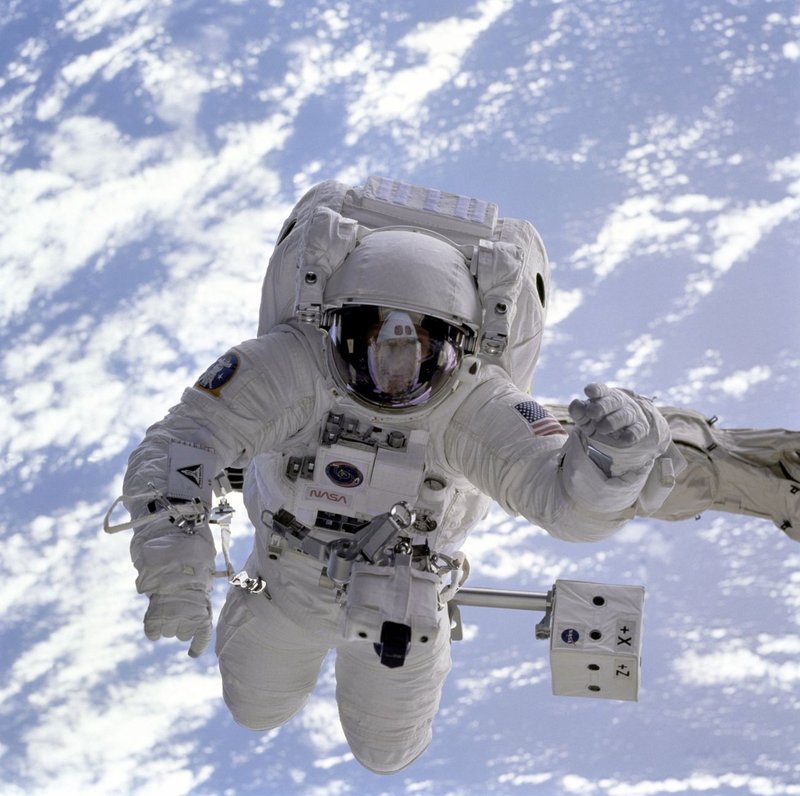
He’s the answer to a specific piece of space trivia: the astronaut who held up a hand-lettered “FOR SALE” sign in orbit. On STS-51-A in November 1984, Gardner and fellow astronaut Joseph Allen used Manned Maneuvering Units — jetpacks, essentially — to fly out from the shuttle and physically retrieve two stranded communications satellites, Palapa B2 and Westar 6, that had failed to reach their intended orbits. It remains one of the only satellite-recovery-by-hand missions NASA ever attempted. Across his two flights, Gardner logged 337 hours in space. He died in 2014.
6. Kjell Lindgren
Lindgren wasn’t born in Minnesota, but the state made him an astronaut in a roundabout way. After medical school in Colorado, he completed a three-year emergency medicine residency at Hennepin County Medical Center in Minneapolis, serving as chief resident in his final year, and picked up a Master of Health Informatics from the University of Minnesota along the way. That Minneapolis ER training fed directly into an aerospace medicine residency and a job as a NASA flight surgeon before he was selected as an astronaut candidate himself in 2009.
He’s flown twice: Expedition 44/45 to the ISS in 2015, and Crew-4 aboard a SpaceX Dragon in 2022 as part of Expedition 67/68. Between missions, he’s become known for photographing the Twin Cities from orbit and posting the images back to the people who trained him.
7. Abigail Harrison
Harrison, who goes by “Astronaut Abby” online, was born in St. Paul and came up through St. Paul and Minneapolis public schools before spending two years at the University of Minnesota. She later transferred to Wellesley College, where she built a self-designed astrobiology major alongside a Russian area studies degree — a combination aimed squarely at a NASA application.
She isn’t a NASA astronaut yet. She’s a candidate in progress: a trained pilot, rescue scuba diver, and EMT, and the founder of The Mars Generation, a nonprofit that runs space camps and STEM programs for teenagers. She’s been public about wanting to be the first person on Mars since she was 13, and unlike most of the names on this list, she’s building her public following — bio science research work, social media, a published memoir — before the astronaut selection rather than after it. If NASA picks her in a future class, she’d be the second St. Paul astronaut to reach orbit, after Stefanyshyn-Piper.
Seven names, four decades, one state that keeps producing people who leave it. Menon’s launch in June 2026 will be the first time in years a Minnesota-connected astronaut has flown — worth watching for the local-news angle, but also for what it says about a pipeline running quietly through a children’s museum, a public university, and an ER in Minneapolis.