Table of Contents
- TLDR
- The Three Solar System Categories
- Terrestrial Planets
- Gas Giants
- Ice Giants
- Dwarf Planets
- Exoplanet Categories: What Astronomers Find Beyond Our Solar System
- Super-Earths
- Mini-Neptunes (and the Boundary Nobody Can Draw)
- Hot Jupiters
- Rogue Planets
- Planet Types at a Glance
TLDR
Every planet in our solar system falls into one of three buckets: terrestrial (rocky, small, close to the sun — Mercury through Mars), gas giant (mostly hydrogen and helium, no solid surface — Jupiter and Saturn), or ice giant (heavier elements like water, ammonia, and methane — Uranus and Neptune). Pluto and its fellow dwarf planets got demoted to their own category in 2006 because they don’t clear their orbital neighborhood. Once you leave the solar system, the categories multiply: super-Earths, mini-Neptunes, hot Jupiters, and rogue planets that drift through space without a star at all. The line between some of these — especially super-Earths and mini-Neptunes — is genuinely unsettled science, not a gap in your understanding.
The Three Solar System Categories
Astronomers didn’t invent these categories to make homework harder. They reflect how planets actually formed: material close to the young sun was too hot for gases to stick around, so the inner planets ended up rocky and small. Farther out, past what’s called the frost line, gas and ice could accumulate into much bigger worlds. That’s the entire logic behind terrestrial, gas giant, and ice giant.
Terrestrial Planets
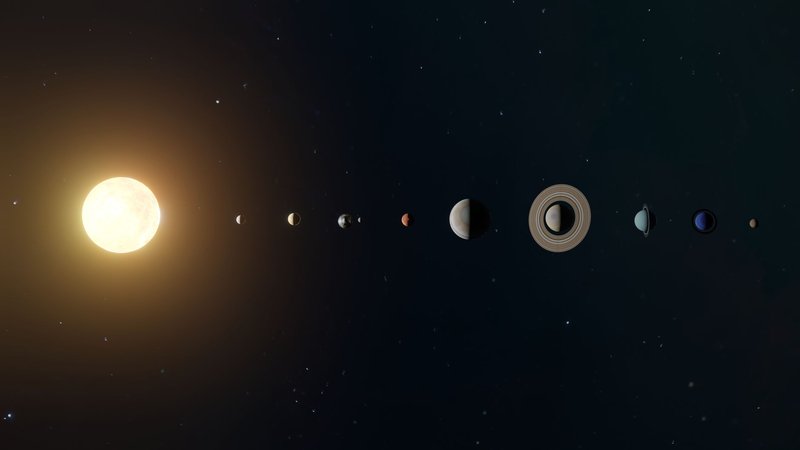
Mercury, Venus, Earth, and Mars share a build: solid rock or metal surfaces, thin or absent atmospheres compared to the giants, and no rings. They’re also the smallest planets in the solar system — Mercury could fit inside Earth roughly 18 times over by volume.
What separates them isn’t just size. Mercury has no real atmosphere and swings from 430°C in daylight to -180°C at night. Venus has a crushing carbon dioxide atmosphere that traps enough heat to melt lead. Earth is the only one with liquid surface water and plate tectonics still actively reshaping the crust. Mars sits in between — thin atmosphere, frozen water at the poles, and the largest volcano in the solar system, Olympus Mons, at roughly 22 kilometers tall.
Gas Giants
Jupiter and Saturn are built almost entirely from hydrogen and helium, the same elements that make up the sun. There’s no surface to stand on — descend far enough and the atmosphere just gets denser until pressure turns hydrogen into a strange metallic liquid. Jupiter alone is more massive than every other planet in the solar system combined, and its Great Red Spot is a storm that’s been raging for at least 190 years.
Saturn’s defining feature is the ring system, made of ice and rock chunks ranging from dust grains to house-sized boulders. It’s also the least dense planet in the solar system — low enough that Saturn would float in a bathtub large enough to hold it.
Ice Giants
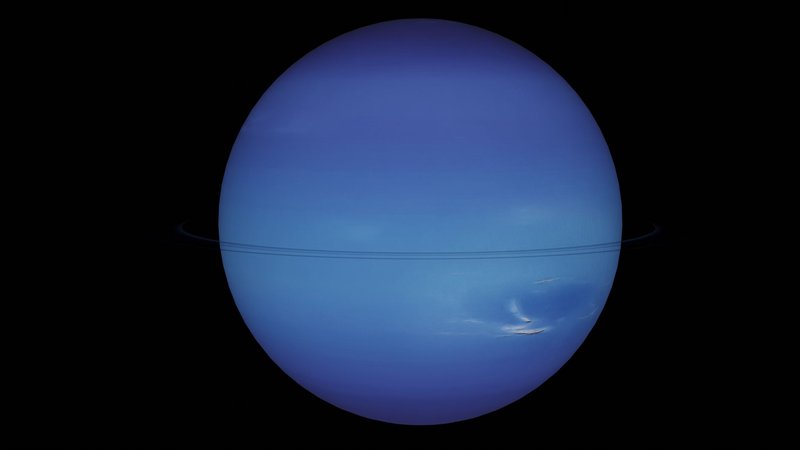
Uranus and Neptune get grouped separately from Jupiter and Saturn because their interiors are dominated by water, ammonia, and methane ices layered over a rocky core, with a hydrogen-helium atmosphere on top rather than making up the bulk of the planet. According to NASA, Uranus is also the only planet that rotates almost entirely on its side, likely the result of an ancient collision.
Neptune has the fastest winds recorded on any planet in the solar system, clocked at over 2,000 kilometers per hour. Both ice giants are a deep blue-green, caused by methane in their atmospheres absorbing red light.
Dwarf Planets
Pluto lost its full-planet status in 2006 when the International Astronomical Union defined a planet as needing to do three things: orbit the sun, be round from its own gravity, and clear its orbital neighborhood of other debris. Pluto fails the third test — it shares the Kuiper Belt with a swarm of similar-sized objects. That third criterion is also why Ceres, sitting in the asteroid belt, got promoted from “asteroid” to dwarf planet rather than staying a planet outright.
The current recognized dwarf planets are Pluto, Ceres, Eris, Haumea, and Makemake, though astronomers suspect dozens more objects in the outer solar system would qualify if we could measure them precisely enough.
Exoplanet Categories: What Astronomers Find Beyond Our Solar System {#exoplanet-categories}
Once you look at the more than 5,000 confirmed planets orbiting other stars, the solar system’s three-way split stops being enough. Exoplanets come in configurations that don’t exist in our own backyard, and astronomers had to build new categories to keep track.
Super-Earths
A super-Earth is bigger than Earth but smaller than Neptune, generally assumed to be rocky like the terrestrial planets rather than gas-dominated. Despite the name, “super” refers to mass, not habitability — a super-Earth can be a scorched, airless rock. Kepler-22b, roughly 2.4 times Earth’s radius, orbits in its star’s habitable zone and is one of the most-cited examples, though its composition is still debated.
Mini-Neptunes (and the Boundary Nobody Can Draw)
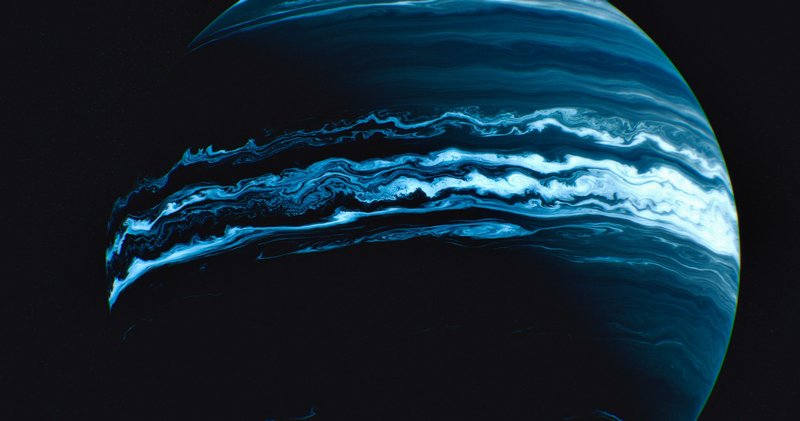
Mini-Neptunes sit in the same size range as super-Earths but carry a thick hydrogen-helium envelope around a smaller core, more like a scaled-down Neptune than a scaled-up Earth. Here’s the part most explainers skip: nobody has a clean mass or radius cutoff that separates the two categories. Current research on the radius valley between rocky and gas-enveloped exoplanets shows the boundary shifts depending on the host star and orbital distance, and some planets sit right in the ambiguous middle where the same data could support either label.
One leading explanation is that super-Earths and mini-Neptunes start out as the same kind of object — a rocky core with a thin gas layer — and only diverge because some lose that atmosphere to stellar radiation over time while others hang onto it. If that’s right, a planet could migrate from one category to the other over millions of years.
Hot Jupiters
Hot Jupiters are gas giants that orbit absurdly close to their star — some complete a full year in under four days. WASP-12b, one of the most extreme known, orbits so close that its star is actively stripping away its atmosphere, and the planet has been stretched into an egg shape by tidal forces. These worlds were also the first type of exoplanet ever confirmed, starting with 51 Pegasi b in 1995, because their size and tight orbit make them the easiest to detect.
Rogue Planets
Rogue planets, also called free-floating planets, don’t orbit any star at all — they drift through interstellar space alone, either ejected from a forming solar system or never bound to one in the first place. A 2023 survey using the James Webb Space Telescope identified dozens of new candidates in a single star-forming region, and estimates suggest the Milky Way could host billions of them. TRAPPIST-1, while not itself a rogue system, is worth mentioning here for contrast — its seven planets are tightly bound to a single red dwarf star, the opposite scenario from a planet with no star at all.
Planet Types at a Glance {#comparison-table}
| Type | Composition | Typical Size | Location | Examples |
|---|---|---|---|---|
| Terrestrial | Rock and metal | Small (Earth-sized or smaller) | Inner solar system | Mercury, Venus, Earth, Mars |
| Gas Giant | Hydrogen and helium | Very large | Outer solar system | Jupiter, Saturn |
| Ice Giant | Water, ammonia, methane ices | Large | Outer solar system | Uranus, Neptune |
| Dwarf Planet | Rock and ice | Small, doesn’t clear its orbit | Asteroid belt, Kuiper Belt | Pluto, Ceres, Eris |
| Super-Earth | Likely rocky | 1–2x Earth’s radius | Any star system | Kepler-22b |
| Mini-Neptune | Rocky core, gas envelope | 2–4x Earth’s radius | Any star system | Boundary with super-Earths is debated |
| Hot Jupiter | Hydrogen and helium | Jupiter-sized or larger | Extremely close orbit | WASP-12b, 51 Pegasi b |
| Rogue Planet | Varies | Varies | No host star | Thousands of candidates identified since 2000 |
Planet classification isn’t a closed system — it’s still being written as telescopes find planets that don’t fit the boxes we already have. The terrestrial-versus-giant split held up for centuries because it was the only data we had. Now that we can measure worlds around other stars, the categories are catching up to what’s actually out there, fuzzy boundaries and all.