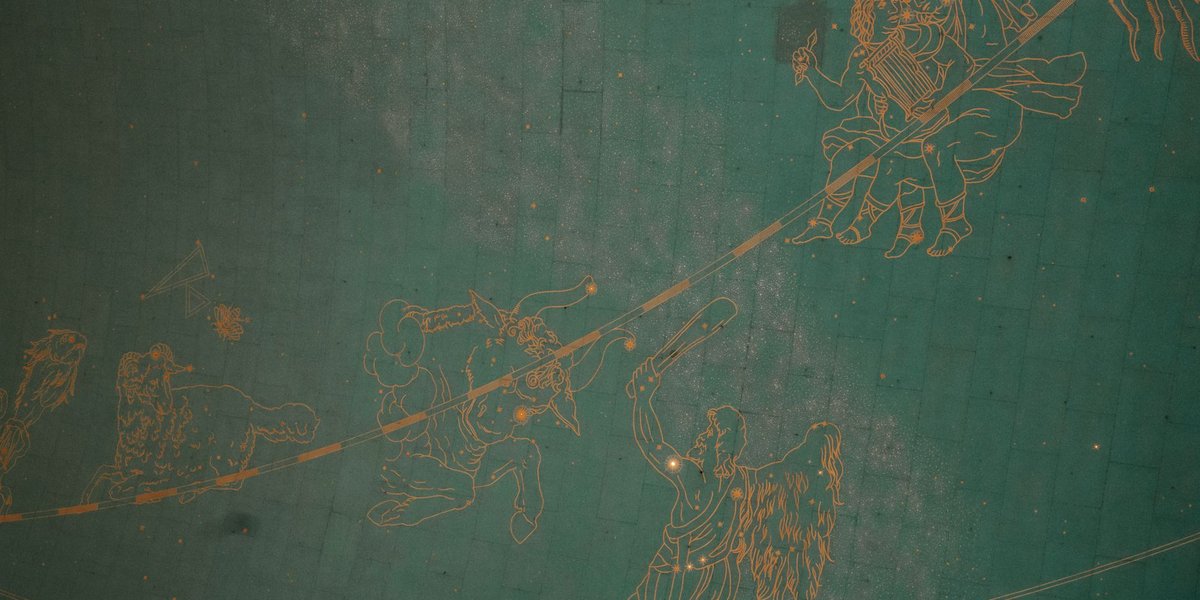
The Ptolemaic constellations are the 48 star patterns catalogued by the astronomer Claudius Ptolemy in the Almagest, around 150 CE. Twelve lie along the zodiac, 21 sit in the northern sky, and 15 in the southern. For roughly 1,400 years they were the constellations. Forty-seven of them are still on the modern map, and the 48th, a giant ship, was broken into pieces.
Contents
- TLDR
- The 48 Ptolemaic constellations, listed
- Where the list came from
- What Ptolemy’s catalogue actually did
- The problem with no boundaries
- What changed after Ptolemy
- How to spot them tonight
- FAQ
TLDR
- The count: 48 constellations: 12 zodiac, 21 northern, 15 southern.
- The source: Books VII and VIII of Ptolemy’s Almagest, written in Alexandria around 150 CE. It lists 1,022 stars.
- What survived: 47 of the 48 are still official constellations. Only Argo Navis is gone, replaced by Carina, Puppis, Vela and (by most accounts) Pyxis.
- The modern map: The IAU recognizes 88 constellations. The other 37 were added by later astronomers, mostly to fill gaps in the southern sky that Ptolemy couldn’t see.
The 48 Ptolemaic constellations, listed
Here’s the full list, grouped the way Ptolemy grouped it. The right-hand column says what happened to each one on the way to the modern sky.
The 12 zodiac constellations
These sit along the ecliptic, the path the Sun traces through the year. They’re the ones that became astrological signs, and they’re only one of several types of constellation astronomers use.
| # | Constellation | Figure | Modern status |
|---|---|---|---|
| 1 | Aries | The Ram | Unchanged |
| 2 | Taurus | The Bull | Unchanged; holds the Pleiades and Hyades |
| 3 | Gemini | The Twins | Unchanged |
| 4 | Cancer | The Crab | Unchanged; dimmest of the zodiac |
| 5 | Leo | The Lion | Unchanged |
| 6 | Virgo | The Maiden | Unchanged; second largest of all 88 |
| 7 | Libra | The Scales | Ptolemy called it the Claws (Chelae) of Scorpius, but listed it as its own constellation |
| 8 | Scorpius | The Scorpion | Unchanged |
| 9 | Sagittarius | The Archer | Unchanged; points toward the galactic center |
| 10 | Capricornus | The Sea-Goat | Unchanged |
| 11 | Aquarius | The Water Bearer | Unchanged |
| 12 | Pisces | The Fishes | Unchanged |
The 21 northern constellations
| # | Constellation | Figure | Modern status |
|---|---|---|---|
| 13 | Ursa Minor | The Little Bear | Unchanged; Polaris marks the tail tip |
| 14 | Ursa Major | The Great Bear | Unchanged; the Big Dipper is only part of it |
| 15 | Draco | The Dragon | Unchanged |
| 16 | Cepheus | The King | Unchanged |
| 17 | Boötes | The Herdsman | Unchanged; home of Arcturus |
| 18 | Corona Borealis | The Northern Crown | Unchanged |
| 19 | Hercules | The Kneeler (Engonasin) | Unchanged; Ptolemy didn’t name the figure Hercules |
| 20 | Lyra | The Lyre | Unchanged; home of Vega |
| 21 | Cygnus | The Bird | Now the Swan |
| 22 | Cassiopeia | The Queen on her throne | Unchanged |
| 23 | Perseus | The Hero | Unchanged |
| 24 | Auriga | The Charioteer | Unchanged |
| 25 | Ophiuchus | The Serpent Bearer | Unchanged; the Sun passes through it, though it isn’t a zodiac sign |
| 26 | Serpens | The Serpent | Now in two halves, Serpens Caput and Serpens Cauda |
| 27 | Sagitta | The Arrow | Unchanged; third smallest of the 88 |
| 28 | Aquila | The Eagle | Unchanged |
| 29 | Delphinus | The Dolphin | Unchanged |
| 30 | Equuleus | The Foal (Horse’s Head) | Unchanged; second smallest of the 88 |
| 31 | Pegasus | The Winged Horse | Unchanged |
| 32 | Andromeda | The Chained Woman | Unchanged |
| 33 | Triangulum | The Triangle | Unchanged |
The 15 southern constellations
“Southern” here means south of the zodiac, and in practice south of what Ptolemy could see from Alexandria, at about 31 degrees north.
| # | Constellation | Figure | Modern status |
|---|---|---|---|
| 34 | Cetus | The Sea Monster | Unchanged |
| 35 | Orion | The Hunter | Unchanged |
| 36 | Eridanus | The River | Unchanged; extends far south, past Ptolemy’s horizon |
| 37 | Lepus | The Hare | Unchanged |
| 38 | Canis Major | The Great Dog | Unchanged; holds Sirius |
| 39 | Canis Minor | The Little Dog | Unchanged; holds Procyon |
| 40 | Argo Navis | The Ship of the Argonauts | Split into Carina (keel), Puppis (stern), Vela (sails), plus Pyxis |
| 41 | Hydra | The Water Snake | Unchanged; the largest of the 88 |
| 42 | Crater | The Cup | Unchanged |
| 43 | Corvus | The Crow | Unchanged |
| 44 | Centaurus | The Centaur | Unchanged, but the Southern Cross was once its feet |
| 45 | Lupus | The Beast (Therion) | Now the Wolf |
| 46 | Ara | The Altar | Unchanged |
| 47 | Corona Australis | The Southern Crown | Unchanged |
| 48 | Piscis Austrinus | The Southern Fish | Unchanged |
Where the list came from
Ptolemy didn’t invent these. He inherited them.
The oldest layer is Mesopotamian. Babylonian star lists such as the MUL.APIN tablets name dozens of star groups, and the twelve-sign zodiac was in place in Babylon by around the fifth century BCE. The Bull, the Lion, the Scorpion and the Twins all trace back there.
The Greeks wrote down their own versions. Eudoxus of Cnidus described the constellations in the fourth century BCE. His book is lost, but the poet Aratus turned it into verse in the Phaenomena around 270 BCE, and that poem became the sky’s standard reference for centuries. We know Eudoxus’s version mostly because Hipparchus, writing in the second century BCE, criticized it. His commentary on Eudoxus and Aratus is the only one of his works that survives intact.
The origin goes back further, and it’s argued about. A lecture transcript hosted by Gresham College covers the theories, including ideas that some figures were shaped by Bronze Age Minoan Crete and that the constellation shapes encode the latitude and date of their original observers. None of it is settled. The only firm constraint is that the 48 existed in recognizable form by about 150 CE, because Ptolemy wrote them down.
What Ptolemy’s catalogue actually did
Ptolemy’s contribution was to turn a poetic sky into a data table.
Books VII and VIII of the Almagest list 1,022 stars, sorted by constellation. Each entry gives a position in ecliptic coordinates, a brightness on a six-step magnitude scale (the ancestor of the scale astronomers still use), and a description of where the star sits on the figure. Something like “the star in the right foot” or “the bright one in the tail”. There were no star names or Bayer letters yet, so you identified a star by its place on the body.
Hipparchus had made an earlier catalogue, and ancient sources suggest it held about 850 stars. It’s lost. Whether Ptolemy measured his own stars or mostly updated Hipparchus’s positions for precession has been argued for centuries. Whatever the answer, the Almagest survived in Greek, Arabic and then Latin, and every European astronomer worked from it until the Renaissance.
That’s why the list is called Ptolemaic. He didn’t design the figures. He fixed them in print.
The problem with no boundaries
Ptolemy’s constellations were figures, not territories. A star belonged to a creature’s body, and the space between creatures didn’t belong to anyone.
That caused overlap. The bright star at the top-left corner of the Great Square of Pegasus is a good example. Ptolemy listed it in both Andromeda (her head) and Pegasus (his navel). Modern astronomers resolved it by giving it to Andromeda, where it’s Alpheratz, though its old Bayer designation, Delta Pegasi, still shows the dual citizenship. Elnath, the northern horn of Taurus, was shared with Auriga in the same way, and now belongs to Taurus.
It also left stars with no home. Ptolemy catalogued a group he called “unformed” stars, dim ones sitting outside any figure. Later mapmakers used these gaps to invent new constellations.
What changed after Ptolemy
The Ptolemaic list stayed fixed for about 1,400 years. Then it grew in three stages.
Exploration filled the south. Dutch and Portuguese navigators sailing south in the 1590s recorded stars that no Greek had seen. Plancius and others turned them into new figures such as Crux, Pavo and Tucana. The Southern Cross is a good case: Ptolemy knew those stars as part of Centaurus, and it was split off as its own constellation in the 17th century.
The ship was dismantled. Argo Navis was so big that astronomers had long found it clumsy. In the 1750s Nicolas-Louis de Lacaille, working at the Cape of Good Hope, cut it into Carina, Puppis and Vela. Pyxis, the compass, was set up next to it from stars that had belonged to the ship’s mast area. Argo is the only Ptolemaic constellation that no longer exists. Its old Greek-letter designations still show the damage: Carina has an Alpha, Beta and Iota but no Gamma or Delta, because those letters belonged to stars that ended up in Vela.
The IAU fixed the map. By the early 20th century, every atlas drew its own boundaries. In 1922 the International Astronomical Union adopted an official list of 88 constellations with standard three-letter abbreviations. Eugène Delporte then drew precise borders along lines of right ascension and declination, which the IAU approved in 1928 and published in 1930. You can see the finished result on the IAU’s constellations page, which includes the official boundary data. For the first time, every point in the sky belonged to exactly one constellation.
The arithmetic is simple. Ptolemy’s 48, minus Argo Navis, plus its four descendants, gives 51 constellations from the original catalogue. The other 37 of today’s 88 came from later eras.
How to spot them tonight
You can see most of the Ptolemaic constellations with the naked eye from the Northern Hemisphere, because Ptolemy drew them from a northern latitude. A few tips:
- Start with Orion. In winter evenings it’s the clearest figure in the sky, and it leads you to Taurus (up and right), Canis Major (down and left, following the belt) and Gemini.
- Use the ecliptic. The zodiac constellations form a rough arc across the sky. Find a bright planet or the Moon and you’re already on it.
- Use a chart that shows both versions. Many planetarium apps can overlay the old figures on the modern boundaries. It’s the fastest way to see how Ptolemy’s shapes differ from the modern ones.
- Trust the dim ones less. Cancer, Sagitta and Equuleus are real Ptolemaic constellations, but you’ll need a dark sky to follow them.

FAQ
How many Ptolemaic constellations are there? There are 48: 12 in the zodiac, 21 in the northern sky and 15 in the southern sky.
Which Ptolemaic constellation no longer exists? Argo Navis. It was divided into Carina, Puppis and Vela by Lacaille in the 18th century, with Pyxis added alongside them.
Are the 48 constellations the same as the 88 modern constellations? Not exactly. The modern 88 include 47 of Ptolemy’s 48 unchanged in name or nearly so, the four pieces of Argo Navis, and 37 newer constellations.
Did Ptolemy invent the constellations? No. He collected constellations that were already ancient, drawing on Babylonian sources, Eudoxus, Aratus and Hipparchus, and recorded their stars with measured positions.
Why did Ptolemy only list 48? He could only catalogue what he could see. From Alexandria, the far southern sky stayed below the horizon, so constellations like Crux, Pavo and Tucana didn’t exist yet.
How many stars did Ptolemy catalogue? The Almagest lists 1,022 stars across the 48 constellations.