
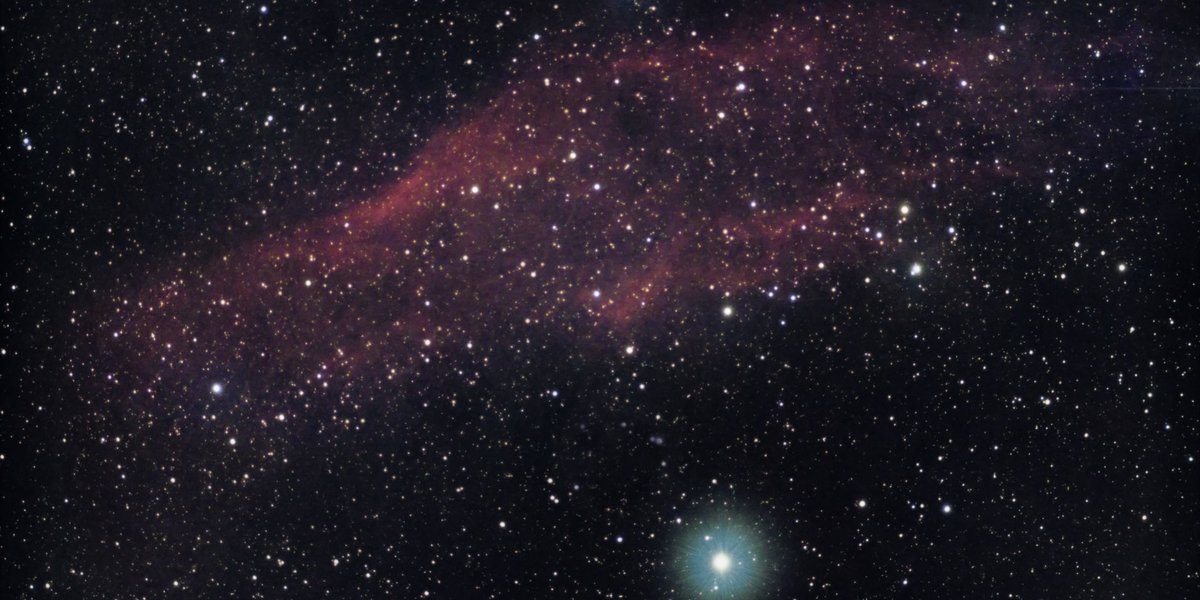
Stars form when a cold cloud of gas and dust collapses under its own weight. Dense knots heat up, ignite, and begin to shine. The newborn stars, especially the heavy ones, flood the surrounding gas with ultraviolet light and stellar wind, and that is what makes a stellar nursery glow and carves it into pillars, cavities and cliffs.
The ten spectacular star-forming regions below are ordered by distance, from a cloud you can spot with your eyes to two that sit in another galaxy. Each entry has a quick fact box, and a comparison table follows the list.
Table of contents
- TLDR
- 1. Orion Nebula
- 2. Flame Nebula
- 3. Lagoon Nebula
- 4. Rosette Nebula
- 5. Eagle Nebula
- 6. Carina Nebula
- 7. W51
- 8. NGC 3603
- 9. Tarantula Nebula
- 10. N79
- What the colors mean
- Comparison table
- Which ones you can see yourself
TLDR
- Biggest and most active: the Tarantula Nebula, in the Large Magellanic Cloud.
- Densest young cluster in our own galaxy: NGC 3603.
- Best first target for your own eyes: the Orion Nebula, visible without any equipment.
- Most famous image: the Pillars of Creation in the Eagle Nebula, shot by Hubble in 1995 and again by Webb in 2022.
1. Orion Nebula
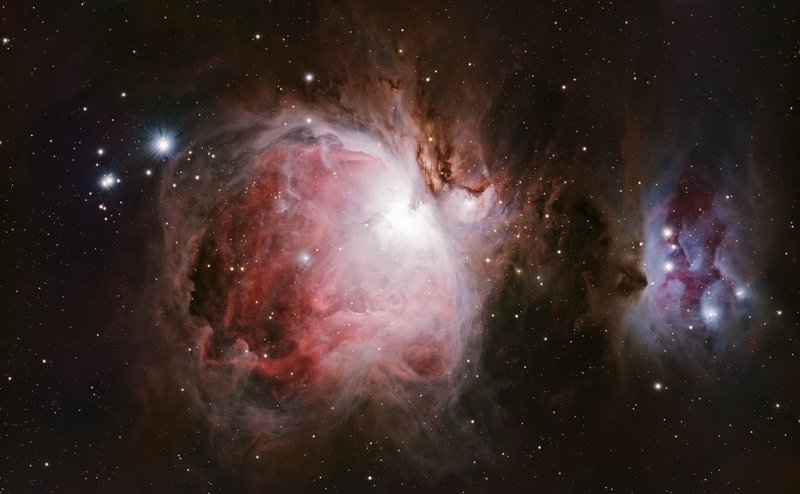
Distance: about 1,350 light-years | Constellation: Orion | Size: about 24 light-years across | Best image: Hubble (2006 mosaic), plus Webb infrared views
This is the closest large stellar nursery to Earth, which is why it shows up in almost every textbook. Look below Orion’s belt: the middle “star” of his sword is a smudge, and that smudge is Messier 42.
At its heart sits the Trapezium, four hot young stars packed into a tiny space. One of them, Theta1 Orionis C, supplies most of the ultraviolet light that makes the whole cloud glow. In the 1990s Hubble spotted dozens of dark, teardrop-shaped silhouettes around young stars here. They turned out to be disks of gas and dust, the raw material for planets.
2. Flame Nebula
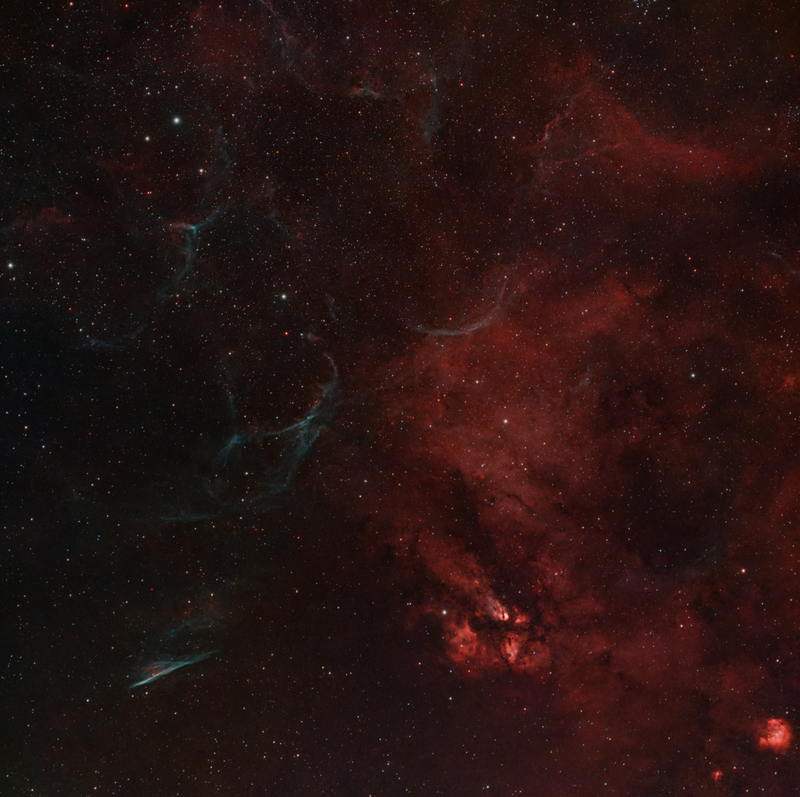
Distance: about 1,400 light-years | Constellation: Orion | Size: about 12 light-years across | Best image: infrared surveys and Spitzer
The Flame sits right beside Alnitak, the eastern star of Orion’s belt, and Alnitak is the one lighting it. A thick dark lane of dust cuts across the glowing gas and gives the nebula its flickering shape.
The better story is in infrared. Behind that dust lane, a cluster of young stars is invisible in ordinary light. Infrared imaging pulls it out, and it is one of the cleanest examples of a nursery hiding inside its own cocoon.
3. Lagoon Nebula
Distance: about 4,000 to 5,000 light-years | Constellation: Sagittarius | Size: about 110 light-years across | Best image: Hubble (the “Hourglass” core) and wide-field ground surveys
The Lagoon is the summer nebula for people with dark skies and a pair of binoculars. It’s bright enough that you can pick it out with the naked eye from a clear, dark site, in the Sagittarius “teapot” region of the Milky Way.
A dark dust lane runs through the middle, the “lagoon” that gives it the name. Close to the center, Hubble imaged a pinched, twisted structure called the Hourglass, where a single hot star is shredding the gas around it.
4. Rosette Nebula
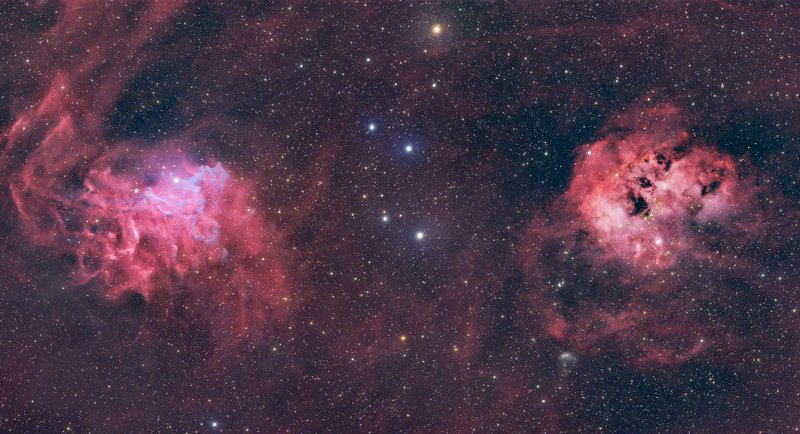
Distance: about 5,200 light-years | Constellation: Monoceros | Size: about 130 light-years across | Best image: Spitzer and Herschel infrared, plus amateur wide-field photography
The Rosette looks like a flower because its stars have blown a hollow hole in the middle. The cluster inside, NGC 2244, is only a few million years old, and its winds have pushed the gas outward into a ring.
Visually it’s a trick of scale. The cluster is easy in binoculars, but the surrounding nebula spans more than a degree of sky and is so faint that you need dark skies and a low-power wide view to see it at all. Photographs show far more than your eye will.
5. Eagle Nebula
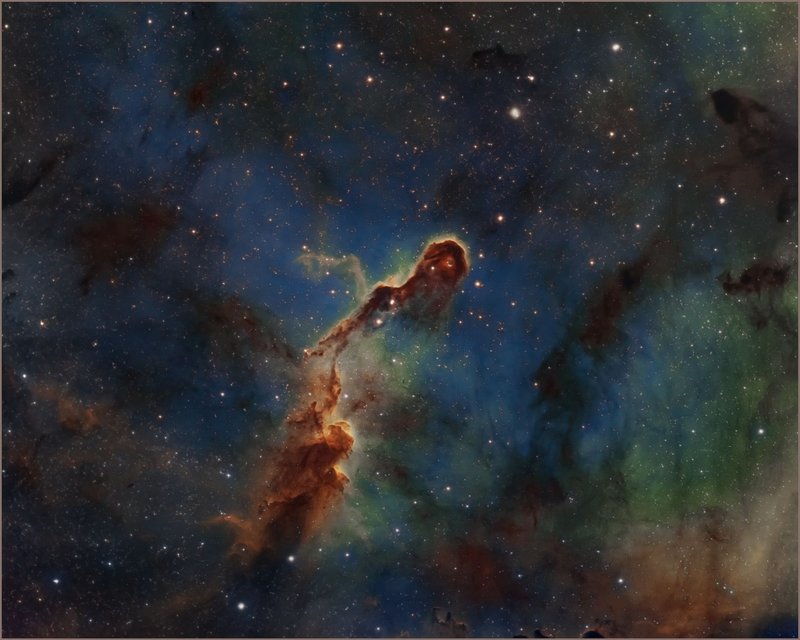
Distance: about 7,000 light-years | Constellation: Serpens | Size: about 70 light-years across (the Pillars are roughly 4 to 5 light-years tall) | Best image: Hubble (1995 and 2014), Webb (2022)
The Eagle Nebula is where the most famous space photograph of its generation was taken. The Pillars of Creation are columns of cool gas and dust, each topped by a glow where ultraviolet light from the cluster beside them is eroding the cloud away.
Webb’s 2022 image made the Pillars look different. In infrared the cosmic dust turns translucent, and the newborn stars appear as red points at the tips of the columns. Hubble’s visible-light version still shows the shape better, and the two make a good pair.
6. Carina Nebula
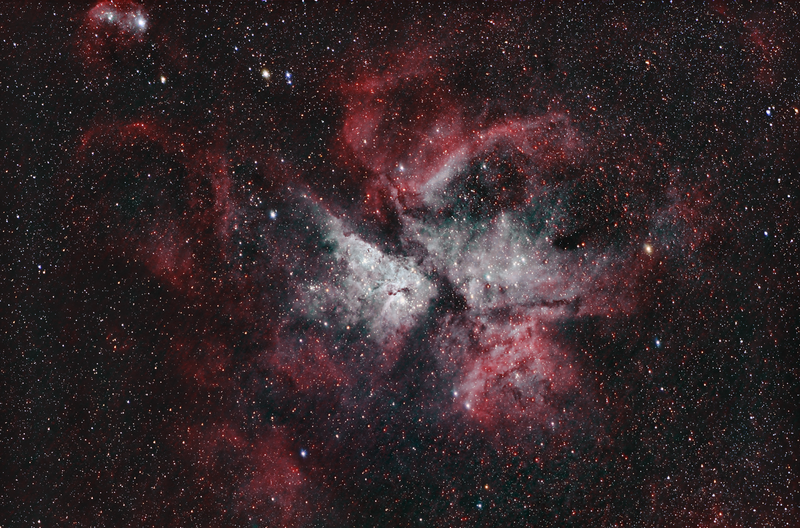
Distance: about 7,500 light-years | Constellation: Carina | Size: more than 300 light-years across | Best image: Hubble and Webb
Carina is about four times larger than the Orion Nebula and far brighter in total output. It contains some of the heaviest stars known, including Eta Carinae, which erupted in the 1840s and briefly became the second-brightest star in the night sky.
Webb’s very first batch of full-color images in 2022 included the “Cosmic Cliffs,” a ridge of gas on Carina’s edge. The cliffs are about 7 light-years high, and the image showed jets and bubbles from stars still forming behind them.
7. W51
Distance: about 17,000 light-years | Constellation: Aquila | Size: about 350 light-years across | Best image: Spitzer (infrared), with Chandra X-ray data
W51 is the region you’ve probably never heard of. Dust hides it completely from optical telescopes, so it has no pretty visible-light portrait, only infrared and X-ray ones. In Spitzer’s image it spans half a degree of sky, close to the width of the full Moon.
Chandra’s X-ray data showed that the massive stars here tend to form in clusters rather than alone. It’s a good reminder that most of the Milky Way’s star formation happens out of sight, behind dust.
8. NGC 3603
Distance: about 20,000 light-years | Constellation: Carina | Size: the central cluster is a few light-years across | Best image: Hubble (core), ESO wide-field
NGC 3603 is the densest young cluster you can see in visible light in our galaxy. Thousands of stars are packed into a tiny volume, including several of the most massive stars known, each many times heavier than the Sun.
ESO published a wide-field view of NGC 3603 and its neighbor NGC 3576 that showed the whole complex as a single landscape of glowing gas and dark dust. Hubble zoomed in on the cluster itself, where you can see the surrounding cloud being blown away.
9. Tarantula Nebula
Distance: about 160,000 to 170,000 light-years | Constellation: Dorado (in the Large Magellanic Cloud) | Size: about 650 light-years across in Hubble’s view | Best image: Webb (2022) and Hubble
Also known as 30 Doradus, this is the most active star-forming region in our neighborhood of galaxies. ESA/Hubble notes that no known star-forming region in the Milky Way is as large or as prolific. It sits in another galaxy 160,000 light-years away and is still visible as a fuzzy patch from the southern hemisphere.
At its core is R136, a cluster of roughly half a million stars, some more than 100 times the mass of the Sun. Webb’s 2022 images show the cluster hollowing out the surrounding gas, with long filaments that look like the legs of the spider it’s named after.
10. N79
Distance: about 160,000 light-years | Constellation: Dorado (in the Large Magellanic Cloud) | Size: about 1,630 light-years across | Best image: Webb (MIRI and NIRCam)
N79 is the younger sibling of the Tarantula. It’s another giant molecular cloud complex in the Large Magellanic Cloud, and ESA’s Webb team imaged its southern section, called N79 South, in 2024. Over the past 500,000 years its star-formation efficiency has been more than twice that of the Tarantula.
The image shows a dense knot of newborn stars wrapped in a web of glowing gas. It’s an unusual target because the cloud is still in an early stage, which makes it a useful comparison for how massive stars get started.
What the colors mean
Almost every image above is false color. Telescopes record light, often in wavelengths your eyes can’t see, and astronomers assign visible colors to make the data readable.
- Webb: infrared wavelengths are mapped to visible colors in order, with the shortest wavelengths shown as blue and the longest as red. Dust that’s opaque in visible light glows or turns translucent.
- Spitzer: in the W51 image, blue marks the warmest material, red the coolest, and green comes from PAHs, long carbon molecules similar to soot.
- Hubble: most famous images use narrowband filters that isolate specific gases, such as hydrogen and oxygen, and assign them red, green and blue. The result isn’t what your eye would see, but it shows where each gas sits.
The stars themselves are the only thing that doesn’t change much. The color of the gas is a map, not a photograph.
Comparison table
| Region | Constellation | Distance (light-years) | Size (light-years) | Best image | How to see it |
|---|---|---|---|---|---|
| Orion Nebula | Orion | ~1,350 | ~24 | Hubble | Naked eye |
| Flame Nebula | Orion | ~1,400 | ~12 | Spitzer, infrared surveys | Dark sky, telescope |
| Lagoon Nebula | Sagittarius | ~4,000 to 5,000 | ~110 | Hubble | Naked eye (dark sky), binoculars |
| Rosette Nebula | Monoceros | ~5,200 | ~130 | Spitzer, Herschel | Binoculars (cluster), wide-field |
| Eagle Nebula | Serpens | ~7,000 | ~70 | Hubble, Webb | Binoculars (cluster), large telescope |
| Carina Nebula | Carina | ~7,500 | 300+ | Hubble, Webb | Naked eye (southern sky) |
| W51 | Aquila | ~17,000 | ~350 | Spitzer, Chandra | Not visible |
| NGC 3603 | Carina | ~20,000 | few (core) | Hubble, ESO | Telescope (southern sky) |
| Tarantula Nebula | Dorado | ~160,000 to 170,000 | ~650 | Webb, Hubble | Naked eye (southern sky) |
| N79 | Dorado | ~160,000 | ~1,630 | Webb | Not a visual target |
Which ones you can see yourself
Start with Orion. From the Northern Hemisphere it’s a winter target, and even in the city you can see its glow with the naked eye. In binoculars it shows a bat-like wing shape, and a small telescope splits the Trapezium into four stars.
The Lagoon and Rosette are the summer and winter follow-ups. Both are easier in binoculars than to the naked eye, and both reward a dark site. The Eagle’s cluster is a binocular object, but the Pillars themselves need a big telescope or a long-exposure camera.
From the Southern Hemisphere, Carina and the Tarantula are the obvious picks, and both are visible without equipment under a dark sky. W51 and N79 are best enjoyed through the space telescopes that imaged them.