Most lists of famous black holes give you the same handful of names and a gallery of artist’s concepts. This one gives you twelve, a table with the same four stats for each, and a plain answer to the questions people actually search: which is biggest, which is closest, which was first, and which one has a photograph.
Black holes are invisible by definition, so every one on this list was found through something else: a star orbiting nothing, an X-ray flare, a ripple in spacetime, or a glowing ring of gas. That’s also why the list keeps changing. Three of the twelve below were announced after 2022.
TLDR
- Biggest: TON 618, roughly 40 billion solar masses (a mass estimate, not a direct measurement).
- Closest known: Gaia BH1, about 1,560 light-years away.
- First found: Cygnus X-1, identified through X-ray observations in the 1960s and 1970s.
- First photographed: M87*, imaged by the Event Horizon Telescope and released in 2019.
- Our own: Sagittarius A*, 4.3 million solar masses at the center of the Milky Way, imaged in 2022.
The Most Famous Black Holes at a Glance
| Black hole | Type | Distance from Earth | Mass (Suns) | Famous for | Year |
|---|---|---|---|---|---|
| Sagittarius A* | Supermassive | ~27,000 light-years | ~4.3 million | Milky Way’s central black hole | Imaged 2022 |
| M87* | Supermassive | ~55 million light-years | ~6.5 billion | First black hole photo | Imaged 2019 |
| TON 618 | Supermassive | ~10.4 billion light-years | ~40 billion | Candidate for largest known | Cataloged 1957 |
| OJ 287 | Supermassive (binary) | ~3.5 billion light-years | ~18 billion (primary) | Predicted 12-year flares | Observed since 1888 |
| Cygnus X-1 | Stellar | ~7,200 light-years | ~21 | First strong black hole candidate | 1964 |
| V404 Cygni | Stellar | ~7,800 light-years | ~9 | Violent outbursts, triple system | 1989 |
| Gaia BH1 | Stellar | ~1,560 light-years | ~9.6 | Closest known | 2022 |
| Gaia BH2 | Stellar | ~3,800 light-years | ~8.9 | Black hole with a red giant | 2023 |
| Gaia BH3 | Stellar | ~1,900 light-years | ~33 | Heaviest stellar one in our galaxy | 2024 |
| GW150914 | Stellar (merger) | ~1.3 billion light-years | ~36 + ~29 = ~62 | First gravitational waves | 2015 |
| Omega Centauri | Intermediate | ~17,700 light-years | ≥8,200 | Nearest intermediate-mass candidate | 2024 |
| HLX-1 | Intermediate | ~290 million light-years | ~20,000 (uncertain) | Early intermediate-mass candidate | 2009 |
Table of Contents
- Supermassive Black Holes
- Stellar-Mass Black Holes
- Intermediate-Mass Black Holes
- Largest, Closest, First: The Quick Answers
- How Astronomers Find Black Holes
- FAQ
Supermassive Black Holes
These sit at the centers of galaxies and weigh millions to billions of Suns. Four of them earned fame for very different reasons.
1. Sagittarius A*
- Distance: about 27,000 light-years
- Mass: about 4.3 million Suns
- Famous for: the black hole at the heart of our own galaxy
- Year: radio source found in 1974, imaged in 2022
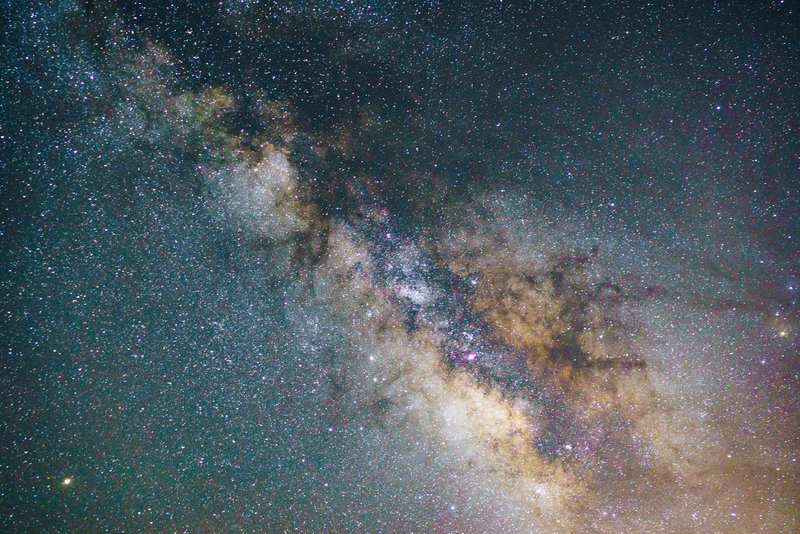
Sagittarius A* (said “Sagittarius A-star”) is the quiet one. It’s a modest eater for its class, so it doesn’t blaze the way distant quasars do. Astronomers worked out its mass for decades by tracking stars that whip around an empty-looking point in the constellation Sagittarius, some completing an orbit in under 20 years.
The Event Horizon Telescope released the first image of it in May 2022: a fuzzy orange ring around a dark center. A polarized-light view followed in 2024, showing magnetic field lines spiraling near the edge. The image took longer than M87‘s because Sgr A is small and its gas churns in minutes, not days.
2. M87*
- Distance: about 55 million light-years
- Mass: about 6.5 billion Suns
- Famous for: the first photograph of a black hole
- Year: imaged in 2017, released April 2019
M87* is the one on the posters. It lives in the giant elliptical galaxy Messier 87 in the Virgo cluster and fires a jet of particles that extends thousands of light-years.
On Sagittarius A vs M87: M87 is about 1,500 times more massive, yet from Earth the two rings look almost the same size, because M87 is also about 2,000 times farther away. That coincidence is why one telescope network could image both. Later EHT work added polarization maps of M87*, and repeat observations showed its ring pattern changing between years.
3. TON 618
- Distance: about 10.4 billion light-years
- Mass: roughly 40 billion Suns (estimates run higher)
- Famous for: the usual answer to “biggest black hole in the universe”
- Year: cataloged in 1957, later identified as a quasar
TON 618 powers a quasar that outshines more than 100 trillion Suns. The event horizon of a 40-billion-solar-mass black hole has a radius of roughly 800 astronomical units, about 26 times the distance from the Sun to Neptune.
Treat “biggest” with some care. Masses at this distance come from indirect methods, the error bars are wide, and other candidates such as Phoenix A have estimates that are higher or competing. TON 618 is the record-holder most often cited, not a settled champion.
4. OJ 287
- Distance: about 3.5 billion light-years
- Mass: about 18 billion Suns (primary), with a much smaller companion
- Famous for: a possible pair of black holes that flare on a schedule
- Year: seen on photographic plates since 1888, cataloged as a radio source in the 1960s
OJ 287 brightens in sharp outbursts roughly every 12 years. The leading explanation is a smaller black hole punching through the disk of gas around the bigger one on each orbit. The model predicted outbursts, and some were observed on schedule, which is why OJ 287 gets so much attention.
The catch: not every astronomer accepts the binary model, and some argue the primary is far lighter than 18 billion Suns. It’s a live argument, not a closed case.
Stellar-Mass Black Holes
Stellar black holes form when a massive star collapses. They weigh from a few to a few dozen Suns, and our galaxy likely holds tens of millions of them. The six below are the ones with names.
5. Cygnus X-1
- Distance: about 7,200 light-years
- Mass: about 21 Suns
- Famous for: the first strong black hole candidate
- Year: X-ray source detected in 1964
A rocket-borne detector picked up Cygnus X-1 in 1964. By the early 1970s astronomers had matched it to a blue supergiant star, HDE 226868, that orbits an unseen companion every 5.6 days. The companion was too massive and too compact to be a neutron star.
Stephen Hawking bet Kip Thorne in 1974 that it wasn’t a black hole. Hawking conceded in 1990. The winner’s prize was a magazine subscription: four years of Private Eye for Thorne. A 2021 re-measurement of the distance raised the mass estimate to about 21 Suns, higher than earlier figures.
6. V404 Cygni
- Distance: about 7,800 light-years
- Mass: about 9 Suns
- Famous for: violent outbursts and a surprise third star
- Year: X-ray outburst detected in 1989
V404 Cygni pulls gas off a companion star and periodically dumps it onto the black hole in a burst of X-rays. The June 2015 outburst was bright enough that observatories around the world dropped what they were doing to watch. Archive plates showed earlier outbursts in 1938 and 1956.
In 2024, astronomers reported that a third star orbits the pair at a distance of about 3,500 astronomical units. That’s hard to square with a violent supernova birth, which suggests some black holes form without blowing their surroundings apart.
7. Gaia BH1
- Distance: about 1,560 light-years
- Mass: about 9.6 Suns
- Famous for: the closest known black hole to Earth
- Year: announced in 2022 and published in 2023
Gaia BH1 gives off no X-rays because it isn’t feeding. Astronomers found it from the wobble of a Sun-like star that orbits an invisible companion every 185.6 days, measured by ESA’s Gaia spacecraft. The star and black hole are about as far apart as Earth and the Sun.
At 1,560 light-years it sits in the constellation Ophiuchus, roughly 3 times closer than Cygnus X-1. It’s closest known, which isn’t the same as closest. Most dormant black holes can’t be seen at all.
8. Gaia BH2
- Distance: about 3,800 light-years
- Mass: about 8.9 Suns
- Famous for: a quiet black hole paired with a red giant
- Year: announced in 2023
Gaia BH2 was found the same way as BH1, but the partner is a red giant and the orbit is much wider: about 1,277 days, or 3.5 years. The two black holes together showed that quiet, non-feeding black holes in binaries are findable, and that there are probably more of them hiding.
9. Gaia BH3
- Distance: about 1,900 light-years
- Mass: about 33 Suns
- Famous for: the heaviest stellar-mass black hole known in the Milky Way
- Year: announced April 2024
Gaia BH3 surprised everyone. ESA reported the find in April 2024, ahead of the main Gaia data release, when the team spotted an odd wobble in an old giant star in the constellation Aquila. The star orbits the black hole every 11.6 years.
The star is metal-poor and belongs to an ancient stellar stream, a clue that heavy black holes like this form from stars born early in the galaxy’s history, when there were fewer heavy elements to blow away a star’s mass. BH3 is the first of its kind found this close.
10. GW150914
- Distance: about 1.3 billion light-years
- Mass: about 36 and 29 Suns, merging into about 62
- Famous for: the first direct detection of gravitational waves
- Year: detected September 14, 2015, announced February 2016
GW150914 is the odd one on this list, because it isn’t an object. It’s an event. Two black holes spiraled together and merged, converting about 3 Suns’ worth of mass into gravitational waves in a fraction of a second. LIGO’s two detectors in Louisiana and Washington recorded the signal seven milliseconds apart.
The detection won the 2017 Nobel Prize in Physics, and it was the first proof that pairs of black holes exist and can merge. Hundreds of mergers have been logged since.
Intermediate-Mass Black Holes
Between stellar and supermassive black holes sits a gap, roughly 100 to 100,000 Suns. Few black holes have been confirmed in it, so the two below get outsized attention.
11. Omega Centauri
- Distance: about 17,700 light-years
- Mass: at least 8,200 Suns
- Famous for: the closest intermediate-mass black hole candidate
- Year: reported in 2024
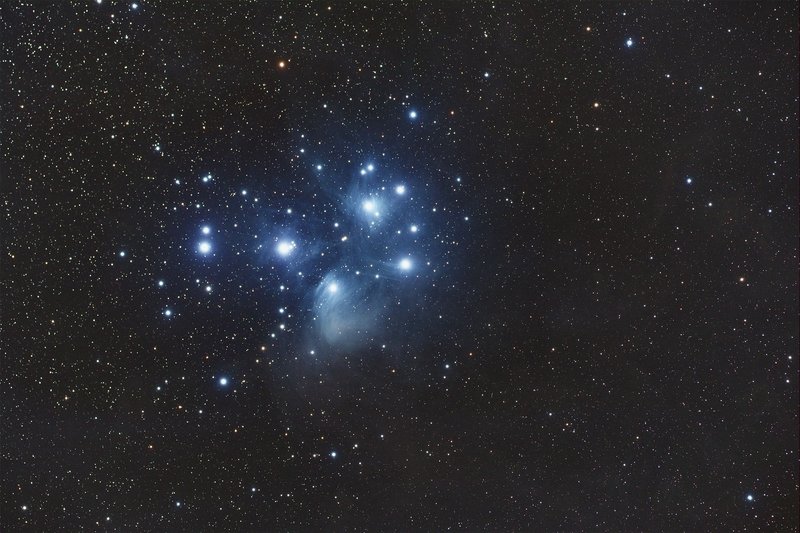
Omega Centauri is the biggest globular cluster in the Milky Way, a ball of around 10 million stars visible to the naked eye from the Southern Hemisphere. In 2024, a team using decades of Hubble images tracked the motions of more than a million stars and found several moving too fast for the cluster’s visible mass. The explanation, published in Nature, is a central black hole of at least 8,200 Suns.
12. HLX-1
- Distance: about 290 million light-years
- Mass: about 20,000 Suns (very uncertain)
- Famous for: one of the first strong intermediate-mass candidates
- Year: discovered in 2009
HLX-1 (Hyper-Luminous X-ray source 1) was spotted by ESA’s XMM-Newton in the outskirts of the galaxy ESO 243-49. It’s far too bright in X-rays for a stellar black hole, and later Hubble data found a young star cluster around it. The mass is still debated, which is the story of this entire category: strong candidates, few confirmations.
Largest, Closest, First: The Quick Answers
- Largest: TON 618, if you go by the commonly cited estimate. Direct measurements only exist for nearby objects, so treat any cosmic record as provisional.
- Closest known: Gaia BH1, 1,560 light-years. Gaia BH3 comes next at about 1,900. Neither is a threat; at those distances a black hole behaves like any other mass.
- First discovered: Cygnus X-1, through its X-rays. The first black hole image is M87, and the first detection of a merger* is GW150914.
- Most massive in the Milky Way: Sagittarius A* overall, and Gaia BH3 among stellar-mass black holes.
How Astronomers Find Black Holes
Light can’t escape a black hole, so astronomers look at what it does to everything around it. There are four main methods, and each of the twelve above used at least one:
- Orbiting stars. Track stars circling an empty point. This gave us Sagittarius A*, and the Gaia binary black holes use the same logic with a wobble instead of an orbit.
- X-rays from feeding. Gas spiraling in heats to millions of degrees and glows in X-rays. Cygnus X-1, V404 Cygni and HLX-1 were found this way.
- Gravitational waves. Merging black holes shake spacetime, and detectors like LIGO pick up the signal. GW150914 was the first.
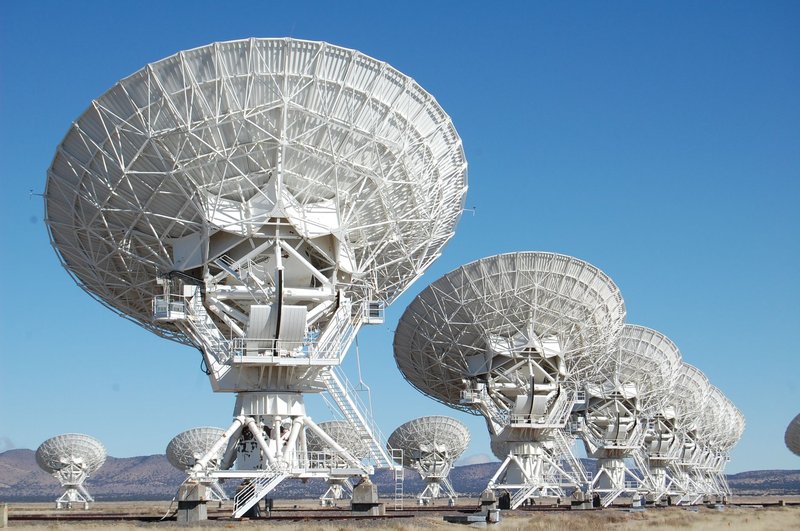
- Direct imaging. The Event Horizon Telescope links radio dishes across Earth into a virtual telescope the size of the planet to photograph the glowing gas around a black hole’s shadow. So far it has done this for M87 and Sagittarius A.
NASA’s black hole overview covers the basics of how they form and grow if you want the background.
FAQ
What is the most famous black hole? M87, because of the 2019 photograph. Cygnus X-1 and Sagittarius A are close behind.
What is the closest black hole to Earth? Gaia BH1, about 1,560 light-years away. It was found in Gaia spacecraft data in 2022.
What was the first black hole discovered? Cygnus X-1. It was detected as an X-ray source in 1964 and became the first strong black hole candidate by the early 1970s.
Has anyone photographed a black hole? Twice. The Event Horizon Telescope imaged M87 (released 2019) and Sagittarius A (released 2022). Both images show the glowing gas around the black hole, not the black hole itself.