
Updated October 2026 by Elena Stone
These printable space quizzes come in six levels, from picture questions for kindergarten to a three-round trivia night for adults. Each one is a free PDF sized for US Letter paper, with a name line, a score box and room to write every answer.
Pick the level that matches the reader, decide whether you want the answer key, and download. The questions and answers for every level are also listed further down this page.
Download a printable space quiz by grade level
-
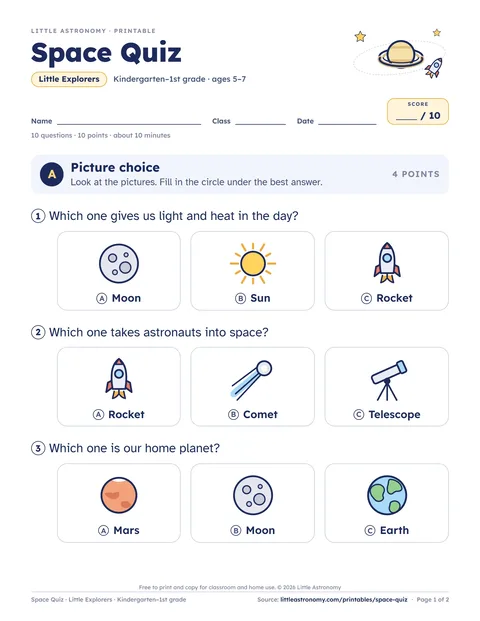
Little Explorers
Best for Kindergarten–1st grade ages 5–7
- Kindergarten
- 1st grade
10 questions 2 pages ~10 min
A picture-based space quiz about the Sun, Moon, Earth, stars and rockets, simple enough for a teacher to read aloud.
With the answer key: Quiz + answer key (PDF, 3 pages)
-
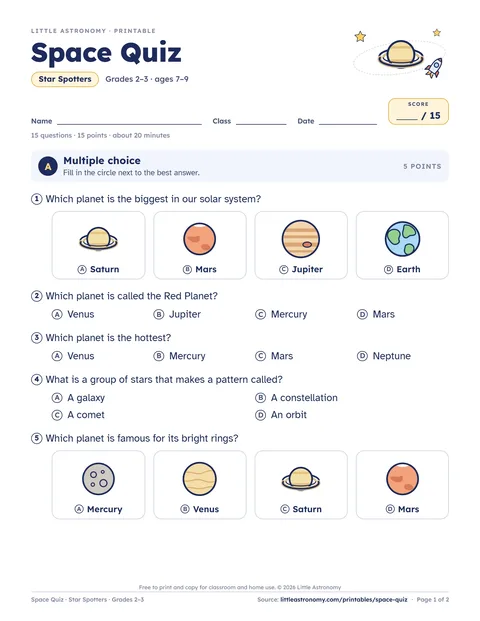

Star Spotters
Best for Grades 2–3 ages 7–9
- 2nd grade
- 3rd grade
15 questions 2 pages ~20 min
A 15-point quiz on the planets, day and night, years, constellations, gravity and astronauts, with a word bank and matching.
With the answer key: Quiz + answer key (PDF, 4 pages)
-
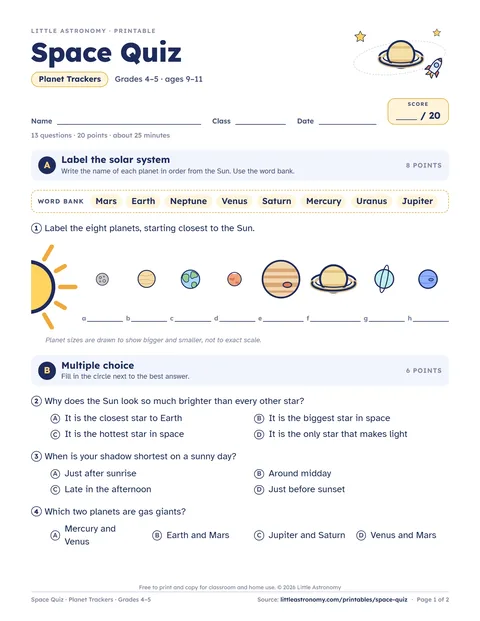
Planet Trackers
Best for Grades 4–5 ages 9–11
- 4th grade
- 5th grade
13 questions 2 pages ~25 min
Label the planets, then tackle seasons, shadows, gravity and the asteroid belt in a 25-minute quiz aligned to NGSS 5-ESS1.
With the answer key: Quiz + answer key (PDF, 4 pages)
-
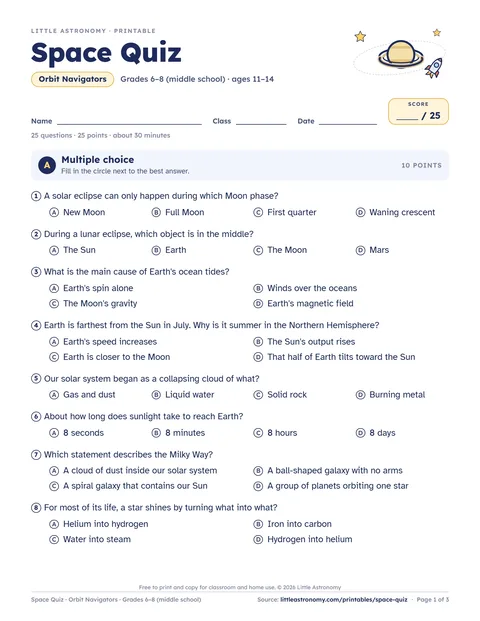
Orbit Navigators
Best for Grades 6–8 (middle school) ages 11–14
- 6th grade
- 7th grade
- 8th grade
25 questions 3 pages ~30 min
Eclipses, tides, star life cycles, galaxies and the scale of space in a 30-minute quiz aligned to NGSS MS-ESS1.
With the answer key: Quiz + answer key (PDF, 6 pages)
-
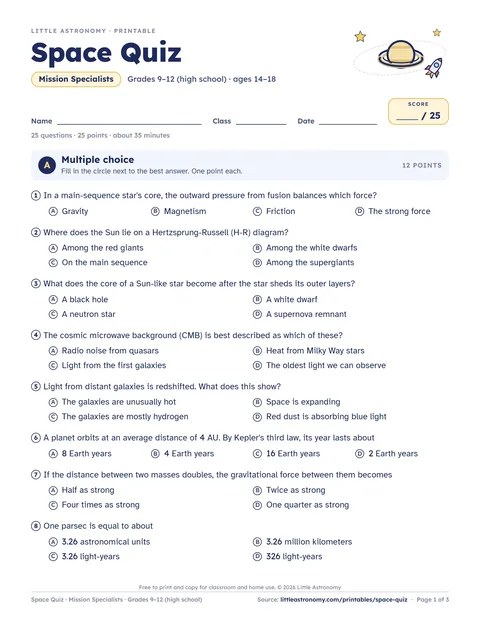
Mission Specialists
Best for Grades 9–12 (high school) ages 14–18
- 9th grade
- 10th grade
- 11th grade
- 12th grade
25 questions 3 pages ~35 min
A 25-point high school astronomy quiz on stellar fusion, the H-R diagram, Big Bang evidence, Kepler and Newton, spectroscopy and exoplanet detection, with an answer key.
With the answer key: Quiz + answer key (PDF, 6 pages)
-
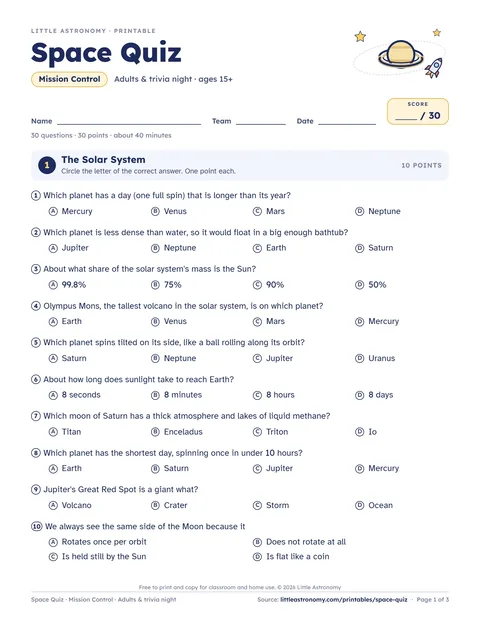
Mission Control
Best for Adults & trivia night ages 15+
- Adults
- Older teens
30 questions 3 pages ~40 min
A 30-question space trivia night with answers: three rounds on the solar system, stars and galaxies, and space history, plus a tiebreaker.
With the answer key: Quiz + answer key (PDF, 6 pages)
How the space quiz generator works
Every level is a finished worksheet, not a random set of questions, so two copies of the same level are identical and a teacher can mark a class set against one key.
- Choose a level. Each card lists the grades and ages it was written for, the number of questions and how long it takes.
- Turn on “Include the answer key” if you need it. The download then adds the key pages after the quiz: every answer, a one-line explanation for each and a quick-check grid for fast marking.
- Download and print. Print at 100% (“Actual size”) so the answer circles and writing lines keep their size.
The quiz-only file is the one to hand out. The answer key version is for the adult running the quiz, so the answers stay off the students’ desks.
What each level covers:
- Kindergarten to 1st grade: the Sun, Moon, Earth and rockets, answered by circling pictures. A teacher can read every question aloud.
- Grades 2–3: the planets, day and night, a year, constellations and gravity, with a word bank and matching.
- Grades 4–5: label the solar system, then seasons, shadows, the asteroid belt and light-years. Covers the NGSS 5-ESS1 standards.
- Grades 6–8: eclipses, tides, the formation of the solar system, star life cycles and galaxies, with two short written answers. Covers NGSS MS-ESS1.
- Grades 9–12: fusion, stellar evolution, Kepler’s and Newton’s laws, the evidence for the Big Bang and how exoplanets are found. Covers NGSS HS-ESS1.
- Adults: 30 trivia questions in three rounds (the solar system, stars and galaxies, space exploration) and a tiebreaker.
Space quiz questions and answers
Every question in the PDFs, by level. Open a level to read the questions and tap “Show answer” to check one. This is also a quick way to preview a quiz before printing it.
Space quiz questions for Kindergarten–1st grade (Little Explorers) · 10 questions
Part A · Picture choice
Look at the pictures. Fill in the circle under the best answer.
- 1.
Which one gives us light and heat in the day?
- Moon
- Sun (correct answer)
- Rocket
Show answer
B. Sun
The Sun gives our planet light and heat. Daytime is when our part of Earth faces the Sun.
- 2.
Which one takes astronauts into space?
- Rocket (correct answer)
- Comet
- Telescope
Show answer
A. Rocket
A rocket is what launches people and spacecraft up into space.
- 3.
Which one is our home planet?
- Mars
- Moon
- Earth (correct answer)
Show answer
C. Earth
Earth is our home planet. It is where we live.
- 4.
Which Moon looks like a whole bright circle?
- New Moon
- Full Moon (correct answer)
- Crescent Moon
Show answer
B. Full Moon
When we can see the whole sunlit side of the Moon, it is called a full Moon.
Part B · True or false
Circle True or False.
- 5.
The Sun is a star. True or false?
Show answer
True
The Sun is a star. It looks big and bright because it is much closer than other stars.
- 6.
The Moon makes its own light. True or false?
Show answer
False
Moonlight is really sunlight bouncing off the Moon.
- 7.
Night comes when we turn away from the Sun. True or false?
Show answer
True
Earth spins. When our side faces away from the Sun, it is night.
Part C · Matching
Draw a line from each picture to the words that match.
- 8.
Sun — Gives us light and heat
Show answer
The Sun gives Earth light and heat.
- 9.
Moon — Goes around Earth
Show answer
The Moon orbits Earth, which means it travels around us.
- 10.
Astronaut — Wears a space suit
Show answer
Astronauts wear space suits to stay safe when they work outside in space.
Space quiz questions for Grades 2–3 (Star Spotters) · 15 questions
Part A · Multiple choice
Fill in the circle next to the best answer.
- 1.
Which planet is the biggest in our solar system?
- Saturn
- Mars
- Jupiter (correct answer)
- Earth
Show answer
C. Jupiter
Jupiter is the largest planet. More than 1,000 Earths could fit inside it.
- 2.
Which planet is called the Red Planet?
- Venus
- Jupiter
- Mercury
- Mars (correct answer)
Show answer
D. Mars
Rusty iron in the dirt and dust makes Mars look red.
- 3.
Which planet is the hottest?
- Venus (correct answer)
- Mercury
- Mars
- Neptune
Show answer
A. Venus
Venus is hotter than Mercury, even though Mercury is closer to the Sun.
- 4.
What is a group of stars that makes a pattern called?
- A galaxy
- A constellation (correct answer)
- A comet
- An orbit
Show answer
B. A constellation
People connect stars into pictures called constellations, like Orion or Ursa Major.
- 5.
Which planet is famous for its bright rings?
- Mercury
- Venus
- Saturn (correct answer)
- Mars
Show answer
C. Saturn
Saturn has the biggest, brightest rings. They are made of ice and rock.
Part B · True or false
Circle True or False.
- 6.
The Moon is bigger than Earth. True or false?
Show answer
False
The Moon is less than a third as wide as Earth, so Earth is much bigger.
- 7.
Day and night happen because the Sun circles Earth. True or false?
Show answer
False
Earth spins. Day is on the side facing the Sun, and night is on the side facing away.
- 8.
Astronauts wear space suits to walk in space. True or false?
Show answer
True
A space suit gives astronauts air to breathe and protects them from heat, cold and dust.
- 9.
There is no gravity on Earth. True or false?
Show answer
False
Gravity keeps you on the ground and makes things fall when you drop them.
Part C · Fill in the blank
Choose a word from the word bank to finish each sentence. Each word is used once, and two words are left over.
- 10.
Earth takes one ____ to travel all the way around the Sun.
Show answer
year
One trip around the Sun takes Earth about 365 days, which we call a year.
- 11.
Earth spins around once every ____, giving us daytime and night.
Show answer
day
Earth turns once about every 24 hours. That spin makes day and night.
- 12.
The Moon travels in an orbit around ____.
Show answer
Earth
The Moon orbits Earth. Earth orbits the Sun.
Part D · Matching
Draw a line from each word to what it means.
- 13.
Mercury — The planet closest to the Sun
Show answer
Mercury is the smallest planet and the nearest to the Sun.
- 14.
Gravity — A force that pulls things together
Show answer
Gravity is an invisible force that pulls objects toward each other.
- 15.
Comet — An icy space rock with a long tail
Show answer
Comets are made of dust and ice and are known for their long tails.
Space quiz questions for Grades 4–5 (Planet Trackers) · 13 questions
Part A · Label the solar system
Write the name of each planet in order from the Sun. Use the word bank.
- 1.
Label the eight planets in order from the Sun.
Show answer
- Mercury
- Venus
- Earth
- Mars
- Jupiter
- Saturn
- Uranus
- Neptune
Part B · Multiple choice
Fill in the circle next to the best answer.
- 2.
Why does the Sun look so much brighter than every other star?
- It is the closest star to Earth (correct answer)
- It is the biggest star in space
- It is the hottest star in space
- It is the only star that makes light
Show answer
A. It is the closest star to Earth
The Sun is our closest star. Other stars are far, far away, so they look like tiny dots.
- 3.
When is your shadow shortest on a sunny day?
- Just after sunrise
- Around midday (correct answer)
- Late in the afternoon
- Just before sunset
Show answer
B. Around midday
At midday the Sun is highest in the sky, so shadows are shortest. A low Sun makes long shadows.
- 4.
Which two planets are gas giants?
- Mercury and Venus
- Earth and Mars
- Jupiter and Saturn (correct answer)
- Venus and Mars
Show answer
C. Jupiter and Saturn
Jupiter and Saturn are gas giants, with swirling gases above a core and no hard surface.
- 5.
What causes the seasons on Earth?
- Earth's distance from the Sun changes
- The Moon blocks sunlight
- The Sun gets hotter and cooler
- Earth's axis is tilted (correct answer)
Show answer
D. Earth's axis is tilted
Earth's tilted axis changes which part of Earth gets the Sun's most direct rays during the year.
- 6.
The main asteroid belt lies between the orbits of which two planets?
- Mars and Jupiter (correct answer)
- Earth and Mars
- Jupiter and Saturn
- Venus and Earth
Show answer
A. Mars and Jupiter
Most asteroids orbit the Sun between Mars and Jupiter, in the main asteroid belt.
- 7.
What does a light-year measure?
- Time
- Speed
- Distance (correct answer)
- Brightness
Show answer
C. Distance
A light-year is the distance light travels in one year, about 9 trillion km (6 trillion miles).
Part C · True or false
Circle TRUE or FALSE.
- 8.
Gravity pulls objects toward the center of Earth. True or false?
Show answer
True
Gravity is the force that draws objects toward the center of a planet or other body.
- 9.
A year on Earth is the time it takes Earth to go once around the Sun. True or false?
Show answer
True
Earth takes about 365 days to orbit the Sun once. That is one year.
- 10.
The phases of the Moon are caused by Earth's shadow falling on the Moon. True or false?
Show answer
False
Half the Moon is always lit by the Sun. Phases come from how much of that half we see.
Part D · Fill in the blank
Choose a word from the word bank to complete each sentence. Each word is used once, and two words are not used.
- 11.
Mercury, Venus, Earth, and Mars are the ____ planets, closest to the Sun.
Show answer
inner
The first four planets from the Sun are the inner planets, also called terrestrial planets.
- 12.
Pluto and Ceres are examples of ____ planets.
Show answer
dwarf
Pluto was reclassified as a dwarf planet. Ceres is also a dwarf planet.
- 13.
Earth ____ around the Sun once every year.
Show answer
revolves
Earth orbits (revolves around) the Sun in 365.25 days. Spinning on its axis is rotation.
Space quiz questions for Grades 6–8 (middle school) (Orbit Navigators) · 25 questions
Part A · Multiple choice
Fill in the circle next to the best answer.
- 1.
A solar eclipse can only happen during which Moon phase?
- New Moon (correct answer)
- Full Moon
- First quarter
- Waning crescent
Show answer
A. New Moon
Solar eclipses happen only at new Moon, when the Moon is between Earth and the Sun.
- 2.
During a lunar eclipse, which object is in the middle?
- The Sun
- Earth (correct answer)
- The Moon
- Mars
Show answer
B. Earth
In a lunar eclipse Earth is between the Sun and Moon, and Earth's shadow falls on the Moon.
- 3.
What is the main cause of Earth's ocean tides?
- Earth's spin alone
- Winds over the oceans
- The Moon's gravity (correct answer)
- Earth's magnetic field
Show answer
C. The Moon's gravity
The Moon's gravity drives Earth's tides. The Sun's gravity also has a smaller effect.
- 4.
Earth is farthest from the Sun in July. Why is it summer in the Northern Hemisphere?
- Earth's speed increases
- The Sun's output rises
- Earth is closer to the Moon
- That half of Earth tilts toward the Sun (correct answer)
Show answer
D. That half of Earth tilts toward the Sun
Axial tilt, not distance, causes seasons. The Northern Hemisphere tilts toward the Sun in July.
- 5.
Our solar system began as a collapsing cloud of what?
- Gas and dust (correct answer)
- Liquid water
- Solid rock
- Burning metal
Show answer
A. Gas and dust
About 4.6 billion years ago a cloud of gas and dust collapsed under gravity, forming the Sun and planets.
- 6.
About how long does sunlight take to reach Earth?
- 8 seconds
- 8 minutes (correct answer)
- 8 hours
- 8 days
Show answer
B. 8 minutes
Sunlight takes about 8 minutes 20 seconds to travel the 150 million km (93 million miles) to Earth.
- 7.
Which statement describes the Milky Way?
- A cloud of dust inside our solar system
- A ball-shaped galaxy with no arms
- A spiral galaxy that contains our Sun (correct answer)
- A group of planets orbiting one star
Show answer
C. A spiral galaxy that contains our Sun
The Milky Way is a spiral galaxy, and our solar system lies along one of its spiral arms.
- 8.
For most of its life, a star shines by turning what into what?
- Helium into hydrogen
- Iron into carbon
- Water into steam
- Hydrogen into helium (correct answer)
Show answer
D. Hydrogen into helium
Main sequence stars fuse hydrogen into helium in their cores. This is the longest phase of a star's life.
- 9.
A space rock that survives the atmosphere and hits the ground is called a what?
- Meteorite (correct answer)
- Meteor
- Comet
- Asteroid
Show answer
A. Meteorite
A meteoroid that survives its trip through the atmosphere and hits the ground is a meteorite.
- 10.
The tail of a comet always points in which direction?
- Toward the Sun
- Away from the Sun (correct answer)
- Along its path
- Toward Earth
Show answer
B. Away from the Sun
A comet's dust and gas tail stretches away from the Sun.
Part B · True or false
Circle TRUE or FALSE.
- 11.
Our Sun sits at the center of the Milky Way galaxy. True or false?
Show answer
False
Earth lies along a spiral arm about halfway from the galaxy's center, and the Solar System orbits that center.
- 12.
A light-year is a unit of distance, not time. True or false?
Show answer
True
A light-year is the distance light travels in one Earth year.
- 13.
The Moon does not rotate, which is why we always see the same side. True or false?
Show answer
False
The Moon rotates, but its rotation matches its orbit (tidal locking), so one side always faces Earth.
- 14.
A lunar eclipse happens at the full Moon phase. True or false?
Show answer
True
Lunar eclipses occur at full Moon, when Earth is between the Moon and the Sun.
- 15.
Venus takes longer to spin once on its axis than to orbit the Sun. True or false?
Show answer
True
Venus rotates once in 243 Earth days but orbits the Sun in 225 Earth days.
Part C · Fill in the blank
Choose a word from the word bank to complete each sentence. Each word is used once, and three words are not used.
- 16.
Mercury, Venus, Earth, and Mars have solid, rocky surfaces, so they are called ____ planets.
Show answer
terrestrial
The four inner planets are known as terrestrial planets because they have solid surfaces.
- 17.
A star much more massive than the Sun can end its life in a huge explosion called a ____.
Show answer
supernova
Massive stars collapse when their fuel runs out and blow apart in a supernova, sometimes leaving a neutron star or black hole.
- 18.
After its red giant stage, the Sun will shrink into a ____ dwarf.
Show answer
white
NASA says the Sun will last about 5 billion more years before it becomes a white dwarf.
- 19.
The path a planet follows around the Sun is called its ____.
Show answer
orbit
Gravity keeps the planets in orbit around the Sun.
- 20.
The Milky Way is a ____ galaxy with curved arms.
Show answer
spiral
The Milky Way is a spiral galaxy with a disk of stars spanning more than 100,000 light-years.
Part D · Matching vocabulary
Draw a line from each word to what it means.
- 21.
Comet — A snowball of frozen gases, rock, and dust that grows a tail near the Sun
Show answer
Comets are cosmic snowballs of frozen gases, rock, and dust that orbit the Sun.
- 22.
Asteroid — A rocky, airless body, mostly found between Mars and Jupiter
Show answer
Asteroids are rocky, airless remnants of the solar system's formation, mostly between Mars and Jupiter.
- 23.
Galaxy — A huge system of stars, gas, and dust held together by gravity
Show answer
Galaxies consist of stars, planets, and clouds of gas and dust bound together by gravity.
Part E · Short answer
Answer in one or two complete sentences.
- 24.
The Moon orbits Earth every month. Why isn't there a lunar eclipse every month?
Show answer
The Moon's orbit is tilted compared to Earth's orbit around the Sun, so the Moon usually passes above or below Earth's shadow.
The tilt of the Moon's orbit means eclipses happen only occasionally instead of every month.
- 25.
Describe one difference between terrestrial planets and gas giants.
Show answer
Terrestrial planets are smaller with solid, rocky surfaces and are closer to the Sun. Gas giants are much larger, have no hard surface, and are farther out.
Inner planets have solid surfaces. The giant outer planets have swirling gases above a core.
Space quiz questions for Grades 9–12 (high school) (Mission Specialists) · 25 questions
Part A · Multiple choice
Fill in the circle next to the best answer. One point each.
- 1.
In a main-sequence star's core, the outward pressure from fusion balances which force?
- Gravity (correct answer)
- Magnetism
- Friction
- The strong force
Show answer
A. Gravity
Fusion's outward pressure supports the star's mass against gravity, which keeps the star from collapsing.
- 2.
Where does the Sun lie on a Hertzsprung-Russell (H-R) diagram?
- Among the red giants
- Among the white dwarfs
- On the main sequence (correct answer)
- Among the supergiants
Show answer
C. On the main sequence
The Sun is a main sequence star, fusing hydrogen into helium in its core, as most stars do for most of their lives.
- 3.
What does the core of a Sun-like star become after the star sheds its outer layers?
- A black hole
- A white dwarf (correct answer)
- A neutron star
- A supernova remnant
Show answer
B. A white dwarf
A Sun-like star ejects its outer layers as a planetary nebula, leaving its hot core behind as a white dwarf.
- 4.
The cosmic microwave background (CMB) is best described as which of these?
- Radio noise from quasars
- Heat from Milky Way stars
- Light from the first galaxies
- The oldest light we can observe (correct answer)
Show answer
D. The oldest light we can observe
The CMB is the oldest light we can observe, a glow left over from the early universe as the first atoms formed.
- 5.
Light from distant galaxies is redshifted. What does this show?
- The galaxies are unusually hot
- Space is expanding (correct answer)
- The galaxies are mostly hydrogen
- Red dust is absorbing blue light
Show answer
B. Space is expanding
As space expands, it stretches light traveling through it to longer, redder wavelengths. More distant galaxies show larger redshifts.
- 6.
A planet orbits at an average distance of 4 AU. By Kepler's third law, its year lasts about
- 8 Earth years (correct answer)
- 4 Earth years
- 16 Earth years
- 2 Earth years
Show answer
A. 8 Earth years
Period squared equals distance cubed (years and AU): 4 cubed is 64, and the square root of 64 is 8.
- 7.
If the distance between two masses doubles, the gravitational force between them becomes
- Half as strong
- Twice as strong
- Four times as strong
- One quarter as strong (correct answer)
Show answer
D. One quarter as strong
Gravity is inversely proportional to the square of the distance, so doubling the distance gives 1/4 the force.
- 8.
One parsec is equal to about
- 3.26 astronomical units
- 3.26 million kilometers
- 3.26 light-years (correct answer)
- 326 light-years
Show answer
C. 3.26 light-years
A parsec is the distance at which a star shows a parallax of one arcsecond: about 3.26 light-years.
- 9.
Absorption lines in a star's spectrum are used to identify its
- Distance from Earth
- Rotation period
- Chemical elements (correct answer)
- Number of planets
Show answer
C. Chemical elements
Each element absorbs light at specific wavelengths, so the pattern of dark lines reveals which elements are present.
- 10.
The transit method finds exoplanets by detecting
- A Doppler shift in the star's light
- Radio signals from the planet
- Direct photos of the planet
- A periodic dip in the star's brightness (correct answer)
Show answer
D. A periodic dip in the star's brightness
When a planet crosses in front of its star, it blocks a small fraction of the light, repeating each orbit.
- 11.
A neutron star forms when
- The core of a massive star collapses (correct answer)
- A white dwarf slowly cools
- Two planets collide
- A Sun-like star runs out of fuel
Show answer
A. The core of a massive star collapses
When a massive star's core collapses, protons and electrons are crushed into neutrons, and neutrons can halt the collapse.
- 12.
Why are X-ray telescopes placed in space?
- X-rays are too faint to detect on Earth
- Earth's atmosphere blocks X-rays (correct answer)
- X-ray telescopes need zero gravity
- The Moon reflects X-ray light
Show answer
B. Earth's atmosphere blocks X-rays
Earth's atmosphere absorbs X-rays, so X-ray detectors must be positioned above it.
Part B · True or false
Circle TRUE or FALSE. One point each.
- 13.
Stars much more massive than the Sun live longer than the Sun. True or false?
Show answer
False
Massive stars use their fuel faster. The Sun gets about 10 billion years on the main sequence; massive stars only millions.
- 14.
The radial velocity method detects planets by measuring Doppler shifts in a star's light as the star wobbles. True or false?
Show answer
True
A planet's gravity tugs its star back and forth, shifting the starlight slightly bluer and redder.
- 15.
Radio waves have shorter wavelengths than visible light. True or false?
Show answer
False
Radio waves have the longest wavelengths in the electromagnetic spectrum, far longer than visible light.
- 16.
Nothing, not even light, can escape from inside a black hole's event horizon. True or false?
Show answer
True
Gravity just beneath the event horizon is strong enough that nothing, not even light, can escape.
Part C · Matching key terms
Draw a line from each term to its meaning. One point each.
- 17.
Astronomical unit (AU) — About the average Earth–Sun distance
Show answer
One AU is the distance from the Sun to Earth's orbit, about 150 million km (93 million miles).
- 18.
Light-year — Distance light travels in one year
Show answer
A light-year is the distance a photon travels in a year, about 9.5 trillion km (5.9 trillion miles).
- 19.
Absorption line — Dark line showing an element in a star
Show answer
Elements absorb light at characteristic wavelengths, leaving dark lines in a spectrum that identify them.
- 20.
Main sequence — Stage when a star fuses hydrogen in its core
Show answer
Stars on the main sequence of the H-R diagram burn hydrogen into helium.
- 21.
Event horizon — Boundary of no return around a black hole
Show answer
Inside the event horizon, gravity is strong enough that nothing, not even light, can escape.
Part D · Short answer
Answer in complete sentences. One point each.
- 22.
Name the nuclear reaction that powers the Sun and say what it produces.
Show answer
Nuclear fusion: hydrogen nuclei join to form helium, releasing energy as light and heat.
The Sun's core fuses hydrogen into helium, and the released energy is what the Sun radiates.
- 23.
Give two pieces of evidence that support the Big Bang theory.
Show answer
Any two: galaxies' light is redshifted, showing space is expanding; the cosmic microwave background is leftover light from the early universe.
Redshift shows the universe is expanding, and the CMB is the oldest light we can observe.
- 24.
Explain how the transit method and the radial velocity method each detect an exoplanet.
Show answer
Transit: the star dims slightly each time a planet crosses in front. Radial velocity: the planet's pull makes the star wobble, shifting its light by the Doppler effect.
Transits show a repeating dip in brightness; radial velocity shows a repeating Doppler shift from the star's wobble.
- 25.
How does a planet's speed change as it moves closer to the Sun, and what law describes this?
Show answer
It speeds up. Kepler's second law: a line from the Sun to the planet sweeps equal areas in equal times.
Kepler's second law means a planet moves fastest at perihelion, its closest point, and slowest at aphelion.
Space quiz questions for Adults & trivia night (Mission Control) · 30 questions
Round 1 · The Solar System
Circle the letter of the correct answer. One point each.
- 1.
Which planet has a day (one full spin) that is longer than its year?
- Mercury
- Venus (correct answer)
- Mars
- Neptune
Show answer
B. Venus
Venus spins once in about 243 Earth days but circles the Sun in about 225.
- 2.
Which planet is less dense than water, so it would float in a big enough bathtub?
- Jupiter
- Neptune
- Earth
- Saturn (correct answer)
Show answer
D. Saturn
Saturn is the only planet in our solar system with an average density less than water.
- 3.
About what share of the solar system's mass is the Sun?
- 99.8% (correct answer)
- 75%
- 90%
- 50%
Show answer
A. 99.8%
The Sun holds 99.8% of the solar system's mass. Everything else combined is a rounding error.
- 4.
Olympus Mons, the tallest volcano in the solar system, is on which planet?
- Earth
- Venus
- Mars (correct answer)
- Mercury
Show answer
C. Mars
Olympus Mons on Mars is the tallest volcano known in the solar system, far taller than Mount Everest.
- 5.
Which planet spins tilted on its side, like a ball rolling along its orbit?
- Saturn
- Neptune
- Jupiter
- Uranus (correct answer)
Show answer
D. Uranus
Uranus appears to spin sideways, rolling along its orbit instead of spinning upright like most planets.
- 6.
About how long does sunlight take to reach Earth?
- 8 seconds
- 8 minutes (correct answer)
- 8 hours
- 8 days
Show answer
B. 8 minutes
The Sun is about 8 light-minutes from Earth, so sunlight takes about 8 minutes to arrive.
- 7.
Which moon of Saturn has a thick atmosphere and lakes of liquid methane?
- Titan (correct answer)
- Enceladus
- Triton
- Io
Show answer
A. Titan
Titan has a thick atmosphere, plus rivers, lakes and seas of liquid methane and ethane.
- 8.
Which planet has the shortest day, spinning once in under 10 hours?
- Earth
- Saturn
- Jupiter (correct answer)
- Mercury
Show answer
C. Jupiter
Jupiter has the shortest day in the solar system, about 9.9 hours.
- 9.
Jupiter's Great Red Spot is a giant what?
- Volcano
- Crater
- Storm (correct answer)
- Ocean
Show answer
C. Storm
The Great Red Spot is a long-lived storm in Jupiter's atmosphere.
- 10.
We always see the same side of the Moon because it
- Rotates once per orbit (correct answer)
- Does not rotate at all
- Is held still by the Sun
- Is flat like a coin
Show answer
A. Rotates once per orbit
The Moon is tidally locked: it spins exactly once per orbit, so one side always faces Earth.
Round 2 · Stars, Galaxies & the Universe
Circle the letter of the correct answer. One point each.
- 11.
Which single star is nearest to the Sun?
- Sirius
- Alpha Centauri A
- Proxima Centauri (correct answer)
- Betelgeuse
Show answer
C. Proxima Centauri
Proxima Centauri, about 4.25 light-years away, is part of the Alpha Centauri system but slightly closer than stars A and B.
- 12.
Which star looks brightest in Earth's night sky?
- Polaris
- Betelgeuse
- Vega
- Sirius (correct answer)
Show answer
D. Sirius
Sirius, also called the Dog Star, is the brightest star in our nighttime sky.
- 13.
What is the nearest large spiral galaxy to our Milky Way?
- Andromeda (correct answer)
- Whirlpool
- Sombrero
- Pinwheel
Show answer
A. Andromeda
Andromeda is the closest large spiral galaxy, about 2.5 million light-years away. The nearer Magellanic Clouds are dwarf galaxies.
- 14.
Which shape best describes our Milky Way galaxy?
- Elliptical
- Irregular
- Barred spiral (correct answer)
- Ring
Show answer
C. Barred spiral
The Milky Way is a large barred spiral galaxy, with a long bar of stars across its center.
- 15.
A sugar-cube-sized scoop of neutron star would weigh about
- 1 billion tons (correct answer)
- 1 ton
- 1 million tons
- 1 kilogram
Show answer
A. 1 billion tons
Neutron star material is so dense that a sugar cube of it would weigh about 1 billion tons on Earth.
- 16.
What is the point of no return around a black hole called?
- Singularity
- Event horizon (correct answer)
- Accretion disk
- Photosphere
Show answer
B. Event horizon
Past the event horizon, gravity is so strong that nothing, not even light, can escape.
- 17.
A rapidly spinning neutron star that sweeps beams of radiation past Earth is called a
- Quasar
- Nova
- Red giant
- Pulsar (correct answer)
Show answer
D. Pulsar
Pulsars are spinning, highly magnetized neutron stars. Their beams sweep past us like a lighthouse.
- 18.
About what share of the universe's total mass and energy is ordinary matter?
- 50%
- 27%
- 5% (correct answer)
- 95%
Show answer
C. 5%
Ordinary matter is about 5% of the mass-energy. Dark matter is about 27% and dark energy about 68%.
- 19.
About how old is the universe?
- 4.6 billion years
- 13.8 billion years (correct answer)
- 138 billion years
- 1 billion years
Show answer
B. 13.8 billion years
Cosmologists date the Big Bang to about 13.8 billion years ago. Earth is only 4.5 billion years old.
- 20.
Stars twinkle mainly because of
- Pulsing inside the star
- Earth's atmosphere bending starlight (correct answer)
- Dust between the stars
- Earth's rotation
Show answer
B. Earth's atmosphere bending starlight
Moving pockets of air bend starlight on its way down to us. Above the atmosphere, stars do not twinkle.
Round 3 · Space Exploration
Circle the letter of the correct answer. One point each.
- 21.
Which country launched Sputnik 1, the first artificial satellite, in 1957?
- United States
- Soviet Union (correct answer)
- China
- Germany
Show answer
B. Soviet Union
The Soviet Union launched Sputnik 1 on Oct. 4, 1957, beginning the space age.
- 22.
Who became the first human in space, in 1961?
- Alan Shepard
- Neil Armstrong
- John Glenn
- Yuri Gagarin (correct answer)
Show answer
D. Yuri Gagarin
Soviet cosmonaut Yuri Gagarin orbited Earth in Vostok 1 in 1961, on a flight lasting 108 minutes.
- 23.
Who was the first woman in space, in 1963?
- Sally Ride
- Valentina Tereshkova (correct answer)
- Svetlana Savitskaya
- Mae Jemison
Show answer
B. Valentina Tereshkova
Valentina Tereshkova flew Vostok 6 on June 16, 1963, becoming the first woman in space.
- 24.
Which Apollo mission first landed people on the Moon?
- Apollo 13
- Apollo 8
- Apollo 11 (correct answer)
- Apollo 17
Show answer
C. Apollo 11
Apollo 11 carried Neil Armstrong, Buzz Aldrin and Michael Collins on the first crewed lunar landing, in July 1969.
- 25.
Which Apollo 11 astronaut orbited the Moon alone while his two crewmates landed?
- Michael Collins (correct answer)
- Buzz Aldrin
- Jim Lovell
- Pete Conrad
Show answer
A. Michael Collins
Michael Collins stayed in the command module Columbia while Armstrong and Aldrin descended in the lunar module Eagle.
- 26.
What was Laika, who orbited Earth aboard Sputnik 2 in 1957?
- A rabbit
- A chimpanzee
- A dog (correct answer)
- A cat
Show answer
C. A dog
Laika, a dog, rode Sputnik 2 and became the first animal to orbit Earth.
- 27.
Which Moon mission was cut short by an onboard explosion, yet its crew returned safely?
- Apollo 13 (correct answer)
- Apollo 1
- Apollo 9
- Apollo 11
Show answer
A. Apollo 13
An explosion on Apollo 13 cost power and oxygen, but the crew looped around the Moon and splashed down safely.
- 28.
Who became the first American woman in space, in 1983?
- Mae Jemison
- Christa McAuliffe
- Judith Resnik
- Sally Ride (correct answer)
Show answer
D. Sally Ride
Sally Ride flew on space shuttle Challenger's STS-7 mission on June 18, 1983.
- 29.
Hubble's first images in 1990 were blurry. What was wrong?
- The lens cap was stuck
- Its primary mirror had the wrong shape (correct answer)
- Its solar panels shaded the camera
- Its camera was aimed wrong
Show answer
B. Its primary mirror had the wrong shape
Hubble's primary mirror had an aberration that blurred early images. A 1993 servicing mission installed corrective optics.
- 30.
Launched in 1977, each Voyager spacecraft carries a golden what, meant for any alien finders?
- Compass
- Camera
- Statue
- Phonograph record (correct answer)
Show answer
D. Phonograph record
Each Voyager carries a gold-plated phonograph record of sounds and images selected to portray life on Earth.
Tiebreaker
Closest answer wins.
- Tiebreaker
Tiebreaker: What is the average distance from Earth to the Moon, in kilometers?
Show answer
About 384,400 km (238,855 miles)
The Moon is an average of 384,400 km (238,855 miles) from Earth.
How to use the quizzes in class
- As a pre-test and post-test. Give the quiz before a space unit and again at the end. The score box makes the change easy to see.
- As a station or early-finisher activity. The quizzes need no screen and no setup.
- Read aloud for younger classes. The kindergarten and grades 2–3 quizzes are written so a teacher can read each question while the class circles the answer.
- For a trivia night or family game. The adult level is split into three rounds of ten, with a tiebreaker.
- As review before the quiz. Our planet facts for kids, Moon facts for kids and questions about Jupiter cover most of the answers in the younger levels.
- As a follow-up. The daily astronomy word search and mini crossword use the same vocabulary.
FAQ
Are these space quizzes free to print?
Yes. Every quiz and answer key is free to download, print and copy for classroom and home use. No sign-up is needed.
Which space quiz should I choose for my child's grade?
Start with the level that lists your child's grade. If they read above grade level or have studied space before, try the next level up. The kindergarten quiz uses pictures, so it works for children who are not reading yet.
Can teachers print copies for a whole class?
Yes. Print as many copies as your class needs. Download the quiz-only version for students and keep the answer key version for yourself.
What is on the answer key?
The answer key lists every answer in order with a one-line explanation, so you can read the reason out when you go over the quiz. It starts with a quick-check grid of question numbers and answers for fast marking.
How long does each quiz take?
About 10 minutes for kindergarten and 1st grade, 20 minutes for grades 2–3, 25 minutes for grades 4–5, 30 minutes for middle school, 35 minutes for high school and 40 minutes for the adult trivia rounds.
What kinds of questions are in the quizzes?
Multiple choice, true or false, fill in the blank with a word bank, matching, labeling the planets and short written answers. Each level uses the types that suit its age. The youngest level answers with pictures.
Are the space facts up to date?
Each answer was checked against NASA and other science agency sources in October 2026. The quizzes leave out facts that change often, such as the number of known moons of Saturn, so the answers stay correct.