On August 15, 1977, a radio telescope in Ohio recorded 72 seconds of a narrow, powerful signal near the hydrogen line, and astronomer Jerry Ehman circled it on the printout and wrote “Wow!” next to it. It never repeated. Nearly 50 years later, it’s still the standard against which every claimed alien signal gets measured, and the reason is simple: it looked like what we expected a message to look like, and then it vanished before anyone could check it.
That’s the central problem with the signs of extraterrestrial intelligence. Finding something odd is easy. Proving it came from a mind, and not from a pulsar, a dust cloud or a loose cable, is the hard part. So this list ranks ten signs from the most credible to the most speculative, and for each one it says what we’d detect, who is looking, and what natural effect could fool us.
Reading time: about 10 minutes.
Contents
- Radio and laser signals
- Atmospheric technosignatures
- Megastructures and waste heat
- Artifacts and probes
- Signs that aren’t technology
- The ten signs at a glance
- How scientists would confirm signs of extraterrestrial intelligence
- Why we haven’t found anything yet
Radio and laser signals
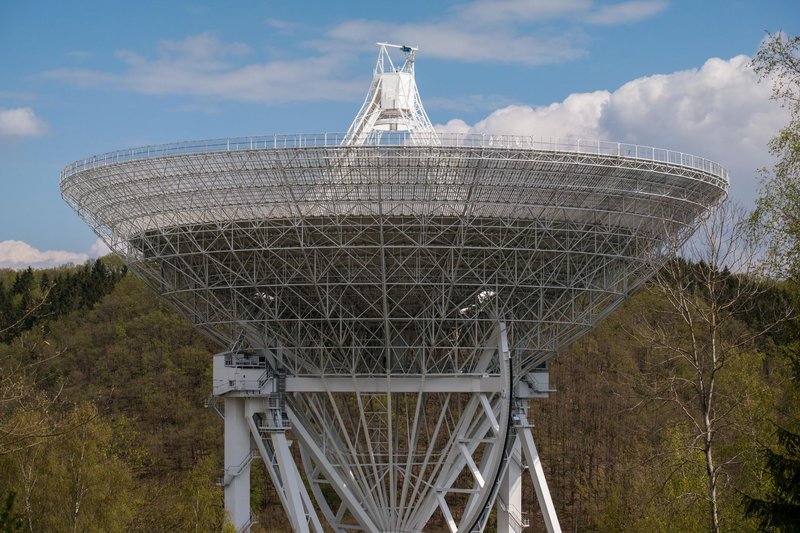
This is the oldest approach and still the best funded. Radio waves cross interstellar space cheaply, and a signal squeezed into a very narrow band of frequencies doesn’t occur in nature. Stars, pulsars and gas clouds all smear their emission across wide ranges. A spike a fraction of a hertz wide looks engineered.
1. A narrowband radio signal
The Wow! signal fits this category, and it’s still the strongest candidate we have, precisely because nobody has been able to explain it away. It came from the direction of Sagittarius, at roughly 1420 MHz, the frequency of neutral hydrogen. Searchers love that frequency because every astronomer in the galaxy would know it.
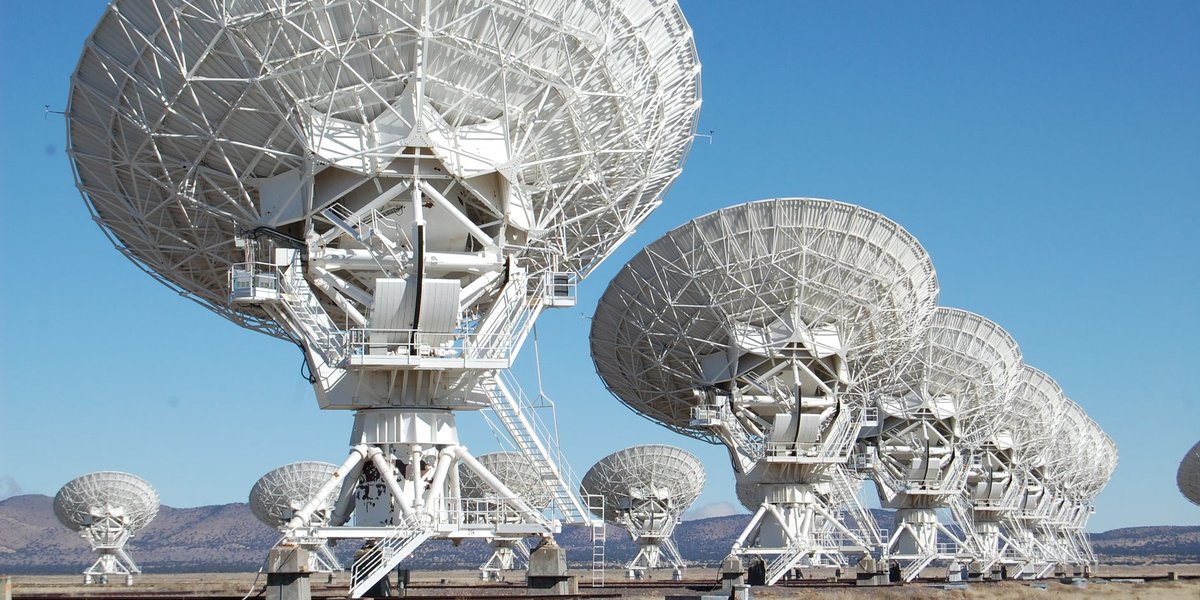
Today the main hunters are Breakthrough Listen, a $100 million program launched in 2015 that uses the Green Bank and Parkes telescopes, and the Allen Telescope Array in California. They scan millions of frequency channels at once and flag anything that is narrow, steady and drifting in frequency the way a transmitter on a moving planet would.
The natural lookalike is human. Satellites, radar and microwave ovens produce narrowband signals all the time. In 2019 Parkes picked up a signal from the direction of Proxima Centauri that looked promising, labeled BLC1. A later analysis traced it to interference from electronics on Earth. Most SETI candidates end this way.
2. Pulses of laser light
Radio isn’t the only option. A civilization that wants to be noticed could fire a laser pulse lasting a billionth of a second, which would briefly outshine its own star in a narrow slice of the spectrum. Optical SETI looks for exactly that.
The PANOSETI project, built by researchers at UC Berkeley and partners, uses wide-field cameras that watch large sections of sky for flashes lasting nanoseconds. Nothing natural is that fast and that bright in visible light, except cosmic rays striking the camera and the atmosphere above it. Detectors that must fire at the same moment in two separate telescopes filter most of those out.
Atmospheric technosignatures
Instead of waiting for a message, you can read a planet’s chemistry. The James Webb Space Telescope splits starlight that passes through an exoplanet’s atmosphere and shows which molecules absorb it. Some of those molecules would be hard to make without factories.
3. Industrial gases
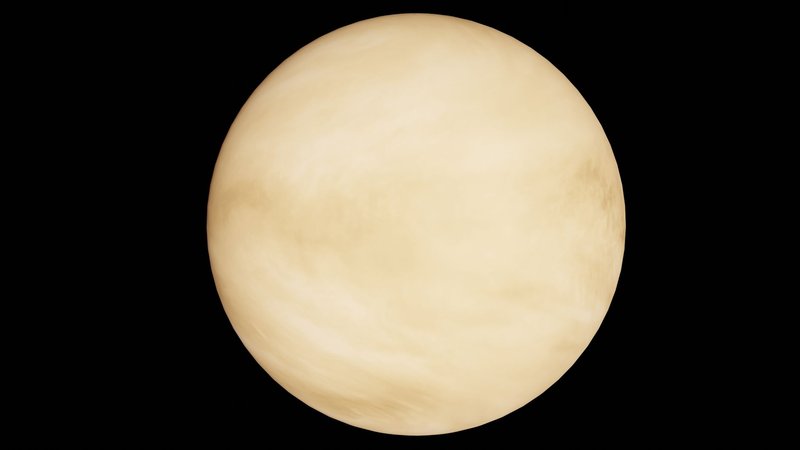
Chlorofluorocarbons, the old refrigerant and aerosol chemicals that punched the ozone hole, have no known natural source. If a planet’s atmosphere shows them, something built them. A 2014 Harvard study argued that JWST could detect CFC levels similar to Earth’s peak around a planet orbiting a white dwarf, a small, dim star that makes the planet’s atmosphere easy to study. Later work by Jacob Haqq-Misra and colleagues found that the cleanest targets are planets around small red stars, and that the signal would need to be several times stronger than anything we produced.
The weakness is the odds. The target has to be a small rocky planet in transit, with a civilization that used the same gases we did, at a concentration high enough to see. It’s a long shot, but it’s a sign with almost no natural mimic.
4. Nitrogen dioxide pollution
Burning fuel produces nitrogen dioxide, and a 2021 study led by Ravi Kopparapu at NASA Goddard found that a planet with Earth-like industry could show it in reflected and transmitted light. Nitrogen dioxide absorbs strongly in visible wavelengths, which makes it easier to spot than many other pollutants.
Here the natural confound is real. Lightning and volcanoes make nitrogen dioxide too, so the question becomes how much, and whether it tracks the planet’s day side where a star’s light would drive the chemistry. The study concluded that detection would need telescopes bigger than anything flying now, so this is a sign for the 2040s, not today.
5. City lights on the night side
A planet’s dark side glowing with artificial light would be hard to explain. Avi Loeb and Edwin Turner proposed in 2012 that we could look for it, but their own math showed the limits: with current telescopes, a city as bright as Earth’s is detectable only in our own outer solar system, not around another star.
Even if a planet were lit up like a Christmas tree, aurora, lightning and wildfires all produce nightside glow. Treat this one as a thought experiment with a use case in the distant future.
Megastructures and waste heat
The physics argument here is the second law of thermodynamics. Any civilization that uses large amounts of energy has to shed waste heat, and heat radiates as infrared light. You don’t have to understand what the aliens are doing. You only have to notice that a star seems to be hiding something warm. Megastructures are one of several signs an advanced civilization could leave behind.
6. A Dyson swarm’s infrared glow
In 1960 physicist Freeman Dyson pointed out in Science that a civilization could harvest a star’s output by surrounding it with collectors, and that the structure would reradiate the absorbed energy as infrared light at roughly room temperature. Such a star would look dimmer in visible light and oddly bright in the infrared. Popular culture calls this a Dyson sphere, though a swarm of separate panels is more physically plausible than a solid shell.
The search is straightforward in principle: compare star positions and brightness from Gaia with infrared data from the WISE and 2MASS surveys, and look for the mismatch. Project Hephaistos, led by astronomers at Uppsala University, did that for about five million stars and in 2024 reported seven candidates, all red dwarfs. The team’s own conclusion was cautious. Dust, background galaxies and imperfect measurements can produce the same excess, and follow-up with better instruments is needed.
7. Strange, irregular dimming
In 2015 volunteers on the Planet Hunters project flagged a star known as KIC 8462852, now called Tabby’s Star after astronomer Tabetha Boyajian. Its brightness dropped by as much as 22 percent in irregular, asymmetric dips, far deeper than any planet could cause. Alien megastructure was one of the hypotheses that got attention.
Follow-up work changed the story. Observations from 2017 and 2018 showed that the star dimmed more at blue wavelengths than at red ones. A solid object blocks all colors equally, while fine dust scatters blue light more, so the data pointed to clouds of dust, not a structure. The cause of the dust is still debated, but the megastructure idea has lost most of its support. It remains a good lesson in how to test a strange signal: ask what each explanation predicts, then check.
Artifacts and probes
Radio signals get weaker with distance. A physical object that sits in our neighborhood doesn’t. Ronald Bracewell suggested in 1960 that an advanced civilization might send automated probes to other stars, and those probes could wait in a system for millennia until something interesting evolved.
8. A probe in our own solar system
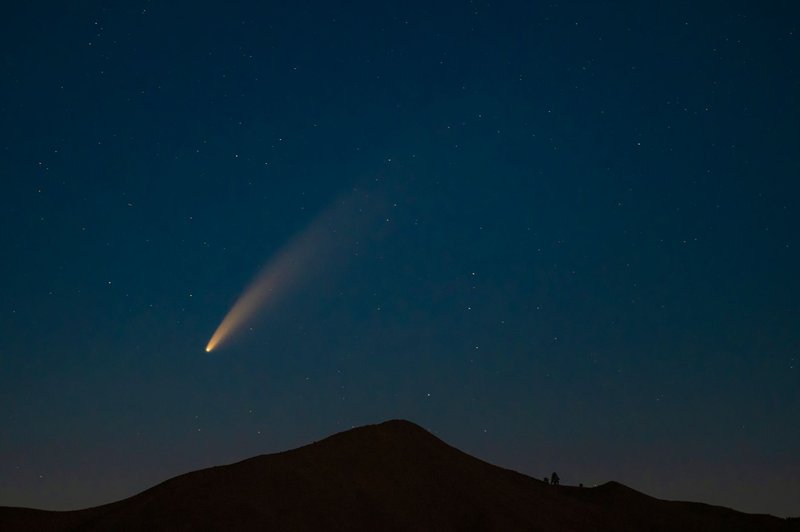
If probes exist, the cheapest place to look is nearby: the Moon, Earth’s Lagrange points, the asteroid belt. In the early 1980s Robert Freitas and Francisco Valdes searched the stable Lagrange points of the Earth-Moon system for objects and found nothing. Modern surveys with better sensors haven’t turned up anything either, and researchers have proposed re-examining lunar orbiter photographs for unnatural features.
The natural lookalike is rock. Anything small and dark that sits in space is far more likely to be an asteroid, and a probe could be built to blend in. The sign would be a thing that doesn’t behave like rock: unusual composition, a controlled orbit, or a signal.
9. An interstellar visitor that behaves oddly
In October 2017 astronomers using the Pan-STARRS telescope in Hawaii spotted ‘Oumuamua, the first confirmed object from outside our solar system. It was elongated, it tumbled, and it sped up slightly as it left without showing the gas tail a comet would. Loeb argued it might be a light sail. Most astronomers preferred natural explanations, and in 2023 a Nature paper by Jennifer Bergner and Darryl Seligman showed that hydrogen released from heated water ice could account for the push, without any tail we’d see.
The third interstellar object, 3I/ATLAS, discovered in July 2025, drew the same speculation. Observations showed a coma and a tail, and astronomers classified it as a comet. The pattern is useful: a visitor that really was artificial would need to fail every natural test, and so far each one has passed.
Signs that aren’t technology
Intelligence and technology aren’t the same thing, and a civilization could leave marks that aren’t signals at all.
Biosignatures are the first thing worth separating out. Finding oxygen and methane together in an atmosphere would be a strong hint of life, since each destroys the other unless something keeps replenishing them. But it says nothing about intelligence. Microbes can do that job. Biosignatures would tell us we aren’t alone. They wouldn’t tell us anyone is thinking.

10. A civilization’s trace in the rock
In 2018 climate scientist Gavin Schmidt and astrophysicist Adam Frank published the Silurian hypothesis, asking whether we could even detect an industrial civilization that existed millions of years ago on Earth. Their answer: probably not directly, because cities and machines erode in a few million years. What would survive is a chemical fingerprint in sediment, such as sudden shifts in carbon isotopes, spikes in metals, synthetic compounds and signs of fertilizer runoff.
The same logic applies to other worlds. A future rover or orbiter on Mars, or a spacecraft sampling a moon’s surface, could look for stratigraphic signs of a vanished civilization. The natural lookalikes are plentiful: volcanism, asteroid impacts and abrupt climate swings all leave similar layers. This is the most speculative item on the list, and also the one that doesn’t depend on any aliens wanting to be found.
The ten signs at a glance
| Sign | Detection method | Natural lookalike | Likelihood of detection |
|---|---|---|---|
| Narrowband radio signal | Radio telescopes (Breakthrough Listen, Allen Telescope Array) | Human interference | Moderate, if anyone is transmitting |
| Laser pulses | Optical cameras (PANOSETI) | Cosmic rays | Low to moderate |
| Industrial gases (CFCs) | JWST spectroscopy | Almost none known | Very low |
| Nitrogen dioxide pollution | Next-generation space telescopes | Lightning, volcanoes | Low |
| Night-side city lights | Large optical telescopes | Aurora, wildfires | Very low |
| Dyson swarm infrared glow | Gaia, WISE, 2MASS surveys | Dust, background galaxies | Low |
| Irregular stellar dimming | Transit photometry (Kepler, TESS) | Dust clouds | Low |
| Probe in our solar system | Optical and radar surveys | Asteroids | Very low |
| Odd interstellar visitor | Wide-field sky surveys | Comets | Very low |
| Geological trace | Sampling by rovers and orbiters | Volcanism, impacts | Very low |
How scientists would confirm signs of extraterrestrial intelligence
A claim of detection triggers a checklist, and it is long and unromantic.
First, rule out ourselves. Breakthrough Listen’s software points the telescope at a target, then moves it off the target for several minutes and back again. A real signal from the sky should appear when the telescope is on target and disappear when it’s off. Interference from nearby electronics usually shows up in both positions, which was part of how BLC1 got rejected.
Second, repeat it. A single event, like the Wow! signal, can’t be tested. A signal that returns at the same sky position and drifts in frequency in a way that matches the target’s motion would be a much stronger case.
Third, get a second telescope somewhere else on Earth. Interference from one site doesn’t show up at another one thousands of kilometers away. Independent confirmation, followed by peer review, is the standard before anything gets announced.
Last, there’s a process for what happens next. The International Academy of Astronautics maintains post-detection protocols that call for verifying the signal, informing international bodies and sharing the data openly, and say that no reply should be sent without broad international consultation. They are voluntary, so the real answer is that nobody can promise how the world would react.
Why we haven’t found anything yet
If intelligent life is common, where is everybody? That’s the Fermi paradox, and the signs above are the practical side of it. We’ve examined a tiny fraction of the galaxy, over a short window of time, at limited sensitivity, for a handful of signal types. Absence of evidence this early isn’t evidence of absence. Researchers compare the search so far to scooping a glass of water from the ocean and concluding there are no fish.
The sign most likely to be found is whichever one we’re best at looking for, which is why the field keeps broadening its list. Radio and laser searches are mature. Atmospheric and infrared searches are just getting the telescopes they need. The unusual finds will probably turn out to be natural, as BLC1, Tabby’s Star and ‘Oumuamua did. But each time, scientists learned something real about how the universe works, and that’s the part of the search that has already paid off.