Table of Contents
- The Seven Stars, Named
- The Numbers: A Star-by-Star Comparison
- It Only Looks Like a Shape
- Using the Dipper to Find Polaris
- Mizar and Alcor: The Ancient Eye Test
- When to See It: Visibility by Month
- What Else Is Hiding Near the Dipper
- A Quick Word on the Mythology
- The Short Version
Seven stars, one shape everybody already knows how to find, and almost nobody can name. That’s the Big Dipper in a sentence. It isn’t a constellation on its own — it’s an asterism, a recognizable pattern carved out of the much bigger constellation Ursa Major, the Great Bear — but it’s the most useful seven-star pattern in the sky. Sailors used it. Escaped slaves on the Underground Railroad used it, calling it the Drinking Gourd. You can use it tonight to find true north without a phone.
Here’s who those seven stars actually are, what separates them, and what they’re good for besides looking like a ladle.
The Seven Stars, Named

Going from the outer edge of the bowl, around the rim, and out to the tip of the handle: Dubhe, Merak, Phecda, Megrez, Alioth, Mizar, and Alkaid.
Dubhe and Merak form the front edge of the bowl — the “pointer stars,” more on that shortly. Phecda and Megrez close out the bowl’s bottom and inner corner. Megrez is the faint one, the hinge where the bowl meets the handle, and it’s dim enough that on a hazy night it can look like the shape has a gap in it. Alioth, Mizar, and Alkaid make up the handle, with Alioth closest to the bowl and Alkaid at the very tip.
Alioth is the brightest of the seven. Dubhe runs a close second and is the only one of the seven that’s an orange giant rather than a white or blue-white star — if you know to look for it, its color is genuinely different from its neighbors.
The Numbers: A Star-by-Star Comparison
| Star | Bayer Designation | Apparent Magnitude | Distance (light-years) | Spectral Type |
|---|---|---|---|---|
| Dubhe | Alpha Ursae Majoris | 1.79 | 123 | K0 III (orange giant) |
| Merak | Beta Ursae Majoris | 2.37 | 79.7 | A1 IV |
| Phecda | Gamma Ursae Majoris | 2.44 | 83.2 | A0 V |
| Megrez | Delta Ursae Majoris | 3.31 | 80.5 | A3 V |
| Alioth | Epsilon Ursae Majoris | 1.77 | 82.6 | A1p |
| Mizar | Zeta Ursae Majoris | 2.23 | 83 | A2 V |
| Alkaid | Eta Ursae Majoris | 1.86 | 103.9 | B3 V |
Remember that apparent magnitude works backward — lower numbers are brighter. Alioth at 1.77 is the standout; Megrez at 3.31 is more than four times fainter than Alioth to the eye, which is why the bowl’s inner corner looks a little washed out compared to the rest.
It Only Looks Like a Shape
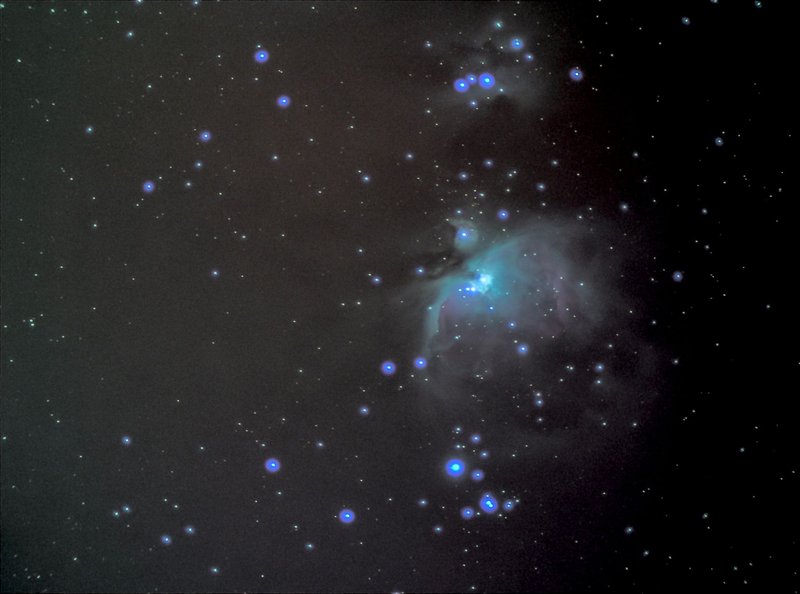
Here’s the part most guides skip: the Big Dipper isn’t a real object. It’s not a cluster, it’s not physically connected, and if you could fly a spaceship above the plane of the galaxy and look down, the shape would fall apart completely.
Dubhe sits 123 light-years away. Merak, on the opposite corner of the bowl, is 79.7 light-years away — meaning light left Merak nearly half a century after the light you’re seeing from Dubhe. These stars only line up into a dipper shape from one specific vantage point in the galaxy: ours.
And yet five of the seven — Merak, Phecda, Megrez, Alioth, and Mizar — really are related. They’re moving through space together at similar speeds, in the same direction, with matching chemical fingerprints, which is strong evidence they formed from the same cluster of gas roughly 300 million years ago. Astronomers call this the Ursa Major Moving Group. Dubhe and Alkaid, the two stars at the far ends of the shape, are outsiders — unrelated stars drifting in a different direction that just happen to be passing through the same patch of sky right now. In a few tens of thousands of years, the whole dipper shape will visibly warp as Dubhe and Alkaid drift off and the real cluster stays put.
Using the Dipper to Find Polaris
This is the trick that makes the Big Dipper worth learning in the first place. Draw an imaginary line through Merak and Dubhe — the two outer stars of the bowl — starting at Merak (the bottom one) and running up through Dubhe. Keep going. About five times the distance between those two stars, you’ll land almost exactly on Polaris, the North Star.
That’s why Merak and Dubhe are called the pointer stars. Polaris isn’t especially bright — it’s only about as bright as the dimmer Dipper stars — so most people can’t pick it out of a crowded sky on sight. The pointer-star trick solves that in about two seconds, and once you’ve found Polaris once, you’ve found true north, no compass required.
A useful bonus: Polaris itself is the end star of the Little Dipper’s handle, and the two dippers roughly mirror each other’s orientation through the night as they wheel around the pole.
Mizar and Alcor: The Ancient Eye Test

Look closely at the middle star of the handle — Mizar — and if your eyes are sharp and the sky is dark, you’ll notice it’s not alone. A dimmer companion, Alcor, sits right beside it, separated by about 12 arcminutes, close enough that most people need to really focus to split them.
This pairing is old news, historically speaking. Arab astronomers used it as a literal vision test centuries ago; the 13th-century writer Zakariya al-Qazwini noted that people tested their eyesight by trying to separate the two. Binoculars make the split trivial. A telescope reveals that Mizar is actually two stars orbiting each other, discovered as the first double star ever resolved by telescope, back in 1650 — and Alcor turns out to have its own faint red dwarf companion. What looks like one star, then two, is really at least four, all gravitationally connected across roughly a light-year of space.
When to See It: Visibility by Month
The Big Dipper is circumpolar for most of the Northern Hemisphere above about 40°N latitude — meaning it never fully sets, it just wheels around Polaris all year. But its position in the evening sky follows a reliable seasonal rhythm that’s summed up in an old stargazing rhyme: “spring up, fall down.”
- Spring (March–May): The Dipper rides high overhead in the evening, bowl tipped as if pouring downward. This is the easiest season to spot it at a glance.
- Summer (June–August): It swings toward the western sky as the evening goes on, handle up and bowl below.
- Autumn (September–November): It sits low near the northern horizon in the evening — in places with a lot of tree cover or hills to the north, it can be genuinely hard to see this time of year.
- Winter (December–February): It climbs back up on the eastern side, handle down, on its way back toward the spring high point.
South of about 25°N latitude, the Dipper dips below the horizon for part of the year rather than staying circumpolar, so autumn evenings can be a bust from those latitudes.
What Else Is Hiding Near the Dipper
Once you can find the seven stars fast, the Dipper becomes a signpost for deep-sky targets that are otherwise hard to locate. A pair of galaxies, M81 and M82, sit just off the bowl’s top corner near Dubhe — visible as faint smudges in binoculars from a dark site, and a genuinely striking pair through even a small telescope, since M82 is a dramatic edge-on “cigar” galaxy undergoing a burst of star formation. Farther out, past the handle, the face-on spiral M101 (the Pinwheel Galaxy) sits near Alkaid and rewards a telescope on a moonless night.
None of these are naked-eye objects, but knowing exactly where to point turns a frustrating star-hop into a five-minute find.
A Quick Word on the Mythology
Ancient Greeks saw the whole of Ursa Major, bowl and handle and all, as the Great Bear — Callisto in one version of the myth, transformed and flung into the sky by a jealous Hera. Indigenous nations across North America told their own versions: several Ojibwe and other Algonquian traditions saw the bowl as the bear itself and the three handle stars as hunters in pursuit, with Alcor as the hunters’ cooking pot trailing behind Mizar. In Britain the same shape is the Plough. In much of Ireland and parts of the American South it was King Charles’s Wain — a wagon, not a bear at all. Same seven stars, three completely different pictures, depending on who was looking up.
The Short Version
Seven stars — Dubhe, Merak, Phecda, Megrez, Alioth, Mizar, Alkaid — sitting between 80 and 123 light-years away, unrelated to each other in three dimensions except for a five-star family group that shares a birthplace. Line up Merak and Dubhe and you’ve found Polaris. Split Mizar and Alcor and you’ve passed an eye test that’s a thousand years old. Learn the shape once, and it hands you true north, a star cluster’s family history, and a shortcut to two galaxies, every clear night for the rest of your life.
Enjoyed this article?
Get daily 10-minute PDFs about astronomy to read before bed!
Sign up for our upcoming micro-learning service where you will learn something new about space and beyond every day while winding down.