Gravitational lensing happens when matter sits between a distant light source and you, and its gravity bends the light on the way past. That’s the whole idea. These facts about gravitational lensing run from the basics to the stranger corners, including a few recent Webb images and one spacecraft idea that hasn’t flown yet.
Contents
- Mass bends light because it bends space
- Newton’s gravity predicts only half the bend
- An eclipse in 1919 made Einstein famous
- Einstein doubted it would ever be seen
- The first lens turned up in 1979
- Gravitational lensing comes in three sizes
- Strong lensing gives you arcs and copies
- An Einstein ring needs near-perfect alignment
- A gravitational lens has a focal line, not a focal point
- Microlensing finds planets you can’t see
- Weak lensing maps dark matter
- Lensing works on every kind of light
- Webb has photographed near-perfect rings
- Lenses magnify the earliest galaxies
- The Sun could be a telescope, 547 AU out
1. Mass bends light because it bends space
Massive objects warp the space around them, and light follows the straightest path available through that warped space. From the outside, that path looks curved.
The usual picture is a bowling ball on a stretched trampoline. A marble rolled past it curves toward the dent. Light does the same thing around a galaxy, only with no marble and no trampoline.
2. Newton’s gravity predicts only half the bend
Newtonian gravity also bends light if you treat light as a stream of tiny particles. For a ray grazing the Sun, the Newtonian answer is about 0.87 arcseconds. General relativity gives about 1.75 arcseconds, double.
The gap exists because general relativity bends space as well as time, and both contribute to the deflection. Newton’s version only captures one of them.
3. An eclipse in 1919 made Einstein famous
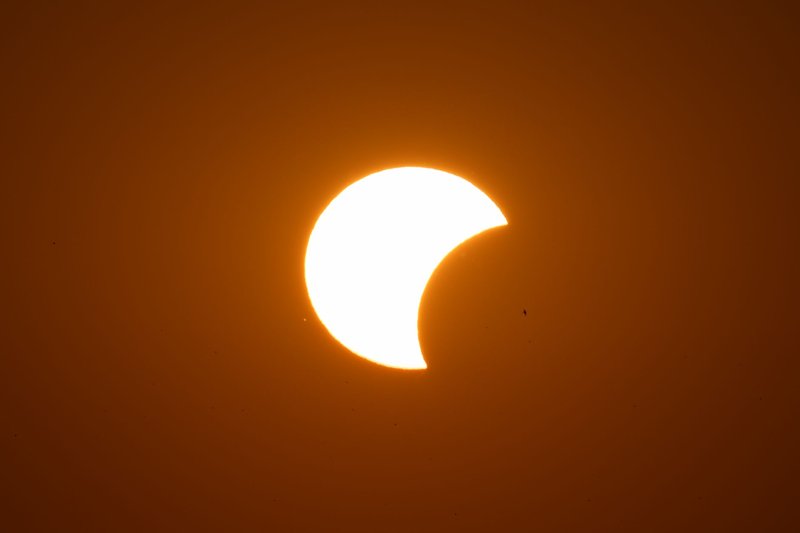
Einstein’s prediction needed a test, and the Sun is the only nearby object massive enough to try. The problem is that you can’t see stars next to the Sun, except during a total eclipse.
In May 1919, two British expeditions photographed the stars near the eclipsed Sun, one led by Arthur Eddington on the island of Príncipe and another in Sobral, Brazil. The stars had shifted by roughly the amount Einstein predicted, and the published results favored general relativity over the Newtonian half-value. The announcement that November put Einstein on front pages worldwide.
4. Einstein doubted it would ever be seen
In 1936 Einstein published a short paper working out how one star could lens another. His conclusion was that nobody would ever observe it, because the images would be far too small to separate.
Fritz Zwicky disagreed the following year. He pointed out that whole galaxies, not single stars, could act as lenses, and that they were massive enough to produce effects astronomers could measure. He was right, though it took decades for telescopes to catch up.
5. The first lens turned up in 1979
Astronomers found two quasars about 6 arcseconds apart that looked suspiciously identical: same brightness pattern, same spectrum. They weren’t twins. They were one quasar, split into two images by a galaxy in the foreground.
Called the Twin Quasar (QSO 0957+561), it was the first gravitational lens ever confirmed, nearly sixty years after the Eddington expedition. NASA’s Hubble lens page covers this system alongside the spectacular cluster lenses Hubble later imaged.
6. Gravitational lensing comes in three sizes
Astronomers sort lenses by how strongly they distort the background:
- Strong lensing produces obvious arcs, rings or multiple copies of one object.
- Weak lensing only stretches background galaxies by a few percent. You can’t spot it in a single galaxy, only by averaging thousands.
- Microlensing is a brief brightening of a background star as a smaller object passes in front of it. No image splitting is visible at all.
The mass of the lens and the alignment decide which one you get.
7. Strong lensing gives you arcs and copies
When a galaxy cluster sits in front of a field of more distant galaxies, the background galaxies get smeared into long, thin arcs. Sometimes the same galaxy appears two, three or four times, mirrored and rotated, at different spots around the cluster.
Can you see this yourself? Not by eye. The arcs are faint and small, and the famous ones come from Hubble and Webb exposures lasting hours.
8. An Einstein ring needs near-perfect alignment
If the source, the lens and Earth line up almost exactly, the background light stretches into a full circle around the lens. That’s an Einstein ring.
The alignment has to be precise to a tiny fraction of a degree, which is why complete rings are rare. Nudge the source slightly off-axis and the ring breaks into arcs or a cluster of separate images.
9. A gravitational lens has a focal line, not a focal point
A glass magnifying lens bends all the light to one focal point. A gravitational lens can’t, because rays passing close to the mass bend more than rays passing far away. The rays cross at different distances, so you get a focal line that starts at a minimum distance and stretches outward.
A wine glass is a decent home demo. Look at a distant light through the stem and base, and you’ll see arcs, rings and doubled images, the same shapes a galaxy produces.
10. Microlensing finds planets you can’t see
When a star drifts in front of a more distant one, the distant star brightens smoothly over days or weeks, then fades. If the foreground star has a planet, a short extra blip appears on top of that curve.
This method is good at catching planets far from their stars, and even rogue planets with no star at all. It has found more than 200 exoplanets so far, though each event happens once and never repeats.
11. Weak lensing maps dark matter
Dark matter doesn’t emit light, but it has mass, so it lenses. Astronomers measure the slight, consistent stretching of thousands of background galaxies and work backward to the mass distribution in front of them.
The results match what you’d expect if every galaxy sits inside a halo of dark matter several times heavier than its visible stars. NASA notes that astronomers also map cluster dark matter by plotting the arcs from warped background galaxies. In the Bullet Cluster, lensing showed most of the mass sitting apart from the hot gas, one of the strongest pieces of evidence for dark matter.
12. Lensing works on every kind of light
Gravity bends the path of light regardless of its color. Radio waves, infrared, visible light, X-rays and gamma rays all take the same curved route, so lensing shows up across the electromagnetic spectrum.
Gravitational waves should lens too, because they also travel through warped space. Searches for lensed gravitational-wave events are ongoing, and no confirmed detection has been announced as of this writing. Sound doesn’t lens at all. It needs a medium to travel through, and space doesn’t have one.
13. Webb has photographed near-perfect rings
In August 2022, Webb imaged a nearly complete Einstein ring around the galaxy SPT-S J041839-4751.8, with light that had been traveling for roughly 12 billion years. Its mid-infrared instrument gave the sharpest view.
One correction that trips people up: 12 billion light-years is the light-travel distance, not where the galaxy is now. The universe kept expanding while that light traveled, at a rate set by the Hubble constant, so the galaxy sits much farther away today.
In 2025, Webb’s SLICE survey, which targets 182 galaxy clusters, released another ring image around a galaxy in the cluster SMACS J0028.2-7537.
14. Lenses magnify the earliest galaxies
A strong lens works as a free telescope upgrade. Light from a faint galaxy at the dawn of the universe gets brightened and enlarged, sometimes enough to reveal details Webb couldn’t resolve otherwise.
Hubble used a cluster lens to spot Earendel, a star whose light started its journey less than a billion years after the Big Bang. The lens magnified it by a factor of thousands. Without that boost, a single star at that distance would be invisible.
15. The Sun could be a telescope, 547 AU out
The Sun bends light too, so past a certain distance its gravity would focus light from a faraway planet into a point you could image. That minimum focal distance is about 547 astronomical units, roughly 14 times farther than Neptune is from the Sun.
NASA has funded concept studies for a fleet of small solar-sail spacecraft to fly there and image an exoplanet’s surface. It’s still a proposal. No mission is approved, and the trip would take decades at current speeds.