TLDR
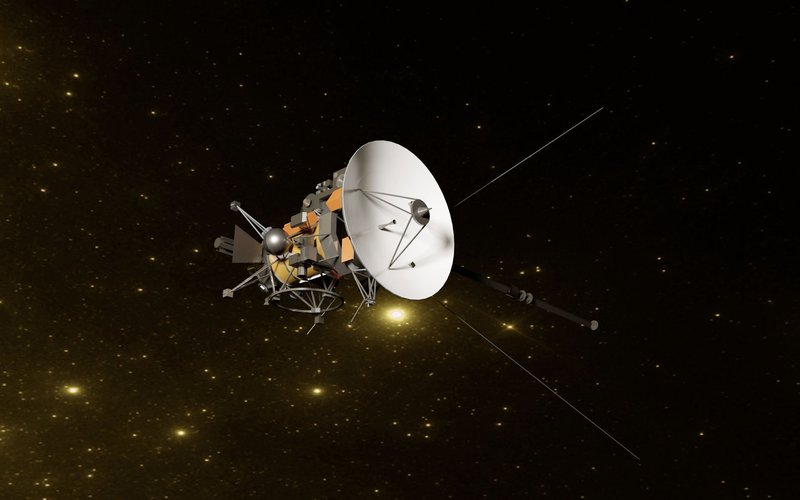
- One spacecraft has ever visited Uranus: NASA’s Voyager 2, which flew past on 24 January 1986. Nothing has orbited it.
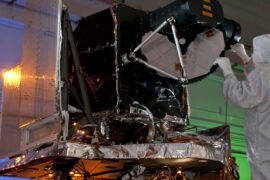
- No mission to Uranus is approved or funded as of this update. NASA’s Uranus Orbiter and Probe is the top-ranked proposal, and China has described a Uranus flyby as part of its Tianwen-4 plan.
- A launch in 2031 or 2032 would put a spacecraft at Uranus in the mid-2040s. Miss that window and the realistic arrival moves to the late 2040s or beyond.
Table of contents
- Which spacecraft have visited Uranus?
- Every mission and concept at a glance
- What Voyager 2 found
- What Voyager 2 left unanswered
- The Uranus Orbiter and Probe and the 2022 Decadal Survey
- Why the trip takes so long
- The engineering obstacles
- When could we realistically arrive?
- FAQ
Which spacecraft have visited Uranus?
Exactly one. Voyager 2 passed Uranus on 24 January 1986, closing to roughly 81,500 km (50,600 miles) above the cloud tops. The encounter lasted a few hours and took in the planet, its rings and five major moons. Then the probe kept going toward Neptune.
That’s the whole list of completed space missions to Uranus. No orbiter, no lander, no atmospheric probe. Every close-up image of the planet you’ve seen came from that one flyby, and everything we’ve learned since has come from telescopes: Hubble, Keck and, more recently, the James Webb Space Telescope.
Several missions have been proposed since the 1980s. None has left the drawing board.
Every mission and concept at a glance
The table below covers the flown mission, the leading proposals and the non-US plans. Dates for concepts are the figures from their proposal documents. Most have already slipped or lapsed.
| Mission | Agency / origin | Type | Proposed launch and arrival | Status |
|---|---|---|---|---|
| Voyager 2 | NASA | Flyby | Launched 1977, arrived 24 January 1986 | Completed |
| Uranus Orbiter and Probe | NASA | Orbiter plus atmospheric probe | Launch 2031 to 2032 preferred, arrival about 2044 to 2045 | Top flagship priority of the 2022 Decadal Survey; not approved or funded |
| Uranus Pathfinder | ESA with UK-led science team | Orbiter | Proposed for an ESA medium-class slot in the 2010s | Not selected |
| MUSE | French-led team, proposed to ESA | Orbiter plus probe | 2030s launch, 2040s arrival | Proposal only |
| OCEANUS | Research-team concept | Orbiter | Concept study | Study only |
| QUEST | NASA-funded concept study | Orbiter | 2030s concept, New Frontiers class | Study only |
| ODINUS | Italian-led, proposed to ESA | Two spacecraft, one each for Uranus and Neptune | Proposed in the early 2010s | Not selected |
| PERSEUS | Research-team concept | Concept study | No launch date set | Not funded |
| Tianwen-4 | China (CNSA) | Jupiter-system mission with a Uranus flyby spacecraft | Launch around 2029, Uranus flyby in the mid-2040s | Planned by China; public details are limited |
Two patterns stand out. European proposals have repeatedly reached the shortlist stage and stopped there. And the only plan with an announced launch year in this decade comes from China, with a flyby rather than an orbit.
What Voyager 2 found
A few hours of data rewrote what we knew about the planet.
Ten new moons. Voyager 2 spotted Cordelia, Ophelia, Bianca, Cressida, Desdemona, Juliet, Portia, Rosalind, Belinda and Puck, all small and dark and most of them tucked in close to the rings. Puck, at about 160 km across, was the largest. Telescopes have since pushed the count to nearly 30.
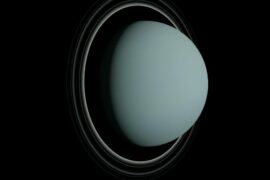
Two new rings. Astronomers already knew of nine narrow rings from stellar occultation observations in 1977. Voyager 2 added two more, and later Hubble images found a further pair, bringing the total to 13.
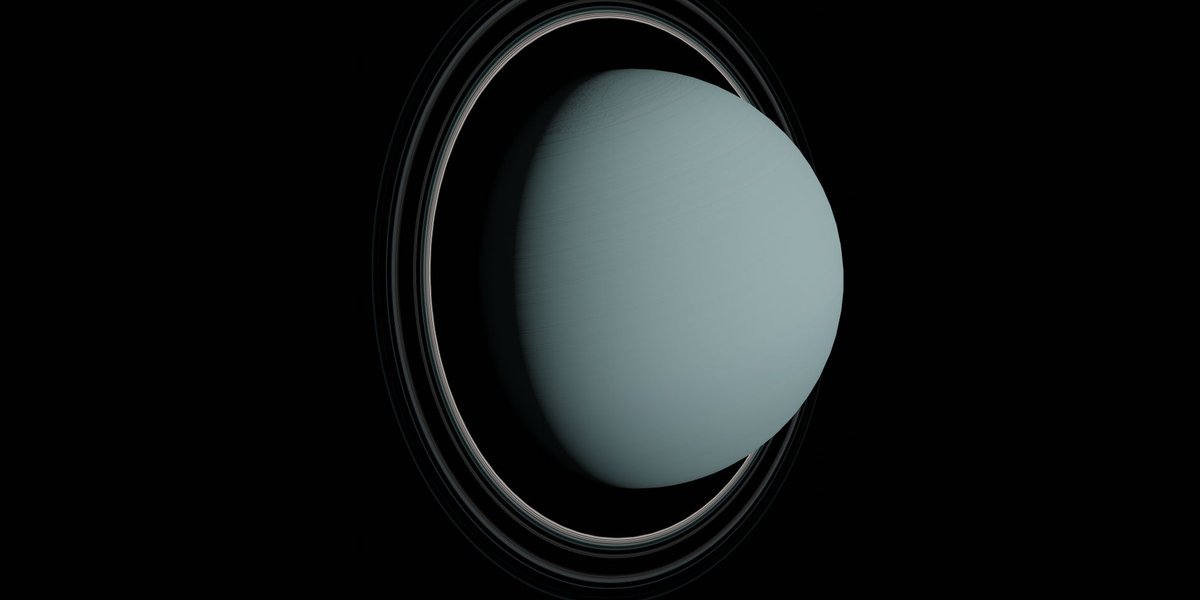
A magnetic field tilted 59 degrees. Earth’s magnetic axis sits about 11 degrees off its rotation axis. Uranus’s is 59 degrees off and shifted well away from the planet’s center. Uranus also rolls on its side, with an axial tilt of about 98 degrees, so its magnetosphere wobbles through space as the planet turns. A 2024 reanalysis of the data suggested Voyager 2 arrived during an unusual solar-wind event that compressed the magnetosphere, which means some of what we think we know about it may be a snapshot of a bad day.
Miranda’s scrambled face. The smallest of the five major moons showed cliffs, grooves and patchwork terrain that look like a moon assembled from mismatched parts. Nobody has settled how it got that way.
A cold, quiet interior. Uranus radiates almost no internal heat, unlike Neptune. That’s a puzzle the NASA Uranus overview still lists among the planet’s open questions.
What Voyager 2 left unanswered
Voyager 2 flew by once, on one side of the planet, during the southern summer solstice, with a camera designed for Jupiter-level sunlight. That leaves large gaps.
- What’s inside. Uranus and Neptune are “ice giants,” mostly water, ammonia and methane in a hot, dense fluid. We don’t know the layering, or why the magnetic field is so lopsided.
- What the atmosphere is made of. Only a probe dropped into the clouds can measure noble gases and isotope ratios, which would show where and when the planet formed.
- Whether the moons hide oceans. Titania, Oberon, Ariel, Umbriel and Miranda are mixes of rock and ice. Some thermal models suggest one or more could have liquid water beneath the crust. Voyager 2 imaged only the southern hemispheres of the moons, since the north was in darkness.
- How the rings and small moons interact. The ring system is dark and sparse, and the inner moons may be gravitationally shepherding it.
Ice giants are also the most common type of planet we’ve detected around other stars. Understanding the nearest ones is a direct test of how exoplanet models perform.
The Uranus Orbiter and Probe and the 2022 Decadal Survey
Every ten years, the US National Academies publishes a ranked wish list for planetary science. The 2023-2032 Planetary Science and Astrobiology Decadal Survey, released in April 2022, placed the Uranus Orbiter and Probe first among new flagship missions, ahead of an Enceladus orbiter. The survey priced the Uranus mission at roughly $4.2 billion.
The reference design is a single spacecraft that carries an atmospheric probe, uses a gravity assist from Jupiter, and then settles into orbit to study the planet, rings and moons for several years. The survey identified launch windows between roughly 2030 and 2034, with the best flight times in 2031 and 2032.
A top ranking is a recommendation, not an appropriation. Congress has to fund the mission, NASA has to commit to it, and so far neither has happened. The mission competes against other flagship programs and a science budget under repeated pressure.
Why the trip takes so long
Uranus orbits at about 19 times Earth’s distance from the Sun, near 2.9 billion km. A direct shot with a modern rocket would still take far longer than a decade, and it would arrive moving too fast to enter orbit. So mission planners use planetary slingshots.
The best trajectories in the survey use Jupiter. Launch at the right time, swing past the giant and pick up speed, and the cruise runs roughly 12 to 13 years. Jupiter and Uranus only line up well for this every so often, so missing a window doesn’t cost a year. It either adds years to the flight or forces a different route. Radio signals take about 2 hours and 40 minutes to cross the distance one way, so the spacecraft has to run itself for long stretches.
This is why the arrival date keeps sliding. Each year of delay in funding moves the launch, and a delay long enough to lose the Jupiter alignment moves the arrival by a lot more than a year.
The engineering obstacles
Sunlight is nearly gone. At Uranus, the Sun delivers about 1/370 of the energy it does at Earth, around 0.27%. Solar panels big enough to matter would be impractical, so the spacecraft needs nuclear power.
Plutonium is limited. Deep-space probes run on radioisotope power systems fueled with plutonium-238. NASA restarted domestic production in 2015, but the supply is small, and other missions also need it. NASA’s radioisotope power program is a bottleneck for any outer-planet orbiter.
Money. A $4 billion flagship has to fit alongside other priorities, and the larger the cost, the more any delay compounds it.
Aging hardware and teams. A 13-year cruise followed by a multi-year orbital tour means some of the engineers who design the mission may retire before it arrives. That sounds like a soft problem. It isn’t, and projects of this length depend on careful handover of knowledge.
When could we realistically arrive?
Take the planners’ own numbers. A launch in 2031 or 2032 gives arrival around 2044 to 2045. Nothing is funded, so that window is already tight. If the approval comes later in the decade, the next workable launch years push arrival into the late 2040s or the 2050s, depending on the route.
The one exception is China. Reports on Tianwen-4 describe a launch around 2029 and a Uranus flyby in the mid-2040s. That would be the first visit since 1986, but it would be a pass, not a stay, and the details haven’t been published in full.
So the most defensible single answer: the mid-2040s at the earliest, and the late 2040s or later is more likely, since nothing has been approved.
FAQ
Has any spacecraft orbited Uranus? No. Only Voyager 2 has visited, and it was a flyby.
When did Voyager 2 reach Uranus? 24 January 1986, about eight and a half years after its launch in August 1977.
Is there a Uranus mission planned? Several are proposed. NASA’s Uranus Orbiter and Probe ranks first among the flagship priorities in the 2022 Decadal Survey, but it has no approved budget or launch commitment. China has publicly described a Tianwen-4 plan that includes a Uranus flyby.
What is the Uranus Orbiter and Probe launch date? The Decadal Survey’s preferred window is 2031 to 2032, with arrival in the mid-2040s. Since no agency has committed to it, treat these as targets rather than a schedule.
How long would a mission to Uranus take? About 12 to 13 years with a Jupiter gravity assist. Without a good alignment, it takes longer.
Why not send a solar-powered probe? Sunlight at Uranus is about 0.27% of Earth’s. The panels required would be enormous, so missions rely on plutonium-powered generators.
Do the moons of Uranus have oceans? Possibly. Titania, Oberon, Ariel, Umbriel and Miranda are candidates in some models, but none has been confirmed. An orbiter would test it.
Last updated: November 2026. Status: no Uranus mission is approved or funded by any agency. Check agency announcements for changes.