First, a quick disambiguation, because the search results are a mess. If you came here looking for Titania the UK military communications satellite, this isn’t that. This is about Titania the moon: the largest of Uranus’s 27 known satellites, a 1,578-km ball of rock and ice orbiting a planet so far away that exactly one spacecraft has ever bothered to fly past it.
That spacecraft was Voyager 2. The year was 1986. And no one has been back since.
That single sentence is the whole story of Titania exploration, and it’s also why this topic is so frustrating to research. Everything we know about this moon comes from a few hours of data gathered four decades ago by a probe that was already on its way out of the solar system. The good news: that’s about to change, at least on paper.
Table of Contents
- The short version
- Why Titania is worth the trip
- Voyager 2: the only mission that ever happened
- Why nobody went back
- The Uranus Orbiter and Probe
- Mission timeline at a glance
- What a future mission would actually do
The short version
Only one spacecraft has ever visited Titania: Voyager 2, which made a single flyby on January 24, 1986, passing about 365,200 km away and imaging roughly 40% of the surface at best resolutions near 3.4 km per pixel.
No dedicated mission has gone since, and as of 2026, no Uranus mission is funded or flying. The leading concept is the Uranus Orbiter and Probe (UOP), ranked the top large-mission priority in the latest planetary science Decadal Survey. Mission studies describe a launch around 2031 and arrival around 2044, with roughly 15 Titania flybys planned during the orbital tour. None of that is guaranteed until Congress writes the check.
So: one real mission, one serious proposal, and a forty-year gap in between.
Why Titania is worth the trip
Here’s the hook that turns Titania from “a gray dot in a textbook” into a target worth a multi-billion-dollar spacecraft: it might have an ocean.
Titania is big enough and contains enough radioactive material in its rocky interior to potentially generate internal heat. Models of similar icy moons suggest that heat could maintain a layer of liquid water sandwiched between an outer ice shell and a rocky core. We’ve seen this exact setup confirmed elsewhere in the solar system, most famously at Saturn’s Enceladus and Jupiter’s Europa. Titania sits in the same category of “possible subsurface-ocean world,” even if the evidence is far thinner because, again, we’ve only ever seen it once from 365,000 km away.
The surface Voyager did capture backs up the intrigue. Titania shows enormous fault canyons, the largest stretching over 1,500 km long, the kind of feature you get when an icy crust expands and cracks, which can happen when an interior ocean freezes and pushes outward. Add relatively few impact craters in places, hinting that the surface has been resurfaced at some point, and you have a moon that may have been geologically active long after it formed.
That’s the difference between Titania and a dead rock. NASA’s broader interest in ocean worlds is driven by one question: where else could life exist? Titania is a long shot on that list, but it’s on the list.
Voyager 2: the only mission that ever happened
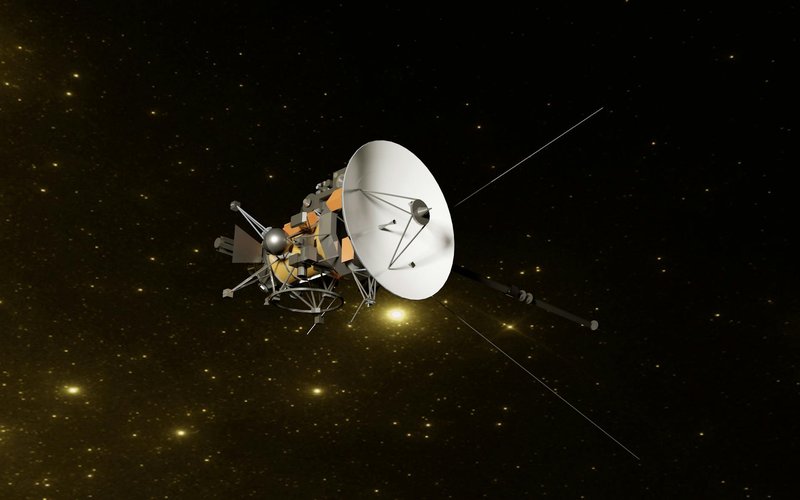
Voyager 2 launched in 1977 on the famous “Grand Tour” trajectory, a once-in-176-years planetary alignment that let a single probe slingshot from Jupiter to Saturn to Uranus to Neptune. It remains the only spacecraft to have visited Uranus at all.
The Uranus encounter happened on January 24, 1986. Voyager 2 swept through the entire Uranian system in a matter of hours, because the planet’s moons orbit in a tight, vertically-stacked arrangement. Uranus is tipped on its side, so its moons circle it like a dartboard rather than a racetrack, which is just one of the strange facts about Uranus that make the system so unusual. That geometry meant Voyager got one pass at everything and then kept moving toward Neptune.
For Titania specifically, the closest approach was roughly 365,200 km. From that distance the cameras resolved features down to about 3.4 km per pixel on the best frames, and mapped close to 40% of the surface. The rest of Titania, more than half the moon, has literally never been photographed by a human spacecraft. It’s a blank.
To put the timing in perspective: the Uranus flyby happened just days before the Challenger disaster on January 28, 1986, which swallowed most of the public’s attention. Voyager 2’s data was groundbreaking and almost entirely overshadowed. You can still browse the original encounter records through NASA’s Voyager mission pages, and most of what any textbook tells you about Titania traces back to those few hours.
Why nobody went back
The obvious question: if Titania is so interesting, why has it been forty years?
The answer is distance and the cruelty of orbital mechanics. Uranus sits about 2.9 billion km from the Sun, roughly 19 times Earth’s distance. A spacecraft can’t just point and go; it needs a gravity assist (usually from Jupiter) to build up enough speed, and the launch windows for an efficient Jupiter slingshot to Uranus only come around every dozen-plus years. Miss the window and your trip gets longer and more expensive.
Then there’s the travel time. Even with a good trajectory, you’re looking at well over a decade in transit before the science even begins. That’s a hard sell for any agency budgeting in election cycles.
And the energy problem is brutal. At Uranus’s distance, sunlight is about 1/370th as strong as at Earth, so solar panels are nearly useless. Any serious Uranus mission needs a nuclear power source (a radioisotope generator fueled by plutonium-238), and that fuel is in genuinely short supply, manufactured slowly and competed over by every deep-space mission in the queue.
Put it together: long trips, rare launch windows, scarce nuclear fuel, and a multi-billion-dollar price tag for a payoff two decades out. Uranus kept losing the funding fight to closer, faster targets like Mars and Europa. That’s not a knock on Titania’s science. It’s just the math.
The Uranus Orbiter and Probe
The thing that changed everything (on paper) was the 2022 planetary science Decadal Survey, the report in which the U.S. planetary community ranks its priorities for the coming decade. The survey named a Uranus Orbiter and Probe as its single highest-priority new Flagship-class mission, ahead of every other large-mission candidate.
That endorsement matters because Decadal Surveys carry real weight with NASA and Congress; the last one is what eventually green-lit the Europa Clipper. You can read the recommendation in the National Academies’ Decadal Survey findings, which lay out the scientific case in detail.
The mission concept itself is exactly what the name says: an orbiter that would settle into orbit around Uranus for a multi-year tour, plus an atmospheric probe dropped into Uranus’s atmosphere to sample its composition directly. Study trajectories have floated a launch around 2031 and an arrival around 2044, the long gap being that unavoidable decade-plus cruise.
For Titania fans, here’s the payoff: the reference tour includes roughly 15 flybys of Titania over the course of the orbital mission. Compare that to Voyager’s single distant pass. Fifteen targeted encounters, with modern instruments, would map the entire surface, hunt for the magnetic and gravitational fingerprints of a subsurface ocean, and tell us whether this moon is geologically alive or long dead.
One enormous caveat, and it’s the one to remember: the Uranus Orbiter and Probe is not funded. Being the Decadal Survey’s top pick is a recommendation, not a budget line. As of 2026, NASA has not formally started the mission, no launch is scheduled, and the 2031 date is a planning target that slips further every year the project isn’t funded. It’s the most promising path back to Titania, and it’s also still just a concept.
Mission timeline at a glance
| Mission | Year | Type | Key facts |
|---|---|---|---|
| Voyager 2 | 1986 | Single flyby | Closest approach ~365,200 km; ~40% of surface mapped at ~3.4 km/pixel resolution; only spacecraft to ever visit |
| Uranus Orbiter and Probe (UOP) | ~2031 launch / ~2044 arrival (proposed) | Orbiter + atmospheric probe | Top Decadal Survey priority; ~15 planned Titania flybys; not yet funded |
Two rows. That’s the entire history and future of Titania exploration in a single table, and one of those rows hasn’t happened yet.
What a future mission would actually do
So if the Uranus Orbiter and Probe flies, what would those 15 Titania flybys actually accomplish? A few concrete things Voyager couldn’t.
Finish the map. More than half of Titania has never been imaged. A modern orbiter would photograph the entire surface at resolutions far better than 3.4 km, turning those giant fault canyons from fuzzy hints into detailed terrain.
Look for the ocean. This is the big one. By precisely tracking the spacecraft’s motion during close flybys, scientists can measure tiny tugs in Titania’s gravity field that reveal whether the interior is uniform rock-ice or layered around a liquid water shell. Magnetometer readings could catch the electrical signature an ocean of salty water produces as it moves through Uranus’s magnetic field, the same trick that confirmed Europa’s ocean.
Date the surface. Counting craters and studying that resurfaced terrain would tell us when Titania was last geologically active, and whether anything is still happening down there.
None of this requires landing or drilling. It’s all achievable from a series of close flybys, which is exactly why the mission planners built 15 of them into the tour.
For now, though, the record stands where it has since the Reagan administration: one spacecraft, one flyby, 40% of a moon, and a very long wait for the rest. Titania is one of the most intriguing unexplored worlds in our solar system, and getting back to it depends less on the science (which is solid) than on whether anyone decides to pay for the trip.
Enjoyed this article?
Get daily 10-minute PDFs about astronomy to read before bed!
Sign up for our upcoming micro-learning service where you will learn something new about space and beyond every day while winding down.