Table of Contents
- Biosignatures vs technosignatures
- Oxygen and methane together
- Dimethyl sulfide and the K2-18b debate
- Chemistry on Mars and icy moons
- A purple Earth and the red edge
- Narrowband radio and laser signals
- Industrial pollution in an atmosphere
- Megastructures and Dyson spheres
- False alarms: Wow!, Venus and Tabby’s star
- Signs of alien life at a glance
- What’s realistic in the next 10 years
Biosignatures vs technosignatures
The question “what are the signs of alien life?” has two different answers, and most articles only give you one.
A biosignature is evidence of biology itself: a gas, a pigment, a molecule that life makes and chemistry alone mostly doesn’t. Think microbes, not people. A technosignature is evidence of technology: a radio transmitter, a pollutant, a structure built around a star. It would point to someone who builds things.
The two searches use different tools and have different odds. Microbial life is probably far more common than engineers, if either exists. But a technosignature, if real, is much harder to explain away. Nobody has confirmed either kind. What follows is what scientists are actually looking for, which instruments do the looking, and how likely a boring natural explanation is for each.
Oxygen and methane together
Earth’s atmosphere is about 21 percent oxygen, and nearly all of it comes from photosynthesis. Without constant replenishment by living things, oxygen would be locked up in rocks within a geologically short time.
Oxygen alone isn’t a clean signal, because sunlight can split water or carbon dioxide and leave free oxygen behind on a lifeless world. The stronger sign is oxygen next to methane. The two gases react with each other, and methane in an oxygen-rich air disappears in roughly a decade. Seeing both at once means something is resupplying them.
How we’d detect it: transmission spectroscopy. When an exoplanet crosses its star, a sliver of starlight filters through the planet’s atmosphere, and each gas absorbs specific wavelengths. NASA’s James Webb Space Telescope is the first instrument that can do this for small, rocky worlds, though it is limited to planets orbiting small, dim red dwarf stars, where the planet’s shadow is large relative to the star.
Natural explanation risk: moderate. Geology and photochemistry can mimic one gas, which is why astronomers want the pair and not a single detection.

Dimethyl sulfide and the K2-18b debate
On Earth, dimethyl sulfide (DMS) is made almost entirely by marine plankton. That’s why it became a favorite candidate biosignature.
K2-18b is a planet about 120 light-years away, roughly 2.6 times Earth’s width. JWST detected methane and carbon dioxide in its atmosphere in 2023, and a team led by Nikku Madhusudhan at Cambridge reported a hint of DMS. In 2025 the same group claimed a stronger detection, around the three-sigma level, which in physics is well short of the five-sigma standard for a discovery. Independent teams reanalyzing the data found the evidence for DMS much weaker, or absent.
Two more problems hang over the claim. Astronomers still argue about whether K2-18b is an ocean world at all, or a gassy sub-Neptune with no surface. And DMS has been found in comets, so non-biological sources exist.
K2-18b is the best live example of how this field works: a tentative signal, a loud headline, then months of other people trying to break it.
Chemistry on Mars and icy moons
Not every search needs a telescope. Some of the best candidates for finding life are in our own solar system, where a spacecraft can touch the evidence.
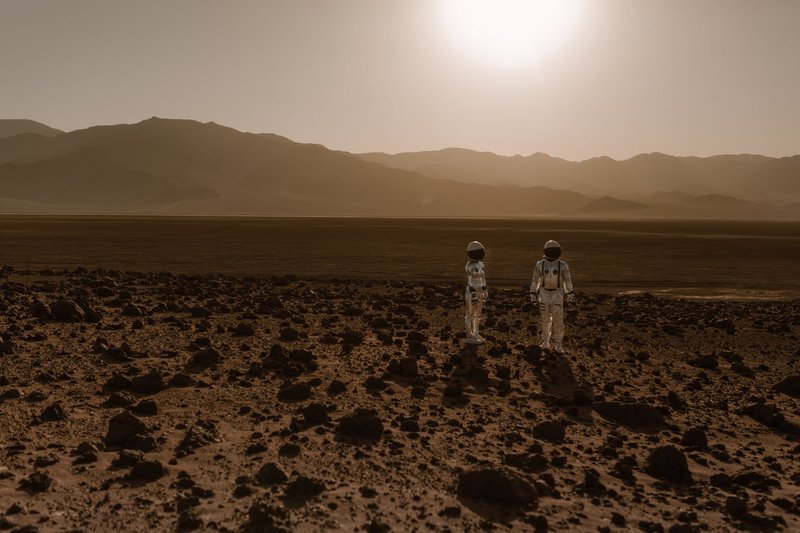
Mars. NASA’s Perseverance rover has been collecting rock cores in Jezero Crater, an ancient lake bed, for eventual return to Earth. In 2024 it examined a rock nicknamed Cheyava Falls, with leopard-like spots whose chemistry resembles reactions microbes can drive on Earth. Chemical reactions without life can also produce those patterns, and the answer will need the samples in a lab here.
Europa and Enceladus. Both moons have oceans of liquid water under ice shells. Cassini flew through jets of water vapor venting from Enceladus and found organic molecules and hydrogen, a possible energy source for microbes. NASA’s Europa Clipper, launched in October 2024, will make dozens of close passes of Europa starting around 2030 to measure the ice, the ocean beneath it, and whatever material reaches the surface.
Natural explanation risk: high until a sample is in hand. A single organic molecule is not life. A pattern of molecules that’s hard to make without biology would be.
A purple Earth and the red edge
Plants reflect near-infrared light strongly, and the jump in reflectivity just past visible red, called the red edge, is a known pigment signature. If a distant planet showed that sharp jump, it would hint at photosynthetic surface life.
The “purple Earth” idea is a twist on this. Astrobiologist Shiladitya DasSarma has proposed that early life on Earth used retinal-based pigments rather than chlorophyll. Those pigments absorb green light and reflect red and blue, which would color the planet purple. A purple signal is potentially a sign of life from an earlier stage of evolution.
The limitation is distance. Surface color is a faint effect and needs a telescope able to separate a planet’s light from its star. That’s a job for the next generation of space observatories, not for what’s flying today.
Narrowband radio and laser signals
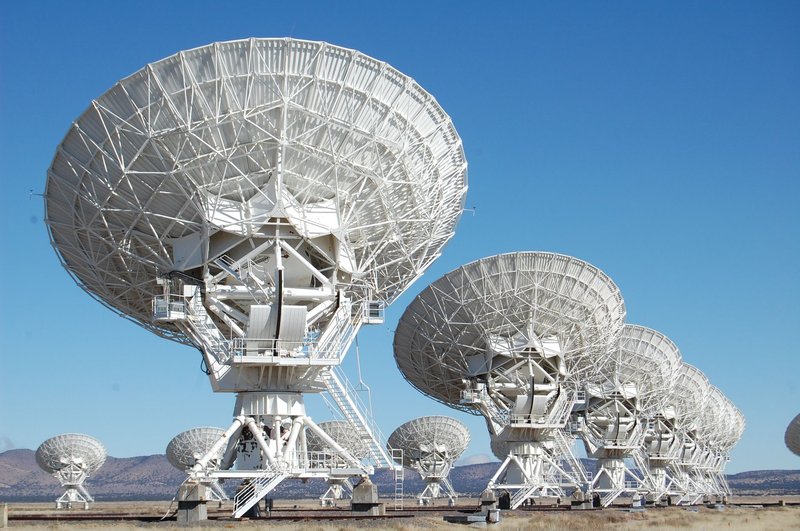
Radio is the classic search, and it’s still the most active. The logic is simple: natural sources like pulsars and stars spread their energy across wide ranges of frequency. A signal squeezed into a width of a few hertz is something transmitters do, and nature essentially doesn’t.
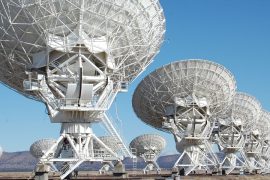
Breakthrough Listen, a $100 million program launched in 2015, scans nearby stars and galaxies with radio telescopes including the Green Bank Telescope in West Virginia, the Parkes dish in Australia and South Africa’s MeerKAT array. Its software screens for narrowband signals that drift in frequency in the way a transmitter on a moving planet would. Optical SETI looks for brief laser pulses, which could outshine a star for nanoseconds.
The main obstacle isn’t alien silence. It’s human noise. Phones, satellites, radar and microwave ovens all produce narrowband signals, so most “candidates” turn out to be local interference. A real one has to point back to a fixed spot in the sky, come back when you look again, and appear in more than one telescope.
Industrial pollution in an atmosphere
Some of the signs of alien life we might detect are chemicals that no natural process makes in quantity. Chlorofluorocarbons (CFCs) and tetrafluoromethane (CF4) are examples: on Earth they come from factories and refrigeration, with essentially no geological source for CFCs.
A 2014 study by Henry Lin, Sara Seager and colleagues at MIT calculated that JWST could, in principle, pick out CFCs in the atmosphere of an Earth-sized planet orbiting a white dwarf, if concentrations were several times higher than Earth’s peak. That is a long shot. It requires a rare setup, and an alien civilization that pollutes at a level we’d call reckless.
The case for it is that pollution accumulates and persists. A radio transmission has to be pointed our way at the right moment. A polluted atmosphere is on all the time.
Megastructures and Dyson spheres
In 1960, physicist Freeman Dyson pointed out that a civilization hungry for energy might build collectors around its star to capture more of the output. No solid shell is needed: swarms of orbiting panels would do. The engineering has a thermodynamic cost. All the starlight absorbed has to be re-radiated as waste heat, so the star would look dimmer in visible light and unusually bright in the infrared.
That makes Dyson sphere detection a survey problem. Researchers scan catalogs from missions like Gaia and WISE for stars with an infrared excess that dust disks don’t explain. A 2024 search found several red dwarf candidates, but dust remains the favored explanation for most of them.
A different approach is to look for stars that flicker in odd ways. Surveys such as the Vera C. Rubin Observatory’s decade-long sky survey, which began operations in 2025, will watch billions of stars for irregular dimming, which can flag everything from exocomets to something stranger.
False alarms: Wow!, Venus and Tabby’s star
Every detection claim gets tested, and most fail. Three cases show how.
The Wow! signal. On August 15, 1977, Ohio State University’s Big Ear radio telescope recorded a 72-second burst near the 1420 MHz hydrogen line. Astronomer Jerry Ehman circled the printout and wrote “Wow!” next to it. It was strong, narrowband and from the right frequency. It was also never seen again, despite many searches. With no repeat, no one can rule anything in or out.
Phosphine on Venus. In 2020, a team led by Jane Greaves reported phosphine in Venus’s clouds in a paper in Nature Astronomy. Phosphine is made by anaerobic microbes on Earth and is hard to produce on a rocky planet. Other groups reanalyzed the data and argued the signal was weaker than claimed, or that the line was actually sulfur dioxide. The debate isn’t fully closed, but most researchers lean against a detection.
Tabby’s star. In 2015 citizen scientists reviewing Kepler data flagged KIC 8462852, a star that dimmed by up to 22 percent in irregular dips. Astronomer Tabetha Boyajian led the paper, which is how the star got its nickname. Megastructures were among the speculations. Follow-up work in 2018 found the dimming was stronger in blue light than red, which is how dust behaves and not how an opaque object behaves. Dust is the standard explanation.
The pattern is useful. Each case produced an anomaly, and the anomaly got stress-tested until a natural explanation fit. That’s the system working.
NASA has formalized part of this in its Confidence of Life Detection (CoLD) scale, a seven-level ladder that runs from “a possible signal was detected” to “other explanations are ruled out and the result has been independently confirmed.” Most claims today sit at the first or second rung.
Signs of alien life at a glance
| Sign | Type | How we’d detect it | Current status |
|---|---|---|---|
| Oxygen plus methane | Biosignature | JWST transmission spectra | Not found on any rocky exoplanet |
| Dimethyl sulfide | Biosignature | JWST spectra of K2-18b | Disputed; weak evidence |
| Mars organics and textures | Biosignature | Perseverance; sample return | Ambiguous; awaiting lab analysis |
| Ocean-moon plumes | Biosignature | Europa Clipper; Enceladus data | Organics found; no life evidence |
| Purple surface color / red edge | Biosignature | Future space observatories | Not yet testable |
| Narrowband radio signals | Technosignature | Breakthrough Listen and others | No confirmed signal |
| Laser pulses | Technosignature | Optical SETI | No confirmed signal |
| CFCs and other pollutants | Technosignature | JWST-class spectroscopy | Theoretical |
| Dyson spheres | Technosignature | Infrared surveys, Gaia, Rubin | Candidates; dust likely |
What’s realistic in the next 10 years
The honest answer: no one can say life is out there, and no confirmed sign exists yet. But the instruments arriving over the next decade can tighten the question.
- JWST will keep adding spectra of small, cool planets. It might find an oxygen-methane pair, though a clean, unambiguous detection on a rocky planet would take hundreds of hours of observing time.
- Europa Clipper arrives around 2030 and will tell us whether Europa’s ocean has the chemistry to support life. It won’t detect microbes directly.
- Mars sample return is the only route to a lab verdict on Perseverance’s samples, but the program’s cost and timeline have been under repeated review, so the date is uncertain.
- Extremely large ground telescopes such as ESO’s Extremely Large Telescope in Chile are due to start observing at the end of the decade and are designed to read the atmospheres of nearby rocky planets.
- Rubin and radio surveys will turn up thousands of oddities. Nearly all will be natural, and the work is in sorting them.
A reasonable bet for 2036 is a handful of promising candidates and an argument about each, not a verdict. That’s how this field should feel. A claim of life is extraordinary, and the way astronomers earn it is by trying to break it first. If the standards used to evaluate such signals keep tightening, the next big headline will be harder to dismiss, and that is the point.