TLDR
A terrestrial planet is a rocky, dense world with a solid surface, built around a layered structure of crust, mantle, and metallic core. Our solar system has four: Mercury, Venus, Earth, and Mars. They formed close to the Sun, where only heat-resistant metal and rock could condense, which is also why none of them carry rings or dozens of moons the way the gas giants do. Astronomers have since found hundreds of rocky worlds — some bigger than Earth, called super-Earths — orbiting other stars.
Table of Contents
- What Actually Makes a Planet “Terrestrial”
- Anatomy of a Rocky Planet: Crust, Mantle, Core
- How Terrestrial Planets Form
- The Four Terrestrial Planets, One by One
- Mercury, Venus, Earth, Mars: Side by Side
- Terrestrial Planets vs. Gas and Ice Giants
- Terrestrial Planets Beyond Our Solar System
- FAQ
What Actually Makes a Planet “Terrestrial”
The word comes from the Latin terra — Earth — and it’s a fair description. A terrestrial planet is built from rock and metal rather than gas, dense enough that you could, in theory, stand on it. Mercury, Venus, Earth, and Mars all qualify, and they share similar composition and structure despite their individual differences—concepts covered in more depth in our guide to types of planets and how they’re classified. Jupiter, Saturn, Uranus, and Neptune don’t, because there’s nothing solid to land on past a thick shroud of gas.
Density is the number that separates the two groups cleanly. Earth averages 5.51 grams per cubic centimeter. Saturn, by contrast, is 0.69 — less dense than water, which is why the old trivia line about Saturn floating in a big enough bathtub happens to be true. Terrestrial planets pack their mass into a small radius; gas giants spread theirs across a much bigger, fluffier volume.
Size tracks with that distinction too. The largest terrestrial planet, Earth, would fit inside Jupiter more than 1,300 times over. Rocky worlds are, by planetary standards, small.
Anatomy of a Rocky Planet: Crust, Mantle, Core
Every terrestrial planet shares the same basic blueprint, laid down while the planet was still molten: heavy elements sank, light ones floated, and the result is a set of concentric layers.
At the center sits a core, usually iron and nickel, sometimes still liquid enough to generate a magnetic field — Earth’s does this; Mars’s core cooled and stalled billions of years ago, which is a big part of why Mars lost its atmosphere to solar wind. Around the core is the mantle, a thick shell of silicate rock that moves slowly over geologic time, driving volcanism and, on Earth, plate tectonics. On top is the crust, thin and brittle by comparison — Earth’s is only about 0.5% of the planet’s total mass.
Density itself is a clue to what’s inside. Mercury is smaller than Earth in every dimension, but it packs a core that makes up roughly 85% of its radius, nearly twice the proportion Earth’s core takes up. Nobody fully agrees on why Mercury got so metal-rich — a giant early impact stripping away outer rock is one of the leading explanations, according to NASA’s Mercury research, though it’s not settled.
How Terrestrial Planets Form
This is the part most explainers skip, and it’s the part that actually explains the “why” behind everything else on this page.
The early solar system was a disk of gas and dust spinning around the young Sun. Close in, temperatures were too high for ice, methane, or ammonia to stay solid — those materials only condense far from the heat. What could condense near the Sun was metal and rock: iron, nickel, silicates. Those particles stuck together through repeated low-speed collisions, first into pebbles, then boulders, then bodies a few kilometers across called planetesimals, and eventually into full-sized planets through a process astronomers call accretion.
That’s the reason terrestrial planets sit in the inner solar system and gas giants sit farther out. Beyond a boundary called the frost line — roughly where Jupiter orbits today — there was enough leftover ice to build much bigger cores, and those cores grew massive enough to pull in huge envelopes of hydrogen and helium gas before the young Sun’s radiation blew the remaining disk material away. The inner planets never had that gas available, so they stayed rocky and comparatively small.
Mars is a useful example of how accretion can stall out. It has only about 11% of Earth’s mass, likely because it finished forming quickly and never merged with enough neighboring planetesimals to grow further — a pattern supported by isotope dating of Martian meteorites.
The Four Terrestrial Planets, One by One
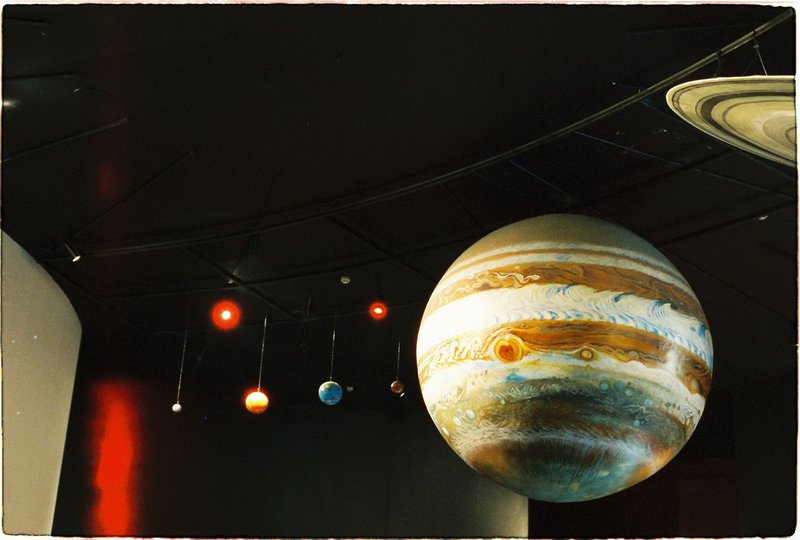
Mercury is the runt of the group and the closest to the Sun, close enough that a year there lasts just 88 Earth days. It has no real atmosphere, only a thin exosphere of atoms knocked loose by solar wind, so there’s nothing to hold in heat or block it. Daytime temperatures reach 427°C; at night, with no blanket of air, they drop to -173°C — the widest temperature swing of any planet in the solar system.
Venus is Earth’s near-twin in size and mass but nothing like it in conditions. A runaway greenhouse effect from a carbon dioxide atmosphere 90 times denser than Earth’s traps heat so effectively that Venus’s surface, at roughly 464°C, is hotter than Mercury’s despite sitting farther from the Sun. Clouds of sulfuric acid finish the picture. It’s the solar system’s clearest cautionary tale about what greenhouse gases can do given enough time.
Earth is the only terrestrial planet with plate tectonics still actively running, liquid water covering most of its surface, and a magnetic field strong enough to deflect solar wind. Those three things working together are a large part of why it’s the only one with life, as far as anyone has confirmed.
Mars has a thin atmosphere, less than 1% the pressure of Earth’s, made mostly of carbon dioxide. It carries the tallest known volcano in the solar system, Olympus Mons, at roughly 22 kilometers high — nearly two and a half times Everest — and evidence in its rock layers of ancient rivers and lakebeds, which is why it remains the top target for finding past microbial life and continues to drive scientific interest covered in our exploration of reasons to explore Mars.
Mercury, Venus, Earth, Mars: Side by Side
| Mercury | Venus | Earth | Mars | |
|---|---|---|---|---|
| Radius | 2,440 km | 6,052 km | 6,371 km | 3,390 km |
| Density | 5.43 g/cm³ | 5.24 g/cm³ | 5.51 g/cm³ | 3.93 g/cm³ |
| Atmosphere | Almost none | Thick CO₂ (96.5%) | N₂/O₂ | Thin CO₂ (95%) |
| Moons | 0 | 0 | 1 | 2 |
| Avg. surface temp | -20°C (wide swings) | 464°C | 15°C | -63°C |
Mars’s lower density stands out on this table. It has less iron relative to its size than the other three, and a smaller, cooler core — one more reason its magnetic field shut off early.
Terrestrial Planets vs. Gas and Ice Giants
Beyond density and composition, the two categories diverge in almost everything that follows from them.
Rings, for one. Every gas and ice giant in the solar system has a ring system; no terrestrial planet does. Rings form from debris — shattered moons, leftover icy material — held in a flat orbital plane by a massive planet’s gravity, and terrestrial planets simply don’t have the mass or the surrounding debris field to hold one together. Saturn’s rings alone contain trillions of individual ice and rock particles, according to NASA’s Cassini mission findings.
Moons follow the same pattern. Jupiter has 95 confirmed moons, Saturn more than 140. The terrestrial planets have three moons combined — one at Earth, two small captured asteroids at Mars — because there simply wasn’t enough surrounding material for more to form or be captured. Jupiter, despite its size and dominance, still holds mysteries that astronomers don’t fully understand.
Rotation and structure differ too. Gas giants spin fast — Jupiter’s day is under 10 hours — and have no solid surface to speak of, just increasingly dense layers of gas that eventually become a slushy, metallic hydrogen interior. Terrestrial planets rotate slower and have a hard boundary you could, in principle, land a spacecraft on.
Terrestrial Planets Beyond Our Solar System
Rocky worlds aren’t unique to our solar system. Missions like Kepler and its successor TESS have confirmed thousands of exoplanets, and a meaningful share of them are terrestrial by the same definition: dense, rocky, no thick gas envelope.
Many of these worlds are bigger than Earth but still rocky — a category astronomers call super-Earths, generally defined as having up to roughly 10 times Earth’s mass while remaining solid rather than gaseous. Kepler-186f, discovered in 2014, was among the first Earth-sized rocky planets found orbiting in its star’s habitable zone, the distance range where liquid water could exist on the surface. TESS has since added closer, more easily studied targets, including planets in the TRAPPIST-1 system, where up to seven roughly Earth-sized worlds orbit a single small, cool star. Data from NASA’s Exoplanet Archive tracks these discoveries as they’re confirmed.
Confirming a planet is terrestrial from light-years away is harder than it sounds. Astronomers mostly infer density from a planet’s mass and radius, measured through slightly different methods — the transit method for radius, radial velocity for mass — and a planet that’s dense enough, by that math, gets classified as rocky rather than gaseous. It’s indirect, but it’s held up well against the handful of cases where follow-up observations added more detail.
FAQ
How many terrestrial planets are there? Four in our solar system: Mercury, Venus, Earth, and Mars. Beyond it, astronomers have confirmed hundreds of rocky exoplanets and candidates, with more added as missions like TESS continue surveying nearby stars.
Why don’t terrestrial planets have rings? Rings need a large reservoir of orbiting debris — ice, rock, shattered moons — held in place by strong gravity. Terrestrial planets are too small and too close to the Sun, where debris either falls to the surface or gets swept away rather than settling into a ring.
Can terrestrial planets support life? Only one confirmed case exists: Earth, thanks to a combination of liquid water, a protective magnetic field, and an atmosphere stable enough to hold both in place over billions of years. Mars may have supported microbial life in its wetter, thicker-atmosphere past, and some rocky exoplanets sit in their star’s habitable zone, but “rocky” and “in the habitable zone” don’t guarantee habitability — atmosphere, magnetic field, and geologic activity all have to line up too.
What’s the difference between a terrestrial planet and a dwarf planet like Pluto? Composition can overlap — Pluto is largely rock and ice — but classification comes down to orbital dominance. A terrestrial planet has cleared its orbital neighborhood of comparably sized debris; a dwarf planet like Pluto shares its orbit with other Kuiper Belt objects of similar size, which is the main reason it was reclassified in 2006.